

Archive for ‘Winemaking’

Biodynamic, organic or sustainable?

March 7th, 2016 | Technical

[:en]White wineBiodynamic, organic or sustainable? What’s the difference? This is a question that causes quite a few headaches, not only for the wine industry in general, but also, more importantly, for the poor confused consumer buying the finished wine. It is also one of the questions that we are most frequently asked by our own importers and customers, and it is a question that we always answer truthfully (even when we know that being economical with the truth might help to widen our potential consumer base).
By far the most complicated to achieve is biodynamic, and for most producers in Rias Baixas is an unattainable status, mostly owing to the damp conditions that we endure in this corner of Spain. To be fully biodynamic doesn’t just mean farming grapes without chemicals, but actually treats the vineyard as an ecosystem, taking into account astrological influences and lunar cycles etc. A true biodynamic wine is also made without any of the common manipulations such as yeast additions or acidity adjustments. Just one obvious reason why Rias Baixas cannot really produce biodynamic wine is because albariño’s naturally occurring yeast flora, by itself, simply cannot sustain a complete alcoholic fermentation.

In the category of organic, there are two types of wine. Those made from organically grown grapes that don’t use any synthetic additives or treatments, or the higher level of completely ‘organic wine’ that uses organic grapes but also doesn’t add sulphites to the wine (although it can include any naturally occurring sulphites).

Sustainable wine (such as our own Castro Martin wines), are made using a range of practices that are not only ecologically sound, but also economically viable and socially responsible. We adopt many of the practices that will be used in organic or biodynamic farming but have a little flexibility to include practices that suit our individual needs. Clearly, we are not going to sit back and watch our fruit rot on the vines if we can take steps to prevent it from happening….. Sustainability also means that we focus on things like water and energy conservation, as well as the use of renewable resources.

As far as selecting your wine is concerned, the simple rule is – if in doubt, read the label![:es]White wineBiodynamic, organic or sustainable? What’s the difference? This is a question that causes quite a few headaches, not only for the wine industry in general, but also, more importantly, for the poor confused consumer buying the finished wine. It is also one of the questions that we are most frequently asked by our own importers and customers, and it is a question that we always answer truthfully (even when we know that being economical with the truth might help to widen our potential consumer base).

By far the most complicated to achieve is biodynamic, and for most producers in Rias Baixas is an unattainable status, mostly owing to the damp conditions that we endure in this corner of Spain. To be fully biodynamic doesn’t just mean farming grapes without chemicals, but actually treats the vineyard as an ecosystem, taking into account astrological influences and lunar cycles etc. A true biodynamic wine is also made without any of the common manipulations such as yeast additions or acidity adjustments. Just one obvious reason why Rias Baixas cannot really produce biodynamic wine is because albariño’s naturally occurring yeast flora, by itself, simply cannot sustain a complete alcoholic fermentation.

In the category of organic, there are two types of wine. Those made from organically grown grapes that don’t use any synthetic additives or treatments, or the higher level of completely ‘organic wine’ that uses organic grapes but also doesn’t add sulphites to the wine (although it can include any naturally occurring sulphites).

Sustainable wine (such as our own Castro Martin wines), are made using a range of practices that are not only ecologically sound, but also economically viable and socially responsible. We adopt many of the practices that will be used in organic or biodynamic farming but have a little flexibility to include practices that suit our individual needs. Clearly, we are not going to sit back and watch our fruit rot on the vines if we can take steps to prevent it from happening….. Sustainability also means that we focus on things like water and energy conservation, as well as the use of renewable resources.

As far as selecting your wine is concerned, the simple rule is –  if in doubt, read the label![:]
Rack & Roll

June 18th, 2015 | Bodega

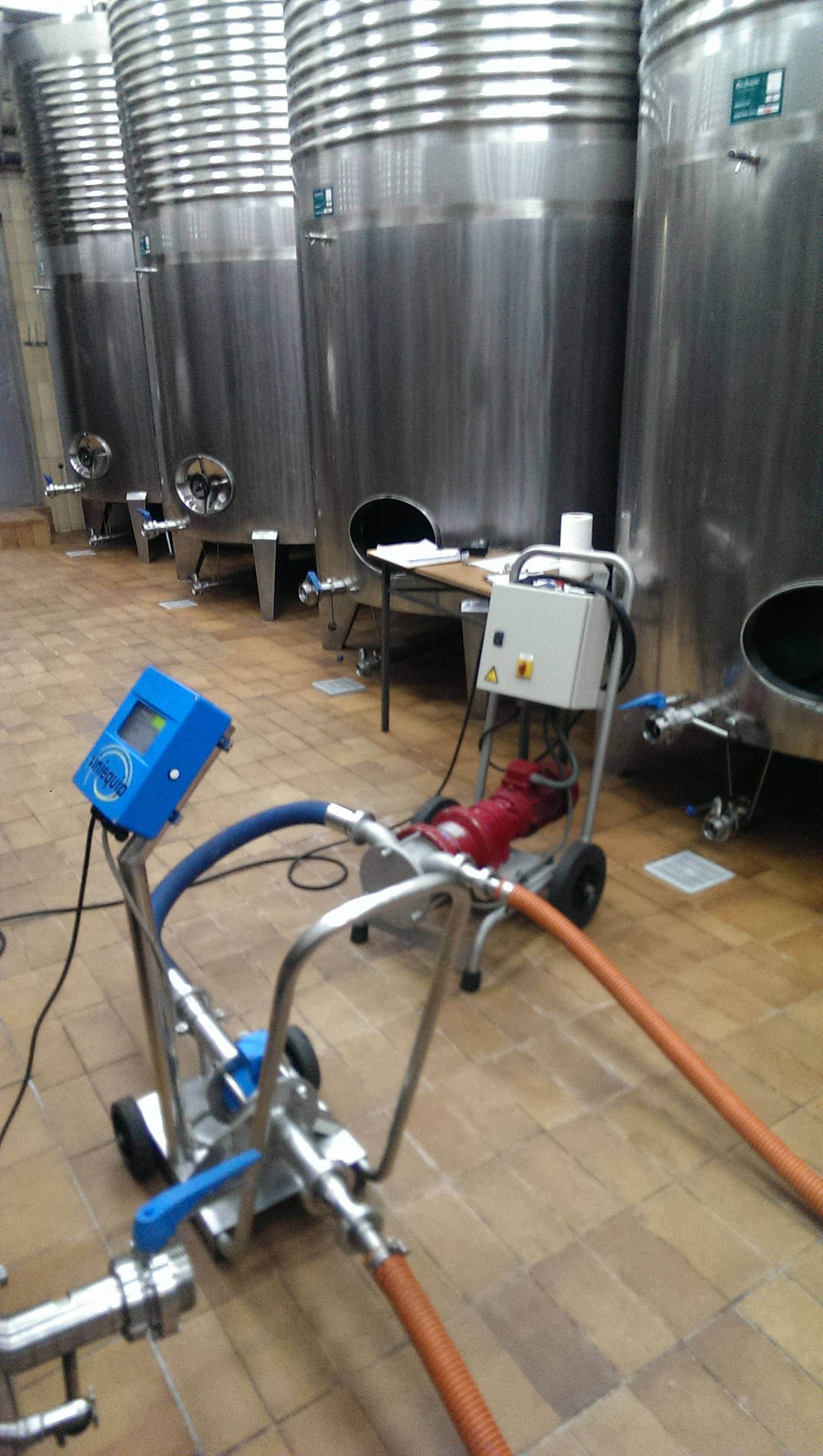
RackingAfter a couple of weeks out of the bodega, we have now embarked on an intense programme of ‘racking’ in our cellars. As I am sure I have explained before, every wine that we make undergoes and extended period of ageing ‘on the lees’ once the fermentation process has finished. The ageing period is always for a minimum of at least five or six months, but in all honesty, there is no fixed timescale attached to this, and sometimes it may be even longer. The way that we decide the optimum time to separate the finished wine from its ‘bed’ of lees, is quite simple, and is the way that we often make many of our wine making decisions in the bodega….. simply by tasting (and of course, our combined experience). If the wine is left for too long it can start to develop what is known as ‘reduction’, which, in layman’s terms, means that it can develop smelly forms of sulphur compounds. Whilst reduction at a low levels is not necessarily a bad thing, and is claimed can actually add complexity to the finished wine, it is certainly something that has to be monitored, and halted at the correct moment.

In the case of our 2014 wines, many of the tanks are being racked now, meaning that they have enjoyed almost 8 months of lees ageing. Once the racking programme is complete, it means that our 2014 wine is almost ready for sale – only the cold-stabilisation and a light filtration remains before bottling. Whilst a very little 2014 wine has already ‘leaked’ onto our domestic market, the vast majority of our stock will not start to hit the streets for perhaps another month or two – almost one year after the grapes were collected.RackingAfter a couple of weeks out of the bodega, we have now embarked on an intense programme of ‘racking’ in our cellars. As I am sure I have explained before, every wine that we make undergoes and extended period of ageing ‘on the lees’ once the fermentation process has finished. The ageing period is always for a minimum of at least five or six months, but in all honesty, there is no fixed timescale attached to this, and sometimes it may be even longer. The way that we decide the optimum time to separate the finished wine from its ‘bed’ of lees, is quite simple, and is the way that we often make many of our wine making decisions in the bodega….. simply by tasting (and of course, our combined experience). If the wine is left for too long it can start to develop what is known as ‘reduction’, which, in layman’s terms, means that it can develop smelly forms of sulphur compounds. Whilst reduction at a low levels is not necessarily a bad thing, and is claimed can actually add complexity to the finished wine, it is certainly something that has to be monitored, and halted at the correct moment.

In the case of our 2014 wines, many of the tanks are being racked now, meaning that they have enjoyed almost 8 months of lees ageing. Once the racking programme is complete, it means that our 2014 wine is almost ready for sale – only the cold-stabilisation and a light filtration remains before bottling. Whilst a very little 2014 wine has already ‘leaked’ onto our domestic market, the vast majority of our stock will not start to hit the streets for perhaps another month or two – almost one year after the grapes were collected.

20,000 leagues under the sea

May 10th, 2015 | Wine & Health

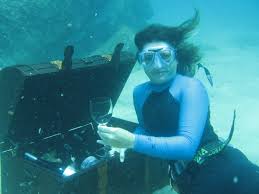
UnderwaterBy coincidence I have continued my recent theme of using film titles for our blog… I posted some time ago about underwater wine ageing, but now it appears that in the United States the FDA have expressed some new concerns about the practice. The Federal Alcohol and Tobacco Tax and Trade Bureau has issued an advisory saying water pressure could cause contaminants to seep into the bottles.

“Overpressure on bottle seals increases the likelihood of seepage of sea water into the product, and biological growth on the container may contribute to the degradation of the cork which could contaminate the product when the bottle is opened”. The advisory warned that contaminants from petrol and oil to pesticides and heavy metals can sometimes be found in sea water.

For the time being the FDA will not approve labels for any underwater aged wine until more tests have been carried out. This ban will not change anything at  Castro Martin, as of course, we don’t use this method for ageing any of our wines, but I do know that there are at least one or two other Galician bodegas that may be affected.UnderwaterBy coincidence I have continued my recent theme of using film titles for our blog… I posted some time ago about underwater wine ageing, but now it appears that in the United States the FDA have expressed some new concerns about the practice. The Federal Alcohol and Tobacco Tax and Trade Bureau has issued an advisory saying water pressure could cause contaminants to seep into the bottles.

“Overpressure on bottle seals increases the likelihood of seepage of sea water into the product, and biological growth on the container may contribute to the degradation of the cork which could contaminate the product when the bottle is opened”. The advisory warned that contaminants from petrol and oil to pesticides and heavy metals can sometimes be found in sea water.

For the time being the FDA will not approve labels for any underwater aged wine until more tests have been carried out. This ban will not change anything at  Castro Martin, as of course, we don’t use this method for ageing any of our wines, but I do know that there are at least one or two other Galician bodegas that may be affected.

Q: When is a wine not a wine?

February 27th, 2015 | Retail

Wine not wineAnswer: When it’s a ‘wine based drink’!

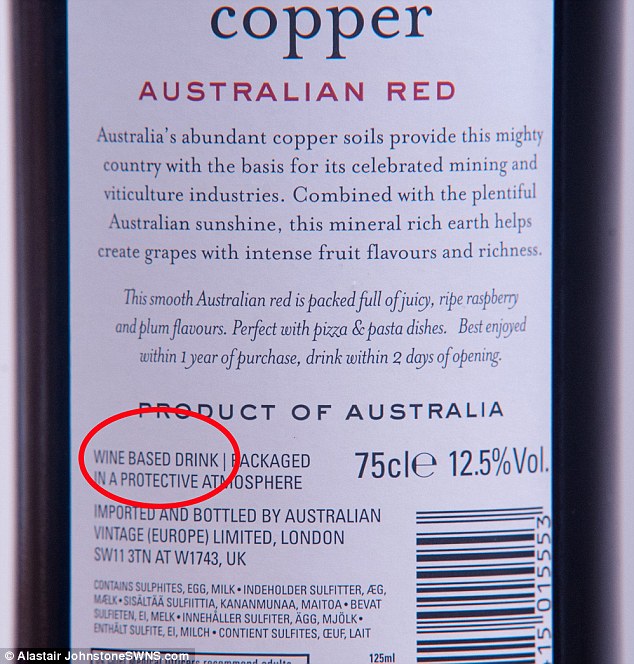
Reading back labels might well be a boring pastime, and you might consider it to be the reserve of the so called ‘wine anoraks’, but actually they might well discover something that you don’t….. The small print could indicate that the ‘wine’ that you think you are enjoying might not be wine at all, but rather a ‘wine based drink’ containing only 75% of real wine.

The make-up of the other 25% is not quite clear, as legally, ‘wine’makers are not obliged to specify, but speculation is that it could be water, grape must, or a combination of water and sugar. Whatever, the unknown constituent, the wines have been described as ” lacking genuine character, dilute, unpleasant, contrived and manufactured”….. they sound delicious!

Having said that, the problem is not so much the flavour (as consumers will inevitably vote with their taste buds), but more the fact that they are being sold alongside real wines, with no obvious distinction between the two. Of course this is not only highly misleading, but could potentially damage the integrity of our industry.
Wine not wineAnswer: When it’s a ‘wine based drink’!

Reading back labels might well be a boring pastime, and you might consider it to be the reserve of the so called ‘wine anoraks’, but actually they might well discover something that you don’t….. The small print could indicate that the ‘wine’ that you think you are enjoying might not be wine at all, but rather a ‘wine based drink’ containing only 75% of real wine.

The make-up of the other 25% is not quite clear, as legally, ‘wine’makers are not obliged to specify, but speculation is that it could be water, grape must, or a combination of water and sugar. Whatever, the unknown constituent, the wines have been described as ” lacking genuine character, dilute, unpleasant, contrived and manufactured”….. they sound delicious!

Having said that, the problem is not so much the flavour (as consumers will inevitably vote with their taste buds), but more the fact that they are being sold alongside real wines, with no obvious distinction between the two. Of course this is not only highly misleading, but could potentially damage the integrity of our industry.

Temperature control

October 21st, 2014 | Winemaking

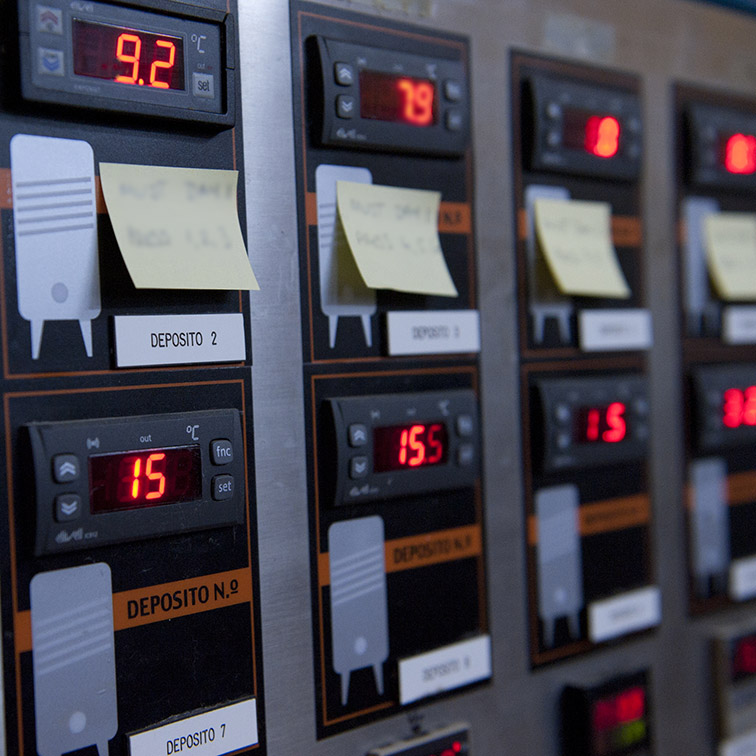
TemperatureFirstly my apologies for the silence over the last few days….. we have been a bit busy. All the additions have finally been made to the fermenting tanks and so the only thing left to do is wait. Of course, it goes without saying that we have to monitor the progress of each and every tank, and sometimes make small adjustments to the temperature if things are not progressing as we wish. This is exactly what we mean by ‘temperature control’ – we can adjust the speed of the fermentation simply by altering the temperature. Fermentation generates heat, and if left unchecked would career out of control and the whole fermentation process would probably be over in less than a week….. but the resulting wine? Well, perhaps not so good.

By monitoring the density twice a day, we can accurately measure how quickly the must is being converted into wine, and if we see that it is moving too quickly then we can simply reduce the tank temperature by half or maybe one degree, and this will bring the process back under control. Of course the speed at which we chose to make the fermentation is down to the individual winemaker, and relies both on experience, but also has to take into account the type of yeast being used. Different strains of yeast behave in very different ways, some are far more vigorous than others, and in addition they will often work within a completely different temperature range. For example, making the temperature too cold might simply kill some strains of  yeast, leaving a partly fermented wine. In addition, towards the end of the fermentation, we have to raise the temperature of the tanks slightly to allow the yeast to fully ferment and complete it’s job. Stopping the fermentation too early will simply result in a little more residual sugar being left in the finished wine – not a typical characteristic of albariño. Having said that, anything less than 5 grams of sugar per litre of wine will be barely discernable to the average consumer.

TemperatureFirstly my apologies for the silence over the last few days….. we have been a bit busy. All the additions have finally been made to the fermenting tanks and so the only thing left to do is wait. Of course, it goes without saying that we have to monitor the progress of each and every tank, and sometimes make small adjustments to the temperature if things are not progressing as we wish. This is exactly what we mean by ‘temperature control’ – we can adjust the speed of the fermentation simply by altering the temperature. Fermentation generates heat, and if left unchecked would career out of control and the whole fermentation process would probably be over in less than a week….. but the resulting wine? Well, perhaps not so good.

By monitoring the density twice a day, we can accurately measure how quickly the must is being converted into wine, and if we see that it is moving too quickly then we can simply reduce the tank temperature by half or maybe one degree, and this will bring the process back under control. Of course the speed at which we chose to make the fermentation is down to the individual winemaker, and relies both on experience, but also has to take into account the type of yeast being used. Different strains of yeast behave in very different ways, some are far more vigorous than others, and in addition they will often work within a completely different temperature range. For example, making the temperature too cold might simply kill some strains of  yeast, leaving a partly fermented wine. In addition, towards the end of the fermentation, we have to raise the temperature of the tanks slightly to allow the yeast to fully ferment and complete it’s job. Stopping the fermentation too early will simply result in a little more residual sugar being left in the finished wine – not a typical characteristic of albariño. Having said that, anything less than 5 grams of sugar per litre of wine will be barely discernable to the average consumer.

Peak picking

October 13th, 2014 | Harvest

2014 Vendimia StatsUsually the grape harvest in our D.O. is spread over a period of about two or three weeks, sometimes more. Under normal circumstances the sub-zones in the south start well before their counterparts in the north, and may even finish before the north picks its first fruit. Despite there only being some 60 km between north and south, it can actually make quite a difference, especially as one moves inland away from the coast, and the cooling influence of the Ocean. This year however, it seems that things were quite different.

We have just received some stats from our local D.O. office showing that almost the entire 2014 harvest was collected in a little over one week. We often talk about waiting for a window in the weather, and this year it appears that almost everyone in our region took advantage of the very same window! After a period of torrential rain, at the very first opportunity, bodegas and their grape suppliers rushed out into the vineyards to gather in their precious crop. Of course, Castro Martin was no exception, mirroring the graph in today’s post and peaking at the very same moment as the rest of the region – Saturday 27th September, when over 3 million kilos were harvested (but not all by Castro Martin).

The total crop for 2014 of 24 million kilos is largely what was estimated before picking began, and although larger than 2012, it is still one of the smaller harvests of recent years. (Remembering that the area under vine has been growing steadily year-on-year since the very creation of the D.O., owing to the vagaries of our weather, growth in production does not always follow suit)

In the cellar our fermentations are all well under way, but it will be at least another week or two before the first stage of winemaking is concluded for this year.

2014 Vendimia StatsUsually the grape harvest in our D.O. is spread over a period of about two or three weeks, sometimes more. Under normal circumstances the sub-zones in the south start well before their counterparts in the north, and may even finish before the north picks its first fruit. Despite there only being some 60 km between north and south, it can actually make quite a difference, especially as one moves inland away from the coast, and the cooling influence of the Ocean. This year however, it seems that things were quite different.

We have just received some stats from our local D.O. office showing that almost the entire 2014 harvest was collected in a little over one week. We often talk about waiting for a window in the weather, and this year it appears that almost everyone in our region took advantage of the very same window! After a period of torrential rain, at the very first opportunity, bodegas and their grape suppliers rushed out into the vineyards to gather in their precious crop. Of course, Castro Martin was no exception, mirroring the graph in today’s post and peaking at the very same moment as the rest of the region – Saturday 27th September, when over 3 million kilos were harvested (but not all by Castro Martin).

The total crop for 2014 of 24 million kilos is largely what was estimated before picking began, and although larger than 2012, it is still one of the smaller harvests of recent years. (Remembering that the area under vine has been growing steadily year-on-year since the very creation of the D.O., owing to the vagaries of our weather, growth in production does not always follow suit)

In the cellar our fermentations are all well under way, but it will be at least another week or two before the first stage of winemaking is concluded for this year.

Nothing to see

October 8th, 2014 | Post Harvest

Tank collageIn terms of activity inside the bodega, this is without doubt, our busiest time of year. It’s not just a question of throwing a bit of yeast into the grape must and waiting for something to happen – it is slightly more complicated than that. Apart from monitoring the tanks on a very regular basis, there are all sorts of additions and processes to be carried out, some that require the tank to be pumped over, and others that don’t. Pumping over is simply a method that we use for thoroughly mixing any addition that we make to a tank – Bentonite for example, a natural product which is added to clarify and stabilise the wine. Once the Bentonite is added we simply attach hoses to the top and bottom of the tank, and pump the grape must over from top to bottom in a cyclical motion. This is just a mixing process (which differs from the pumping over in red wine making where it is done as part of the process to help extract colour from the skins). Clearly, this doesn’t apply to white wine making.

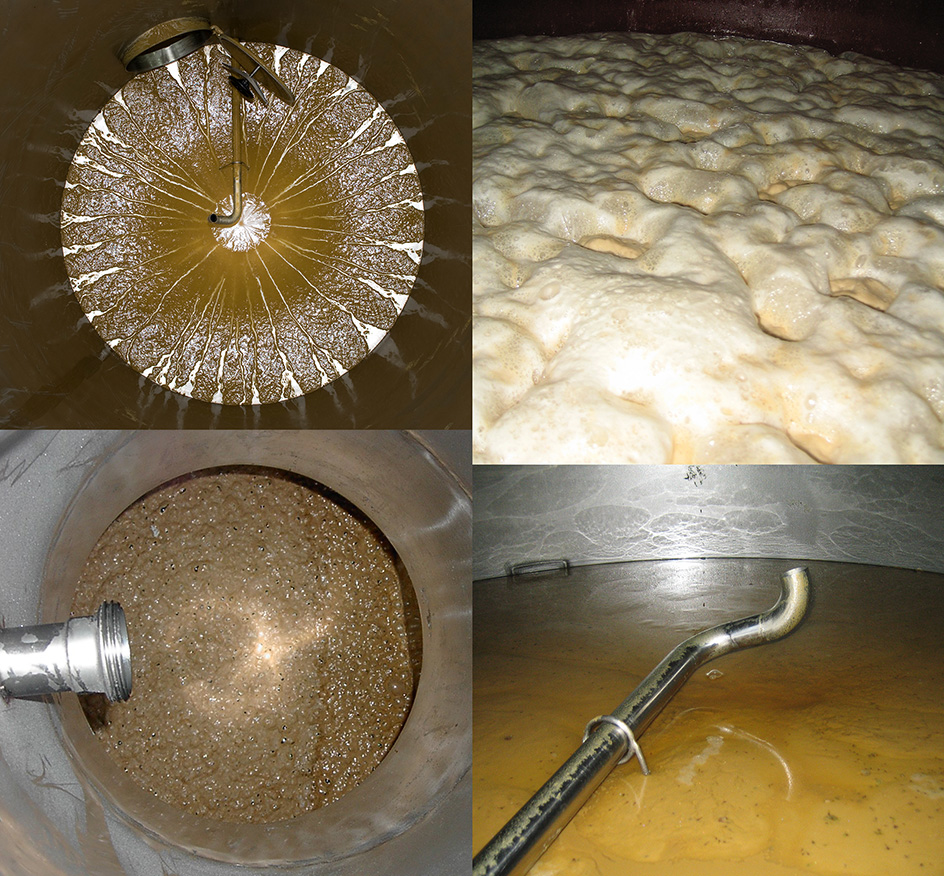
Despite all this activity, there’s really not that much to see. A visitor to the bodega might see a bit of mixing, and perhaps the odd pump connected to a tank, but nothing that interesting to look at. Inside the tank there is a bit of foam and some bubbles, but as we mentioned a day or two ago, putting you head into a tank of fermenting wine is not recommended. As a keen photographer I have been trying to find some interesting pictures to add to my post, but to be honest most potential examples are pretty dull and don’t really show too much. By way of compensation I have made a small collage of various tank shots, and as you will see it does not make the most colourful compilation….

Tank collageIn terms of activity inside the bodega, this is without doubt, our busiest time of year. It’s not just a question of throwing a bit of yeast into the grape must and waiting for something to happen – it is slightly more complicated than that. Apart from monitoring the tanks on a very regular basis, there are all sorts of additions and processes to be carried out, some that require the tank to be pumped over, and others that don’t. Pumping over is simply a method that we use for thoroughly mixing any addition that we make to a tank – Bentonite for example, a natural product which is added to clarify and stabilise the wine. Once the Bentonite is added we simply attach hoses to the top and bottom of the tank, and pump the grape must over from top to bottom in a cyclical motion. This is just a mixing process (which differs from the pumping over in red wine making where it is done as part of the process to help extract colour from the skins). Clearly, this doesn’t apply to white wine making.

Despite all this activity, there’s really not that much to see. A visitor to the bodega might see a bit of mixing, and perhaps the odd pump connected to a tank, but nothing that interesting to look at. Inside the tank there is a bit of foam and some bubbles, but as we mentioned a day or two ago, putting you head into a tank of fermenting wine is not recommended. As a keen photographer I have been trying to find some interesting pictures to add to my post, but to be honest most potential examples are pretty dull and don’t really show too much. By way of compensation I have made a small collage of various tank shots, and as you will see it does not make the most colourful compilation….

2014 – The aftermath

October 2nd, 2014 | Bodega

BagazoAlthough we breath a big sigh of relief once the picking has finished, this is of course, only the first part of the process, but I’m not going to stand, hands on hip, and boldly declare “mission accomplished” like one famous politician that we all know and love (or not)! There are now two very big, and equally important jobs that follow: cleaning and winemaking.

I have to be honest and say that I know that cleaning is not one of the most popular jobs, but it’s just one of those things that has to be done – roll your sleeves up and get on with it. As I have described many times before, it’s all about the must – the thick, sticky grape juice gets everywhere, and when it does, then boy does it stick. The worst of all is when it appears in an exposed place where it can be ‘baked on’ by the sun; then it simply dries like a coat of varnish. Take for example, the pathways and loading area in front of the Bodega. In today’s photo you can see the containers of ‘bagazo’ (skins and stalks left after pressing) lined up waiting to be collected by the distillery, to be made into aguardiente (grappa or eau-de-vie). It doesn’t matter how careful you are, they always leave a trail of juice and skins behind when you move them. The big problem is that the front of our Bodega faces due south, and so this trail becomes baked on to the terracotta pavement. It can only be removed with pressure washing machines.

Meanwhile, in the cellar, the first step of the winemaking process has already begun, as we seed the very first tanks with yeast. In another week or two we will actually have wine – but still a very long way from being finished. More on that as we go along.

BagazoAlthough we breath a big sigh of relief once the picking has finished, this is of course, only the first part of the process, but I’m not going to stand, hands on hip, and boldly declare “mission accomplished” like one famous politician that we all know and love (or not)! There are now two very big, and equally important jobs that follow: cleaning and winemaking.

I have to be honest and say that I know that cleaning is not one of the most popular jobs, but it’s just one of those things that has to be done – roll your sleeves up and get on with it. As I have described many times before, it’s all about the must – the thick, sticky grape juice gets everywhere, and when it does, then boy does it stick. The worst of all is when it appears in an exposed place where it can be ‘baked on’ by the sun; then it simply dries like a coat of varnish. Take for example, the pathways and loading area in front of the Bodega. In today’s photo you can see the containers of ‘bagazo’ (skins and stalks left after pressing) lined up waiting to be collected by the distillery, to be made into aguardiente (grappa or eau-de-vie). It doesn’t matter how careful you are, they always leave a trail of juice and skins behind when you move them. The big problem is that the front of our Bodega faces due south, and so this trail becomes baked on to the terracotta pavement. It can only be removed with pressure washing machines.

Meanwhile, in the cellar, the first step of the winemaking process has already begun, as we seed the very first tanks with yeast. In another week or two we will actually have wine – but still a very long way from being finished. More on that as we go along.

How to make wine

August 24th, 2014 | Denomination

VimeoOur local D.O. office has just commissioned this short cartoon/video which is very nicely done – condensing our region’s wine making process into a brief story of only 2 minutes and 45 seconds (if only the real process were so simple). The only downside is that, at the moment, it is only available in Spanish, and so in the coming days I will try to find out if they are going to make an English version. The simple visuals might help you, even if you don’t speaka da lingo perfectimundo….. like what I do!

You can either click HERE to see the video, or alternatively go to the YouTube page on our website, where it is listed together with some other fun and informative shorts.

VimeoOur local D.O. office has just commissioned this short cartoon/video which is very nicely done – condensing our region’s wine making process into a brief story of only 2 minutes and 45 seconds (if only the real process were so simple). The only downside is that, at the moment, it is only available in Spanish, and so in the coming days I will try to find out if they are going to make an English version. The simple visuals might help you, even if you don’t speaka da lingo perfectimundo….. like what I do!

You can either click HERE to see the video, or alternatively go to the YouTube page on our website, where it is listed together with some other fun and informative shorts.

Rack around the clock

May 15th, 2014 | Bodega

LeesSince the end of the alcoholic fermentation our wines have been sitting quietly, in tank, on their lees. Just in case you don’t know, lees are the exhausted yeast cells that fall to the bottom of the tank at the end of fermentation when their job is done, and the sugar is converted into alcohol. Despite the fact that they are dead, they still contain some nutrients that feed the wine, over time adding to the character, structure and complexity of the finished product. The problem is that the lees cannot simply be left in contact with the wine for an infinite amount of time, and deciding the optimum moment to remove them is best judged by simply tasting the tanks at regular intervals throughout the winter and early spring. It’s really a matter of experience and judgement. If for any reason the lees are not completely healthy, they will simply taint the wine, leaving unpleasant ‘off’ flavours – clearly not something that we want.

Our 2013 vintage has been ‘on the lees’ (sur lie in French or sobre lias in Spanish) for some seven months now, and so we have just embarked on a programme of racking the first few tanks. The process of racking is actually quite straight forward and involves pumping the wine to a clean tank, leaving the lees behind at the bottom of the original tank.

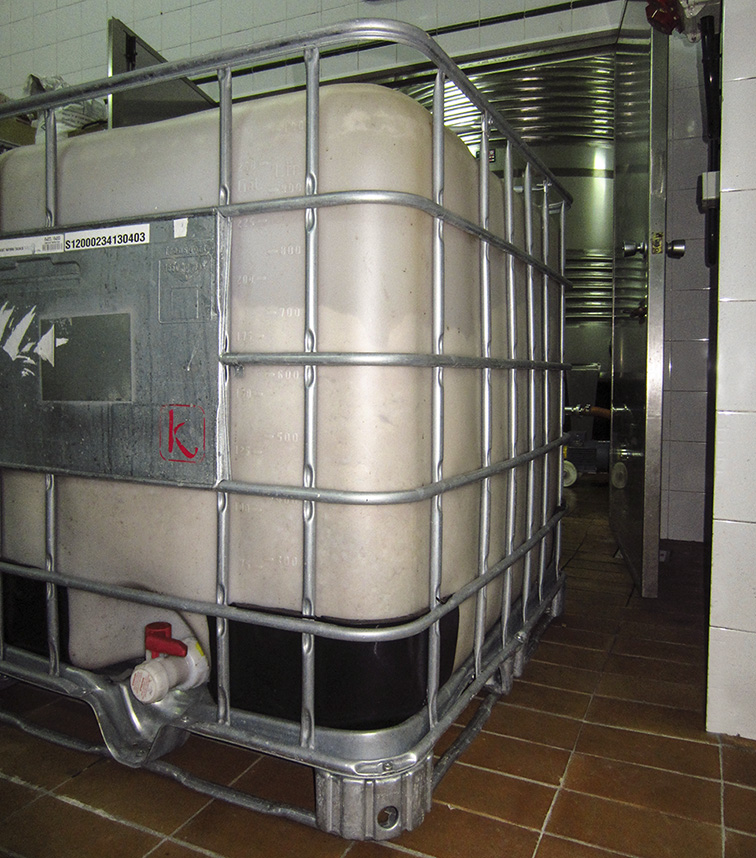
The law does not allow us to simply wash the redundant lees down the drain, quite naturally we are obliged to dispose of them responsibly. Indeed, they actually still have some value! This thick paste still contains wine, and so we actually collect it in large plastic tanks (see photo), ensuring that it is correctly sulphured, and sell it for a nominal amount to our local distillery. You may recall that we also sell our pomace (the residue of grape skins and stalks left after pressing) to our distillery, but they much prefer to buy lees….. and the reason? The answer is quite simple – the skins and stalks are not fermented and contain only grape juice, whereas the lees contain finished wine. This makes the distillation process a whole lot easier for them.

LeesSince the end of the alcoholic fermentation our wines have been sitting quietly, in tank, on their lees. Just in case you don’t know, lees are the exhausted yeast cells that fall to the bottom of the tank at the end of fermentation when their job is done, and the sugar is converted into alcohol. Despite the fact that they are dead, they still contain some nutrients that feed the wine, over time adding to the character, structure and complexity of the finished product. The problem is that the lees cannot simply be left in contact with the wine for an infinite amount of time, and deciding the optimum moment to remove them is best judged by simply tasting the tanks at regular intervals throughout the winter and early spring. It’s really a matter of experience and judgement. If for any reason the lees are not completely healthy, they will simply taint the wine, leaving unpleasant ‘off’ flavours – clearly not something that we want.

Our 2013 vintage has been ‘on the lees’ (sur lie in French or sobre lias in Spanish) for some seven months now, and so we have just embarked on a programme of racking the first few tanks. The process of racking is actually quite straight forward and involves pumping the wine to a clean tank, leaving the lees behind at the bottom of the original tank.

The law does not allow us to simply wash the redundant lees down the drain, quite naturally we are obliged to dispose of them responsibly. Indeed, they actually still have some value! This thick paste still contains wine, and so we actually collect it in large plastic tanks (see photo), ensuring that it is correctly sulphured, and sell it for a nominal amount to our local distillery. You may recall that we also sell our pomace (the residue of grape skins and stalks left after pressing) to our distillery, but they much prefer to buy lees….. and the reason? The answer is quite simple – the skins and stalks are not fermented and contain only grape juice, whereas the lees contain finished wine. This makes the distillation process a whole lot easier for them.

Monthly Archives

Categories

ARE YOU OF LEGAL AGE? This site is intended for those of legal drinking age. By entering, you confirm that you are of legal drinking age in the country where this site is being accessed. ¿ERES MAYOR DE EDAD? Este sitio está destinado a personas en edad legal para beber alcohol. Al ingresar, confirma que tiene la edad legal para beber en el país donde se accede a este sitio.