
Archive for ‘Winemaking’

The wine ‘purist’

January 8th, 2014 | Denomination
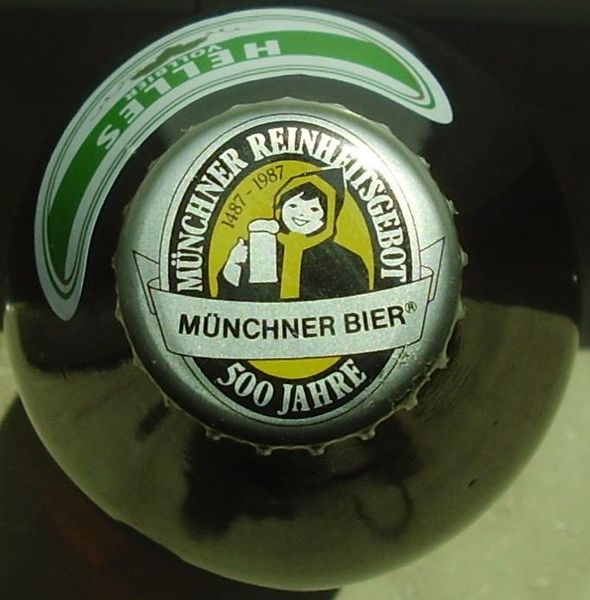
Reinheitsgebot - 500 yearsWhen it comes to wine styles and the ‘typicity’ of an appellation or denomination, then I confess that I am a bit (or probably a lot) of a purist. I like my wines to taste as they should, and to be a true representation of both the grape variety and the region that they are supposed to represent. For example, I have never been a great lover of Chablis with oak, over-ripe, over-extracted Bordeaux wines, or even Albariño with oak for that matter….. but then that’s just my personal taste.

On the subject of purists, I discovered only quite recently that the German beer brewers association wants a five-century-old law governing how German beer is made to become part of the UNESCO world heritage list. Written by Bavarian noblemen in 1516, the law says only water, barley and hops may be used to brew beer. Yeast was added to the list, known as the ‘beer purity law’ or Reinheitsgebot, when scientists discovered the fermenting agent centuries later.

Some brewers however, do not support this idea, as they want to be more creative, introducing aromatic hops, berries, or even spices and herbs to their beer. This is, in some ways, quite reminiscent of modern winemaking…..

Our denomination rules prevent us from adding artificial flavourings or additives to our wines (not that we would ever want to), but it is however, still possible to modify the flavour of a wine by using some of the more recently developed strains of yeast. Reading a catalogue of the yeasts available these days can be quite enlightening – some yeasts claim to enhance or perhaps exaggerate certain fruit characteristics in your grape, whilst others might even add certain a-typical flavours. Of course there is always the temptation to stray a little from the ‘norm’ and to make styles that are a touch more ‘commercial’ as I call it. Such wines might end up being easier to drink, but on the other hand, they could simply lack the real character of the grape variety and the area in which they are grown. In the end there’s quite a thin line between improving a wine, and making something that is unrecognisable and not representative of what it is supposed to be.

And that quite simply is why I will always be a purist!

Reinheitsgebot - 500 yearsWhen it comes to wine styles and the ‘typicity’ of an appellation or denomination, then I confess that I am a bit (or probably a lot) of a purist. I like my wines to taste as they should, and to be a true representation of both the grape variety and the region that they are supposed to represent. For example, I have never been a great lover of Chablis with oak, over-ripe, over-extracted Bordeaux wines, or even Albariño with oak for that matter….. but then that’s just my personal taste.

On the subject of purists, I discovered only quite recently that the German beer brewers association wants a five-century-old law governing how German beer is made to become part of the UNESCO world heritage list. Written by Bavarian noblemen in 1516, the law says only water, barley and hops may be used to brew beer. Yeast was added to the list, known as the ‘beer purity law’ or Reinheitsgebot, when scientists discovered the fermenting agent centuries later.

Some brewers however, do not support this idea, as they want to be more creative, introducing aromatic hops, berries, or even spices and herbs to their beer. This is, in some ways, quite reminiscent of modern winemaking…..

Our denomination rules prevent us from adding artificial flavourings or additives to our wines (not that we would ever want to), but it is however, still possible to modify the flavour of a wine by using some of the more recently developed strains of yeast. Reading a catalogue of the yeasts available these days can be quite enlightening – some yeasts claim to enhance or perhaps exaggerate certain fruit characteristics in your grape, whilst others might even add certain a-typical flavours. Of course there is always the temptation to stray a little from the ‘norm’ and to make styles that are a touch more ‘commercial’ as I call it. Such wines might end up being easier to drink, but on the other hand, they could simply lack the real character of the grape variety and the area in which they are grown. In the end there’s quite a thin line between improving a wine, and making something that is unrecognisable and not representative of what it is supposed to be.

And that quite simply is why I will always be a purist!
The sweet smell of winemaking

October 19th, 2013 | Post Harvest

The noseIn the world of wine we rely on our noses much more than the vast majority of other industries, and as I think I have said before, the more we use our sense of smell, the more sensitive it becomes. During the wine making process we witness a whole range of different aromas many of which are unique to grapes, wine and the fermentation process.

Naturally, the first real smell emerges as we start to press the grapes. It’s probably a bit obvious to say but the scent that dominates is an intense fruit, which at this very early stage does not vary to much from year to year – the factor which perhaps varies the most according to the vintage is the floral, perfumed element. I am please to say that the 2013 grapes were both fruity and floral, so all we have to do now is capture that in the bottle!

I think one of our favourite smells, which is always a very ‘homely, welcoming’ aroma when we open the cellar door in the morning is the yeast. It’s sometimes more like opening the door of a bakery than a wine cellar. They say that if you’re ever trying to sell your home, there are three things that you can do to improve your chances when people come to view – light a fire (assuming that you have a fire place!), brew some fresh coffee (even if you don’t like coffee), or bake some bread. Yeast is such a great smell, but in wine making it should never really be allowed to dominate the nose of your finished product. Anyway, I digress a little….

Unfortunately this wonderful yeasty smell only lasts for a few days during the seeding of the tanks, and even more unfortunately, it is replaced by something far more sinister – the silent killer – carbon dioxide. Of course this is not a smell at all,which is what it makes it so dangerous. Once the fermentation kicks in, we have to make sure that our ventilators are working at full power to remove this dangerous gas, one of the by-products of wine making (together with the alcohol). If you forget for even a second and try to put your head near an open tank to see what is happening, it will, quite literally, take your breath away, but not in a good way.

The noseIn the world of wine we rely on our noses much more than the vast majority of other industries, and as I think I have said before, the more we use our sense of smell, the more sensitive it becomes. During the wine making process we witness a whole range of different aromas many of which are unique to grapes, wine and the fermentation process.

Naturally, the first real smell emerges as we start to press the grapes. It’s probably a bit obvious to say but the scent that dominates is an intense fruit, which at this very early stage does not vary to much from year to year – the factor which perhaps varies the most according to the vintage is the floral, perfumed element. I am please to say that the 2013 grapes were both fruity and floral, so all we have to do now is capture that in the bottle!

I think one of our favourite smells, which is always a very ‘homely, welcoming’ aroma when we open the cellar door in the morning is the yeast. It’s sometimes more like opening the door of a bakery than a wine cellar. They say that if you’re ever trying to sell your home, there are three things that you can do to improve your chances when people come to view – light a fire (assuming that you have a fire place!), brew some fresh coffee (even if you don’t like coffee), or bake some bread. Yeast is such a great smell, but in wine making it should never really be allowed to dominate the nose of your finished product. Anyway, I digress a little….

Unfortunately this wonderful yeasty smell only lasts for a few days during the seeding of the tanks, and even more unfortunately, it is replaced by something far more sinister – the silent killer – carbon dioxide. Of course this is not a smell at all,which is what it makes it so dangerous. Once the fermentation kicks in, we have to make sure that our ventilators are working at full power to remove this dangerous gas, one of the by-products of wine making (together with the alcohol). If you forget for even a second and try to put your head near an open tank to see what is happening, it will, quite literally, take your breath away, but not in a good way.

How dense is your wine?

October 17th, 2013 | Post Harvest

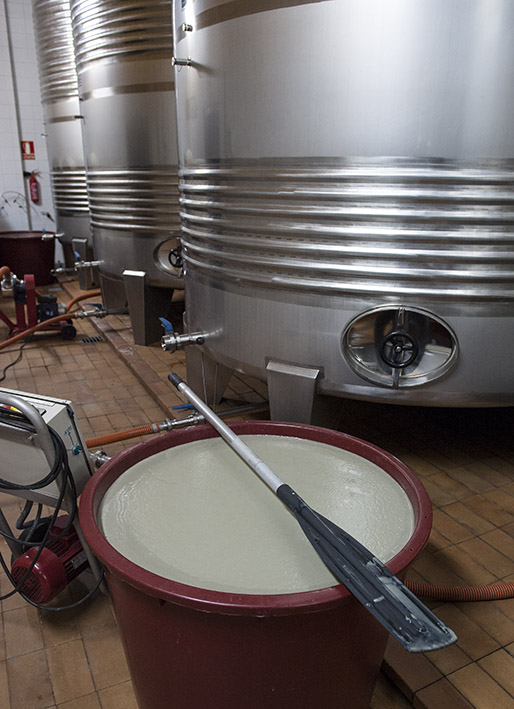
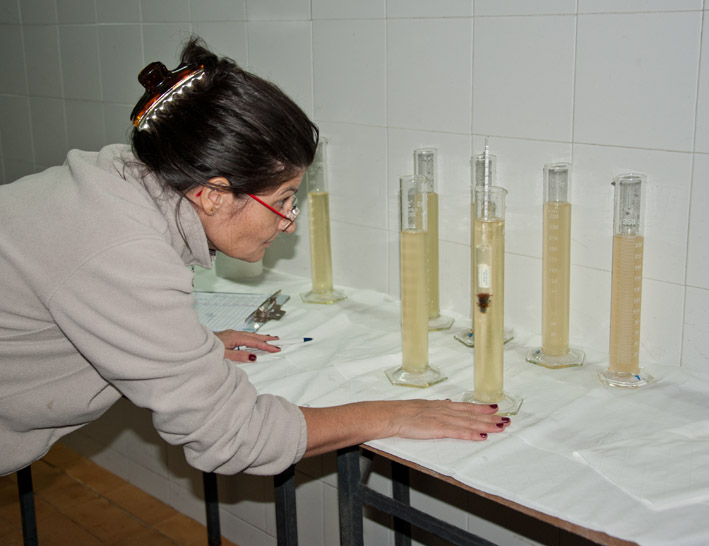
DensitiesNow that most of the seeding of the tanks is done, we have to carefully monitor the progress of the new wine. The way that we do this during fermentation is by measuring the density or specific gravity. The principle is quite simple – as the grape must starts to ferment the amount of sugar in the solution decreases and the amount of ethanol increases – ethanol solution is less dense than sugar solution, so all we have to do is monitor the change using a hydrometer. Two or three times a day (seven days a week) we take a sample of fermenting juice from each tank in a graduated cylinder (see photo). We then allow the hydrometer to float in the liquid and take a reading from the scale etched onto the stem of the instrument. This reading tells us the amount of sugar still remaining, and from this we can calculate the progress of the fermentation process.

There are two main factors that will dictate how quickly the fermentation advances – the strain of yeast used, and of course, the temperature. Some yeasts are very vigorous and will work well in a wide variety of temperatures, whilst others are much more delicate and will only survive during slightly warmer fermentations. As you may well already know, the simple rule is – the warmer the temperature the shorter the fermentation, which is why we are always obsessed by strict temperature control. Here at Castro Martin we prefer a long, slow controlled fermentation, that takes roughly 3 to 4 weeks to complete. Patience is a virtue, and, good things come to those who wait, to coin a couple of well-worn phrases…..

DensitiesNow that most of the seeding of the tanks is done, we have to carefully monitor the progress of the new wine. The way that we do this during fermentation is by measuring the density or specific gravity. The principle is quite simple – as the grape must starts to ferment the amount of sugar in the solution decreases and the amount of ethanol increases – ethanol solution is less dense than sugar solution, so all we have to do is monitor the change using a hydrometer. Two or three times a day (seven days a week) we take a sample of fermenting juice from each tank in a graduated cylinder (see photo). We then allow the hydrometer to float in the liquid and take a reading from the scale etched onto the stem of the instrument. This reading tells us the amount of sugar still remaining, and from this we can calculate the progress of the fermentation process.

There are two main factors that will dictate how quickly the fermentation advances – the strain of yeast used, and of course, the temperature. Some yeasts are very vigorous and will work well in a wide variety of temperatures, whilst others are much more delicate and will only survive during slightly warmer fermentations. As you may well already know, the simple rule is – the warmer the temperature the shorter the fermentation, which is why we are always obsessed by strict temperature control. Here at Castro Martin we prefer a long, slow controlled fermentation, that takes roughly 3 to 4 weeks to complete. Patience is a virtue, and, good things come to those who wait, to coin a couple of well-worn phrases…..

Looks like Guiness – tastes like Albariño

October 15th, 2013 | Post Harvest

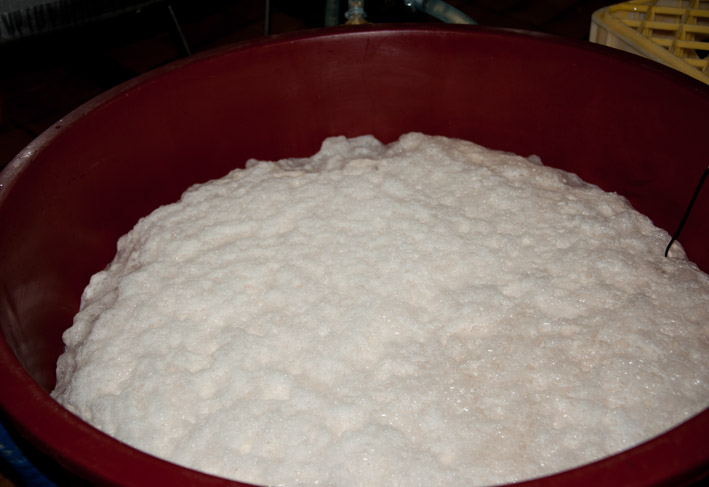
Guiness_OK, so at this point in the wine making the must doesn’t really taste like albariño, but my point is simply that the yeast makes a lot of foam when we mix it with the juice ready for seeding. Preparing yeast to make wine is not a secret process – first we hydrate it using warm water (usually around body temperature 38°C or 100°F), and then, over an extended period, we add grape juice from the tank to ‘equalise’ the temperature between the yeast mixture and the juice in tank. For example, if the tank temperature is 15°C and then we add the yeast at 38°C the shock of the sudden change in temperature would simply kill most, if not all, of the yeast. The method therefore is to reduce the temperature of the yeast solution in increments – 5 degrees at a time. We do this by adding juice from the tank, waiting for the yeast to ‘acclimatise’, and then adding more juice – it’s quite a long process. Once the yeast solution is within a few degrees of the tank temperature we can finally add the mixture and start to make some wine!

Of course the other part of the equation is the strain of yeast that we actually chose for seeding. These days there are so many new and different yeasts, all claiming to enhance your wine in different ways. When the salesman arrives with his catalogue of yeasts he more or less asks “what flavour do you want?”. In these circumstances our answer is always the same – we want the flavour of albariño please! In other words we normally chose a fairly neutral yeast in order that the character of our grape variety shines through (otherwise there would be little point!) Having said that, there are some new strains of yeast that claim to enhance this varietal character, and in this case we always make one or two tanks using these to see if they really do match the claims of their manufacturers. In recent years we haven’t found one…. but we always keep and open mind.

Guiness_OK, so at this point in the wine making the must doesn’t really taste like albariño, but my point is simply that the yeast makes a lot of foam when we mix it with the juice ready for seeding. Preparing yeast to make wine is not a secret process – first we hydrate it using warm water (usually around body temperature 38°C or 100°F), and then, over an extended period, we add grape juice from the tank to ‘equalise’ the temperature between the yeast mixture and the juice in tank. For example, if the tank temperature is 15°C and then we add the yeast at 38°C the shock of the sudden change in temperature would simply kill most, if not all, of the yeast. The method therefore is to reduce the temperature of the yeast solution in increments – 5 degrees at a time. We do this by adding juice from the tank, waiting for the yeast to ‘acclimatise’, and then adding more juice – it’s quite a long process. Once the yeast solution is within a few degrees of the tank temperature we can finally add the mixture and start to make some wine!

Of course the other part of the equation is the strain of yeast that we actually chose for seeding. These days there are so many new and different yeasts, all claiming to enhance your wine in different ways. When the salesman arrives with his catalogue of yeasts he more or less asks “what flavour do you want?”. In these circumstances our answer is always the same – we want the flavour of albariño please! In other words we normally chose a fairly neutral yeast in order that the character of our grape variety shines through (otherwise there would be little point!) Having said that, there are some new strains of yeast that claim to enhance this varietal character, and in this case we always make one or two tanks using these to see if they really do match the claims of their manufacturers. In recent years we haven’t found one…. but we always keep and open mind.

Inside the press

July 8th, 2013 | Equipment

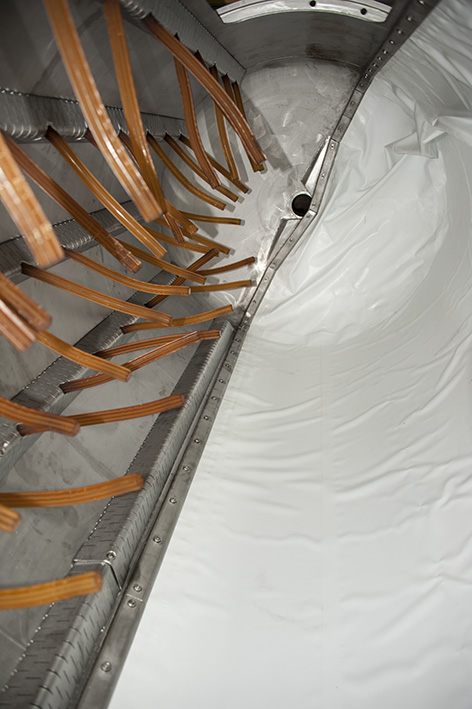
New membrane (3)Having just written about changing the membrane in one of our presses I thought that this might be the ideal moment to explain how the wine press really works…..

Using today’s photo you can clearly see that the press is a cylinder more or less divided into two halves. On one side there is the new (beautifully white) inflatable membrane, whilst on the other side you can see a series of silicone rubber ‘fingers’. Once the press has been filled with grapes the pressing cycle begins and the whole cylinder rotates rather like a large tumble dryer. As it rotates the pneumatic membrane slowly inflates to a predetermined pressure, and the grapes are gently crushed, releasing their juice. The juice escapes through holes and is collected in a large tray underneath before it is chilled rapidly and moved to the tank room ready for fermentation. The membrane then deflates and the rubber ‘fingers’ begin to do their job.

Once the bag has deflated the cylinder rotates and the fingers serve to break up the compacted grape pomace. (Pomace is the mixture of grape skins and stalks – known as marc in French, and bagazo in Spanish). Once the pomace is broken up a little the membrane re-inflates to a slightly higher pressure and crushes the grapes again extracting yet more juice.

The length of the cycle, amount of pressure used and the number of pressings for each load of grapes is determined according to the requirement of the individual winemaker and the style and quality of wine they are attempting to make. Less pressing, less pressure and shorter cycles usually equate to a higher quality wine – indeed, some high quality wines are made entirely from ‘free run’ juice, or possibly just the first press. However, there is a danger that if the juice is too clean and pure, lacking in phenolic compounds, that the finished wine could potentially lack a bit of structure and balance.

Of course another decision which has to be made even before the grapes are pressed is whether they should be de-stemmed or not. Certainly the act of de-stemming will allow a much greater weight of grapes to enter the press (without the stems they occupy much less space), but on  the downside, for a white wine maker, fruit oxidation starts from the very second that the skin of the fruit is broken. Again this is the winemaker’s choice, and again this will have an influence on the style of the finished wine.

New membrane (3)Having just written about changing the membrane in one of our presses I thought that this might be the ideal moment to explain how the wine press really works…..

Using today’s photo you can clearly see that the press is a cylinder more or less divided into two halves. On one side there is the new (beautifully white) inflatable membrane, whilst on the other side you can see a series of silicone rubber ‘fingers’. Once the press has been filled with grapes the pressing cycle begins and the whole cylinder rotates rather like a large tumble dryer. As it rotates the pneumatic membrane slowly inflates to a predetermined pressure, and the grapes are gently crushed, releasing their juice. The juice escapes through holes and is collected in a large tray underneath before it is chilled rapidly and moved to the tank room ready for fermentation. The membrane then deflates and the rubber ‘fingers’ begin to do their job.

Once the bag has deflated the cylinder rotates and the fingers serve to break up the compacted grape pomace. (Pomace is the mixture of grape skins and stalks – known as marc in French, and bagazo in Spanish). Once the pomace is broken up a little the membrane re-inflates to a slightly higher pressure and crushes the grapes again extracting yet more juice.

The length of the cycle, amount of pressure used and the number of pressings for each load of grapes is determined according to the requirement of the individual winemaker and the style and quality of wine they are attempting to make. Less pressing, less pressure and shorter cycles usually equate to a higher quality wine – indeed, some high quality wines are made entirely from ‘free run’ juice, or possibly just the first press. However, there is a danger that if the juice is too clean and pure, lacking in phenolic compounds, that the finished wine could potentially lack a bit of structure and balance.

Of course another decision which has to be made even before the grapes are pressed is whether they should be de-stemmed or not. Certainly the act of de-stemming will allow a much greater weight of grapes to enter the press (without the stems they occupy much less space), but on  the downside, for a white wine maker, fruit oxidation starts from the very second that the skin of the fruit is broken. Again this is the winemaker’s choice, and again this will have an influence on the style of the finished wine.

Underwater storage

April 17th, 2013 | Bottles and bottling

Underwater bottles

I think it was last summer that I wrote briefly about a new development in wine storage and ageing – keeping bottles underwater. At that time I mentioned a French producer that had gleaned a lot of publicity for storing his bottles on the seabed for a while, but I guess the real question is…… is this just a fashion, a publicity stunt, or does it add some real value to the finished wine?

Certainly there are many plus points for ageing wine on the seabed. The light is subdued, the temperature usually does not vary by too much (depending on where you are) and oxygen penetration is really not an issue. Finally you could add to the plus side that the storage itself is free, but then only if you don’t count the cost of submerging your stock and then retrieving it when required. Of course once the bottles are eventually brought to the surface, then they will certainly require a good scrubbing down before they can be labelled.

Other downsides include (besides the added cost of such an operation), that it is possible the salt water might actually penetrate and contaminate the wine. This would bring a whole new meaning to the expression often used for albariño “you can taste the sea”. Perhaps in these health and safety concious days, health inspectors might eventually start to pay closer attention should this idea begin to catch on.

Finally, perhaps a more obvious problem might be security. It is possible that a new profession as ‘wine pirate’ might emerge as thieves start to plunder this unguarded underwater booty!

Underwater bottles

I think it was last summer that I wrote briefly about a new development in wine storage and ageing – keeping bottles underwater. At that time I mentioned a French producer that had gleaned a lot of publicity for storing his bottles on the seabed for a while, but I guess the real question is…… is this just a fashion, a publicity stunt, or does it add some real value to the finished wine?

Certainly there are many plus points for ageing wine on the seabed. The light is subdued, the temperature usually does not vary by too much (depending on where you are) and oxygen penetration is really not an issue. Finally you could add to the plus side that the storage itself is free, but then only if you don’t count the cost of submerging your stock and then retrieving it when required. Of course once the bottles are eventually brought to the surface, then they will certainly require a good scrubbing down before they can be labelled.

Other downsides include (besides the added cost of such an operation), that it is possible the salt water might actually penetrate and contaminate the wine. This would bring a whole new meaning to the expression often used for albariño “you can taste the sea”. Perhaps in these health and safety concious days, health inspectors might eventually start to pay closer attention should this idea begin to catch on.

Finally, perhaps a more obvious problem might be security. It is possible that a new profession as ‘wine pirate’ might emerge as thieves start to plunder this unguarded underwater booty!

Women in wine

February 15th, 2013 | International News

 I recently read an article listing the top 50 most influential women in the wine trade. As you might imagine there was an interesting mix of characters, including property owners, journalists, MW’s, winemakers, writers etc.,etc. – a real cross-section of our industry. Perhaps not unsurprisingly at No.1 sits Gina Gallo, chief winemaker of the Gallo empire. Whilst I have never met her, I do know her husband Jean-Charles Boisset rather well. I have visited the Boisset family home on a number of occasions, and indeed it was his father Jean-Claude who sponsored me to become a Chevalier du Tastevin at the world famous Clos de Vougeot in Burgundy. The night of my induction was something that I will never forget, and I should also mention that it was the first official event that Angela and I attended together, even before we were married. Jean-Charles attended the dinner with us.

Meanwhile, back at the list of famous women, I am pleased to say that, despite not knowing Gina Gallo, I have met at least two of the other top five candidates on the list, namely Jancis Robinson and Lalou Bize-Leroy. The latter (formerly the joint head of Domaine de la Romanée-Conti), and now the owner of the world famous Domaine Leroy, is certainly near the very top of my own list of favourite winemakers. In the last few months Angela and I have enjoyed at least two bottles of Domaine Leroy at our favourite restaurant Pepe Vieira. Naturally, these wines are highly sought after, and usually quite difficult to find (especially here in Spain). It was Angela’s first experience of this Domaine’s stunning wines, and I think it’s fair to say that she was quite impressed….

A bit nearer to home we have our own list of famous women. Within the denomination of Rias Baixas several of the best wines are made by women (including our very own I hasten to add). It’s probably at this point in my post that I should admit that there is a vaild argument that women make better wines than men. Without trying to sound sexist for one moment, they do have a very good touch around the cellar, and produce some very fine and elegant wines.

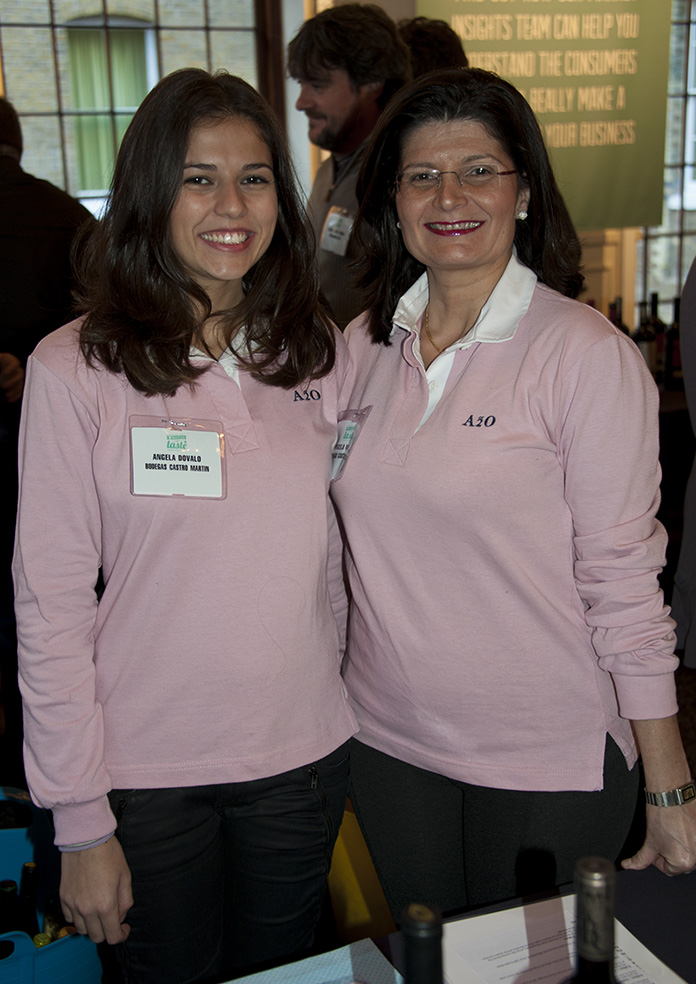
I should close by saying that today’s photo shows my very own famous women – the two Angelas, my wife and our beautiful daughter. The photo was taken at a recent tasting and was the very first time that we have revealed Angela 2.o to the world of wine! The next generation? We shall see…..

I recently read an article listing the top 50 most influential women in the wine trade. As you might imagine there was an interesting mix of characters, including property owners, journalists, MW’s, winemakers, writers etc.,etc. – a real cross-section of our industry. Perhaps not unsurprisingly at No.1 sits Gina Gallo, chief winemaker of the Gallo empire. Whilst I have never met her, I do know her husband Jean-Charles Boisset rather well. I have visited the Boisset family home on a number of occasions, and indeed it was his father Jean-Claude who sponsored me to become a Chevalier du Tastevin at the world famous Clos de Vougeot in Burgundy. The night of my induction was something that I will never forget, and I should also mention that it was the first official event that Angela and I attended together, even before we were married. Jean-Charles attended the dinner with us.

Meanwhile, back at the list of famous women, I am pleased to say that, despite not knowing Gina Gallo, I have met at least two of the other top five candidates on the list, namely Jancis Robinson and Lalou Bize-Leroy. The latter (formerly the joint head of Domaine de la Romanée-Conti), and now the owner of the world famous Domaine Leroy, is certainly near the very top of my own list of favourite winemakers. In the last few months Angela and I have enjoyed at least two bottles of Domaine Leroy at our favourite restaurant Pepe Vieira. Naturally, these wines are highly sought after, and usually quite difficult to find (especially here in Spain). It was Angela’s first experience of this Domaine’s stunning wines, and I think it’s fair to say that she was quite impressed….

A bit nearer to home we have our own list of famous women. Within the denomination of Rias Baixas several of the best wines are made by women (including our very own I hasten to add). It’s probably at this point in my post that I should admit that there is a vaild argument that women make better wines than men. Without trying to sound sexist for one moment, they do have a very good touch around the cellar, and produce some very fine and elegant wines.

I should close by saying that today’s photo shows my very own famous women – the two Angelas, my wife and our beautiful daughter. The photo was taken at a recent tasting and was the very first time that we have revealed Angela 2.o to the world of wine! The next generation? We shall see…..

Christmas Fizz

December 7th, 2012 | Bottles and bottling

I wrote a few days ago about our denomination’s new sparkling albariño, and whilst there will be a few bottles on the market before Christmas, it’s very unlikely to be appearing in your local supermarket any time soon (if at all). Not because it isn’t a good product, but more because it is likely to be very much a niche product – a curiosity that will never be produced in any great volume.

In stark contrast to this small, limited production it is quite clear that there must be some sparkling wines appearing on the Christmas market which are produced in some quite serious volumes. The reason behind this sweeping statement is actually quite simple…… their price! Picking out recent examples from the UK market (sold by a supermarket which shall remain nameless), they are promoting sparkling wines from as little as £3.29 a bottle, and a handful of others all under £5.00. When you consider that all sparkling wines sold in the UK attracts a higher level of excise duty, £2.43 a bottle to be precise, you might begin to understand where I am going with this. The Value Added Tax on a £5.00 bottle is £0.83, which added to the duty, makes £3.26, leaving only £1.74 for the wine itself (on the £3.29 bottle the residue after tax is only £0.31). Now, when I use the word ‘wine’ this does not actually mean just the liquid in the bottle, the £1.74 (or £0.31) has to account for the liquid, the bottle, the cork, the label, the capsule, the carton, the shipping, the warehousing, the distribution, and oh! I nearly forgot, perhaps a bit of profit for the producer and the retailer. These numbers do not really add up for the £5.00 bottle, and therefore even less so for the £3.29 bottle. The latter must be what is known as a “loss leader” – a product perhaps sold at a loss merely to attract custom and get people into the store on the basis that they will buy other, more profitable items. Also known as “cross town deal” – a deal so good that customers will go out of their way, or possibly make a special journey just to take advantage of it.

I’m very sorry to admit that personally I am never tempted by these offers, especially when it comes to Champagne or sparkling wine. I’m a great believer in the old adage ‘you get what you pay for’, and if an offer is too good to be true, then there really must be a reason.

I wrote a few days ago about our denomination’s new sparkling albariño, and whilst there will be a few bottles on the market before Christmas, it’s very unlikely to be appearing in your local supermarket any time soon (if at all). Not because it isn’t a good product, but more because it is likely to be very much a niche product – a curiosity that will never be produced in any great volume.

In stark contrast to this small, limited production it is quite clear that there must be some sparkling wines appearing on the Christmas market which are produced in some quite serious volumes. The reason behind this sweeping statement is actually quite simple…… their price! Picking out recent examples from the UK market (sold by a supermarket which shall remain nameless), they are promoting sparkling wines from as little as £3.29 a bottle, and a handful of others all under £5.00. When you consider that all sparkling wines sold in the UK attracts a higher level of excise duty, £2.43 a bottle to be precise, you might begin to understand where I am going with this. The Value Added Tax on a £5.00 bottle is £0.83, which added to the duty, makes £3.26, leaving only £1.74 for the wine itself (on the £3.29 bottle the residue after tax is only £0.31). Now, when I use the word ‘wine’ this does not actually mean just the liquid in the bottle, the £1.74 (or £0.31) has to account for the liquid, the bottle, the cork, the label, the capsule, the carton, the shipping, the warehousing, the distribution, and oh! I nearly forgot, perhaps a bit of profit for the producer and the retailer. These numbers do not really add up for the £5.00 bottle, and therefore even less so for the £3.29 bottle. The latter must be what is known as a “loss leader” – a product perhaps sold at a loss merely to attract custom and get people into the store on the basis that they will buy other, more profitable items. Also known as “cross town deal” – a deal so good that customers will go out of their way, or possibly make a special journey just to take advantage of it.

I’m very sorry to admit that personally I am never tempted by these offers, especially when it comes to Champagne or sparkling wine. I’m a great believer in the old adage ‘you get what you pay for’, and if an offer is too good to be true, then there really must be a reason.

The wine making continues

October 16th, 2012 | Post Harvest

As our fermentations progress there are a number of additions that we have to make to our tanks during this busy wine making period. Possibly one of the most important is the ‘fining agent’, added to clarify and stabilise the finished wine. There are a number of different fining agents available, and these are usually applied according to the type of wine or perhaps even the characteristics of a particular grape variety. For example, egg whites are commonly used for red wines as they have the effect of reducing harsh tannins, and some even claim, add a certain silkiness. Another common fining agent in gelatine, which not only clarifies wine, but can also reduce astringency – this is often used in conjunction with kieselsol, that can also help to reduce bitterness.Of course the downside of both egg whites and gelatine is that it renders the finished wine unsuitable for vegetarians.

At Castro Martin we chose perhaps the most commonly used fining agent – Bentonite. Many deposits of this volcanic clay material are found in the USA, especially in Wyoming. Indeed, the name itself is derived from Fort Benton where an American geologist discovered the first deposits around 100 years ago. In Europe, bentonite occurs and is mined in the Mediterranean region and in Lower Bavaria, Germany.

The dried bentonite powder is mixed into a thick, smooth paste and then diluted with a little fermenting grape juice before being added back to the tank. It is then mixed thoroughly with the developing wine. At this point the fermenting must carries a lot of suspended matter (such as dead yeast cells and grape fragments) that would potentially render the finished wine dull or even cloudy. The bentonite forms an ionic bond with these suspended particles, in effect weighing them down, so that over time they will gradually fall by gravity and settle at the bottom of the tank. (This deposit, containing the yeast cells, is known as the ‘lees’). Not only does this leave the wine clean and bright, but bentonite also absorbs some of the proteins and bacteria that can be harmful to the future development of the wine. For example, some proteins can cause haziness if the wine is exposed to a higher temperature after bottling.

As you can see, there is quite a bit of science involved in the wine making process….. much more than simply adding a bit of yeast and hoping for the best!

As our fermentations progress there are a number of additions that we have to make to our tanks during this busy wine making period. Possibly one of the most important is the ‘fining agent’, added to clarify and stabilise the finished wine. There are a number of different fining agents available, and these are usually applied according to the type of wine or perhaps even the characteristics of a particular grape variety. For example, egg whites are commonly used for red wines as they have the effect of reducing harsh tannins, and some even claim, add a certain silkiness. Another common fining agent in gelatine, which not only clarifies wine, but can also reduce astringency – this is often used in conjunction with kieselsol, that can also help to reduce bitterness.Of course the downside of both egg whites and gelatine is that it renders the finished wine unsuitable for vegetarians.

At Castro Martin we chose perhaps the most commonly used fining agent – Bentonite. Many deposits of this volcanic clay material are found in the USA, especially in Wyoming. Indeed, the name itself is derived from Fort Benton where an American geologist discovered the first deposits around 100 years ago. In Europe, bentonite occurs and is mined in the Mediterranean region and in Lower Bavaria, Germany.

The dried bentonite powder is mixed into a thick, smooth paste and then diluted with a little fermenting grape juice before being added back to the tank. It is then mixed thoroughly with the developing wine. At this point the fermenting must carries a lot of suspended matter (such as dead yeast cells and grape fragments) that would potentially render the finished wine dull or even cloudy. The bentonite forms an ionic bond with these suspended particles, in effect weighing them down, so that over time they will gradually fall by gravity and settle at the bottom of the tank. (This deposit, containing the yeast cells, is known as the ‘lees’). Not only does this leave the wine clean and bright, but bentonite also absorbs some of the proteins and bacteria that can be harmful to the future development of the wine. For example, some proteins can cause haziness if the wine is exposed to a higher temperature after bottling.

As you can see, there is quite a bit of science involved in the wine making process….. much more than simply adding a bit of yeast and hoping for the best!

Hollywood Wines

May 15th, 2012 | International News

There is, and has always been, a somewhat strange, romantic notion surrounding the food and wine industry – owning your own restaurant, or perhaps having a wine with your name on the label is actually a very fashionable idea, or so it would seem.

There are a growing number of Hollywood stars that are putting their names to a wine or vineyard – Francis Ford-Coppola, Dan Ackroyd and Antonio Banderas, to name but a few. Indeed, our very own Cliff Richard (an English pop star from the 60’s), has also put down roots in the Portuguese Algarve, if you’ll pardon the pun. His property, Adega do Cantor, also boasts an English wine maker, Max Birch.

Then only today I discover that the one and only Lady Gaga is thinking of branching out into wine production too (sorry, that pun was not really intended), surveying wine properties in Sonoma, California. In the very same article they mention that actress Drew Barrymore, and pop star Fergie have also purchased vineyards. Now I doubt very much if any one of these will be rolling their sleeves up to do the pruning, or drive the tractors, but they will no doubt, be looking forward to sampling the fruit of their labours. I should mention by the way, that Drew Barrymore’s wine is actually a Pinot Grigio from the Trentino region of Northern Italy, and is described as “fresh, dynamic and fun” reflecting her own style and personality!

If these wines are truly a reflection of the people who make them, then my own wine would have to be old, tired and grumpy!

There is, and has always been, a somewhat strange, romantic notion surrounding the food and wine industry – owning your own restaurant, or perhaps having a wine with your name on the label is actually a very fashionable idea, or so it would seem.

There are a growing number of Hollywood stars that are putting their names to a wine or vineyard – Francis Ford-Coppola, Dan Ackroyd and Antonio Banderas, to name but a few. Indeed, our very own Cliff Richard (an English pop star from the 60’s), has also put down roots in the Portuguese Algarve, if you’ll pardon the pun. His property, Adega do Cantor, also boasts an English wine maker, Max Birch.

Then only today I discover that the one and only Lady Gaga is thinking of branching out into wine production too (sorry, that pun was not really intended), surveying wine properties in Sonoma, California. In the very same article they mention that actress Drew Barrymore, and pop star Fergie have also purchased vineyards. Now I doubt very much if any one of these will be rolling their sleeves up to do the pruning, or drive the tractors, but they will no doubt, be looking forward to sampling the fruit of their labours. I should mention by the way, that Drew Barrymore’s wine is actually a Pinot Grigio from the Trentino region of Northern Italy, and is described as “fresh, dynamic and fun” reflecting her own style and personality!

If these wines are truly a reflection of the people who make them, then my own wine would have to be old, tired and grumpy!

Monthly Archives

Categories

ARE YOU OF LEGAL AGE? This site is intended for those of legal drinking age. By entering, you confirm that you are of legal drinking age in the country where this site is being accessed. ¿ERES MAYOR DE EDAD? Este sitio está destinado a personas en edad legal para beber alcohol. Al ingresar, confirma que tiene la edad legal para beber en el país donde se accede a este sitio.