Archive for ‘Tasting’

Taste and taste again

March 9th, 2014 | Tasting

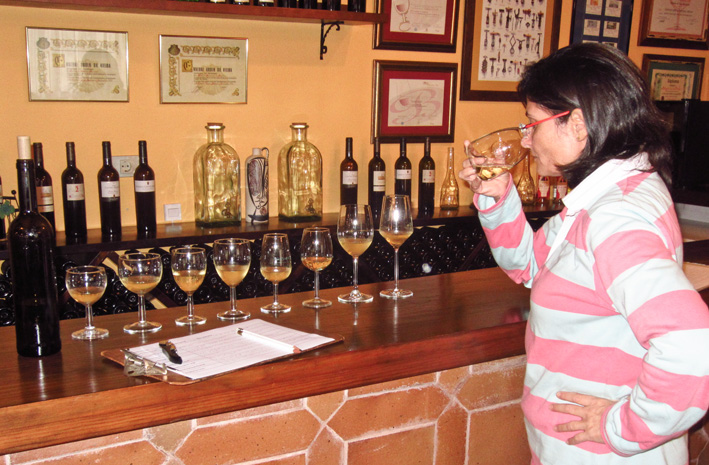
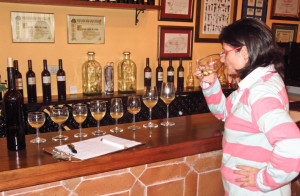
Tasting2It’s probably fair to say that there’s not much happening in the Bodega at this time of year. Of course our team are busy out in the vineyards, as they approach the end of the pruning – and I should add that this year in particular, they deserve a medal. Pruning can be a backbreaking job at the best of times, but with torrential rain nearly all winter, this year has been a nightmare for them. Please don’t forget that with our pergola training system to prune overhead vines means facing skyward – imagine all that rain beating down directly into your face!

Meanwhile, back in the cellar, one of the most important, ongoing jobs that we do, is tasting the tanks. Our 2013 albariños are all still lying, undisturbed on their lees and have to be monitored at very regular intervals. When we age our wines on the lees, there is absolutely no hard and fast rule as to how long this process should take – normally it will be a minimum of at least 5 months, but this can actually be much longer, depending on the wine and the vintage. The object of tasting is to ensure that the lees are clean and not tainted – we are really looking for any signs of ‘reduction’ caused by the sulphur compounds that are formed in the wine during fermentation. Once the available nitrogen in a must or grape juice is exhausted, the yeast will break down and form compounds such as hydrogen sulphide, which we all know as ‘bad egg gas’. Apart from the eggs, a vast number of different sulphur compounds can taint a wine with all manner of unappealing characteristics such as onion, garlic, cabbage and burnt rubber, which is why we have to keep a sharp eye (or keen nose) to make sure that the wine remains clean. We then chose the optimum moment to ‘rack’ the wine into clean tanks, discarding the unwanted yeast deposits.

Tasting2It’s probably fair to say that there’s not much happening in the Bodega at this time of year. Of course our team are busy out in the vineyards, as they approach the end of the pruning – and I should add that this year in particular, they deserve a medal. Pruning can be a backbreaking job at the best of times, but with torrential rain nearly all winter, this year has been a nightmare for them. Please don’t forget that with our pergola training system to prune overhead vines means facing skyward – imagine all that rain beating down directly into your face!

Meanwhile, back in the cellar, one of the most important, ongoing jobs that we do, is tasting the tanks. Our 2013 albariños are all still lying, undisturbed on their lees and have to be monitored at very regular intervals. When we age our wines on the lees, there is absolutely no hard and fast rule as to how long this process should take – normally it will be a minimum of at least 5 months, but this can actually be much longer, depending on the wine and the vintage. The object of tasting is to ensure that the lees are clean and not tainted – we are really looking for any signs of ‘reduction’ caused by the sulphur compounds that are formed in the wine during fermentation. Once the available nitrogen in a must or grape juice is exhausted, the yeast will break down and form compounds such as hydrogen sulphide, which we all know as ‘bad egg gas’. Apart from the eggs, a vast number of different sulphur compounds can taint a wine with all manner of unappealing characteristics such as onion, garlic, cabbage and burnt rubber, which is why we have to keep a sharp eye (or keen nose) to make sure that the wine remains clean. We then chose the optimum moment to ‘rack’ the wine into clean tanks, discarding the unwanted yeast deposits.

My last bottle….

January 2nd, 2014 | Odds & Sods

My last bottleOpening the last bottle of a wine that you cherish is always a very sad occasion, whether it be the last of a particular vintage or simply something that is no longer available. What ever the reason there is always a certain reluctance to pull that final cork.

I make no secret of the fact that I am a great Champagne lover, and more especially those with a bit of bottle age. Of course it would be easy to select only Grande Marque Champagnes, although in truth, they might not necessarily be the best available and almost certainly won’t represent the best value for money. For me the answer is to source a Champagne made by one of the multitude of smaller Champagne houses, often as good, if not better than some of the Grande Marque brands. The downside is the time and effort that it takes to determine which are the best – as with all wine, it simply comes down to trial and error.

Two or three years ago, in a Spanish supermarket, I decided to try one of these lesser known brands, a Louis Barthélémy Cuvée Améthyste Brut NV. It ended up providing me with a very pleasant surprise indeed – a ripe, fruity, well-balanced Champagne, it’s richness coming from a blend dominated by the two pinot grapes of the appellation. The full bodied flavour was further enhanced by the price – a good few Euros less than any of the well-known brands on offer. Over time this Champagne became a staple in my cellar, and a good stock was always maintained in order that I could store them for a while to enhance their bottle age. Indeed, after 12-18 months of additional ageing they were quite delicious (or at least for my own personal taste).

Then suddenly, several months ago, the stock in my local supermarket started to dry up, and as it appeared that this was my only source in the whole of Spain, I immediately hurried out to buy all the bottles that I could find. Sadly, over the holidays I arrived at the very last bottle, but at least I am happy to tell you that  it tasted just as delicious as the very first….. I guess that now I will just have to revert back to the Krug Clos de Mesnil.

My last bottleOpening the last bottle of a wine that you cherish is always a very sad occasion, whether it be the last of a particular vintage or simply something that is no longer available. What ever the reason there is always a certain reluctance to pull that final cork.

I make no secret of the fact that I am a great Champagne lover, and more especially those with a bit of bottle age. Of course it would be easy to select only Grande Marque Champagnes, although in truth, they might not necessarily be the best available and almost certainly won’t represent the best value for money. For me the answer is to source a Champagne made by one of the multitude of smaller Champagne houses, often as good, if not better than some of the Grande Marque brands. The downside is the time and effort that it takes to determine which are the best – as with all wine, it simply comes down to trial and error.

Two or three years ago, in a Spanish supermarket, I decided to try one of these lesser known brands, a Louis Barthélémy Cuvée Améthyste Brut NV. It ended up providing me with a very pleasant surprise indeed – a ripe, fruity, well-balanced Champagne, it’s richness coming from a blend dominated by the two pinot grapes of the appellation. The full bodied flavour was further enhanced by the price – a good few Euros less than any of the well-known brands on offer. Over time this Champagne became a staple in my cellar, and a good stock was always maintained in order that I could store them for a while to enhance their bottle age. Indeed, after 12-18 months of additional ageing they were quite delicious (or at least for my own personal taste).

Then suddenly, several months ago, the stock in my local supermarket started to dry up, and as it appeared that this was my only source in the whole of Spain, I immediately hurried out to buy all the bottles that I could find. Sadly, over the holidays I arrived at the very last bottle, but at least I am happy to tell you that  it tasted just as delicious as the very first….. I guess that now I will just have to revert back to the Krug Clos de Mesnil.

Wine words

November 22nd, 2013 | Tasting

scratch_and_sniff_wine_bookI heard a weather forecaster this morning using the expression a ‘nagging wind’, and I confess that I had to stop for a moment to think about what she actually meant by it. Of course I know what the expression nagging wife means, and so my guess was that she was implying that the wind was persistent and perhaps even annoying! It reminded me that only yesterday I had been reading some wine descriptions on Snooth.com which had had the same effect – I had to stop and think exactly what the taster meant by the words he had chosen.

I am very familiar with Beaujolais, and more especially the wines of Georges Duboeuf, as my former company was the UK importer for this well known producer. In one of the descriptions I was reading the taster described a Fleurie as having ‘bright thistle’ and being a ‘little pasty in the mouth’, and I was left trying to work out exactly what he meant by this. To be honest I have never described any wine as tasting or smelling of thistle, simply because it is not an aroma that I have registered in my memory banks – I will now have to find one, have a good whiff, and then perhaps everything will fall into place.

As for the wine being ‘pasty’ in the mouth, well, again it is not an expression that I have used, but at least I think I know what the author meant by it. Indeed, an expression that I use quite a lot myself is describing a wine as having ‘good grip’, which to many people might be completely meaningless. However, as I have always said, this is why tasting and tasting descriptions are actually quite a personal thing. If you are trying to remember a wine simply use vocabulary that works for you (even if it makes no sense to others), and try to commit your ideas to memory. That’s how we end up with wines being described as being sweaty or having an odour of cat’s pee.

Anyway, I have to finish this post now and get back to the nagging wife!

scratch_and_sniff_wine_bookI heard a weather forecaster this morning using the expression a ‘nagging wind’, and I confess that I had to stop for a moment to think about what she actually meant by it. Of course I know what the expression nagging wife means, and so my guess was that she was implying that the wind was persistent and perhaps even annoying! It reminded me that only yesterday I had been reading some wine descriptions on Snooth.com which had had the same effect – I had to stop and think exactly what the taster meant by the words he had chosen.

I am very familiar with Beaujolais, and more especially the wines of Georges Duboeuf, as my former company was the UK importer for this well known producer. In one of the descriptions I was reading the taster described a Fleurie as having ‘bright thistle’ and being a ‘little pasty in the mouth’, and I was left trying to work out exactly what he meant by this. To be honest I have never described any wine as tasting or smelling of thistle, simply because it is not an aroma that I have registered in my memory banks – I will now have to find one, have a good whiff, and then perhaps everything will fall into place.

As for the wine being ‘pasty’ in the mouth, well, again it is not an expression that I have used, but at least I think I know what the author meant by it. Indeed, an expression that I use quite a lot myself is describing a wine as having ‘good grip’, which to many people might be completely meaningless. However, as I have always said, this is why tasting and tasting descriptions are actually quite a personal thing. If you are trying to remember a wine simply use vocabulary that works for you (even if it makes no sense to others), and try to commit your ideas to memory. That’s how we end up with wines being described as being sweaty or having an odour of cat’s pee.

Anyway, I have to finish this post now and get back to the nagging wife!

Smell the difference

November 11th, 2013 | Tasting

Tasting glasses 2At the end of last week we held one of the most interesting tastings that we have done for many a year….. a comparative tasting. However, we were not comparing different wines, but rather comparing different tasting glasses! Over the years the evolution of the wine glass has become a science in itself, and nearly every serious manufacturer offers a specialist range of wine glasses, with each glass targeted at a particular style of wine, or perhaps even a specific grape variety.

The tasting we set up was targeted at the evolution of glass design over the years, from the humble Paris goblet, tiptoeing through the tulip shapes, to the ISO and then on to the modern manufacturers (Riedel, Schott-Zwiesel and a bit of Peugeot thrown in at the end for good measure). The results were not at all what we expected, and in the end threw up one or two surprises as well as one or two disappointments. 

Naturally, we used the same wine throughout the tasting – a Castro Martin Family Estate, and started with two sizes of Paris goblet. To be honest there was very little to chose between the two – firstly, swirling the wine was not easy, and for aroma they were more or less exactly as we had anticipated – quite poor. With a very open bowl shape the bouquet of the wine was not ‘captured’ or focused in any way towards the nose, and simply escaped. The following two tulip shaped glasses revealed the first surprise – the smaller one of the two was actually quite good for capturing the fragrance of the wine. Almost certainly the slightly more enclosed shape of the bowl allowed a good ‘fusion’ between the wine and the oxygen, giving a good result overall.

We then experienced the biggest surprise of the entire tasting – the ISO standard wine tasting glass. Compared to nearly every other glasses in the tasting this actually yielded perhaps the least aroma on the nose of all! Logically you might imagine that the design of the bowl (a very enclosed shape) would focus the aromas even more, but for some reason this was not the case. The nose of the wine simply appeared quite dumb and not very forthcoming at all. My own theory is that this is something to do with the reduced amount of oxygen in the glass. The real reason for swirling a wine glass before tasting is to expose the wine to more oxygen, allowing it to release its perfume, but as the bowl of the ISO is comparatively narrow, it could be that the release of aroma is simply restricted – but I remind you that this is just my theory.

We then moved on to the more modern, ‘professional’ glasses – firstly we had two Riedel Vinum glasses of different sizes. The smaller Viognier glass two actually fared much better than the large glass, but when compared side by side, the small Riedel was only as good as the small tulip glass we had sampled earlier (so much for the technology of glass making)! Then finally, I think we found the best tasting glass of all. The Schott-Zwiesel ‘Pure’ Riesling glass. Not only did this glass appear to release the most perfume from our delicate albariño grape, but the glass itself also had a very nice feel to it….. the weight and balance of the glass, quite fine and elegant, perfect for showing our wine at its very best. Now all we have to do is replace all of our current Riedel glasses with this model!

By way of a curiosity we ended this exercise with a crazy designer tasting cup/glass – the Impitoyable ‘Le Taster’ (made by a subsiduary of Peugeot). A very unusual hand-blown shape with no stem designed specifically for professional tasters. In this tasting there was no doubt that Le Taster produced the most dramatic results, enhancing every little nuance of the perfume. The only possible downside of this glass might be in tasting an alcoholic wine (which of course, albariño is not), I believe that  the sensation of alcohol might become too exaggerated, and could spoil the overall effect.

In summary, I would highly recommend this tasting to anyone – even after many years in the trade we still learned many new things about tasting wine!

Tasting glasses 2At the end of last week we held one of the most interesting tastings that we have done for many a year….. a comparative tasting. However, we were not comparing different wines, but rather comparing different tasting glasses! Over the years the evolution of the wine glass has become a science in itself, and nearly every serious manufacturer offers a specialist range of wine glasses, with each glass targeted at a particular style of wine, or perhaps even a specific grape variety.

The tasting we set up was targeted at the evolution of glass design over the years, from the humble Paris goblet, tiptoeing through the tulip shapes, to the ISO and then on to the modern manufacturers (Riedel, Schott-Zwiesel and a bit of Peugeot thrown in at the end for good measure). The results were not at all what we expected, and in the end threw up one or two surprises as well as one or two disappointments. 

Naturally, we used the same wine throughout the tasting – a Castro Martin Family Estate, and started with two sizes of Paris goblet. To be honest there was very little to chose between the two – firstly, swirling the wine was not easy, and for aroma they were more or less exactly as we had anticipated – quite poor. With a very open bowl shape the bouquet of the wine was not ‘captured’ or focused in any way towards the  nose, and simply escaped. The following two tulip shaped glasses revealed the first surprise – the smaller one of the two was actually quite good for capturing the fragrance of the wine. Almost certainly the slightly more enclosed shape of the bowl allowed a good ‘fusion’ between the wine and the oxygen, giving a good result overall.

We then experienced the biggest surprise of the entire tasting – the ISO standard wine tasting glass. Compared to nearly every other glasses in the tasting this actually yielded perhaps the least aroma on the nose of all! Logically you might imagine that the design of the bowl (a very enclosed shape) would focus the aromas even more, but for some reason this was not the case. The nose of the wine simply appeared quite dumb and not very forthcoming at all. My own theory is that this is something to do with the reduced amount of oxygen in the glass. The real reason for swirling a wine glass before tasting is to expose the wine to more oxygen, allowing it to release its perfume, but as the bowl of the ISO is comparatively narrow, it could be that the release of aroma is simply restricted – but I remind you that this is just my theory.

We then moved on to the more modern, ‘professional’ glasses – firstly we had two Riedel Vinum glasses of different sizes. The smaller Viognier glass two actually fared much better than the large glass, but when compared side by side, the small Riedel was only as good as the small tulip glass we had sampled earlier (so much for the technology of glass making)! Then finally, I think we found the best tasting glass of all. The Schott-Zwiesel ‘Pure’ Riesling glass. Not only did this glass appear to release the most perfume from our delicate albariño grape, but the glass itself also had a very nice feel to it….. the weight and balance of the glass, quite fine and elegant, perfect for showing our wine at its very best. Now all we have to do is replace all of our current Riedel glasses with this model!

By way of a curiosity we ended this exercise with a crazy designer tasting cup/glass – the Impitoyable ‘Le Taster’ (made by a subsiduary of Peugeot). A very unusual hand-blown shape with no stem designed specifically for professional tasters. In this tasting there was no doubt that Le Taster produced the most dramatic results, enhancing every little nuance of the perfume. The only possible downside of this glass might be in tasting an alcoholic wine (which of course, albariño is not), I believe that  the sensation of alcohol might become too exaggerated, and could spoil the overall effect.

In summary, I would highly recommend this tasting to anyone – even after many years in the trade we still learned many new things about tasting wine!

Library tasting

October 22nd, 2013 | Bodega

Library tasting2Today we have been working flat out on the wine making, but in the days before our 2013 harvest, whilst we were waiting for a suitable break in the horrible, wet weather, Angela and I decided to hold a private tasting…. and what an interesting tasting it proved to be! Each time we bottle a tank of our albariño we are obliged to send several sample bottles to our denomination office for tasting and analysis – once approved we get our tirilla (the small Rias Baixas sticker on the back of every bottle). At the same time we also send our own independent sample to our local, accredited laboratory, in order that we have two separate analyses to compare. Finally, during the bottling itself we also take random samples that we mark carefully and keep for reference (and also in case of any future problem). By the time all these samples have been taken it’s a wonder that there’s any wine left in the tank for our customers!

The range of these ‘reference’ samples that we keep extends back for several years and so, now and again, it’s really interesting to pull out a few and taste them to find out how they have evolved. This latest tasting was for wines bottled during 2011 – a selection of 2009 and 2010 vintages.

The first thing that I have to tell you, hand on heart, is that there was not one oxidised bottle. One or two were starting to show their age, and there were certainly a few secondary aromas developing, but every bottle was still quite drinkable. Not bad for wines bottled up to three years ago. Please remember that wines stored in tank will always keep much better and remain much fresher than those in bottle, singularly the most important reason that we only bottle tanks as and when they are required. (In tank there is virtually no oxygen present as our wines are stored under nitrogen). Specially selected, older ‘vendimia’ wines sold by a few other bodegas in our region are made this way – stored in tank for several years, and then only bottled just before being released into the market (in a similar way to RD champagne). Of course it would be fairly simple for us to make selected wines such as this, but then I remind myself that our production is already complicated enough when I think of the legal label requirements of our different export markets.

In tasting older albariños there are several new words that can appear in the tasting vocabulary – of course this, like all wine tasting, is purely subjective. For example, looking at my notes from this latest tasting you will find words such as honey, toffee, caramel, sour cream, ripe apple, vegetal, mature fruit – but without one mention of oxidation. Please don’t forget, it was Robert Joseph who once wrote about our albariño “would not disappoint Burgundy drinkers”, and if you taste a more mature example you might begin to understand exactly what he meant by this.

Library tasting2Today we have been working flat out on the wine making, but in the days before our 2013 harvest, whilst we were waiting for a suitable break in the horrible, wet weather, Angela and I decided to hold a private tasting…. and what an interesting tasting it proved to be! Each time we bottle a tank of our albariño we are obliged to send several sample bottles to our denomination office for tasting and analysis – once approved we get our tirilla (the small Rias Baixas sticker on the back of every bottle). At the same time we also send our own independent sample to our local, accredited laboratory, in order that we have two separate analyses to compare. Finally, during the bottling itself we also take random samples that we mark carefully and keep for reference (and also in case of any future problem). By the time all these samples have been taken it’s a wonder that there’s any wine left in the tank for our customers!

The range of these ‘reference’ samples that we keep extends back for several years and so, now and again, it’s really interesting to pull out a few and taste them to find out how they have evolved. This latest tasting was for wines bottled during 2011 – a selection of 2009 and 2010 vintages.

The first thing that I have to tell you, hand on heart, is that there was not one oxidised bottle. One or two were starting to show their age, and there were certainly a few secondary aromas developing, but every bottle was still quite drinkable. Not bad for wines bottled up to three years ago. Please remember that wines stored in tank will always keep much better and remain much fresher than those in bottle, singularly the most important reason that we only bottle tanks as and when they are required. (In tank there is virtually no oxygen present as our wines are stored under nitrogen). Specially selected, older ‘vendimia’ wines sold by a few other bodegas in our region are made this way – stored in tank for several years, and then only bottled just before being released into the market (in a similar way to RD champagne). Of course it would be fairly simple for us to make selected wines such as this, but then I remind myself that our production is already complicated enough when I think of the legal label requirements of our different export markets.

In tasting older albariños there are several new words that can appear in the tasting vocabulary – of course this, like all wine tasting, is purely subjective. For example, looking at my notes from this latest tasting you will find words such as honey, toffee, caramel, sour cream, ripe apple, vegetal, mature fruit – but without one mention of oxidation. Please don’t forget, it was Robert Joseph who once wrote about our albariño “would not disappoint Burgundy drinkers”, and if you taste a more mature example you might begin to understand exactly what he meant by this.

It’s all about value

September 18th, 2013 | Press

SnoothThe single most important factor as either a wine buyer or a wine consumer is value for money. At the cellar door, when I was buying wine in my previous job, the discussion was always about the relationship between quality and price – and this applied to any country, in any language. Indeed, this is more or less the ‘Holy Grail’ of the wine buyer, to find the best quality wine at the best price – not necessarily the cheapest price, but the ‘correct’ price. To back this up is one of my very favourite sayings in the wine trade that I have pinned to my office wall: “The bitterness of poor quality remains long after the sweetness of low price has been forgotten”……. That says it all for me.

So, on the subject of value for money, we were very happy to appear on the Snooth website yesterday as the top value Spanish wine tasted in 2013. Snooth is a very big website in the U.S. (and around the world for that matter) and so it’s really great to have our wine endorsed by them, especially in an article about value. Click HERE to see the article.

SnoothThe single most important factor as either a wine buyer or a wine consumer is value for money. At the cellar door, when I was buying wine in my previous job, the discussion was always about the relationship between quality and price – and this applied to any country, in any language. Indeed, this is more or less the ‘Holy Grail’ of the wine buyer, to find the best quality wine at the best price – not necessarily the cheapest price, but the ‘correct’ price. To back this up is one of my very favourite sayings in the wine trade that I have pinned to my office wall: “The bitterness of poor quality remains long after the sweetness of low price has been forgotten”……. That says it all for me.

So, on the subject of value for money, we were very happy to appear on the Snooth website yesterday as the top value Spanish wine tasted in 2013. Snooth is a very big website in the U.S. (and around the world for that matter) and so it’s really great to have our wine endorsed by them, especially in an article about value. Click HERE to see the article.

Big Apple tasting

September 15th, 2013 | Tasting

NYC3This year’s late harvest has enabled us both to make a trip that is often difficult, if not impossible…… a visit to New York for the annual tasting of our importer. Unfortunately this tasting is nearly always held at the beginning of September, meaning that it usually collides head on with the arrival of our grapes! Of course we could employ a sales director, an executive who could attend these events on our behalf, but this is just not the way we chose to work. Angela and I prefer to work ‘hands-on’ and travel to meet our friends and partners around the world in person. It goes without saying that, given the choice, our importers and their customers also prefer to meet those responsible for making Castro Martin face-to-face. The family behind the wine.

One of the other advantages of Angela making the journey to New York with me is that it negates the need to travel with a huge shopping list! The credit cards take a pounding as we both shop for the goods simply not available in our remote corner of Spain. It also gives me the opportunity to make my annual pilgrimage to the home of photography – the B&H store on 34th and 9th Ave – the world’s best photographic shop.

On the wine side of things, it is always very gratifying to witness the growth of albariño in the U.S. market, and the fact that many of those who taste already know our wine, or at the very least, know our denomination. That is why the United States is by far the biggest and most important market for our grape variety, and happily the numbers are still increasing….


NYC3This year’s late harvest has enabled us both to make a trip that is often difficult, if not impossible…… a visit to New York for the annual tasting of our importer. Unfortunately this tasting is nearly always held at the beginning of September, meaning that it usually collides head on with the arrival of our grapes! Of course we could employ a sales director, an executive who could attend these events on our behalf, but this is just not the way we chose to work. Angela and I prefer to work ‘hands-on’ and travel to meet our friends and partners around the world in person. It goes without saying that, given the choice, our importers and their customers also prefer to meet those responsible for making Castro Martin face-to-face. The family behind the wine.

One of the other advantages of Angela making the journey to New York with me is that it negates the need to travel with a huge shopping list! The credit cards take a pounding as we both shop for the goods simply not available in our remote corner of Spain. It also gives me the opportunity to make my annual pilgrimage to the home of photography – the B&H store on 34th and 9th Ave – the world’s best photographic shop.

On the wine side of things, it is always very gratifying to witness the growth of albariño in the U.S. market, and the fact that many of those who taste already know our wine, or at the very least, know our denomination. That is why the United States is by far the biggest and most important market for our grape variety, and happily the numbers are still increasing….

Garçon, this water is bland!

August 28th, 2013 | Tasting

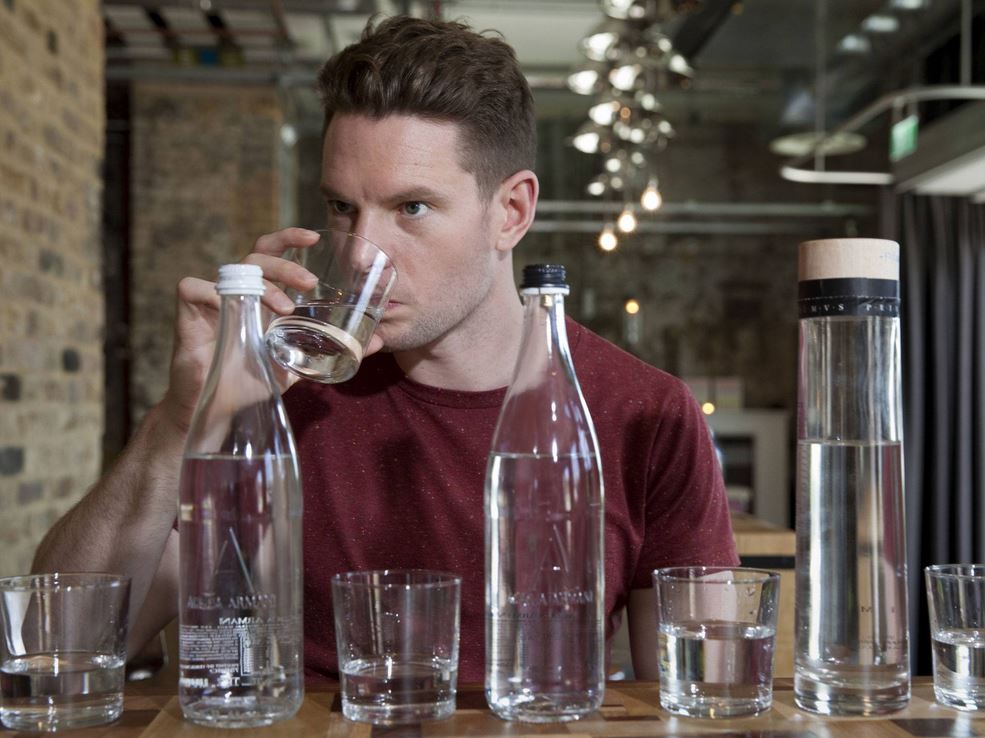
Bottled waterMy guess is that in the majority of the food and beverage industries there are professional tasters. Wine tasting is nothing unique – perhaps a tad more glamorous than say, a tomato ketchup taster, but certainly not unique. (Please note that I have nothing against ketchup or ketchup tasters!) 

Water tasting is however, something far more curious. As we all know the bottled water industry has grown enormously in recent years (and dare I suggest, is also a generator of some handsome profits). Only a decade ago there was quite a scandal in the UK when the Coca-Cola Company attempted to sell filtered mains water to consumers under the brand name Dasani. When the source of this water was made known the backlash resulted in its rapid withdrawal from the market. Supplying a water that cost only 0.03p and selling it in a plastic bottle for 95p was deemed simply not acceptable, no matter how ‘space age’ the filtering process was claimed to be.

Having said all that, I personally use different types of water in different situations. For example, I use mains tap water to boil for making tea, whereas our everyday drinking water is sourced from a natural spring in Sanxenxo and collected in large containers every few days. I have to admit that you can really taste the difference – the mains tap water obviously contains chlorine (that strangely makes good tea), whereas the spring water is much softer on the palate – what some people might describe as ‘sweet ‘water.

In London there are now bartenders who are creating infusions of water, adding a distillation of hay and grass to give consumers an alternative type of soft drink with their meal. The end result is apparently quite unusual. It’s perfectly clear, but has a straw-like bouquet, and in the mouth is slightly savoury with a lingering and rather pleasant taste. However, at £4 ($6) a glass, this might seem a little steep for many.

Another alternative might be pure iceberg water, claimed by its producer to be “the purest water on Earth”, made from icebergs formed by snowfall that settled in Greenland 12,000 years ago – a snip at only £13 ($20) a bottle.  Of course, all this is paled into insignificance when compared to Claridge’s Hotel in London which has a ‘water menu’, including bottles up to £50 ($78) a litre!  For water……..

Bottled waterMy guess is that in the majority of the food and beverage industries there are professional tasters. Wine tasting is nothing unique – perhaps a tad more glamorous than say, a tomato ketchup taster, but certainly not unique. (Please note that I have nothing against ketchup or ketchup tasters!) 

Water tasting is however, something far more curious. As we all know the bottled water industry has grown enormously in recent years (and dare I suggest, is also a generator of some handsome profits). Only a decade ago there was quite a scandal in the UK when the Coca-Cola Company attempted to sell filtered mains water to consumers under the brand name Dasani. When the source of this water was made known the backlash resulted in its rapid withdrawal from the market. Supplying a water that cost only 0.03p and selling it in a plastic bottle for 95p was deemed simply not acceptable, no matter how ‘space age’ the filtering process was claimed to be.

Having said all that, I personally use different types of water in different situations. For example, I use mains tap water to boil for making tea, whereas our everyday drinking water is sourced from a natural spring in Sanxenxo and collected in large containers every few days. I have to admit that you can really taste the difference – the mains tap water obviously contains chlorine (that strangely makes good tea), whereas the spring water is much softer on the palate – what some people might describe as ‘sweet ‘water.

In London there are now bartenders who are creating infusions of water, adding a distillation of hay and grass to give consumers an alternative type of soft drink with their meal. The end result is apparently quite unusual. It’s perfectly clear, but has a straw-like bouquet, and in the mouth is slightly savoury with a lingering and rather pleasant taste. However, at £4 ($6) a glass, this might seem a little steep for many.

Another alternative might be pure iceberg water, claimed by its producer to be “the purest water on Earth”, made from icebergs formed by snowfall that settled in Greenland 12,000 years ago – a snip at only £13 ($20) a bottle.  Of course, all this is paled into insignificance when compared to Claridge’s Hotel in London which has a ‘water menu’, including bottles up to £50 ($78) a litre!  For water……..

A new way of tasting?

August 12th, 2013 | Oddballs

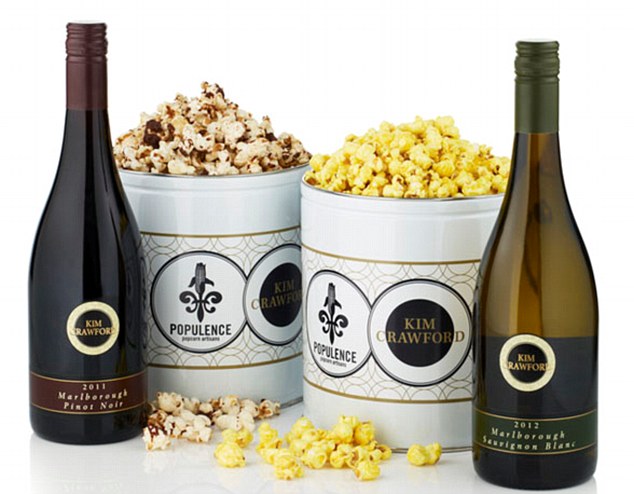
Wine popcornNow I think I’ve seen it all. The latest invention to hit the market….. wine flavoured popcorn! Spain is, of course, the creator of  the tapas phenomena, and having a bite sized snack with your wine is a very common practice. Indeed, it would be almost unthinkable to have a drink without some small, delicious titbit to accompany it. Nearly every bar in Spain, no matter how small, will automatically give you something with your drink, whether it be some olives, a piece of bread with a ham or cheese topping, or sometimes even a warm dish of rice, lentils or some other creation. All in all it’s actually a very civilised practice, and the fact that it is given free makes it even more agreeable.

This new wine popcorn has been created by a New York based company called Populence. Apparently its founder noticed that an increasing number of people were eating popcorn whilst they enjoyed their glass of wine and so created two (non-alcoholic) flavours to go with two selected Kim Crawford wines from New Zealand. They have suggested that the popcorn would be best enjoyed with a glass of the corresponding wine. The flavours in question (or should that be grape varieties?) are Pinot Noir Chocolate Drizzle and Sauvignon Blanc Kettle.

Personally I have never tried popcorn with wine, but that could be because I just don’t like popcorn. Having said that I guess it could make life a bit more interesting for cinema goers, but at a price of £23 for a one gallon tin ($36 or €27) I rather doubt it!

Wine popcornNow I think I’ve seen it all. The latest invention to hit the market….. wine flavoured popcorn! Spain is, of course, the creator of  the tapas phenomena, and having a bite sized snack with your wine is a very common practice. Indeed, it would be almost unthinkable to have a drink without some small, delicious titbit to accompany it. Nearly every bar in Spain, no matter how small, will automatically give you something with your drink, whether it be some olives, a piece of bread with a ham or cheese topping, or sometimes even a warm dish of rice, lentils or some other creation. All in all it’s actually a very civilised practice, and the fact that it is given free makes it even more agreeable.

This new wine popcorn has been created by a New York based company called Populence. Apparently its founder noticed that an increasing number of people were eating popcorn whilst they enjoyed their glass of wine and so created two (non-alcoholic) flavours to go with two selected Kim Crawford wines from New Zealand. They have suggested that the popcorn would be best enjoyed with a glass of the corresponding wine. The flavours in question (or should that be grape varieties?) are Pinot Noir Chocolate Drizzle and Sauvignon Blanc Kettle.

Personally I have never tried popcorn with wine, but that could be because I just don’t like popcorn. Having said that I guess it could make life a bit more interesting for cinema goers, but at a price of £23 for a one gallon tin ($36 or €27) I rather doubt it!

Tunnel tasting

August 2nd, 2013 | Tasting

Tunnel tastingThis is the time of year that we celebrate the Festival of Albariño in Cambados (the spiritual home of our beloved grape variety). 2013 is the 61st time that the event has been held and it runs for four days from 1st – 4th August. For perhaps the second or third time at the festival, the D.O. have opened their doors to the ‘Tunnel of Wine’ tasting. Many of you reading this will already understand the concept of a tasting tunnel, but for those who don’t it is actually very simple. The tunnel comprises a series of tables containing rows of opened bottles, each bottle accompanied by a fiche technique (cheat sheet) giving details of how each wine is vinified. It is entirely self-service and so each taster is able to work at their own pace, but more importantly, completely unhindered, allowing the taster to concentrate completely on the task in hand. This year there are 114 wines on show and so it’s an ideal opportunity to assess the progress of many of the wines in our denomination – all under one roof.

I should mention that there is a 15 Euro entry fee, which is perhaps designed to deter some from taking advantage and simply turning the tunnel into a subsidised drinking session. This is a professional tasting and completely separate from the main fiesta which enjoys much more of an informal party atmosphere. For me at least, the tunnel is a much better option.

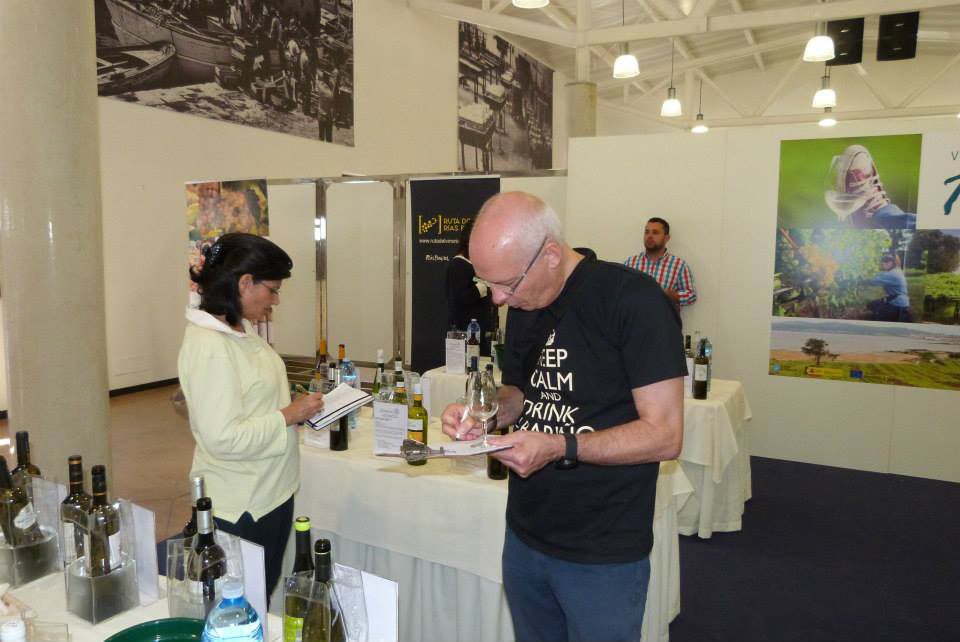
Today’s photo is lifted from the Facebook page of the Rias Baixas D.O. and shows Angela and myself hard at work doing what we do best – tasting wine. Please note my ‘trendy’ t-shirt “Keep calm and drink albariño” – good advice I think!

Tunnel tastingThis is the time of year that we celebrate the Festival of Albariño in Cambados (the spiritual home of our beloved grape variety). 2013 is the 61st time that the event has been held and it runs for four days from 1st – 4th August. For perhaps the second or third time at the festival, the D.O. have opened their doors to the ‘Tunnel of Wine’ tasting. Many of you reading this will already understand the concept of a tasting tunnel, but for those who don’t it is actually very simple. The tunnel comprises a series of tables containing rows of opened bottles, each bottle accompanied by a fiche technique (cheat sheet) giving details of how each wine is vinified. It is entirely self-service and so each taster is able to work at their own pace, but more importantly, completely unhindered, allowing the taster to concentrate completely on the task in hand. This year there are 114 wines on show and so it’s an ideal opportunity to assess the progress of many of the wines in our denomination – all under one roof.

I should mention that there is a 15 Euro entry fee, which is perhaps designed to deter some from taking advantage and simply turning the tunnel into a subsidised drinking session. This is a professional tasting and completely separate from the main fiesta which enjoys much more of an informal party atmosphere. For me at least, the tunnel is a much better option.

Today’s photo is lifted from the Facebook page of the Rias Baixas D.O. and shows Angela and myself hard at work doing what we do best – tasting wine. Please note my ‘trendy’ t-shirt “Keep calm and drink albariño” – good advice I think!

Monthly Archives

Categories

ARE YOU OF LEGAL AGE? This site is intended for those of legal drinking age. By entering, you confirm that you are of legal drinking age in the country where this site is being accessed. ¿ERES MAYOR DE EDAD? Este sitio está destinado a personas en edad legal para beber alcohol. Al ingresar, confirma que tiene la edad legal para beber en el país donde se accede a este sitio.