

Archive for ‘Vineyards’

Our new, second-hand ‘Baby’

May 1st, 2014 | Equipment
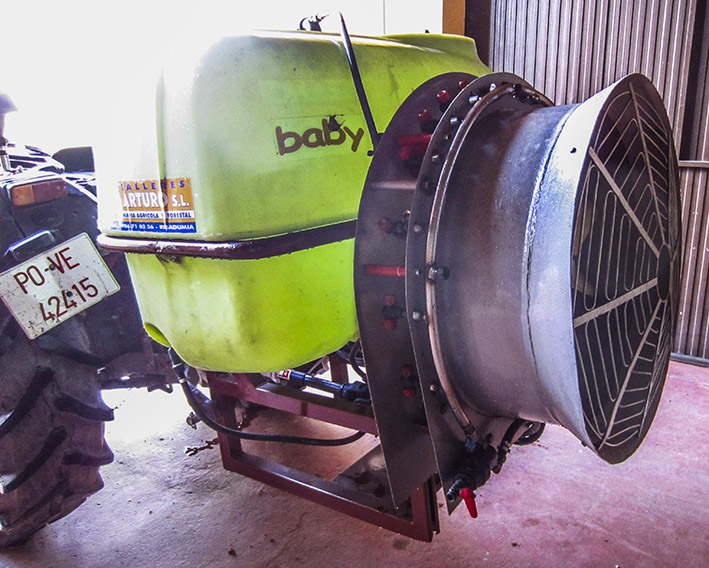
Baby sprayLet’s make one thing clear – spraying the vines is something we don’t like to do, but unfortunately, owing to the vagaries of our climate, it is a necessary evil. Clearly we make every attempt to keep our interventions to the minimum, and always try to use the most environmentally friendly treatments that we can find, but in the end, hand on heart, we are never going to simply sit back and watch our fruit rot on the vines. There’s no doubt that Galicia is a beautiful corner of Spain, but it is also has a very damp climate, which explains why the coastline of our province is just so verdant.

In giving the treatments, one simple, ongoing problem that we have always had is when our tractor has to negotiate the space between the pergolas with crop spraying equipment in tow. Some of the manoeuvres required can be a bit tight, especially around the perimeter of the vineyard. In the past we have tackled some of these tight corners by using a special hose attached to the main reservoir of the equipment, spraying by hand, but obviously this is very time consuming, and of course, we all know the simple equation: Time=Money!

Our solution to this problem has been by making a relatively small outlay, buying a good quality, second-hand ‘Baby’ crop sprayer with 500 litre capacity (the ‘Baby’ sticker was already on the tank when we bought it). With the continued wet weather it had it’s very first outing only a day or two ago, and the good news is that it seems to make the whole task just a little more efficient. Hopefully it will soon pay for itself simply by the time we save.
Baby sprayLet’s make one thing clear – spraying the vines is something we don’t like to do, but unfortunately, owing to the vagaries of our climate, it is a necessary evil. Clearly we make every attempt to keep our interventions to the minimum, and always try to use the most environmentally friendly treatments that we can find, but in the end, hand on heart, we are never going to simply sit back and watch our fruit rot on the vines. There’s no doubt that Galicia is a beautiful corner of Spain, but it is also has a very damp climate, which explains why the coastline of our province is just so verdant.

In giving the treatments, one simple, ongoing problem that we have always had is when our tractor has to negotiate the space between the pergolas with crop spraying equipment in tow. Some of the manoeuvres required can be a bit tight, especially around the perimeter of the vineyard. In the past we have tackled some of these tight corners by using a special hose attached to the main reservoir of the equipment, spraying by hand, but obviously this is very time consuming, and of course, we all know the simple equation: Time=Money!

Our solution to this problem has been by making a relatively small outlay, buying a good quality, second-hand ‘Baby’ crop sprayer with 500 litre capacity (the ‘Baby’ sticker was already on the tank when we bought it). With the continued wet weather it had it’s very first outing only a day or two ago, and the good news is that it seems to make the whole task just a little more efficient. Hopefully it will soon pay for itself simply by the time we save.

Easter update

April 18th, 2014 | Vineyards

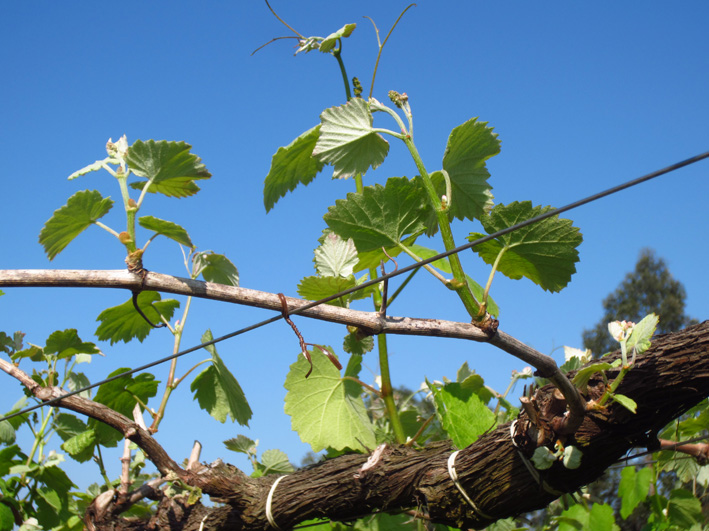
Spring 2014I have recently been writing about the pruning and tying of vines in our fincas, but it occurred to me that I didn’t actually say too much about the progress of the vines themselves. After a prolonged cold, wet winter it was really a ten day period of sun and warmth in the middle of March that kick-started the 2014 growing cycle. 

However, do not be misled by the intensely blue sky in today’s photo – this was taken yesterday, and the sky has now reverted back to it’s more familiar overcast, grey colour. So far this year we have not really seen any prolonged period of settled weather, and it looks like this year’s Easter break is going to be quite a damp affair. So much for the new gas barbecue that I have just bought for the summer – methinks that it will have to wait until later in the year to be inaugurated…..

Spring 2014I have recently been writing about the pruning and tying of vines in our fincas, but it occurred to me that I didn’t actually say too much about the progress of the vines themselves. After a prolonged cold, wet winter it was really a ten day period of sun and warmth in the middle of March that kick-started the 2014 growing cycle. 

However, do not be misled by the intensely blue sky in today’s photo – this was taken yesterday, and the sky has now reverted back to it’s more familiar overcast, grey colour. So far this year we have not really seen any prolonged period of settled weather, and it looks like this year’s Easter break is going to be quite a damp affair. So much for the new gas barbecue that I have just bought for the summer – methinks that it will have to wait until later in the year to be inaugurated…..

All tied up

April 15th, 2014 | Vineyards

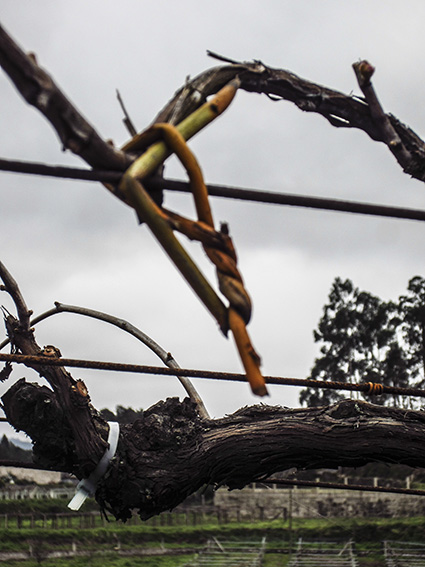
WillowBy far the most time consuming process in our vineyards is the pruning, which starts in the late autumn and continues throughout the winter, almost until bud break in early spring. As I have explained many times before, pruning is a really tough, backbreaking task. The procedure itself has not really changed too much for years, but some of the materials that we use have evolved just a little to make the job just a bit easier. For example, it’s not that many years ago our guys would use willow plant cuttings to attach the canes to the wires of our overhead pergolas (see photo). Of course, it is obviously more desirable to use a natural material to tie the vines, but there is a major downside to this – the amount of time it takes. It is painfully slow to attach the canes by hand, knotting each piece of willow individually. This system has inevitably been streamlined by machinery.

In all honesty, we usually don’t get too much opportunity to use any mechanised equipment under our pergolas, but in the case of the tying, we now have battery operated machines that enable one man to do the work of four people, when compared to the old method of attaching the vines. Labour is singularly the greatest cost element of our grape production and so I’m afraid to admit that the decision to use this modern method for tying is quite simply a “no brainer”.

WillowBy far the most time consuming process in our vineyards is the pruning, which starts in the late autumn and continues throughout the winter, almost until bud break in early spring. As I have explained many times before, pruning is a really tough, backbreaking task. The procedure itself has not really changed too much for years, but some of the materials that we use have evolved just a little to make the job just a bit easier. For example, it’s not that many years ago our guys would use willow plant cuttings to attach the canes to the wires of our overhead pergolas (see photo). Of course, it is obviously more desirable to use a natural material to tie the vines, but there is a major downside to this – the amount of time it takes. It is painfully slow to attach the canes by hand, knotting each piece of willow individually. This system has inevitably been streamlined by machinery.

In all honesty, we usually don’t get too much opportunity to use any mechanised equipment under our pergolas, but in the case of the tying, we now have battery operated machines that enable one man to do the work of four people, when compared to the old method of attaching the vines. Labour is singularly the greatest cost element of our grape production and so I’m afraid to admit that the decision to use this modern method for tying is quite simply a “no brainer”.

Taste and taste again

March 9th, 2014 | Tasting

Tasting2It’s probably fair to say that there’s not much happening in the Bodega at this time of year. Of course our team are busy out in the vineyards, as they approach the end of the pruning – and I should add that this year in particular, they deserve a medal. Pruning can be a backbreaking job at the best of times, but with torrential rain nearly all winter, this year has been a nightmare for them. Please don’t forget that with our pergola training system to prune overhead vines means facing skyward – imagine all that rain beating down directly into your face!

Meanwhile, back in the cellar, one of the most important, ongoing jobs that we do, is tasting the tanks. Our 2013 albariños are all still lying, undisturbed on their lees and have to be monitored at very regular intervals. When we age our wines on the lees, there is absolutely no hard and fast rule as to how long this process should take – normally it will be a minimum of at least 5 months, but this can actually be much longer, depending on the wine and the vintage. The object of tasting is to ensure that the lees are clean and not tainted – we are really looking for any signs of ‘reduction’ caused by the sulphur compounds that are formed in the wine during fermentation. Once the available nitrogen in a must or grape juice is exhausted, the yeast will break down and form compounds such as hydrogen sulphide, which we all know as ‘bad egg gas’. Apart from the eggs, a vast number of different sulphur compounds can taint a wine with all manner of unappealing characteristics such as onion, garlic, cabbage and burnt rubber, which is why we have to keep a sharp eye (or keen nose) to make sure that the wine remains clean. We then chose the optimum moment to ‘rack’ the wine into clean tanks, discarding the unwanted yeast deposits.

Tasting2It’s probably fair to say that there’s not much happening in the Bodega at this time of year. Of course our team are busy out in the vineyards, as they approach the end of the pruning – and I should add that this year in particular, they deserve a medal. Pruning can be a backbreaking job at the best of times, but with torrential rain nearly all winter, this year has been a nightmare for them. Please don’t forget that with our pergola training system to prune overhead vines means facing skyward – imagine all that rain beating down directly into your face!

Meanwhile, back in the cellar, one of the most important, ongoing jobs that we do, is tasting the tanks. Our 2013 albariños are all still lying, undisturbed on their lees and have to be monitored at very regular intervals. When we age our wines on the lees, there is absolutely no hard and fast rule as to how long this process should take – normally it will be a minimum of at least 5 months, but this can actually be much longer, depending on the wine and the vintage. The object of tasting is to ensure that the lees are clean and not tainted – we are really looking for any signs of ‘reduction’ caused by the sulphur compounds that are formed in the wine during fermentation. Once the available nitrogen in a must or grape juice is exhausted, the yeast will break down and form compounds such as hydrogen sulphide, which we all know as ‘bad egg gas’. Apart from the eggs, a vast number of different sulphur compounds can taint a wine with all manner of unappealing characteristics such as onion, garlic, cabbage and burnt rubber, which is why we have to keep a sharp eye (or keen nose) to make sure that the wine remains clean. We then chose the optimum moment to ‘rack’ the wine into clean tanks, discarding the unwanted yeast deposits.

The storms continue

February 6th, 2014 | Vineyards

Pruning 2014Despite the fact that we are currently being lashed by rain and strong winds on a daily basis, I guess that by comparison, we should consider ourselves lucky. Large areas of the UK are still under water (some areas have been flooded since Christmas), and huge parts of the US are gripped by snow and ice, and have been for many weeks. Apparently, over in the US, the cold weather extends as far south as northern Texas.

Here at Castro Martin we have not been flooded by the storms, but suffice to say that the heavy rain is now barely absorbed by the totally saturated ground. To compound matters even further, this is the time of year that we are traditionally extremely busy in our vineyards pruning, but to be honest this is the type of weather when you would be reluctant to send your dog out, let alone your poor pruning team! As they leave the cellar they are completely cocooned in their oilskins and boots, but even so, in this weather, it is really the most unenviable task. The problem is that we cannot really stop and wait, it’s simply a job that has to be completed, and with no break in the weather on the horizon, our guys simply have to soldier on regardless….

Pruning 2014Despite the fact that we are currently being lashed by rain and strong winds on a daily basis, I guess that by comparison, we should consider ourselves lucky. Large areas of the UK are still under water (some areas have been flooded since Christmas), and huge parts of the US are gripped by snow and ice, and have been for many weeks. Apparently, over in the US, the cold weather extends as far south as northern Texas.

Here at Castro Martin we have not been flooded by the storms, but suffice to say that the heavy rain is now barely absorbed by the totally saturated ground. To compound matters even further, this is the time of year that we are traditionally extremely busy in our vineyards pruning, but to be honest this is the type of weather when you would be reluctant to send your dog out, let alone your poor pruning team! As they leave the cellar they are completely cocooned in their oilskins and boots, but even so, in this weather, it is really the most unenviable task. The problem is that we cannot really stop and wait, it’s simply a job that has to be completed, and with no break in the weather on the horizon, our guys simply have to soldier on regardless….

Ship-shape and Bristol fashion

August 1st, 2013 | Odds & Sods

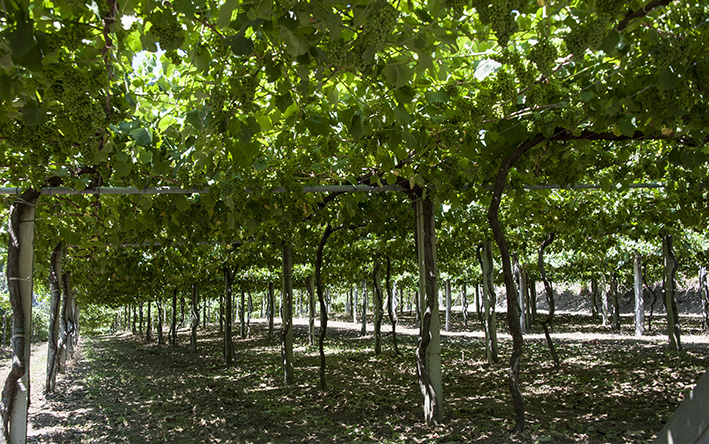
Bodega VineyardRoughly ten years ago we planted a new vineyard around the bodega. Any new vineyard yields virtually no usable fruit for the first few years, and it takes much longer than that to produce high quality grapes, so the return on investment can be quite protracted. Even at ten years old this ‘finca’ is still very young – the fruit that it produces now is not bad, but the very good news is that it is going to get much better in the years to come. Of course it goes without saying that all the vines that we plant, whether it be in new vineyards, or to replace old or damaged vines, are the very best clones of the albariño grape variety that we can lay our hands on.

 Although today’s photo is just another boring shot of the new bodega vineyard, I wanted to put it in as a tribute to David, Juan and Freddie, our young  and enthusiastic team who work very hard, often in inclement weather, to keep all our vineyards in tip-top condition. Our fincas are quite deliberately manicured like gardens in order to fully support our philosophy that ‘quality begins in the vineyard’.

The expression that I use to describe the state of this finca is ‘Ship-shape and Bristol fashion’ which is an old English nautical term, or to be more accurate, two separate terms from the 17th and 18th centuries which over the years have become married together. The city of Bristol is a port in the south west of England. Situated inland on the River Severn it experiences the second highest rise and fall of tides of anywhere in the world (I believe that this can be up to 40ft or 12/13metres). The old wooden Royal Navy ships that used the port had to be extremely strong as at low tide they would be left beached, resting on their keels, and therefore tilting over. Before they could use the port they had to ensure that everything was lashed down and secured, so that when it tilted its contents would not simply be strewn across the ship. 

The term ‘ship-shape’ refers to neat order; ‘Bristol fashion’ refers to the critical specifications that ships had to meet before entering Bristol. The phrase in its entirety therefore comes to mean ‘neat, tidy and well-ordered’. Some old phrases can be quite interesting, we often use them without really knowing their true origins…..

Bodega VineyardRoughly ten years ago we planted a new vineyard around the bodega. Any new vineyard yields virtually no usable fruit for the first few years, and it takes much longer than that to produce high quality grapes, so the return on investment can be quite protracted. Even at ten years old this ‘finca’ is still very young – the fruit that it produces now is not bad, but the very good news is that it is going to get much better in the years to come. Of course it goes without saying that all the vines that we plant, whether it be in new vineyards, or to replace old or damaged vines, are the very best clones of the albariño grape variety that we can lay our hands on.

 Although today’s photo is just another boring shot of the new bodega vineyard, I wanted to put it in as a tribute to David, Juan and Freddie, our young  and enthusiastic team who work very hard, often in inclement weather, to keep all our vineyards in tip-top condition. Our fincas are quite deliberately manicured like gardens in order to fully support our philosophy that ‘quality begins in the vineyard’.

The expression that I use to describe the state of this finca is ‘Ship-shape and Bristol fashion’ which is an old English nautical term, or to be more accurate, two separate terms from the 17th and 18th centuries which over the years have become married together. The city of Bristol is a port in the south west of England. Situated inland on the River Severn it experiences the second highest rise and fall of tides of anywhere in the world (I believe that this can be up to 40ft or 12/13metres). The old wooden Royal Navy ships that used the port had to be extremely strong as at low tide they would be left beached, resting on their keels, and therefore tilting over. Before they could use the port they had to ensure that everything was lashed down and secured, so that when it tilted its contents would not simply be strewn across the ship. 

The term ‘ship-shape’ refers to neat order; ‘Bristol fashion’ refers to the critical specifications that ships had to meet before entering Bristol. The phrase in its entirety therefore comes to mean ‘neat, tidy and well-ordered’. Some old phrases can be quite interesting, we often use them without really knowing their true origins…..

Ship-shape and Bristol fashion

August 1st, 2013 | Odds & Sods

Bodega VineyardRoughly ten years ago we planted a new vineyard around the bodega. Any new vineyard yields virtually no usable fruit for the first few years, and it takes much longer than that to produce high quality grapes, so the return on investment can be quite protracted. Even at ten years old this ‘finca’ is still very young – the fruit that it produces now is not bad, but the very good news is that it is going to get much better in the years to come. Of course it goes without saying that all the vines that we plant, whether it be in new vineyards, or to replace old or damaged vines, are the very best clones of the albariño grape variety that we can lay our hands on.

 Although today’s photo is just another boring shot of the new bodega vineyard, I wanted to put it in as a tribute to David, Juan and Freddie, our young  and enthusiastic team who work very hard, often in inclement weather, to keep all our vineyards in tip-top condition. Our fincas are quite deliberately manicured like gardens in order to fully support our philosophy that ‘quality begins in the vineyard’.

The expression that I use to describe the state of this finca is ‘Ship-shape and Bristol fashion’ which is an old English nautical term, or to be more accurate, two separate terms from the 17th and 18th centuries which over the years have become married together. The city of Bristol is a port in the south west of England. Situated inland on the River Severn it experiences the second highest rise and fall of tides of anywhere in the world (I believe that this can be up to 40ft or 12/13metres). The old wooden Royal Navy ships that used the port had to be extremely strong as at low tide they would be left beached, resting on their keels, and therefore tilting over. Before they could use the port they had to ensure that everything was lashed down and secured, so that when it tilted its contents would not simply be strewn across the ship. 

The term ‘ship-shape’ refers to neat order; ‘Bristol fashion’ refers to the critical specifications that ships had to meet before entering Bristol. The phrase in its entirety therefore comes to mean ‘neat, tidy and well-ordered’. Some old phrases can be quite interesting, we often use them without really knowing their true origins…..

Bodega VineyardRoughly ten years ago we planted a new vineyard around the bodega. Any new vineyard yields virtually no usable fruit for the first few years, and it takes much longer than that to produce high quality grapes, so the return on investment can be quite protracted. Even at ten years old this ‘finca’ is still very young – the fruit that it produces now is not bad, but the very good news is that it is going to get much better in the years to come. Of course it goes without saying that all the vines that we plant, whether it be in new vineyards, or to replace old or damaged vines, are the very best clones of the albariño grape variety that we can lay our hands on.

 Although today’s photo is just another boring shot of the new bodega vineyard, I wanted to put it in as a tribute to David, Juan and Freddie, our young  and enthusiastic team who work very hard, often in inclement weather, to keep all our vineyards in tip-top condition. Our fincas are quite deliberately manicured like gardens in order to fully support our philosophy that ‘quality begins in the vineyard’.

The expression that I use to describe the state of this finca is ‘Ship-shape and Bristol fashion’ which is an old English nautical term, or to be more accurate, two separate terms from the 17th and 18th centuries which over the years have become married together. The city of Bristol is a port in the south west of England. Situated inland on the River Severn it experiences the second highest rise and fall of tides of anywhere in the world (I believe that this can be up to 40ft or 12/13metres). The old wooden Royal Navy ships that used the port had to be extremely strong as at low tide they would be left beached, resting on their keels, and therefore tilting over. Before they could use the port they had to ensure that everything was lashed down and secured, so that when it tilted its contents would not simply be strewn across the ship. 

The term ‘ship-shape’ refers to neat order; ‘Bristol fashion’ refers to the critical specifications that ships had to meet before entering Bristol. The phrase in its entirety therefore comes to mean ‘neat, tidy and well-ordered’. Some old phrases can be quite interesting, we often use them without really knowing their true origins…..

Vine vigour

July 18th, 2013 | Vineyards

ClimberAfter a long, cool, wet spring building up the water table in the soil, we now have very hot, sunny weather. Of course our vines really revel in these conditions, and they start to grow very, very quickly – almost out of control. This very rapid development of the shoots is known as vine vigour, and will hopefully slow down as the grape clusters start to develop during ‘veraison’ – the moment when the recognisable fruit starts to develop. The problem is that if the canopy grows unchecked then this will simply detract from the quality of the grapes, as the excess foliage competes for the resources of the vine plant. This is why we spend long periods during the summer removing leaves and thinning the canopy.

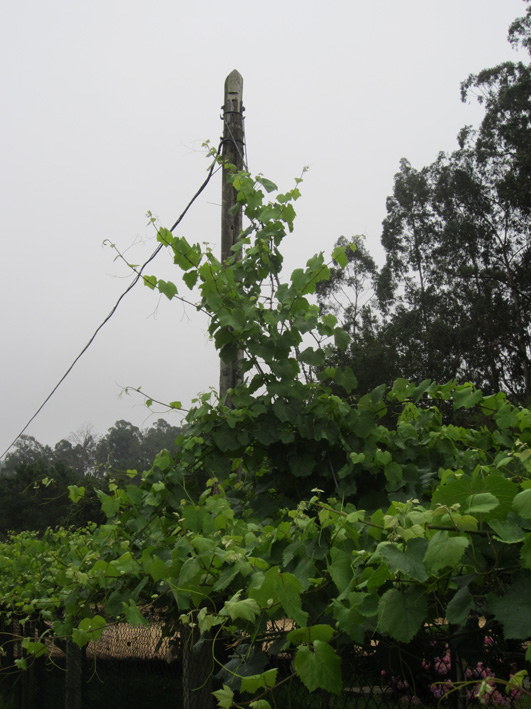
Of course vines are natural climbers, which is why we use wires to train them. Unfortunately they do not distinguish between different types of wire, which is why today’s photo shows a vine plotting its escape from the vineyard by means of a telephone cable. (Yes, we still have some overhead telephone cables out here in the wilds of Galicia – fibre optics are merely a dream of the future!)

ClimberAfter a long, cool, wet spring building up the water table in the soil, we now have very hot, sunny weather. Of course our vines really revel in these conditions, and they start to grow very, very quickly – almost out of control. This very rapid development of the shoots is known as vine vigour, and will hopefully slow down as the grape clusters start to develop during ‘veraison’ – the moment when the recognisable fruit starts to develop. The problem is that if the canopy grows unchecked then this will simply detract from the quality of the grapes, as the excess foliage competes for the resources of the vine plant. This is why we spend long periods during the summer removing leaves and thinning the canopy.

Of course vines are natural climbers, which is why we use wires to train them. Unfortunately they do not distinguish between different types of wire, which is why today’s photo shows a vine plotting its escape from the vineyard by means of a telephone cable. (Yes, we still have some overhead telephone cables out here in the wilds of Galicia – fibre optics are merely a dream of the future!)

Let the flowering begin

May 22nd, 2013 | Vineyards

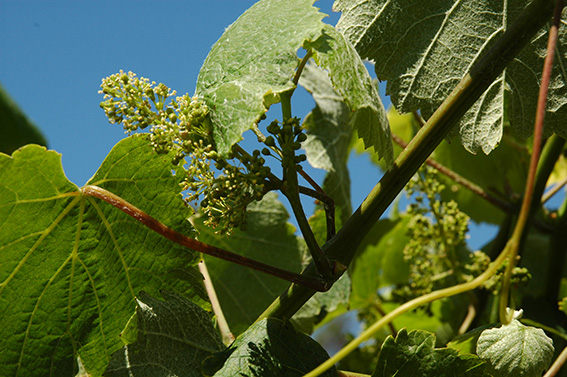
FloweringToday we have sun, and hopefully the forecast predicts that we should have sun for the next week or two – we need it for the flowering! The weather here has been quite unusual for the last few months as, although we’ve enjoyed a bit of sunshine recently, the temperatures still stubbornly refuse to break the 20°C (68°F) barrier. I can recall years when we’ve reached these temperatures as early as February or March, albeit that this is not necessarily a good thing either…. I think our problem lies with the cold northerly winds which are quite unusual at this time of year, by now we should really be drawing our weather systems (and winds) from the west or south west.

The truth is that in the context of the vine cycle this is a very critical time of year where we really need a period of warm, dry, settled weather. The tiny, delicate grape flowers can be dislodged by rain, wind or excessive cold, and is they are not allowed to self-pollenate or ‘set’ to form the grape berries then a significant percentage of the year’s crop can be lost. Cold, unsettled weather can also result in what the French call ‘Millerandage’  (I think this is known as ‘Corrimiento’ in Spanish), which is when we end up with berries of different sizes within each bunch – where some berries have matured, and others have not. These bunches are largely unusable and the resultant crop can be quite poor.

As always we have our fingers crossed that nature will be kind to us.

FloweringToday we have sun, and hopefully the forecast predicts that we should have sun for the next week or two – we need it for the flowering! The weather here has been quite unusual for the last few months as, although we’ve enjoyed a bit of sunshine recently, the temperatures still stubbornly refuse to break the 20°C (68°F) barrier. I can recall years when we’ve reached these temperatures as early as February or March, albeit that this is not necessarily a good thing either…. I think our problem lies with the cold northerly winds which are quite unusual at this time of year, by now we should really be drawing our weather systems (and winds) from the west or south west.

The truth is that in the context of the vine cycle this is a very critical time of year where we really need a period of warm, dry, settled weather. The tiny, delicate grape flowers can be dislodged by rain, wind or excessive cold, and is they are not allowed to self-pollenate or ‘set’ to form the grape berries then a significant percentage of the year’s crop can be lost. Cold, unsettled weather can also result in what the French call ‘Millerandage’  (I think this is known as ‘Corrimiento’ in Spanish), which is when we end up with berries of different sizes within each bunch – where some berries have matured, and others have not. These bunches are largely unusable and the resultant crop can be quite poor.

As always we have our fingers crossed that nature will be kind to us.

Albariño – The Next Generation

May 13th, 2013 | Technical

Vines - The Next GenerationI think it would be fair to say that there is almost never a quiet moment in the calendar of the vigneron – it’s pretty much non-stop, there’s always something going on, even in winter. Usually, once the harvest is completed, the wine making takes over, and often before this has even finished we have to start on the pruning. By the time we finish all the pruning and tying the shoots to the wires, the growing season has started once again, and so the cycle continues….

At the end of the pruning, once the wires have been cleaned up ready for the new growth, this is really the best (and only) moment to carry out repairs and general ‘rejuvenation’ of the vineyards. A week or two ago I wrote about the repair of broken wires, but probably the most important of all the spring chores is the replanting/replacement of any damaged, broken or diseased vine plants. Very regrettably some of the vines that we have to replace are simply the ones which have reached the end of their productive life cycle. The dilemma is that as the vine gets very old so the yield of the plant is greatly reduced, but this will often produce the very best quality grapes of the entire vineyard. This is why many wineries make a special ‘Old Vines’ Cuvée (always at a premium price) – a very low yield wine, but of very high quality and with great concentration.

The best solution to this ‘old vine’ conundrum, is therefore something of a compromise. To replace vines almost on a ‘rolling’ basis whereby we never arrive in a situation where we have to replace large sections of any one vineyard at any one time. The best permutation is always to have a good cross-section of mature vines, producing good quality fruit, whilst always maintaining a viable working volume.

Today’s photo shows some of our latest new arrivals – our next generation of fruit producers direct from the nursery. Not any old nursery I should tell you, but an officially registered producer of vines, where every plant is certified and comes with its own complete traceability. We are however, still able to select from a handful of different clones, and our choice is of course based on both experience and the style that we want to achieve in our finished wine – the results of which will only be seen several years down the line.

Vines - The Next GenerationI think it would be fair to say that there is almost never a quiet moment in the calendar of the vigneron – it’s pretty much non-stop, there’s always something going on, even in winter. Usually, once the harvest is completed, the wine making takes over, and often before this has even finished we have to start on the pruning. By the time we finish all the pruning and tying the shoots to the wires, the growing season has started once again, and so the cycle continues….

At the end of the pruning, once the wires have been cleaned up ready for the new growth, this is really the best (and only) moment to carry out repairs and general ‘rejuvenation’ of the vineyards. A week or two ago I wrote about the repair of broken wires, but probably the most important of all the spring chores is the replanting/replacement of any damaged, broken or diseased vine plants. Very regrettably some of the vines that we have to replace are simply the ones which have reached the end of their productive life cycle. The dilemma is that as the vine gets very old so the yield of the plant is greatly reduced, but this will often produce the very best quality grapes of the entire vineyard. This is why many wineries make a special ‘Old Vines’ Cuvée (always at a premium price) – a very low yield wine, but of very high quality and with great concentration.

The best solution this ‘old vine’ conundrum, is therefore something of a compromise. To replace vines almost on a ‘rolling’ basis whereby we never arrive in a situation where we have to replace large sections of any one vineyard at any one time. The best permutation is always to have a good cross-section of mature vines, producing good quality fruit, whilst always maintaining a viable working volume.

Today’s photo shows some of our latest new arrivals – our next generation of fruit producers direct from the nursery. Not any old nursery I should tell you, but an officially registered producer of vines, where every plant is certified and comes with its own complete traceability. We are however, still able to select from a handful of different clones, and our choice is of course based on both experience and the style that we want to achieve in our finished wine – the results of which will only be seen several years down the line.

Monthly Archives

Categories

ARE YOU OF LEGAL AGE? This site is intended for those of legal drinking age. By entering, you confirm that you are of legal drinking age in the country where this site is being accessed. ¿ERES MAYOR DE EDAD? Este sitio está destinado a personas en edad legal para beber alcohol. Al ingresar, confirma que tiene la edad legal para beber en el país donde se accede a este sitio.