




Seeding without seeds
October 11th, 2012 | Post Harvest
 With the 2012 fruit safely gathered in our focus of attention now moves inside, with the small matter of trying to make some decent wine. As you may have read in my harvest posts, despite a relatively poor summer, we are more than satisfied with the quality of our grapes, and believe that this year might yield a very good wine. There is certainly quite a contrast between this and last year’s harvest, not only in terms of the grape quality, but also relating to the actual volume produced. However, before we start to make any comparison we should not forget that 2011 was a record harvest by some distance, yielding 10 million kilos more than the next biggest vintages of 2010 and 2006 – a huge difference for our tiny denomination (currently standing at around 4,000 hectares in total). Taking this into account, the fact that at our own volume this year is roughly half that of 2011, should not come as too much of a surprise.
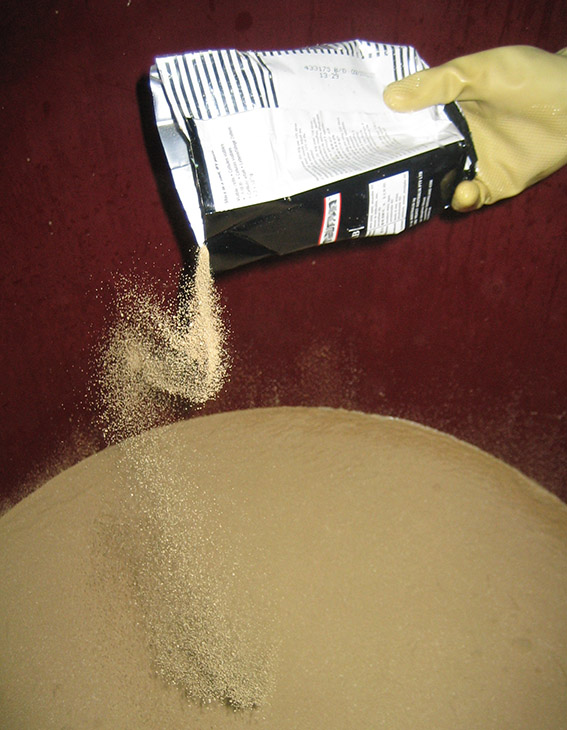
Now that the tanks have been ‘racked’, separating the clean juice from the ‘fangos’ (residue of skins, pips, stalks etc.), it’s finally time to seed the tanks. Seeding is quite an interesting term, as of course, there are actually no seeds involved as such. In this case we are actually referring to the process of adding our selected yeasts to the grape must in order to initiate the fermentation. My guess is that we use the term ‘seeding’ simply because we are supplying the nutrients required to help our new wine evolve. Also, I have deliberately used the term ‘selected’ yeast as there are so many to chose from. These days wine makers can select from a catalogue of different strains, each imparting their own characteristics and flavour profile. It’s a matter of experience and personal taste…. we deliberately select very neutral yeasts so that the character of our own fantastic grape variety will dominate the finished wine.
Finally, I am pleased to tell you that our 2012 vintage report is now complete and already posted on this website (click on our download menu).
 With the 2012 fruit safely gathered in our focus of attention now moves inside, with the small matter of trying to make some decent wine. As you may have read in my harvest posts, despite a relatively poor summer, we are more than satisfied with the quality of our grapes, and believe that this year might yield a very good wine. There is certainly quite a contrast between this and last year’s harvest, not only in terms of the grape quality, but also relating to the actual volume produced. However, before we start to make any comparison we should not forget that 2011 was a record harvest by some distance, yielding 10 million kilos more than the next biggest vintages of 2010 and 2006 – a huge difference for our tiny denomination (currently standing at around 4,000 hectares in total). Taking this into account, the fact that at our own volume this year is roughly half that of 2011, should not come as too much of a surprise.
Now that the tanks have been ‘racked’, separating the clean juice from the ‘fangos’ (residue of skins, pips, stalks etc.), it’s finally time to seed the tanks. Seeding is quite an interesting term, as of course, there are actually no seeds involved as such. In this case we are actually referring to the process of adding our selected yeasts to the grape must in order to initiate the fermentation. My guess is that we use the term ‘seeding’ simply because we are supplying the nutrients required to help our new wine evolve. Also, I have deliberately used the term ‘selected’ yeast as there are so many to chose from. These days wine makers can select from a catalogue of different strains, each imparting their own characteristics and flavour profile. It’s a matter of experience and personal taste…. we deliberately select very neutral yeasts so that the character of our own fantastic grape variety will dominate the finished wine.
Finally, I am pleased to tell you that our 2012 vintage report is now complete and already posted on this website (click on our download menu).


