

Archive for ‘Food & Wine’

Percebes – Goose barnacles

September 2nd, 2015 | Food & Wine
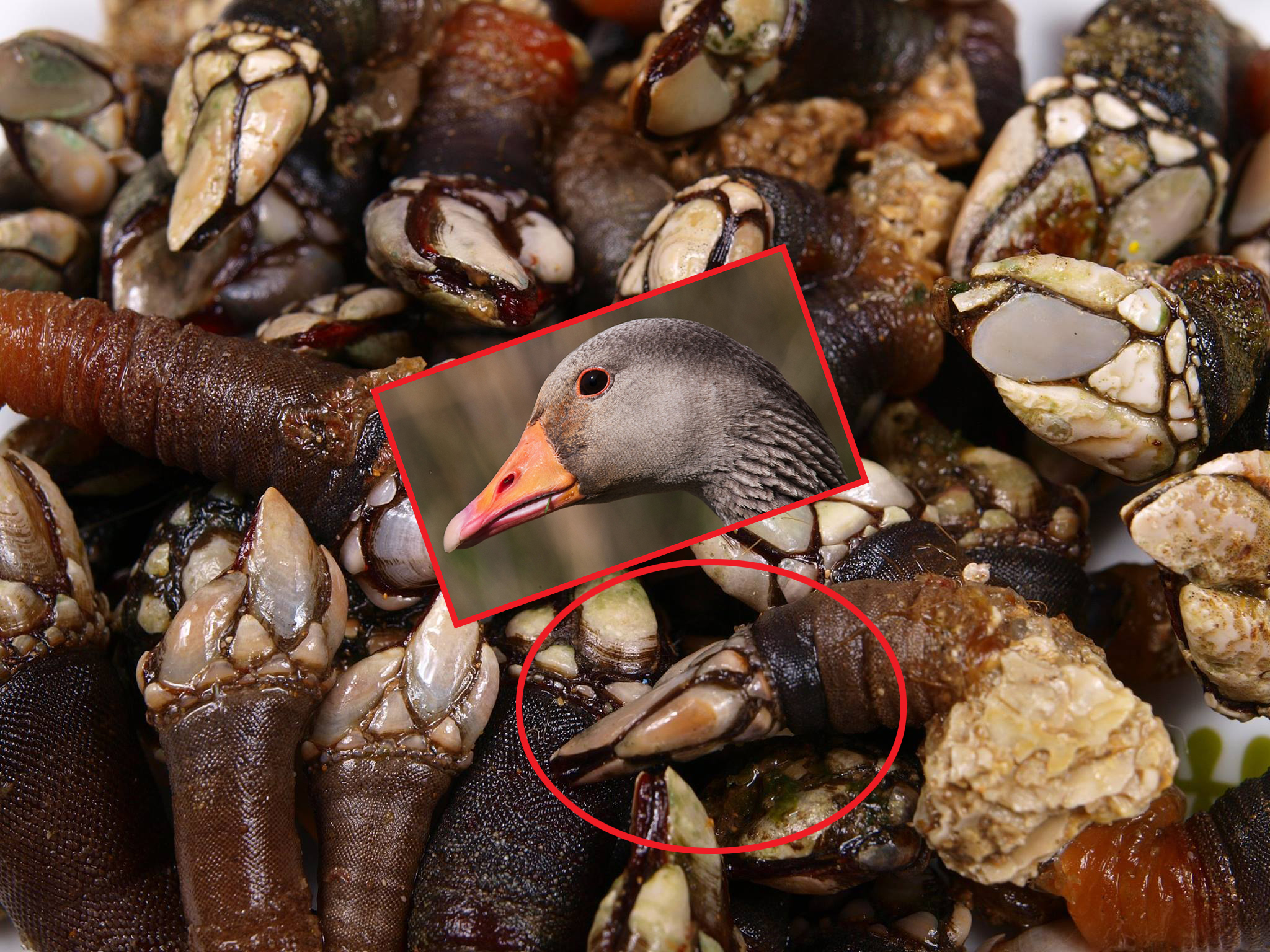
Goose barnaclesPercebes, or goose barnacles are a highly sought-after local delicacy, perhaps at the very pinnacle of Galicia’s wide selection of crustaceans, molluscs and other seafoods. The name ‘goose barnacle’ (or sometimes gooseneck barnacle) is surrounded by many a curious tale. Quite obviously they are named after the barnacle goose, as their shape and colour was thought to resemble the head of this Arctic/North Atlantic bird. As these birds were not native to the UK, and no one had ever seen their nest, it was originally believed that the goose was actually spawned from the barnacles and actually grew on the hull of the old wooden ships! The church was delighted to decree that because this particular species of goose was not born out of flesh, but of the sea, that they could not only be eaten on Fridays, but also throughout the period of Lent. A convenient truth?

If you have no idea as to how difficult (and dangerous) it is to find percebes, then this link is a very good illustration, as celebrity chef Gordon Ramsay risks life and limb, absailing down a sheer cliff face in Galicia in an attempt to harvest a mere handful of these tasty treats. It is in the shadow of these cliffs and rocky outcrops where the roaring surf crashes in, that the largest and fattest percebes (the ones that bring in the most money), will develop. The fishermen can make up to €300 per kilo at auction, and, with luck, they can earn €1,000 in a day. But the stakes they play for are high; this is a dangerous way to make a living – on average five people per year will lose their lives gathering these rare, but delicious delicacies. Unlike their near neighbours, the mussels, these crustaceans have resisted all attempts to be bred in a controlled environment. Scientists suspect that they need the tides and crashing waves to survive, which of course, serves only to make them even more expensive.

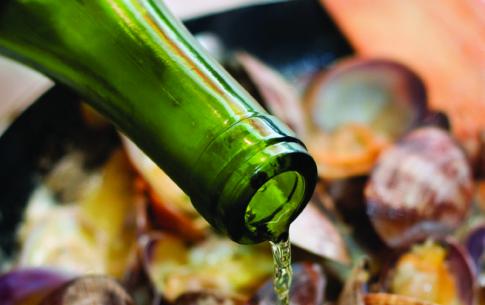
Tasting goose barnacles for the first time is quite an experience, as the super intense flavour of the sea bursts on your tongue. Then, of course, you next mouthful has to be from a chilled glass of albariño. Perfect.Goose barnaclesPercebes, or goose barnacles are a highly sought-after local delicacy, perhaps at the very pinnacle of Galicia’s wide selection of crustaceans, molluscs and other seafoods. The name ‘goose barnacle’ (or sometimes gooseneck barnacle) is surrounded by many a curious tale. Quite obviously they are named after the barnacle goose, as their shape and colour was thought to resemble the head of this Arctic/North Atlantic bird. As these birds were not native to the UK, and no one had ever seen their nest, it was originally believed that the goose was actually spawned from the barnacles and actually grew on the hull of the old wooden ships! The church was delighted to decree that because this particular species of goose was not born out of flesh, but of the sea, that they could not only be eaten on Fridays, but also throughout the period of Lent. A convenient truth?

If you have no idea as to how difficult (and dangerous) it is to find percebes, then this link is a very good illustration, as celebrity chef Gordon Ramsay risks life and limb, absailing down a sheer cliff face in Galicia in an attempt to harvest a mere handful of these tasty treats. It is in the shadow of these cliffs and rocky outcrops where the roaring surf crashes in, that the largest and fattest percebes (the ones that bring in the most money), will develop. The fishermen can make up to €300 per kilo at auction, and, with luck, they can earn €1,000 in a day. But the stakes they play for are high; this is a dangerous way to make a living – on average five people per year will lose their lives gathering these rare, but delicious delicacies. Unlike their near neighbours, the mussels, these crustaceans have resisted all attempts to be bred in a controlled environment. Scientists suspect that they need the tides and crashing waves to survive, which of course, serves only to make them even more expensive.

Tasting goose barnacles for the first time is quite an experience, as the super intense flavour of the sea bursts on your tongue. Then, of course, you next mouthful has to be from a chilled glass of albariño. Perfect.

Food fiestas…. Oh dear!

August 26th, 2015 | Fiestas

Delicious worms!The months of July and August are probably ‘peak’ fiesta season here in Galicia (and around Spain) – there are fireworks and rockets exploding nearly every night around around our home. (This is perhaps the moment to mention that I am always just a bit shocked when I see the men setting off these huge, exploding rockets…. launching them from their hands! Not something that is recommended to try at home).

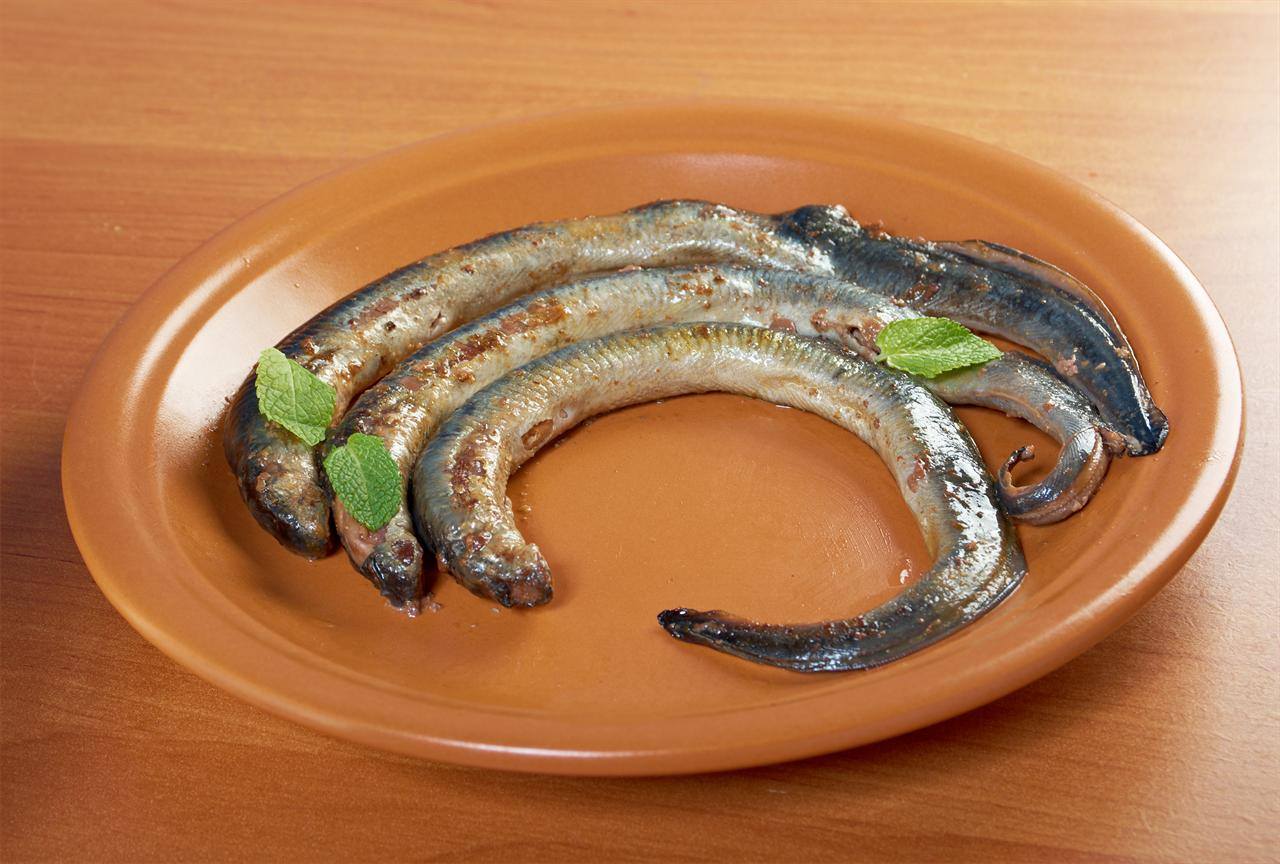
I have written on many previous occasions about food fiestas, not because I don’t think they’re a great idea, but mostly because of the way that they are publicised. Of course, these local fiestas need to be supported and encouraged, as I have no doubt whatsoever that a huge amount of work goes into organising them. I do feel however, that all the effort is not necessarily augmented by the advertising, and the latest example of this is for a celebration starting tomorrow in the municipio de Valga – the Eel and Aguardiente festival. Unfortunately, once again, the photo that they have chosen to publicise the event is possibly not the most attractive or mouth watering…..

Now I’m sure that the eels are actually quite delicious, but what is it they say? It’s all in the presentation, and that we also ‘eat with our eyes’, but to be brutally honest if I was undecided as to where to spend my day out, I wouldn’t necessarily be attracted by this publicity shot. I think that they look like large grey worms, or is that just me?Delicious worms!The months of July and August are probably ‘peak’ fiesta season here in Galicia (and around Spain) – there are fireworks and rockets exploding nearly every night around around our home. (This is perhaps the moment to mention that I am always just a bit shocked when I see the men setting off these huge, exploding rockets…. launching them from their hands! Not something that is recommended to try at home).

I have written on many previous occasions about food fiestas, not because I don’t think they’re a great idea, but mostly because of the way that they are publicised. Of course, these local fiestas need to be supported and encouraged, as I have no doubt whatsoever that a huge amount of work goes into organising them. I do feel however, that all the effort is not necessarily augmented by the advertising, and the latest example of this is for a celebration starting tomorrow in the municipio de Valga – the Eel and Aguardiente festival. Unfortunately, once again, the photo that they have chosen to publicise the event is possibly not the most attractive or mouth watering…..

Now I’m sure that the eels are actually quite delicious, but what is it they say? It’s all in the presentation, and that we also ‘eat with our eyes’, but to be brutally honest if I was undecided as to where to spend my day out, I wouldn’t necessarily be attracted by this publicity shot. I think that they look like large grey worms, or is that just me?

You can’t judge a wine by it’s colour!

August 5th, 2015 | Food & Wine

Blue wineI have just read a very interesting article about the importance of colour in food production. For example, the hue of orange juice is carefully measured, and in the United States there is even a juice colour standard for producers (or should that be color?). In terms of colour standards it would appear that fruit and vegetables are at the top of our list, and I’m sure that it’s true to say that our purchasing choices are often dictated by what we see – those bright red strawberries, vibrant orange carrots or perhaps that head of vivid green broccoli. If the colours were slightly washed out, or perhaps even completely wrong, would we then still buy the goods? For instance, I think I am correct in saying that when carrots were first introduced they were not orange, but white, and that they still exist in colours such as red, purple or yellow. But would we buy a yellow carrot? I’m not so sure. Now, this fact leads me fact leads me quite neatly to the real point of my post….. Does the colour change your perception of taste?

Tests carried out seem to suggest that it does. It appears that a type of ‘taste expectation’ from what we see, can actually determine what we perceive in our mouth. For example, in a taste test, when a lime-flavored drink was coloured orange, nearly half of participants thought it was flavoured orange, and when blindfold, hardly any identified the taste at all! But then it appears that colour can actually play an even bigger role when we change either the presentation or even the receptacle used. Respondents said that strawberry mousse tasted better from a white round plate than it did from a black square one, and that coffee in a white mug tasted less sweet than in a transparent or blue mug! The hypothesis goes further, whereby even the strength or hue of lighting can have an influence on taste…..

So how does this concept extend to wine? If you add red colouring to a white wine, will it taste different? Or if you can’t see it at all, will you even be able to determine if it’s red or white? I would certainly like to think that I could tell, but I’m sure that there still exists an opportunity for confusion. We certainly have a tendency to prejudge a wine by what we see. When seeing a white wine with a very deep colour or orange hue, we might immediately start to imagine that it could be either sweet, or perhaps oxidised, even before we have got it anywhere near our nose or mouth. Colouring our taste expectation you might call it.

Of course we would normally drink wine from a white clear glass, as the first, visual phase of the tasting process is extremely important, but imagine if the wine glass was opaque, or perhaps even coloured, how much would that influence what you taste? Certainly food (or wine) for thought.Blue wineI have just read a very interesting article about the importance of colour in food production. For example, the hue of orange juice is carefully measured, and in the United States there is even a juice colour standard for producers (or should that be color?). In terms of colour standards it would appear that fruit and vegetables are at the top of our list, and I’m sure that it’s true to say that our purchasing choices are often dictated by what we see – those bright red strawberries, vibrant orange carrots or perhaps that head of vivid green broccoli. If the colours were slightly washed out, or perhaps even completely wrong, would we then still buy the goods? For instance, I think I am correct in saying that when carrots were first introduced they were not orange, but white, and that they still exist in colours such as red, purple or yellow. But would we buy a yellow carrot? I’m not so sure. Now, this fact leads me fact leads me quite neatly to the real point of my post….. Does the colour change your perception of taste?

Tests carried out seem to suggest that it does. It appears that a type of ‘taste expectation’ from what we see, can actually determine what we perceive in our mouth. For example, in a taste test, when a lime-flavored drink was coloured orange, nearly half of participants thought it was flavoured orange, and when blindfold, hardly any identified the taste at all! But then it appears that colour can actually play an even bigger role when we change either the presentation or even the receptacle used. Respondents said that strawberry mousse tasted better from a white round plate than it did from a black square one, and that coffee in a white mug tasted less sweet than in a transparent or blue mug! The hypothesis goes further, whereby even the strength or hue of lighting can have an influence on taste…..

So how does this concept extend to wine? If you add red colouring to a white wine, will it taste different? Or if you can’t see it at all, will you even be able to determine if it’s red or white? I would certainly like to think that I could tell, but I’m sure that there still exists an opportunity for confusion. We certainly have a tendency to prejudge a wine by what we see. When seeing a white wine with a very deep colour or orange hue, we might immediately start to imagine that it could be either sweet, or perhaps oxidised, even before we have got it anywhere near our nose or mouth. Colouring our taste expectation you might call it.

Of course we would normally drink wine from a white clear glass, as the first, visual phase of the tasting process is extremely important, but imagine if the wine glass was opaque, or perhaps even coloured, how much would that influence what you taste? Certainly food (or wine) for thought.

Come to Galicia…. for a taste of India!?

July 11th, 2015 | Fiestas

Ribadeo IndianOK, I know that I sometimes poke fun at the local fiestas, under the banner of “any excuse to celebrate”, but even I was a bit puzzled by the latest – the Ribadeo Festival of India. Perhaps all the ideas for fiestas have finally been used up – chicken, sardine, cocido and even the odd Oktoberfest, but India? As far as I’m aware many Spanish people don’t even like very spicy food! For example, there have been several Indian restaurants popping up locally in recent years, but then they have all disappeared, almost as quickly as they arrived.

I’m actually quite a big curry fan, and regularly make them for myself during the winter months. I say for myself, because although Angela loves the smell, she finds even my very ‘mild’ versions too hot to digest. I’m afraid I’m just the opposite, I make Madras and Vindaloo in my kitchen, albeit that neither of these two styles originate from India! Madras style is actually a restaurant invention (like the infamous tikka masala), and is really just a hotter version of a standard curry. Vindaloo is a dish of Portuguese origin, which over time was spiced up by the people of the ex-Portuguese colony of Goa. It’s name originates from the two main ingredients which were “vinho”, wine/wine vinegar, and “alhos”, garlic.

I doubt very much if the Spanish will be inventing curry dishes any time soon, although this latest Indian Festival could be a step in the right direction.Ribadeo IndianOK, I know that I sometimes poke fun at the local fiestas, under the banner of “any excuse to celebrate”, but even I was a bit puzzled by the latest – the Ribadeo Festival of India. Perhaps all the ideas for fiestas have finally been used up – chicken, sardine, cocido and even the odd Oktoberfest, but India? As far as I’m aware many Spanish people don’t even like very spicy food! For example, there have been several Indian restaurants popping up locally in recent years, but then they have all disappeared, almost as quickly as they arrived.

I’m actually quite a big curry fan, and regularly make them for myself during the winter months. I say for myself, because although Angela loves the smell, she finds even my very ‘mild’ versions too hot to digest. I’m afraid I’m just the opposite, I make Madras and Vindaloo in my kitchen, albeit that neither of these two styles originate from India! Madras style is actually a restaurant invention (like the infamous tikka masala), and is really just a hotter version of a standard curry. Vindaloo is a dish of Portuguese origin, which over time was spiced up by the people of the ex-Portuguese colony of Goa. It’s name originates from the two main ingredients which were “vinho”, wine/wine vinegar, and “alhos”, garlic.

I doubt very much if the Spanish will be inventing curry dishes any time soon, although this latest Indian Festival could be a step in the right direction.

National Burger Month

May 21st, 2015 | Fiestas

Burger MonthHere in Galicia (and Spain) we have more than our fair share of food festivals – any excuse for celebrating food is embraced with great enthusiasm, from the more basic products, such as tomato, cheese, sausage, or chicken, through to some slightly more elaborate dishes such as our local cocido. Of course in Galicia many of the festivals are centered around fish and seafood, but generally speaking, if it can be cooked or eaten, then it will be celebrated!

Meanwhile, on the other side of the Atlantic, they also have festivals for the appreciation of food. For example, this month is National Burger Month, and the good news is that I will be in the States next week to sample one or two. Now, I know that this might make me sound like a heathen, so I have to qualify this by saying that I’m not talking about Burger King or McDonalds – I’m talking about real, honest to goodness, quality beef! I have to admit that I have a craving, and please allow me to explain why….. The ‘red’ meat that is most commonly found here is called ternera, and it is not beef as I know it, but actually a cross between beef and veal. When cooked it always looks slightly anemic, and not entirely appetising. Real red meat here is known as buey, but this is not always available, it is only carried by certain shops and restaurants, and believe me I have found every one of them!

Suffice to say that next week I might be on a high protein diet.Burger MonthHere in Galicia (and Spain) we have more than our fair share of food festivals – any excuse for celebrating food is embraced with great enthusiasm, from the more basic products, such as tomato, cheese, sausage, or chicken, through to some slightly more elaborate dishes such as our local cocido. Of course in Galicia many of the festivals are centered around fish and seafood, but generally speaking, if it can be cooked or eaten, then it will be celebrated!

Meanwhile, on the other side of the Atlantic, they also have festivals for the appreciation of food. For example, this month is National Burger Month, and the good news is that I will be in the States next week to sample one or two. Now, I know that this might make me sound like a heathen, so I have to qualify this by saying that I’m not talking about Burger King or McDonalds – I’m talking about real, honest to goodness, quality beef! I have to admit that I have a craving, and please allow me to explain why….. The ‘red’ meat that is most commonly found here is called ternera, and it is not beef as I know it, but actually a cross between beef and veal. When cooked it always looks slightly anemic, and not entirely appetising. Real red meat here is known as buey, but this is not always available, it is only carried by certain shops and restaurants, and believe me I have found every one of them!

Suffice to say that next week I might be on a high protein diet.

May 4th… be with you

May 4th, 2015 | Food & Wine

Albariño + MeatToday is May the Fourth, which, as you may know, holds a special significance for Star Wars fans – indeed one UK TV channel is running a Star Wars marathon, showing every film ever made, back-to-back. And so, if you still don’t understand the significance of today’s date, then please don’t expect me to explain it any further.

However, the real reason that I wanted to make today’s post was simply to include an image of the second of our new Denomination campaign adverts. As I said last week, I think they look great, and certainly represent an improvement as to how we might be perceived out there in the big wide world of wine. Good work boys (and girls)!Albariño + MeatToday is May the Fourth, which, as you may know, holds a special significance for Star Wars fans – indeed one UK TV channel is running a Star Wars marathon, showing every film ever made, back-to-back. And so, if you still don’t understand the significance of today’s date, then please don’t expect me to explain it any further.

However, the real reason that I wanted to make today’s post was simply to include an image of the second of our new Denomination campaign adverts. As I said last week, I think they look great, and certainly represent an improvement as to how we might be perceived out there in the big wide world of wine. Good work boys (and girls)!

Spanish crumble? Whatever next?

April 30th, 2015 | Food & Wine

Spanish crumbleOne of the great old traditions of British cooking are the puddings, or desserts as they are more commonly called these days. For me there’s something quite emotive about these old recipes, transporting me back to my school days, when pudding was one of the highlights of an otherwise bland school menu. The only positive about school food in those days, is that the diet was constructed around a culture of ‘meat and two veg’ (and/or potatoes), but without any fried food whatsoever, and not a greasy chip in sight. Perhaps unwittingly much healthier than some of the ‘fast food’ dishes offered by schools these days – this type of convenience food was simply not an option, and the only menu choice was take it or leave it!

The puddings were great (possibly because I have a ‘sweet tooth’), and included many an old favourite, such as jam roly-poly, apple crumble, baked custard tart, rice pudding, chocolate sponge and many others. Included within that list you will notice a quintessentially British and very traditional dish – crumble. Crumble can be made with any number of different fruits: apple, rhubarb, peach, pear, gooseberry, apricot or any number of different berry fruits – the possibilities are almost endless, and suffice to say that they are all delicious when made correctly.

I am not sure of the exact origin of the crumble, but I do know that they became very popular during the Second World War when there was food rationing in the UK. Cooks were obliged to economise and cut corners wherever they could, and the simple crumble topping of fat, flour and sugar was apparently easier to ‘eek out’ than the more usual pastry topping.

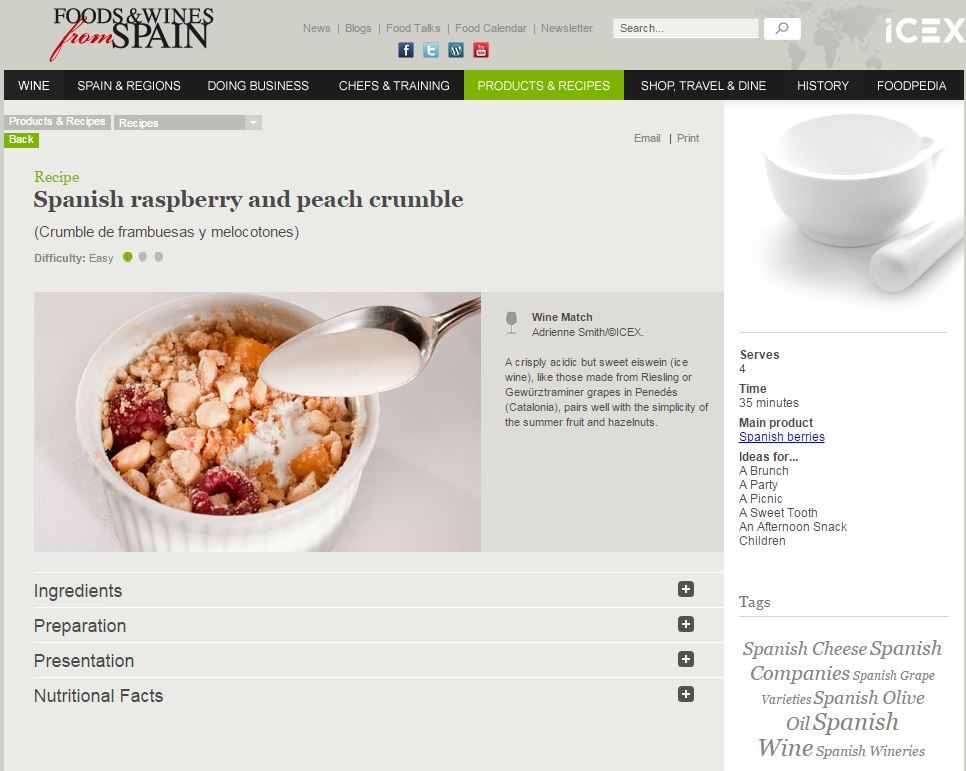
I think I read recently that crumbles are actually enjoying something of a renaissance, and springing up on many a fashionable restaurant menu. Having said that, I was still quite surprised to find a crumble recipe featured in a recent mailing from ICEX – Food & Wines from Spain –  crumble de frambuesas y melocotones. The wine recommended by ICEX was either riesling or gewürztraminer, which could work (although they would probably require a degree of residual sugar) – I’m afraid to admit that our own albariño is far too dry for this hearty British pudding.Spanish crumbleOne of the great old traditions of British cooking are the puddings, or desserts as they are more commonly called these days. For me there’s something quite emotive about these old recipes, transporting me back to my school days, when pudding was one of the highlights of an otherwise bland school menu. The only positive about school food in those days, is that the diet was constructed around a culture of ‘meat and two veg’ (and/or potatoes), but without any fried food whatsoever, and not a greasy chip in sight. Perhaps unwittingly much healthier than some of the ‘fast food’ dishes offered by schools these days – this type of convenience food was simply not an option, and the only menu choice was take it or leave it!

The puddings were great (possibly because I have a ‘sweet tooth’), and included many an old favourite, such as jam roly-poly, apple crumble, baked custard tart, rice pudding, chocolate sponge and many others. Included within that list you will notice a quintessentially British and very traditional dish – crumble. Crumble can be made with any number of different fruits: apple, rhubarb, peach, pear, gooseberry, apricot or any number of different berry fruits – the possibilities are almost endless, and suffice to say that they are all delicious when made correctly.

I am not sure of the exact origin of the crumble, but I do know that they became very popular during the Second World War when there was food rationing in the UK. Cooks were obliged to economise and cut corners wherever they could, and the simple crumble topping of fat, flour and sugar was apparently easier to ‘eek out’ than the more usual pastry topping.

I think I read recently that crumbles are actually enjoying something of a renaissance, and springing up on many a fashionable restaurant menu. Having said that, I was still quite surprised to find a crumble recipe featured in a recent mailing from ICEX – Food & Wines from Spain –  crumble de frambuesas y melocotones. The wine recommended by ICEX was either riesling or gewürztraminer, which could work (although they would probably require a degree of residual sugar) – I’m afraid to admit that our own albariño is far too dry for this hearty British pudding.

Oysters & Albariño

February 14th, 2015 | Food & Wine

Valentines testI often write about the conflicting/contradictory ideas that we are given about the rights and wrongs of consuming different types of food and alcohol. (I recently mentioned a claim that drinking a bottle of wine a day won’t do you any harm). So what about aphrodisiacs? Today being St Valentines, I thought I might find at least one excuse to mention albariño, and I think I’ve found at least one…. oysters.

Whilst it’s true that certain compounds attributed to sexual arousal do exist in some foods, the problem is that, generally speaking, the concentrations are so low that it’s unlikely that they would ever reach the brain, where the stimulation takes place.

However, it is widely accepted that oysters have at least some aphrodisiac qualities (albeit I am not exactly sure how many you would have to eat), but the one thing that I can tell you, hand on heart, is that they really do make the perfect pairing to a refreshing, chilled glass of albariño. (Possibly one of the best matches that there is). So tonight, if your menu includes a plate of fresh oysters, then there truly is only one wine that you can drink…. Castro Martin albariño!Valentines testI often write about the conflicting/contradictory ideas that we are given about the rights and wrongs of consuming different types of food and alcohol. (I recently mentioned a claim that drinking a bottle of wine a day won’t do you any harm). So what about aphrodisiacs? Today being St Valentines, I thought I might find at least one excuse to mention albariño, and I think I’ve found at least one…. oysters.

Whilst it’s true that certain compounds attributed to sexual arousal do exist in some foods, the problem is that, generally speaking, the concentrations are so low that it’s unlikely that they would ever reach the brain, where the stimulation takes place.

However, it is widely accepted that oysters have at least some aphrodisiac qualities (albeit I am not exactly sure how many you would have to eat), but the one thing that I can tell you, hand on heart, is that they really do make the perfect pairing to a refreshing, chilled glass of albariño. (Possibly one of the best matches that there is). So tonight, if your menu includes a plate of fresh oysters, then there truly is only one wine that you can drink…. Castro Martin albariño!

Groundhog day….. again!

February 4th, 2015 | Fiestas

Cocido in LalinGroundhog day was actually two days ago, when Punxsutawney Phil saw his shadow and predicted six weeks more of winter, but that’s another story. Most of us remember Groundhog Day because of the well-known Bill Murray film, finding himself trapped, living the same day over and over again. Today’s subject is not exactly a daily recurrence, but actually an annual event that I have written about at least once before….. the Cocido Festival!

Cocido is a type of local stew or casserole made by cooking various types of meat and vegetables in stock – in many ways similar to the French ‘Pot au Feu’ (except using different meats). Usually a traditional Galician cocido would be made from a selection of salt pork cuts, including the head, ears or tail, together with pieces of cock or chicken. Chorizo and pork belly or bacon, are also added. The selection of vegetables includes potato (a food staple of the Galician diet), grelos, which are actually the leaves of turnips (although cabbage can be used as an alternative to this), and finally garbanzos, or chickpeas to you and me.

OK, so it’s not for me to judge whether Cocido is good or bad, as with everything, it’s all a matter of personal taste. As always, my only problem is with the publicity shot that they have used to advertise the Festival (todays’ photo). For the undecided, or uninitiated I don’t believe that you would be particularly attracted to Cocido by the picture that they have chosen….. but then that’s just my own point of view.

Cocido in LalinGroundhog day was actually two days ago, when Punxsutawney Phil saw his shadow and predicted six weeks more of winter, but that’s another story. Most of us remember Groundhog Day because of the well-known Bill Murray film, finding himself trapped, living the same day over and over again. Today’s subject is not exactly a daily recurrence, but actually an annual event that I have written about at least once before….. the Cocido Festival!

Cocido is a type of local stew or casserole made by cooking various types of meat and vegetables in stock – in many ways similar to the French ‘Pot au Feu’ (except using different meats). Usually a traditional Galician cocido would be made from a selection of salt pork cuts, including the head, ears or tail, together with pieces of cock or chicken. Chorizo and pork belly or bacon, are also added. The selection of vegetables includes potato (a food staple of the Galician diet), grelos, which are actually the leaves of turnips (although cabbage can be used as an alternative to this), and finally garbanzos, or chickpeas to you and me.

OK, so it’s not for me to judge whether Cocido is good or bad, as with everything, it’s all a matter of personal taste. As always, my only problem is with the publicity shot that they have used to advertise the Festival (todays’ photo). For the undecided, or uninitiated I don’t believe that you would be particularly attracted to Cocido by the picture that they have chosen….. but then that’s just my own point of view.

Turning wine into sauce

December 1st, 2014 | Food & Wine

cooking wineOne of my favourite pastimes is cooking, there’s something very satisfying (and therapeutic) about it. I do nearly all the cooking at home, including a lot of the traditional English dishes that I crave from time-to-time. Angela has now acquired a taste for one or two of these and sometimes even requests them….. Chicken and mushroom pie? No problem! In English cooking I will sometimes use an ale or stout when preparing meat or sauces, but usually the use of wine is reserved for ‘continental style’ dishes and sauces. After all, until recently, the UK was not considered as a serious wine producing country, which is probably the reason that it was never considered as an ingredient in traditional English cooking. However, as cooking around the world becomes more eclectic and fusions of different styles become more common, the use of wine in preparing sauces is now considered quite normal. 

I saw an article the other day entitled ‘the art of turning wine into sauce’ – a statement that could possibly offend one or two top wine producers. The thought of having their precious libation slopped into a pan and boiled might be a bit upsetting to them. Of course, I doubt very much if any chef would be using a First Growth Bordeaux or Grand Cru Burgundy to prepare their Coq Au Vin, but it does beg the question, will using a better or more expensive wine result in a better sauce? Well, the answer is, to a certain extent, yes.

Now I’m not suggesting for one moment that you should use a very expensive wine for cooking, but rather that, if you use a very cheap and nasty wine then you will probably be able to detect this in the finished dish. Wine, after all, is used to add flavour or perhaps a bit of acidity, so the quality, to an extent, will be reflected….. but there is a limit. Not all the flavour in a wine will survive a good boiling, so don’t waste too much money on cooking wine – just make sure that it is at least drinkable before you add it. Finally, don’t forget to boil the wine for at least a few minutes after it is added to burn off the alcohol – the alcohol will not enhance flavour and might even leave a harsh or unpleasant taste.

cooking wineOne of my favourite pastimes is cooking, there’s something very satisfying (and therapeutic) about it. I do nearly all the cooking at home, including a lot of the traditional English dishes that I crave from time-to-time. Angela has now acquired a taste for one or two of these and sometimes even requests them….. Chicken and mushroom pie? No problem! In English cooking I will sometimes use an ale or stout when preparing meat or sauces, but usually the use of wine is reserved for ‘continental style’ dishes and sauces. After all, until recently, the UK was not considered as a serious wine producing country, which is probably the reason that it was never considered as an ingredient in traditional English cooking. However, as cooking around the world becomes more eclectic and fusions of different styles become more common, the use of wine in preparing sauces is now considered quite normal. 

I saw an article the other day entitled ‘the art of turning wine into sauce’ – a statement that could possibly offend one or two top wine producers. The thought of having their precious libation slopped into a pan and boiled might be a bit upsetting to them. Of course, I doubt very much if any chef would be using a First Growth Bordeaux or Grand Cru Burgundy to prepare their Coq Au Vin, but it does beg the question, will using a better or more expensive wine result in a better sauce? Well, the answer is, to a certain extent, yes.

Now I’m not suggesting for one moment that you should use a very expensive wine for cooking, but rather that, if you use a very cheap and nasty wine then you will probably be able to detect this in the finished dish. Wine, after all, is used to add flavour or perhaps a bit of acidity, so the quality, to an extent, will be reflected….. but there is a limit. Not all the flavour in a wine will survive a good boiling, so don’t waste too much money on cooking wine – just make sure that it is at least drinkable before you add it. Finally, don’t forget to boil the wine for at least a few minutes after it is added to burn off the alcohol – the alcohol will not enhance flavour and might even leave a harsh or unpleasant taste.

Monthly Archives

Categories

ARE YOU OF LEGAL AGE? This site is intended for those of legal drinking age. By entering, you confirm that you are of legal drinking age in the country where this site is being accessed. ¿ERES MAYOR DE EDAD? Este sitio está destinado a personas en edad legal para beber alcohol. Al ingresar, confirma que tiene la edad legal para beber en el país donde se accede a este sitio.