Archive for ‘Bodega’

On top of the world

July 13th, 2014 | Bodega

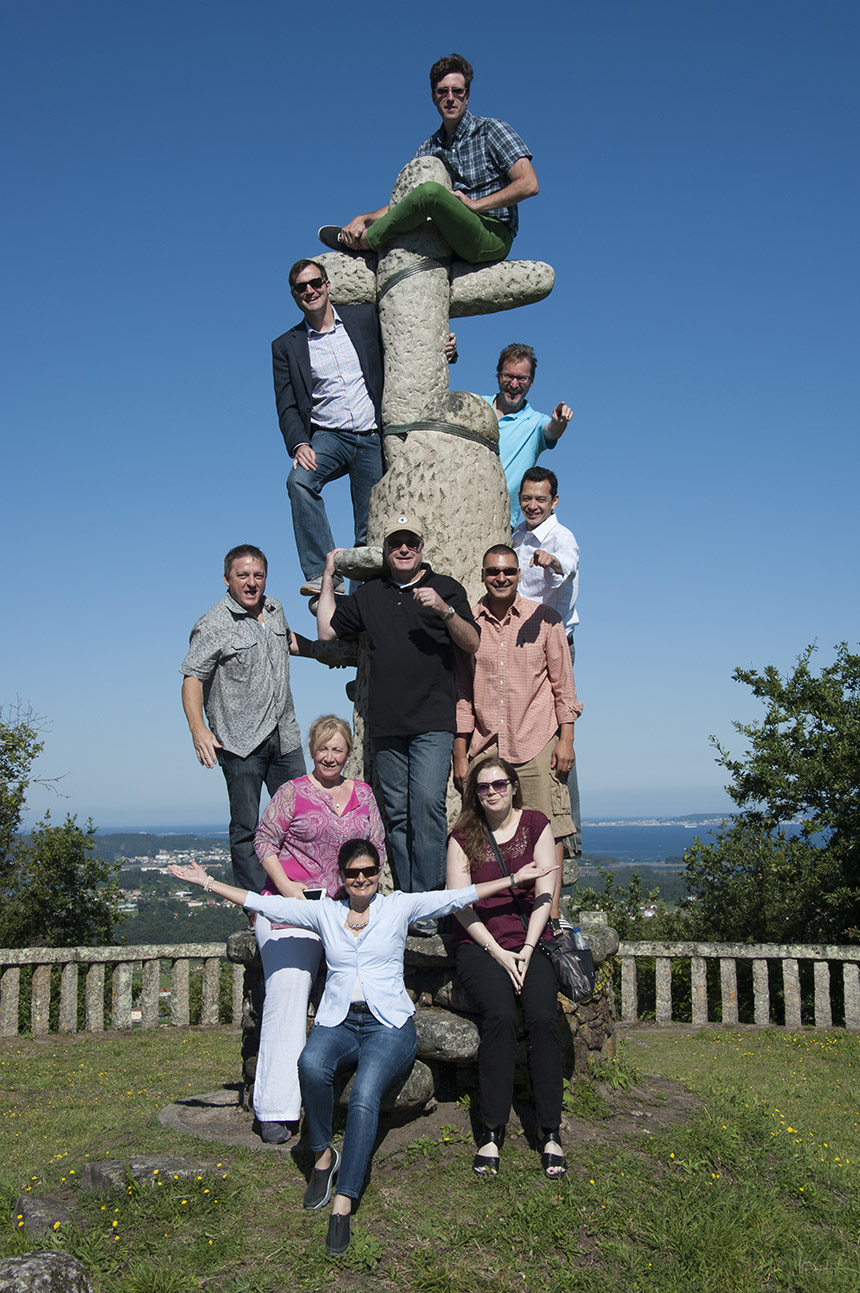
Top of the worldLast week was a busy week for visits – on Monday a small group comprised of some of the UK’s top wine journalists, followed later in the week by two days with a group from our U.S. importer (Frederick Wildman & Sons), and their distributors. Angela and I are completely worn out and have decided that we should create ‘virtual visits’ to use in future if only to save our vocal chords. Actually, that wouldn’t work at all – you really have to visit the region to discover it’s true beauty, especially when the sun shines, as it did for us this week.

Apart from the usual tastings and tour of the bodega and vineyards we took our American friends up a hill….. to the Mirador of San Cibrán – a viewing point that overlooks almost the entire Salnés Valley (where our Bodega is located). I think that the panorama is probably greater than 18o° and on a clear day is really quite breathtaking (even to those who were visiting from New York City). Quite a different skyline, but providing a great photo opportunity just the same.

Top of the worldLast week was a busy week for visits – on Monday a small group comprised of some of the UK’s top wine journalists, followed later in the week by two days with a group from our U.S. importer (Frederick Wildman & Sons), and their distributors. Angela and I are completely worn out and have decided that we should create ‘virtual visits’ to use in future if only to save our vocal chords. Actually, that wouldn’t work at all – you really have to visit the region to discover it’s true beauty, especially when the sun shines, as it did for us this week.

Apart from the usual tastings and tour of the bodega and vineyards we took our American friends up a hill….. to the Mirador of San Cibrán – a viewing point that overlooks almost the entire Salnés Valley (where our Bodega is located). I think that the panorama is probably greater than 18o° and on a clear day is really quite breathtaking (even to those who were visiting from New York City). Quite a different skyline, but providing a great photo opportunity just the same.

Controlled parking

June 23rd, 2014 | Bodega

Car ParkIn the years that I have had my car, the only damage that I have ever suffered has been caused by other people…… whilst my car has been parked! And, of course, not one person has come forward to admit any sort of liability. Door dinks, bumps and a couple of scratches, all from car parks.

At Castro Martin we are quite fortunate that when Angela’s father built the Bodega over 30 years ago, he had the foresight to include a loading area for trucks, and also a generous area for parking. Until now this was simply an open area of concrete, and parking was simply a free-for-all – you parked your car where you could squeeze it in (and with Angela around, that was never going to be the best arrangement – for vehicle safety purposes). Suffice to say that she has a bit of a reputation for bumping into things, and suffers horribly from walls and posts that have a habit of reversing out in front of her!

Anyway, after painting an exterior wall the other day, we had a bit of white paint left over, and decided to paint some ‘official’ parking bays. We have made sure that each space is very generous so that even Angela has no excuse for causing any door dinks!!

Car ParkIn the years that I have had my car, the only damage that I have ever suffered has been caused by other people…… whilst my car has been parked! And, of course, not one person has come forward to admit any sort of liability. Door dinks, bumps and a couple of scratches, all from car parks.

At Castro Martin we are quite fortunate that when Angela’s father built the Bodega over 30 years ago, he had the foresight to include a loading area for trucks, and also a generous area for parking. Until now this was simply an open area of concrete, and parking was simply a free-for-all – you parked your car where you could squeeze it in (and with Angela around, that was never going to be the best arrangement – for vehicle safety purposes). Suffice to say that she has a bit of a reputation for bumping into things, and suffers horribly from walls and posts that have a habit of reversing out in front of her!

Anyway, after painting an exterior wall the other day, we had a bit of white paint left over, and decided to paint some ‘official’ parking bays. We have made sure that each space is very generous so that even Angela has no excuse for causing any door dinks!!

Summer starts here

June 3rd, 2014 | Bodega

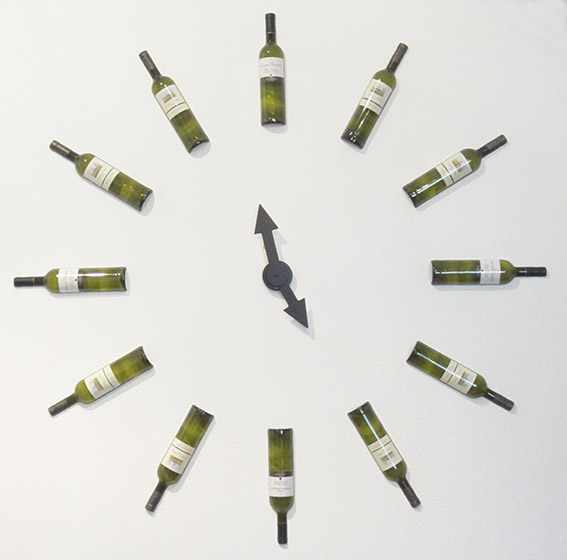
ClockThis week signals our move to a summer timetable – working from 8am to 4pm, instead of the 9am to 5pm that we work in winter. Of course we are at the extreme western edge of Europe, which means that the sun rises just a little later, but on the plus side we do enjoy very long, light summer evenings (now all we need is a bit of sunshine!) However, the real reason for starting a little earlier is based around the summer heat. Clearly, we do not suffer the extreme temperatures that they do in other parts of the country, but it does at least mean that we are able to complete much of our working day in the vineyards before the mercury hits its late afternoon peak. (Note that during periods of excessive heat our vineyard guys do start at 7am).

I should also say that our bodega is fairly unique in that our working day is not split in two – as practised by many other industries around Spain. The tradition is normally to have a break of some two or three hours in the middle of the day, but for many different reasons (not least of all efficiency), we actively chose not to follow this practice.

ClockThis week signals our move to a summer timetable – working from 8am to 4pm, instead of the 9am to 5pm that we work in winter. Of course we are at the extreme western edge of Europe, which means that the sun rises just a little later, but on the plus side we do enjoy very long, light summer evenings (now all we need is a bit of sunshine!) However, the real reason for starting a little earlier is based around the summer heat. Clearly, we do not suffer the extreme temperatures that they do in other parts of the country, but it does at least mean that we are able to complete much of our working day in the vineyards before the mercury hits its late afternoon peak. (Note that during periods of excessive heat our vineyard guys do start at 7am).

I should also say that our bodega is fairly unique in that our working day is not split in two – as practised by many other industries around Spain. The tradition is normally to have a break of some two or three hours in the middle of the day, but for many different reasons (not least of all efficiency), we actively chose not to follow this practice.

Steam clean

May 19th, 2014 | Bodega

Steam cleanOne of the questions that we are most frequently asked about our wine making is whether we use any oak or not. My answer is always a most emphatic “NO”. When it comes to wine, and not just albariño, at Castro Martin we always want to be known as purists – our ultimate goal is quite simply to make a wine that is an honest expression of our grape variety, untainted by flavours of yeast, oak or any other additive for that matter.

Having said all that, I can sometimes understand why people might ask….. a young albariño is always fresh, clean, zesty with a lovely concentration of intense, focused fruit, but then, with a little extended ageing, all that can change. After a year or two in bottle, quite naturally, the wine will start to evolve (this is not to be confused with oxidation, which is something completely different). Older albariño can start to develop secondary aromas and flavours that are perhaps more usually associated with oak aged or barrel fermented wines – it can develop a slightly ‘honeyed’ sweetness, with just a touch of toffee or caramel. Altogether quite different from its original, widely known style. In some ways it’s a bit of a shame that consumers really only know our wine in its young, zesty form, and normally don’t get to experience its older alter ego (unless they find a forgotten bottle at the bottom of their wine cupboard). When stored correctly an older, well-made albariño can actually become quite an interesting wine. 

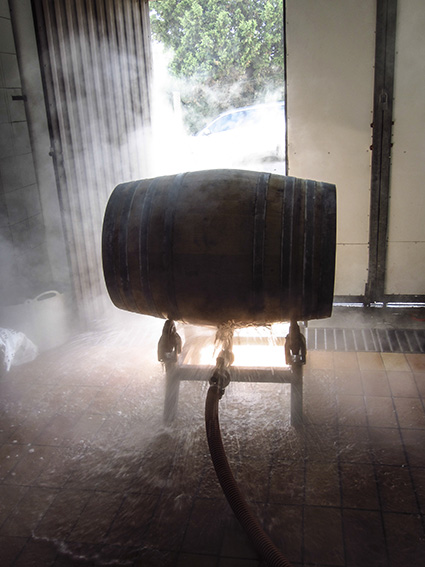
So why does today’s photo show a barrel being steam cleaned in our bodega, you may ask? OK, so I’ll admit it, we do make a very small amount of barrel aged (not fermented) albariño for a very specific customer. Not necessarily my own personal taste, but if there’s a niche market for this wine, then why not? I should add that we can only oak age wine in certain vintages, when the wine has sufficient body and weight to support the oak. If the vintage is not suitable you may just end up with a glass of oak and acidity – altogether unpleasant.

Steam cleanOne of the questions that we are most frequently asked about our wine making is whether we use any oak or not. My answer is always a most emphatic “NO”. When it comes to wine, and not just albariño, at Castro Martin we always want to be known as purists – our ultimate goal is quite simply to make a wine that is an honest expression of our grape variety, untainted by flavours of yeast, oak or any other additive for that matter.

Having said all that, I can sometimes understand why people might ask….. a young albariño is always fresh, clean, zesty with a lovely concentration of intense, focused fruit, but then, with a little extended ageing, all that can change. After a year or two in bottle, quite naturally, the wine will start to evolve (this is not to be confused with oxidation, which is something completely different). Older albariño can start to develop secondary aromas and flavours that are perhaps more usually associated with oak aged or barrel fermented wines – it can develop a slightly ‘honeyed’ sweetness, with just a touch of toffee or caramel. Altogether quite different from its original, widely known style. In some ways it’s a bit of a shame that consumers really only know our wine in its young, zesty form, and normally don’t get to experience its older alter ego (unless they find a forgotten bottle at the bottom of their wine cupboard). When stored correctly an older, well-made albariño can actually become quite an interesting wine. 

So why does today’s photo show a barrel being steam cleaned in our bodega, you may ask? OK, so I’ll admit it, we do make a very small amount of barrel aged (not fermented) albariño for a very specific customer. Not necessarily my own personal taste, but if there’s a niche market for this wine, then why not? I should add that we can only oak age wine in certain vintages, when the wine has sufficient body and weight to support the oak. If the vintage is not suitable you may just end up with a glass of oak and acidity – altogether unpleasant.

Rack around the clock

May 15th, 2014 | Bodega

LeesSince the end of the alcoholic fermentation our wines have been sitting quietly, in tank, on their lees. Just in case you don’t know, lees are the exhausted yeast cells that fall to the bottom of the tank at the end of fermentation when their job is done, and the sugar is converted into alcohol. Despite the fact that they are dead, they still contain some nutrients that feed the wine, over time adding to the character, structure and complexity of the finished product. The problem is that the lees cannot simply be left in contact with the wine for an infinite amount of time, and deciding the optimum moment to remove them is best judged by simply tasting the tanks at regular intervals throughout the winter and early spring. It’s really a matter of experience and judgement. If for any reason the lees are not completely healthy, they will simply taint the wine, leaving unpleasant ‘off’ flavours – clearly not something that we want.

Our 2013 vintage has been ‘on the lees’ (sur lie in French or sobre lias in Spanish) for some seven months now, and so we have just embarked on a programme of racking the first few tanks. The process of racking is actually quite straight forward and involves pumping the wine to a clean tank, leaving the lees behind at the bottom of the original tank.

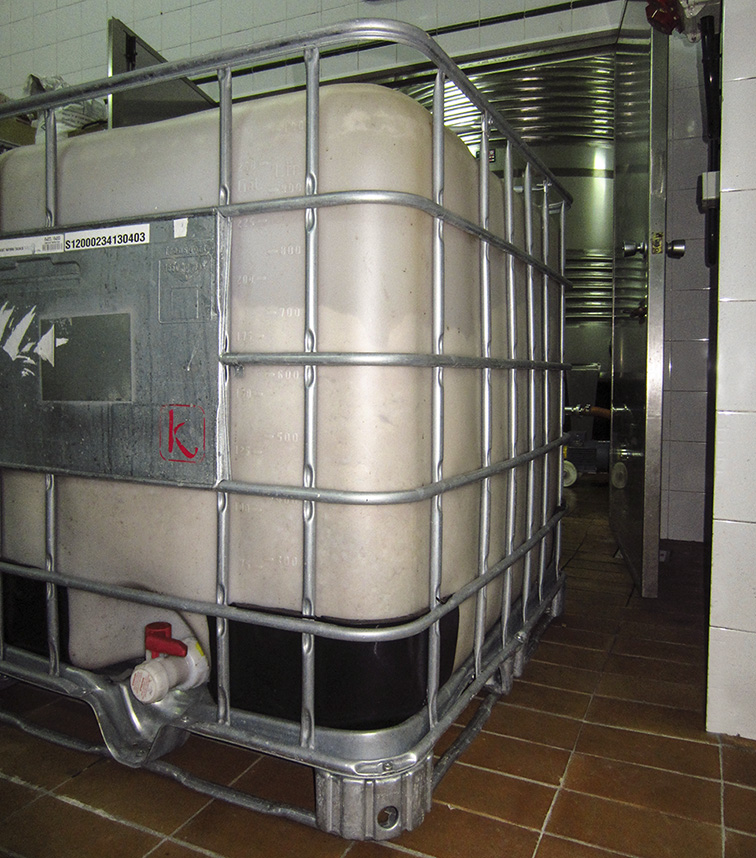
The law does not allow us to simply wash the redundant lees down the drain, quite naturally we are obliged to dispose of them responsibly. Indeed, they actually still have some value! This thick paste still contains wine, and so we actually collect it in large plastic tanks (see photo), ensuring that it is correctly sulphured, and sell it for a nominal amount to our local distillery. You may recall that we also sell our pomace (the residue of grape skins and stalks left after pressing) to our distillery, but they much prefer to buy lees….. and the reason? The answer is quite simple – the skins and stalks are not fermented and contain only grape juice, whereas the lees contain finished wine. This makes the distillation process a whole lot easier for them.

LeesSince the end of the alcoholic fermentation our wines have been sitting quietly, in tank, on their lees. Just in case you don’t know, lees are the exhausted yeast cells that fall to the bottom of the tank at the end of fermentation when their job is done, and the sugar is converted into alcohol. Despite the fact that they are dead, they still contain some nutrients that feed the wine, over time adding to the character, structure and complexity of the finished product. The problem is that the lees cannot simply be left in contact with the wine for an infinite amount of time, and deciding the optimum moment to remove them is best judged by simply tasting the tanks at regular intervals throughout the winter and early spring. It’s really a matter of experience and judgement. If for any reason the lees are not completely healthy, they will simply taint the wine, leaving unpleasant ‘off’ flavours – clearly not something that we want.

Our 2013 vintage has been ‘on the lees’ (sur lie in French or sobre lias in Spanish) for some seven months now, and so we have just embarked on a programme of racking the first few tanks. The process of racking is actually quite straight forward and involves pumping the wine to a clean tank, leaving the lees behind at the bottom of the original tank.

The law does not allow us to simply wash the redundant lees down the drain, quite naturally we are obliged to dispose of them responsibly. Indeed, they actually still have some value! This thick paste still contains wine, and so we actually collect it in large plastic tanks (see photo), ensuring that it is correctly sulphured, and sell it for a nominal amount to our local distillery. You may recall that we also sell our pomace (the residue of grape skins and stalks left after pressing) to our distillery, but they much prefer to buy lees….. and the reason? The answer is quite simple – the skins and stalks are not fermented and contain only grape juice, whereas the lees contain finished wine. This makes the distillation process a whole lot easier for them.

A coat of spring paint

April 23rd, 2014 | Bodega

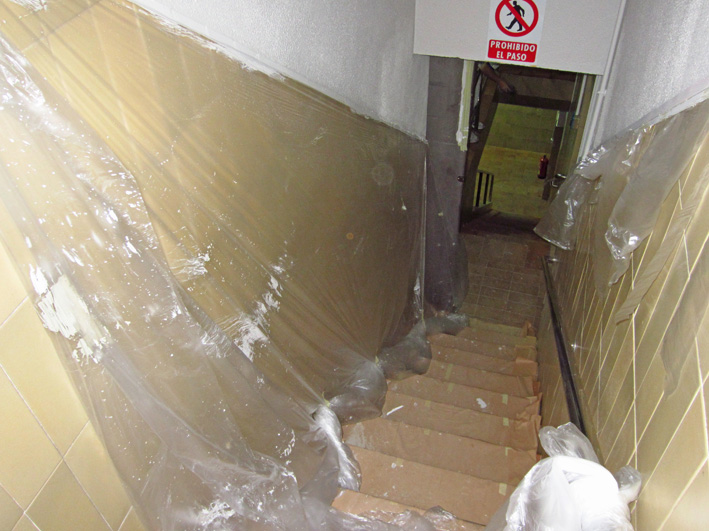
PaintingIt’s the time of year, when the days get a bit longer (and allegedly a bit brighter), that we start to think about the renewal and rejuvenation of the bodega. This year we couldn’t afford Bob the Builder, so we decided to call Pedro the Painter instead (that’s really his name)! Clearly we have to keep the bodega clean at all times, and more especially, after a very cool, damp winter we have to take preventative measures against the growth of mould. One of the most effective methods is simply to redecorate the walls using special mould resistant paints. Large areas of the cellar are actually tiled and so do not pose a problem, but there are still one or two areas that need the occasional lick of paint, and springtime presents us with the perfect opportunity.

Today we are painting the famous ’39 steps’ between the grape reception at the top of the bodega, and the tank room, two floors below (at ground level). I know each single step of this staircase very well, as it keeps me fit during the harvest when I make this climb several hundred times…. or at least, that’s how it feels. Hopefully everything will be finished in the next day or two, so that we have have a thorough, deep clean and return everything to normal in time for some spring bottling.

PaintingIt’s the time of year, when the days get a bit longer (and allegedly a bit brighter), that we start to think about the renewal and rejuvenation of the bodega. This year we couldn’t afford Bob the Builder, so we decided to call Pedro the Painter instead (that’s really his name)! Clearly we have to keep the bodega clean at all times, and more especially, after a very cool, damp winter we have to take preventative measures against the growth of mould. One of the most effective methods is simply to redecorate the walls using special mould resistant paints. Large areas of the cellar are actually tiled and so do not pose a problem, but there are still one or two areas that need the occasional lick of paint, and springtime presents us with the perfect opportunity.

Today we are painting the famous ’39 steps’ between the grape reception at the top of the bodega, and the tank room, two floors below (at ground level). I know each single step of this staircase very well, as it keeps me fit during the harvest when I make this climb several hundred times…. or at least, that’s how it feels. Hopefully everything will be finished in the next day or two, so that we have have a thorough, deep clean and return everything to normal in time for some spring bottling.

The last bottling (2013)

December 6th, 2013 | Bodega

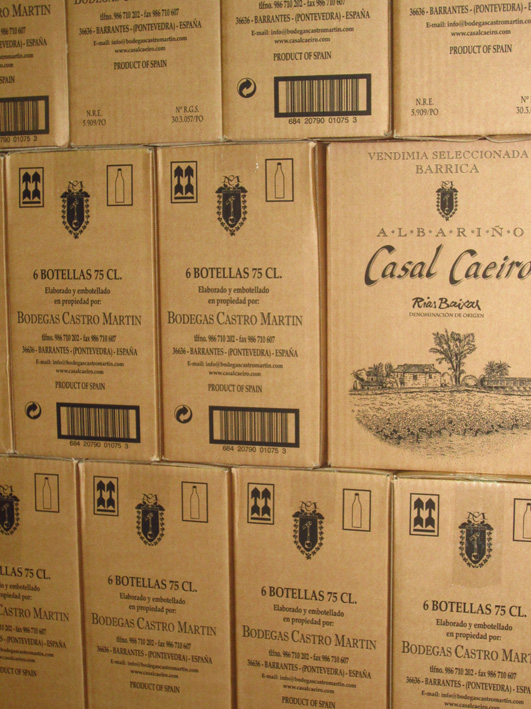
BarricaBy now the vast majority of our overseas orders for Christmas have long since left our cellars, leaving us to tackle the orders of our Spanish customers, plus a few others for the gift market. One of our best sellers at Christmas time is our Vendimia Seleccionada Barrica wine, which, owing to its extended barrel ageing, takes us several months to prepare.

Over recent weeks the orders for this wine have accelerated rapidly, and so we thought it prudent to bottle just a few barrels more (that sounds a bit like a movie title). I say ‘latest’, but the wine we are bottling is in fact from the 2010 vintage – a ripe, full and fruity wine that stands up well to the toasted vanillin of the French oak that we use. As a wine purist, I admit that I am not a great fan of mixing oak and albariño, but I have to say that this particular vintage works very well and the wine has pleasantly surprised many a sceptic (such as me)! I should add that we do not make this wine in every vintage, which is why we call it ‘vendimia seleccionada’, so once this 2010 is exhausted we will have to work out what the follow up vintage is going to be. It takes a certain style of wine to marry with the oak (and not be simply overpowered by it).

In an ideal world we would never send a recently bottled wine straight out to the customer,  and so today’s bottling is really intended more as an insurance, just in case the Christmas rush continues (and between you and me I hope it does!)

By the way, just in case you are curious, this wine is not actually fermented in oak, but merely aged in oak – fermented in stainless steel using the same vinification as our unoaked wines, and then passed through French oak as required. Just to put this into some sort of perspective, this is almost a ‘garagiste’ wine, as the annual production amounts to only a few thousand bottles.

This only leaves us with one question…… does it go with turkey? Well, to be very honest I haven’t tried it, but my best guess is that it would be just perfect!

BarricaBy now the vast majority of our overseas orders for Christmas have long since left our cellars, leaving us to tackle the orders of our Spanish customers, plus a few others for the gift market. One of our best sellers at Christmas time is our Vendimia Seleccionada Barrica wine, which, owing to its extended barrel ageing, takes us several months to prepare.

Over recent weeks the orders for this wine have accelerated rapidly, and so we thought it prudent to bottle just a few barrels more (that sounds a bit like a movie title). I say ‘latest’, but the wine we are bottling is in fact from the 2010 vintage – a ripe, full and fruity wine that stands up well to the toasted vanillin of the French oak that we use. As a wine purist, I admit that I am not a great fan of mixing oak and albariño, but I have to say that this particular vintage works very well and the wine has pleasantly surprised many a sceptic (such as me)! I should add that we do not make this wine in every vintage, which is why we call it ‘vendimia seleccionada’, so once this 2010 is exhausted we will have to work out what the follow up vintage is going to be. It takes a certain style of wine to marry with the oak (and not be simply overpowered by it).

In an ideal world we would never send a recently bottled wine straight out to the customer,  and so today’s bottling is really intended more as an insurance, just in case the Christmas rush continues (and between you and me I hope it does!)

By the way, just in case you are curious, this wine is not actually fermented in oak, but merely aged in oak – fermented in stainless steel using the same vinification as our unoaked wines, and then passed through French oak as required. Just to put this into some sort of perspective, this is almost a ‘garagiste’ wine, as the annual production amounts to only a few thousand bottles.

This only leaves us with one question…… does it go with turkey? Well, to be very honest I haven’t tried it, but my best guess is that it would be just perfect!

Library tasting

October 22nd, 2013 | Bodega

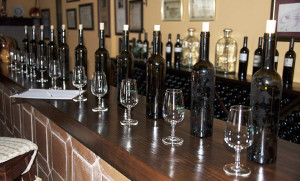
Library tasting2Today we have been working flat out on the wine making, but in the days before our 2013 harvest, whilst we were waiting for a suitable break in the horrible, wet weather, Angela and I decided to hold a private tasting…. and what an interesting tasting it proved to be! Each time we bottle a tank of our albariño we are obliged to send several sample bottles to our denomination office for tasting and analysis – once approved we get our tirilla (the small Rias Baixas sticker on the back of every bottle). At the same time we also send our own independent sample to our local, accredited laboratory, in order that we have two separate analyses to compare. Finally, during the bottling itself we also take random samples that we mark carefully and keep for reference (and also in case of any future problem). By the time all these samples have been taken it’s a wonder that there’s any wine left in the tank for our customers!

The range of these ‘reference’ samples that we keep extends back for several years and so, now and again, it’s really interesting to pull out a few and taste them to find out how they have evolved. This latest tasting was for wines bottled during 2011 – a selection of 2009 and 2010 vintages.

The first thing that I have to tell you, hand on heart, is that there was not one oxidised bottle. One or two were starting to show their age, and there were certainly a few secondary aromas developing, but every bottle was still quite drinkable. Not bad for wines bottled up to three years ago. Please remember that wines stored in tank will always keep much better and remain much fresher than those in bottle, singularly the most important reason that we only bottle tanks as and when they are required. (In tank there is virtually no oxygen present as our wines are stored under nitrogen). Specially selected, older ‘vendimia’ wines sold by a few other bodegas in our region are made this way – stored in tank for several years, and then only bottled just before being released into the market (in a similar way to RD champagne). Of course it would be fairly simple for us to make selected wines such as this, but then I remind myself that our production is already complicated enough when I think of the legal label requirements of our different export markets.

In tasting older albariños there are several new words that can appear in the tasting vocabulary – of course this, like all wine tasting, is purely subjective. For example, looking at my notes from this latest tasting you will find words such as honey, toffee, caramel, sour cream, ripe apple, vegetal, mature fruit – but without one mention of oxidation. Please don’t forget, it was Robert Joseph who once wrote about our albariño “would not disappoint Burgundy drinkers”, and if you taste a more mature example you might begin to understand exactly what he meant by this.

Library tasting2Today we have been working flat out on the wine making, but in the days before our 2013 harvest, whilst we were waiting for a suitable break in the horrible, wet weather, Angela and I decided to hold a private tasting…. and what an interesting tasting it proved to be! Each time we bottle a tank of our albariño we are obliged to send several sample bottles to our denomination office for tasting and analysis – once approved we get our tirilla (the small Rias Baixas sticker on the back of every bottle). At the same time we also send our own independent sample to our local, accredited laboratory, in order that we have two separate analyses to compare. Finally, during the bottling itself we also take random samples that we mark carefully and keep for reference (and also in case of any future problem). By the time all these samples have been taken it’s a wonder that there’s any wine left in the tank for our customers!

The range of these ‘reference’ samples that we keep extends back for several years and so, now and again, it’s really interesting to pull out a few and taste them to find out how they have evolved. This latest tasting was for wines bottled during 2011 – a selection of 2009 and 2010 vintages.

The first thing that I have to tell you, hand on heart, is that there was not one oxidised bottle. One or two were starting to show their age, and there were certainly a few secondary aromas developing, but every bottle was still quite drinkable. Not bad for wines bottled up to three years ago. Please remember that wines stored in tank will always keep much better and remain much fresher than those in bottle, singularly the most important reason that we only bottle tanks as and when they are required. (In tank there is virtually no oxygen present as our wines are stored under nitrogen). Specially selected, older ‘vendimia’ wines sold by a few other bodegas in our region are made this way – stored in tank for several years, and then only bottled just before being released into the market (in a similar way to RD champagne). Of course it would be fairly simple for us to make selected wines such as this, but then I remind myself that our production is already complicated enough when I think of the legal label requirements of our different export markets.

In tasting older albariños there are several new words that can appear in the tasting vocabulary – of course this, like all wine tasting, is purely subjective. For example, looking at my notes from this latest tasting you will find words such as honey, toffee, caramel, sour cream, ripe apple, vegetal, mature fruit – but without one mention of oxidation. Please don’t forget, it was Robert Joseph who once wrote about our albariño “would not disappoint Burgundy drinkers”, and if you taste a more mature example you might begin to understand exactly what he meant by this.

A new working platform

July 24th, 2013 | Bodega

PlatformIf you look back at our blogs or vintage reports over the last few years you will probably find a photo or two of Fran (our cellar guy) balancing precariously on top of the presses during harvest. His task at this point is simply to distribute the grapes evenly inside the press as they tumble from the reception area on the level above, which is much more difficult than it sounds. To be completely honest, clambering up on a ladder and then straddling the machine is very far from ideal, some might say, even a little dangerous.

Finding a solution to alleviate the danger was never going to be easy, and whatever we decided would certainly have to be a customised design and build to fit into a very tight space. Indeed, we quickly realised that short of removing the roof, it was probably a design that would have to be built in situ. Our planners (Fran and myself) got our heads together, and based on our experience of working together on the presses over the last decade, came up with a plan of what was needed.

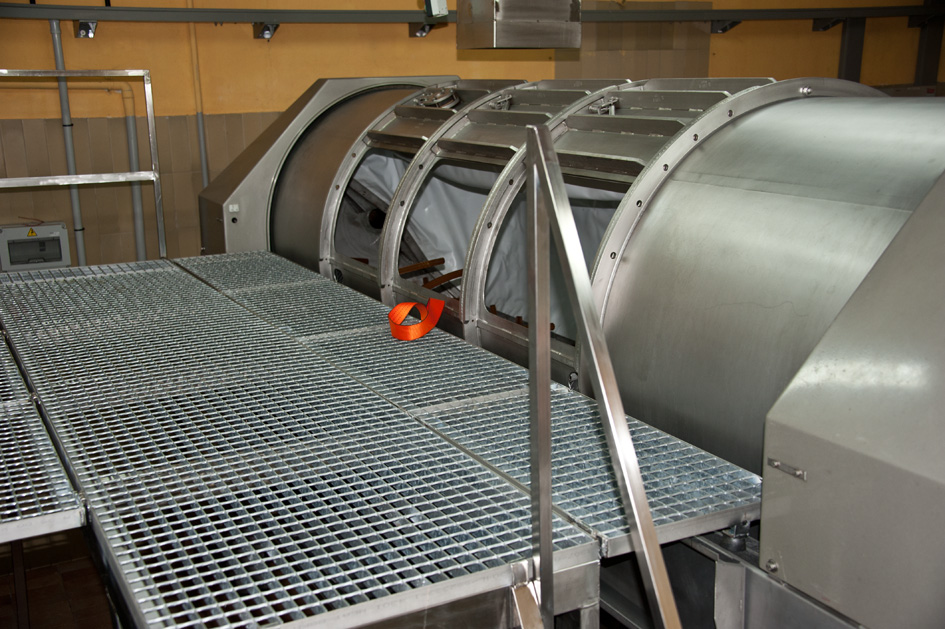
Having missed the window to do this last year (we left it to late!), we got an early start this year, and presto! Our design has now come to fruition. It is an in-house build (as Fran is also very handy with a welding torch), but I’m sure you will agree from today’s photograph, that the finished platform looks both very solid and very professional. Of course the one thing that you don’t really appreciate is that this new working areas is actually 1.80m (nearly 6ft) above the floor, and that the top of the press is nearly 3.0m (over 9ft), which would be a long way to fall onto the tiled concrete floor below!

The genius of the design (that you can just about make out from the photo) are the two side platforms that pull up from each side of the main platform, rather like a draw bridge, allowing the press to be closed up and to turn freely once it has been charged with grapes. 

It’s so impressive that maybe we should give up making wine and move into light engineering!

PlatformIf you look back at our blogs or vintage reports over the last few years you will probably find a photo or two of Fran (our cellar guy) balancing precariously on top of the presses during harvest. His task at this point is simply to distribute the grapes evenly inside the press as they tumble from the reception area on the level above, which is much more difficult than it sounds. To be completely honest, clambering up on a ladder and then straddling the machine is very far from ideal, some might say, even a little dangerous.

Finding a solution to alleviate the danger was never going to be easy, and whatever we decided would certainly have to be a customised design and build to fit into a very tight space. Indeed, we quickly realised that short of removing the roof, it was probably a design that would have to be built in situ. Our planners (Fran and myself) got our heads together, and based on our experience of working together on the presses over the last decade, came up with a plan of what was needed.

Having missed the window to do this last year (we left it to late!), we got an early start this year, and presto! Our design has now come to fruition. It is an in-house build (as Fran is also very handy with a welding torch), but I’m sure you will agree from today’s photograph, that the finished platform looks both very solid and very professional. Of course the one thing that you don’t really appreciate is that this new working areas is actually 1.80m (nearly 6ft) above the floor, and that the top of the press is nearly 3.0m (over 9ft), which would be a long way to fall onto the tiled concrete floor below!

The genius of the design (that you can just about make out from the photo) are the two side platforms that pull up from each side of the main platform, rather like a draw bridge, allowing the press to be closed up and to turn freely once it has been charged with grapes. 

It’s so impressive that maybe we should give up making wine and move into light engineering!

Blowing hot and cold

July 15th, 2013 | Bodega

Ye Olde AirconI have now been living in Spain for 11 years, and although there have been quite a few changes and modifications in the bodega, the office where we work remains largely unchanged. Having spent several years working on a large table, I now at least, have a desk.

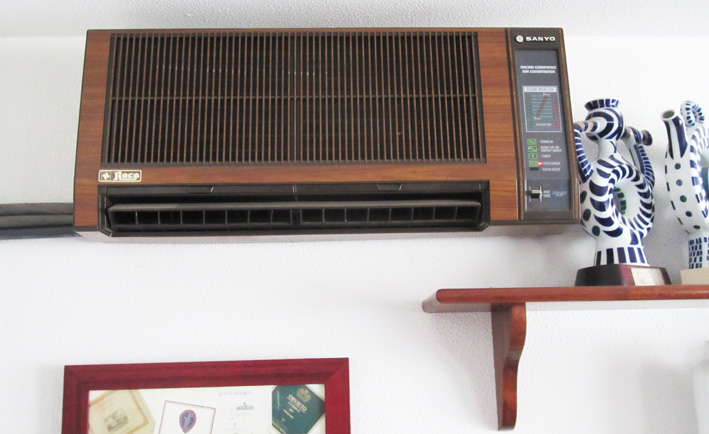
One of the other things I noticed is that, following a decidedly chilly winter, we are now sitting in the office perspiring (and quite profusely in recent days). The problem is that our offices have no fixed heating or cooling system. In winter we have a couple of plug-in radiators, and in summer we leave the windows open as long as we dare, until our south-facing office becomes too unbearable. On the wall of the office we have a very old air conditioning unit which has never worked in all the time that I have lived here. I have therefore come to one simple conclusion – we take much greater care of the temperature of our cellar, tanks and wine, than we do of ourselves. And quite right too…. our wine will always take priority.

Having said that, we have now decided that enough is enough (Angela has finally objected to me sitting here in my Speedos). We have just placed an order for a new aircon unit that will replace the original Sanyo unit which may have been here since the bodega was first built (see picture).

Of course, Sod’s Law dictates that the moment that we have the new air conditioning installed, then so the current period of stifling weather will come to an end!

Ye Olde AirconI have now been living in Spain for 11 years, and although there have been quite a few changes and modifications in the bodega, the office where we work remains largely unchanged. Having spent several years working on a large table, I now at least, have a desk.

One of the other things I noticed is that, following a decidedly chilly winter, we are now sitting in the office perspiring (and quite profusely in recent days). The problem is that our offices have no fixed heating or cooling system. In winter we have a couple of plug-in radiators, and in summer we leave the windows open as long as we dare, until our south-facing office becomes too unbearable. On the wall of the office we have a very old air conditioning unit which has never worked in all the time that I have lived here. I have therefore come to one simple conclusion – we take much greater care of the temperature of our cellar, tanks and wine, than we do of ourselves. And quite right too…. our wine will always take priority.

Having said that, we have now decided that enough is enough (Angela has finally objected to me sitting here in my Speedos). We have just placed an order for a new aircon unit that will replace the original Sanyo unit which may have been here since the bodega was first built (see picture).

Of course, Sod’s Law dictates that the moment that we have the new air conditioning installed, then so the current period of stifling weather will come to an end!

Monthly Archives

Categories

ARE YOU OF LEGAL AGE? This site is intended for those of legal drinking age. By entering, you confirm that you are of legal drinking age in the country where this site is being accessed. ¿ERES MAYOR DE EDAD? Este sitio está destinado a personas en edad legal para beber alcohol. Al ingresar, confirma que tiene la edad legal para beber en el país donde se accede a este sitio.