

Archive for ‘Bodega’

Natural wine (and food) – Part 4 – Sulphites

February 25th, 2019 | Bodega

A couple of weeks ago we attended a very interesting seminar – ‘Making wines with low SO2 (sulphur dioxide) content’.

One of the most defining characteristics of a ‘natural’ wine is that it will certainly be low in sulphur – sometimes with no added SO2 whatsoever. Added sulphur has two roles to play in a finished wine: Firstly, it acts as a microbicide, killing bacteria or any remaining yeasts that could eventually lead to spoilage. Secondly, it prevents oxidation of the wine, by preventing or reducing interaction of wine with oxygen.

During fermentation yeast will naturally produce a very small amount of SO2 (and so it will always be present), the question is – is this enough to protect a wine in the medium to long-term? For example, it’s worth noting that premature oxidation is actually a very common fault in ‘natural’ wines.

Our seminar talked of this, and offered alternative solutions, products to be used in the grape must to replace SO2, yeast strains that produce very little natural SO2, and pre-bottling additives – all apparently quite natural. We tasted two Spanish white wines from the 2018 vintage made using the low-sulphur products….

When I was a wine buyer, one of the most important issues for me was not only the quality, but mainly the longevity of the wine – looking into its future and trying to imagine how it might evolve. (Bearing in mind that many of my purchasing decisions were made in the producers cellar, tasting raw wine from tanks and barrels). If a wine tasted ready for drinking from the first sip, then the likely hood was that it would not last the course. It is rare that a good or great wine will show it’s true colours during its infancy – and that is where the buyers judgement comes into play.

I say this because of the two 2018 wines in the tasting. They were fine for drinking NOW, very commercial styles, but simply ready to give a bit of ‘instant gratification’. Perhaps perfect for the two wines in question, but not really for our albariño, which can often be consumed two or three years down the road. I’m sorry to say, that we will almost certainly continue with our current policy of adding a little pre-bottling SO2, simply because it works for us, and our export customers (who require an extended shelf-life).


Natural wine (and food) – Part 3

February 18th, 2019 | Bodega

In my last post I raised the question – what steps can we take to make our wine more natural? Of course, the answer to this question is, as always, divided into two parts – grape production and wine making.

We start by examining every process in detail by considering the best and most effective, natural products and operations that we can use, thereby manipulating the must and wine as little as possible. This might seem quite straightforward, but then, unfortunately, some of these processes can have drawbacks and can create potential problems, both to the finished wine and also its evolution in bottle.

Over the years I have written extensively about our vineyard practices, using as many traditional and organic products as possible. Not only are these better for the plants and soils, but the vines will also react naturally, not building any product resistance, as they might do in the case of some more modern systemic treatments. It’s very similar to humans. For example, the difference between using homeopathic medicines as opposed to antibiotics. The former is very natural, and whilst the latter might be more convenient, it can cause long-term problems, forming immunity and rendering treatment useless.

Inside the cellar we already know that white wines are especially prone to oxidation during every stage of their lifetime – from the moment fruit is picked to the moment that it sits in a glass waiting to be consumed. Preservation and longevity are therefore our biggest considerations in everything that we do. What can we do to capture, and ultimately preserve the freshness of the albariño grape variety, whilst at the same time keeping it as ‘natural’ as possible. It ain’t easy, that’s for sure!

Happy New Year!

January 7th, 2019 | Bodega

Whilst we are already a week into the New Year, the Christmas holiday has only just ended here in Spain. Yesterday, 6th January, was Reyes, known outside Spain as Epiphany. which celebrates the baptism of Jesus and is also known for the visit of the Three Kings. Some Spanish households still celebrate Reyes rather than Christmas, and gifts are exchanged on 6th January. This year, as 6th falls on a Sunday, some autonomies of Spain will have an additional ‘festivo’ day today – 7th January – but not here in Galicia, it is a normal working day.

Owing to this extended holiday, some businesses are only returning to full production this week, including ourselves, as many of our team return from their break. Thankfully they will be greeted by a busy month! To start the New Year we have some pretty large orders in the pipeline, that will necessitate at least two bottlings during the month of January. Of course, it’s always nice to start the year with a few orders in the book, but our longer-term goal will be to maintain this momentum throughout the year!

Let it snow!

November 19th, 2018 | Bodega

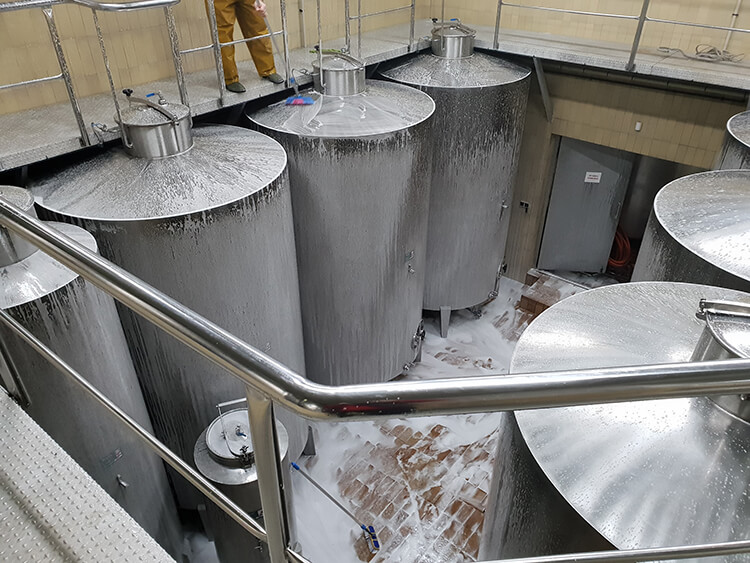
Our cellar team are finally coming to the end of the post-harvest deep clean (only started once all fermentations were complete and tanks could be closed and secured). I walked into one of tank storage rooms this morning, and for a split second it almost looked like it had been snowing. The tanks and the floor were veiled in white – but of course, it wasn’t snow!

We have a special cleaning product for stainless steel which is applied by machine as a foam. Just to clarify for a moment, all the cleaning products that we use are both approved for use in food (wine) production areas, and are environmentally friendly.

Not only do all the wine making products that we use have to be approved and recorded, but this also applies to cleaning materials. These days every process and product has to be recorded – it is part of what is known as traceability. Heaven forbid, if something should go wrong, and there is a problem with one of our wines, then not only can the entire batch be withdrawn from sale, but we can then look back through our records, tracing back, if necessary, to the origin of every grape that went into a particular bottle. That’s what traceability is all about – consumer protection.

Winter touch up

November 7th, 2018 | Bodega

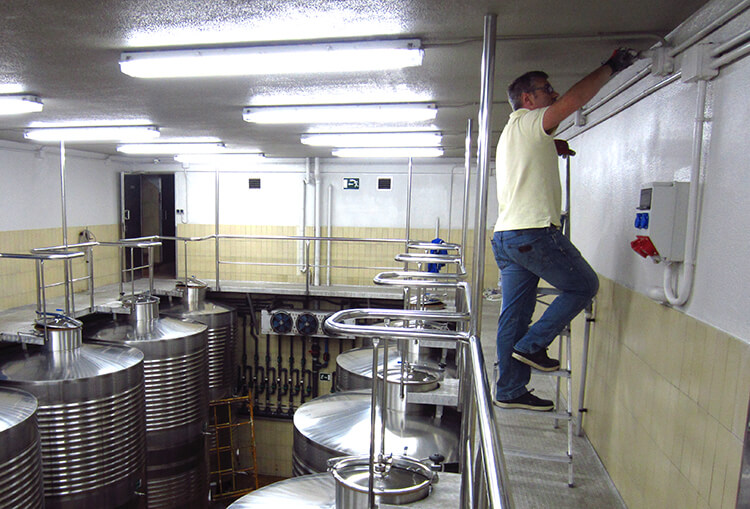
As the rain pours down outside, and in the period before pruning begins, we are still catching up on jobs inside the bodega.

You may recall that several months ago we had a serious filtration of water in the roof (tank room) of the bodega, and that at first, we were not even sure where it originated from (water will always find the nearest and easiest escape route). Eventually, after much digging and breaking of cement, we were convinced that we had found the source, but even then, we were not 100% certain. We simply had to wait and see.

Fortunately, everything has remained dry since then, and after some long periods of warm weather, we now feel that the structure has finally dried out. Of course this means that it can be repaired and re-painted – which is exactly what we are doing now.

To be honest the difference is not very noticeable, as it’s rare that we walk around staring up at the ceiling, but at least it now looks much more presentable for when we have visitors. Amazing what a simple lick of paint can do.

The Salon – Phase 2

October 22nd, 2018 | Bodega

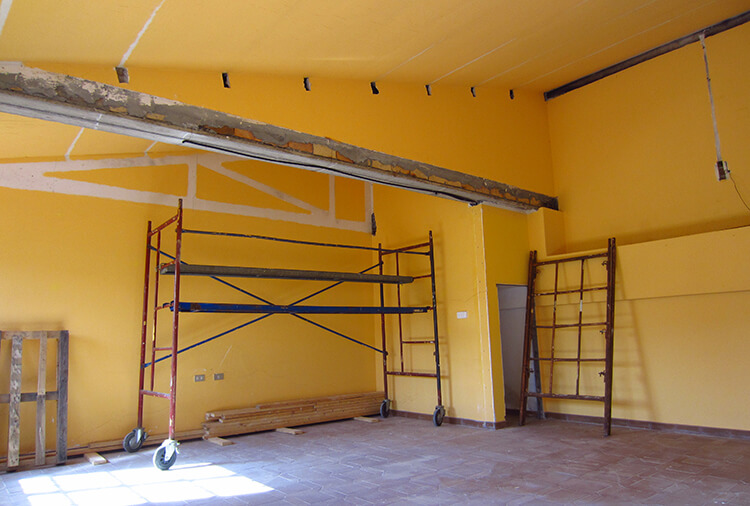
Of course, dismantling the salon a few days ago, removing a few tables and chairs was very much the easy part of the job. Phase two is quite a bit more serious, requiring more manpower and just a few building and/or demolition skills – removing all the wooden beams from around the ceiling space. I did mention in my last post that none of these beams were actually real, and therefore not load bearing, but it still required a bit of skill (and muscle) to take them down.

I guess that many visitors over the years had assumed that the beams were real, but as you can clearly see from today’s photo, these large wooden beams were, in fact, just a bit of wood cladding around a much bigger and uglier concrete beam. The smaller beams running across the ceiling were also purely decorative, and served no practical purpose at all. So much for authenticity!

Phase three,  the rebuilding phase, will not be so easy. The reason I say this is because we haven’t even decided what we are going to do with this space. In the past, it has been used (very infrequently) for meetings and parties, but we feel that it really could be used for something more worthwhile. We are currently scratching our heads.

Salon dismantled…

October 15th, 2018 | Bodega

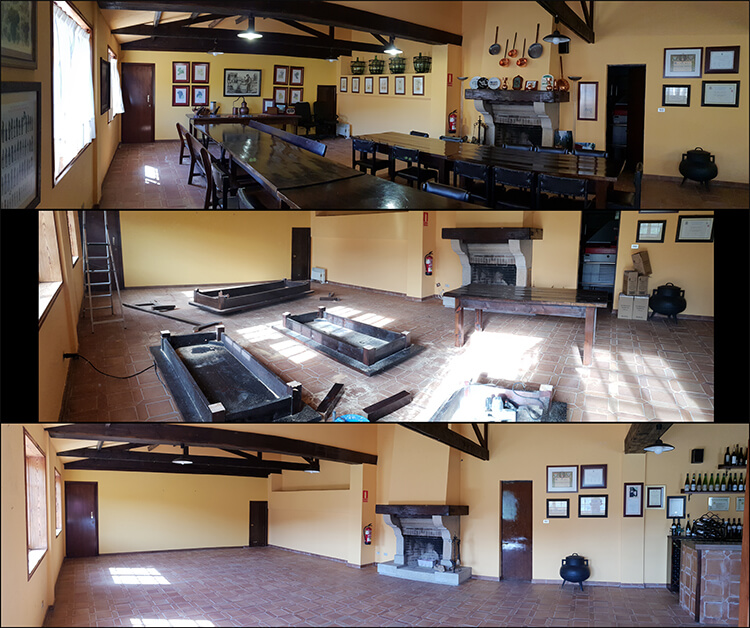
A year or so ago we discovered a problem in the ‘salon’ of our bodega – we have been attacked by wood boring insects! Of course we do not really know where they originated from, only that they have slowly but surely started to munch their way through chairs, tables and the beams in our roof. (Thankfully the beams are not structural, and are purely aesthetic, so removing them should not cause us a problem).

There are different ways of tackling this problem; insecticide is just one option, as is fumigation by professionals. Although this could probably done quite safely (even in a wine making environment), we are not taking any chances – we are simply going to remove all of the wood and burn it! This might seem quite dramatic, but the reality is that we have been thinking of modernising our reception room/function room for some time now.

Now that most of the post-harvest cleaning jobs have been completed, and before the long, tedious chore of pruning begins, we have a bit of a lull in activity (not forgetting that the wine making is still ticking-over in the background). This provides us with the perfect opportunity to start.

The first step was easy – removing all the furniture, fixture and fittings (see photo). The next step will be to tackle the beams.

What a difference!

October 8th, 2018 | Bodega

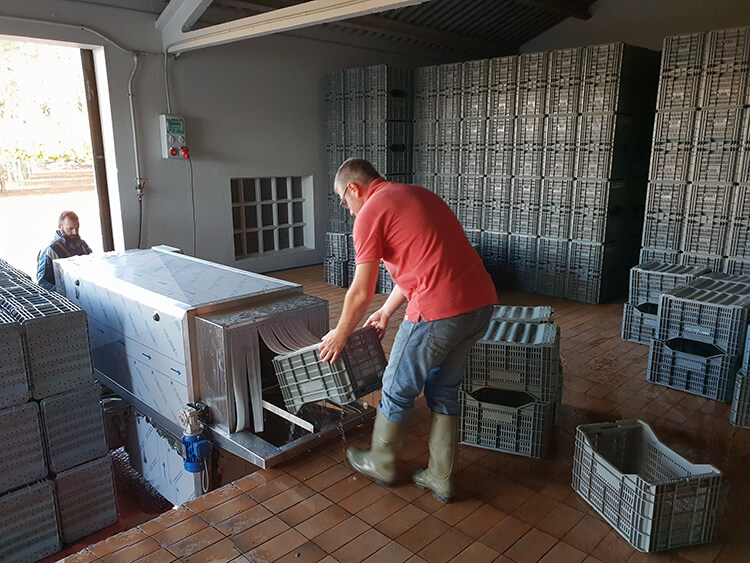
One of the biggest post-harvest jobs that we have to do, apart from the wine making, is cleaning the cases that were used for collecting grapes – we have about 2,000 of these.

In previous years they were washed case-by-case using a pressure washer, simply because there was always a build up of grape juice almost ‘baked’ onto the plastic. This year it is a little different….

With our new case washing machine (inaugurated at the beginning of the harvest), every case was washed thoroughly each time it was used. A conveyor-like system pulls each case into the machine where it is ‘attacked’ from all sides by a set of high pressure water jets – this removes all the lose dirt. It then undergoes a second wash in clean water (re-cycled through filters) before it is left to dry. The result is that, over the period of the harvest, there is no dried juice build-up (our old wash-by-hose method was not quite so effective), and the cases are always completely clean and dry.

At the end of the harvest we now simply give all the cases one more final wash before they were stacked away for next year. Any that that fail inspection are separated and undergo a quick pressure wash to remove all residuals. This year, using the machine for this final wash took just over one working day, whereas our old method employed three people for a period of up to two weeks! Now that’s what I call a labour (and cost) saving investment!

Post Harvest – Fermentation

October 1st, 2018 | Bodega

Just when you think that all the hard work, collecting grapes is done, then it all starts again inside the bodega. We have two huge programmes running simultaneously with one another…. The first is a deep clean, and when I say deep clean, it really has to be deep! Grape juice must be one of the stickiest substances on the planet (perhaps it could give Gorilla Glue a run for it’s money!) To be honest it’s not really ‘super’ sticky but it’s special property is that it simply transfers everywhere – there are few places that escape, so much so that a full change of clothes and shoes is really essential at the end of each working day. So now the task in hand is that we have to unstick everything, by far the most difficult chore being the presses – the epicentre of juice production.

The second, and most important project is getting the fermentation under way. I did post a quick photo a day or two ago, taken as we started to re-hydrate the yeast, but once this is done then it has to be carefully and slowly added to each tank, one-by-one. The process of seeding a single large tank (see photo) can take up to 4 or 5 hours – the smaller tanks are a bit quicker, taking about 3 hours. Of course this time includes the pumping-over after the yeast is added. Pumping over is simply a mixing process, when we connect the top of the tank to the bottom using hoses, and then circulate the juice and yeast mixture in a cyclical motion for a couple of hours.

The timing of fermentation is determined by the juice, when, after cold settling, the temperature recovers to a level warm enough to support the yeast. If the juice is too cold, then the yeast will simply die of shock – the result? No fermentation!

This year the temperature dictated that we were here for the entire weekend, meaning that for the last two or three weeks, none of us have had a break! Who was it said that running a wine cellar is a romantic profession?!

Post Harvest – let’s make wine

September 27th, 2018 | Bodega

So now that the last grape is safely in, and the cold settling period is concluded, we embark on the small matter of wine making. Year-on-year there is never too much variation in what we do – we might make some small adjustments according to the vintage, and perhaps trial a new product or two in one odd tank, but the majority of what we do remains largely unchanged.

There is one characteristic of the 2018 vintage that I haven’t really mentioned as yet…. alcohol. I did say that we had been surprised by the quality of the fruit, and that it was quite viscose (rescued by a dry and warm August and September), but the other side effect of heat is alcohol. My guess is that we will see the FIRST EVER Castro Martin wines of 13% Alcohol!

We had already seen a number of 13% wines appearing last year, whereas our own mean average alcohol for 2017 was somewhere between 12.5% and 13% (the label has to be within 0.5% of the actual). This year we will almost certainly break this barrier, whilst bearing in mind that many people are still picking in 32°C heat (heaven only knows what level of alcohol this fruit will yield). Could we see albariños approaching 14% in 2018?

Oh, and by the way, don’t simply dismiss today’s picture as just another ‘moon shot’ – this is actually the yeast being mixed, just before it is added to one of our tanks!

Monthly Archives

Categories

ARE YOU OF LEGAL AGE? This site is intended for those of legal drinking age. By entering, you confirm that you are of legal drinking age in the country where this site is being accessed. ¿ERES MAYOR DE EDAD? Este sitio está destinado a personas en edad legal para beber alcohol. Al ingresar, confirma que tiene la edad legal para beber en el país donde se accede a este sitio.