

Too much information?

February 12th, 2013 | Labels

At the beginning of this month a UK government health minister revealed that in future wine labels might be required to include yet more information, this time relating to calorie content. Wine labels are already crammed with consumer advice, and this is made even more complicated by the fact that each country has its own regulations.

This latest idea suggests that wine consumers are becoming overweight and obese owing to excessive alcohol consumption, although I would have thought that this problem is perhaps more related to beer than it is to wine. Having said that it is perhaps true to say that alcohol can be underestimated when it come to calories, one pint of lager beer for example can contain 250 calories, whilst one single glass of wine might be anything from 140 up to 230 calories (depending on the wine style).

Perhaps I am biased but I still believe that wine is sometimes unfairly blamed for specific health problems. For example, binge drinking is rarely associated with wine, liver disease is more often caused by spirits, and I am still of the opinion that weight problems are probably more related to beer drinking. Of course, wine is not completely blameless, but it does often get dragged into the argument. 

The calorie count in wine comes from the sugar and alcohol, but there is no hard and fast rule as to which type of wine contains the most carbohydrates – it is perfectly possible to find a slightly sweet, low alcohol wine that has less calories than a dry, high alcohol wine. Perhaps surprisingly, it’s not all about sugar, indeed there are more calories in the alcohol itself which is why it is so difficult to provide a standard calculation.

The good news is that besides the carbs and calories, there are also nutrients in wine that come from the skin of the grape itself. Generally speaking red wine contains more minerals and antioxidants than white wine, but any colour of wine, in moderation, is not bad for you!

At the beginning of this month a UK government health minister revealed that in future wine labels might be required to include yet more information, this time relating to calorie content. Wine labels are already crammed with consumer advice, and this is made even more complicated by the fact that each country has its own regulations.

This latest idea suggests that wine consumers are becoming overweight and obese owing to excessive alcohol consumption, although I would have thought that this problem is perhaps more related to beer than it is to wine. Having said that it is perhaps true to say that alcohol can be underestimated when it come to calories, one pint of lager beer for example can contain 250 calories, whilst one single glass of wine might be anything from 140 up to 230 calories (depending on the wine style).

Perhaps I am biased but I still believe that wine is sometimes unfairly blamed for specific health problems. For example, binge drinking is rarely associated with wine, liver disease is more often caused by spirits, and I am still of the opinion that weight problems are probably more related to beer drinking. Of course, wine is not completely blameless, but it does often get dragged into the argument. 

The calorie count in wine comes from the sugar and alcohol, but there is no hard and fast rule as to which type of wine contains the most carbohydrates – it is perfectly possible to find a slightly sweet, low alcohol wine that has less calories than a dry, high alcohol wine. Perhaps surprisingly, it’s not all about sugar, indeed there are more calories in the alcohol itself which is why it is so difficult to provide a standard calculation.

The good news is that besides the carbs and calories, there are also nutrients in wine that come from the skin of the grape itself. Generally speaking red wine contains more minerals and antioxidants than white wine, but any colour of wine, in moderation, is not bad for you!

Wine flavoured drink

February 10th, 2013 | Tasting

We have just got back from a short overseas trip – hence the fact that our blog has been silent for the last few days. On our outward flight we again discovered an alcohol-free “wine” on the in-flight menu, but this time the airline actually had it in stock. We ordered a small plastic bottle…. served with a small plastic glass.

Whilst it is actually advertised as wine, technically, as it has no alcohol, it is not actually wine but merely a wine flavoured soft drink. Of course, packing any drink into an 18cl screw top plastic bottle is never going to be the best way of preserving freshness, and this particular beverage only served to confirm that theory. The nose was a combination of oxidised, volatile acetones – hardly making it an attractive proposition for drinking. And the palate? Well, what can I say? Not really much better. To be brutally honest it simply tasted like flavoured water, the type that you might buy in litre bottles in a supermarket, flavoured with peach, or perhaps a hint of summer fruits.

The question must therefore be, why bother? Or at the very least, why advertise it as alcohol-free wine and not just as a flavoured soft drink? Sorry, I just don’t see the point and certainly can’t recommend it.

We have just got back from a short overseas trip – hence the fact that our blog has been silent for the last few days. On our outward flight we again discovered an alcohol-free “wine” on the in-flight menu, but this time the airline actually had it in stock. We ordered a small plastic bottle…. served with a small plastic glass.

Whilst it is actually advertised as wine, technically, as it has no alcohol, it is not actually wine but merely a wine flavoured soft drink. Of course, packing any drink into an 18cl screw top plastic bottle is never going to be the best way of preserving freshness, and this particular beverage only served to confirm that theory. The nose was a combination of oxidised, volatile acetones – hardly making it an attractive proposition for drinking. And the palate? Well, what can I say? Not really much better. To be brutally honest it simply tasted like flavoured water, the type that you might buy in litre bottles in a supermarket, flavoured with peach, or perhaps a hint of summer fruits.

The question must therefore be, why bother? Or at the very least, why advertise it as alcohol-free wine and not just as a flavoured soft drink? Sorry, I just don’t see the point and certainly can’t recommend it.

Table for two?

January 31st, 2013 | Restaurants

Now, call me old fashioned, but when I book a table for two I don’t think it’s unreasonable to expect a bit of space and relative privacy as we enjoy our meal. These days however, in some restaurants at least, tables can be wedged together, resembling some sort of production line, so close in fact that you can easily share the condiments (and perhaps the conversation) of the table next to you!

For example, in today’s photo, you would be forgiven for thinking that the diners shown are actually eating together, maybe attending a banquet and sharing one long table. Closer examination reveals that they are in fact a series of small tables for two, and that all the diners are eating separately…… well, sort of. I’m afraid to tell you that this is pretty much my idea of hell, and that given the choice, I would actively give such restaurants a miss. I really hate it where there is so little space that you have to re-arrange the table to accommodate your main course plate, or that there is so much noise that you can’t hold a private conversation.

If my memory serves me one of the earliest examples of this style of ‘cosy eating’ was (and perhaps still is), Quaglino’s in London. Created in the early 90’s by Sir Terence Conran, I can clearly remember that the place caused quite a stir, not simply because of it’s overall size, but also because of the close proximity of it’s smaller dining tables – diners were virtually rubbing elbows with their neighbours sitting at adjacent tables.

I remember once going to a small, intimate restaurant in London – our first experience was fantastic. On our second visit they located us on a tiny table at the top of a stair case – a table so small that our cutlery was practically falling off the edges. There was never a third visit!

Now, call me old fashioned, but when I book a table for two I don’t think it’s unreasonable to expect a bit of space and relative privacy as we enjoy our meal. These days however, in some restaurants at least, tables can be wedged together, resembling some sort of production line, so close in fact that you can easily share the condiments (and perhaps the conversation) of the table next to you!

For example, in today’s photo, you would be forgiven for thinking that the diners shown are actually eating together, maybe attending a banquet and sharing one long table. Closer examination reveals that they are in fact a series of small tables for two, and that all the diners are eating separately…… well, sort of. I’m afraid to tell you that this is pretty much my idea of hell, and that given the choice, I would actively give such restaurants a miss. I really hate it where there is so little space that you have to re-arrange the table to accommodate your main course plate, or that there is so much noise that you can’t hold a private conversation.

If my memory serves me one of the earliest examples of this style of ‘cosy eating’ was (and perhaps still is), Quaglino’s in London. Created in the early 90’s by Sir Terence Conran, I can clearly remember that the place caused quite a stir, not simply because of it’s overall size, but also because of the close proximity of it’s smaller dining tables – diners were virtually rubbing elbows with their neighbours sitting at adjacent tables.

I remember once going to a small, intimate restaurant in London – our first experience was fantastic. On our second visit they located us on a tiny table at the top of a stair case – a table so small that our cutlery was practically falling off the edges. There was never a third visit!

Winter Update

January 28th, 2013 | Bodega

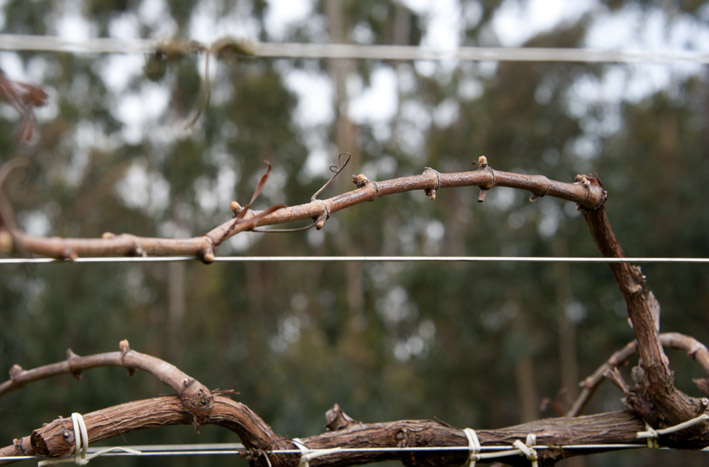
The skies outside our Bodega are leaden with rain, the temperature hovering between 8 and 12°C (45-55°F), with hardly any variation between day and night. The damp, cold weather penetrates through to the bone – the worst possible weather to be out in the vineyards pruning. At this time of year there is not a lot of activity in the bodega itself, apart from  in the office where Luisa is busy with our year-end accounts! The only other development worthy of note is the continued maturation of the 2012 wines as they sit quietly on their lees, waiting to be racked in the spring. (We do, of course, have to make regular tastings to ensure that all is well, and that no ‘off flavours’ are developing).

All the ‘action’ is really outdoors, the unenviable job of pruning our 11 hectares. I say unenviable simply because the weather is so awful at the moment – perhaps the typical Galician winter, but pretty grim nonetheless. There has been a lot of rain so far this winter, and the ground is completely sodden, some vineyards (not ours) are actually under water as there is simply nowhere for the water to escape. There have been very few sunny days, in fact, it has been quite rare to see the sun at all and so there is really nothing to warm things up.

I suppose we shouldn’t complain as, yet again, we witness forest fires raging in Australia, and other parts of Europe that have stumbled to a halt under a blanket of snow. Roll on the Spring…. please!

The skies outside our Bodega are leaden with rain, the temperature hovering between 8 and 12°C (45-55°F), with hardly any variation between day and night. The damp, cold weather penetrates through to the bone – the worst possible weather to be out in the vineyards pruning. At this time of year there is not a lot of activity in the bodega itself, apart from  in the office where Luisa is busy with our year-end accounts! The only other development worthy of note is the continued maturation of the 2012 wines as they sit quietly on their lees, waiting to be racked in the spring. (We do, of course, have to make regular tastings to ensure that all is well, and that no ‘off flavours’ are developing).

All the ‘action’ is really outdoors, the unenviable job of pruning our 11 hectares. I say unenviable simply because the weather is so awful at the moment – perhaps the typical Galician winter, but pretty grim nonetheless. There has been a lot of rain so far this winter, and the ground is completely sodden, some vineyards (not ours) are actually under water as there is simply nowhere for the water to escape. There have been very few sunny days, in fact, it has been quite rare to see the sun at all and so there is really nothing to warm things up.

I suppose we shouldn’t complain as, yet again, we witness forest fires raging in Australia, and other parts of Europe that have stumbled to a halt under a blanket of snow. Roll on the Spring…. please!

Foods from Spain

January 23rd, 2013 | Food & Wine

Every few months we used to receive an attractive, professionally presented food and wine magazine called Spain Gourmetour. It was produced and distributed free of charge by ICEX, the Spanish Government trade office. The printing of this magazine has now “been suppressed” – no reason was given, but I have absolutely no doubt that it is down to budget cuts. Gourmetour and its accompanying website have now been replaced by a new website called Foods from Spain.

As the name implies this new site is all about the foods (and wine) from the different provinces of Spain, and includes information and recipes from around the country. As you might expect the recipes include wine pairing suggestions, albeit that the real detail of Spanish wine is covered on their sister website…. Wines from Spain (they must have spent hours deliberating over that name!) Believe me, there’s a lot of really useful information to be gleaned from both the food and wine sites, and I would recommend that you add them to your list of favourite tourism web pages too.

For example, if your looking for somewhere to eat there is a page listing some of Spain’s best Chefs, and consequently, their restaurants. It comes as no surprise that my own personal favourite here in Galicia is included on the list. Pepe Vieira, with its fabulous Chef/Proprietor Xosé Cannas. Don’t forget to pay them a visit when you’re next in the area, and tell them that I sent you! Their restaurant is a bit off the beaten track, hidden in the hills above Raxo (mid way between Pontevedra and Sanxenxo), but I can assure you, it’s well worth the detour.

Every few months we used to receive an attractive, professionally presented food and wine magazine called Spain Gourmetour. It was produced and distributed free of charge by ICEX, the Spanish Government trade office. The printing of this magazine has now “been suppressed” – no reason was given, but I have absolutely no doubt that it is down to budget cuts. Gourmetour and its accompanying website have now been replaced by a new website called Foods from Spain.

As the name implies this new site is all about the foods (and wine) from the different provinces of Spain, and includes information and recipes from around the country. As you might expect the recipes include wine pairing suggestions, albeit that the real detail of Spanish wine is covered on their sister website…. Wines from Spain (they must have spent hours deliberating over that name!) Believe me, there’s a lot of really useful information to be gleaned from both the food and wine sites, and I would recommend that you add them to your list of favourite tourism web pages too.

For example, if your looking for somewhere to eat there is a page listing some of Spain’s best Chefs, and consequently, their restaurants. It comes as no surprise that my own personal favourite here in Galicia is included on the list. Pepe Vieira, with its fabulous Chef/Proprietor Xosé Cannas. Don’t forget to pay them a visit when you’re next in the area, and tell them that I sent you! Their restaurant is a bit off the beaten track, hidden in the hills above Raxo (mid way between Pontevedra and Sanxenxo), but I can assure you, it’s well worth the detour.

The castles and monasteries downsize

January 17th, 2013 | Business

If you’ve ever visited Galicia, or any part of Spain for that matter, the chances are that you might have stayed in a Parador Hotel. What you might already know is that the group consists of more than 90 converted castles, monasteries and palaces dotted around the country – many are quite breathtaking, imposing buildings. The thing that you might not have realised is that the Parador group is owned and run by the Spanish Government, it’s entire workforce therefore being public sector workers.

I remember when I first arrived in Spain 10 or 11 years ago that the Parador hotels were not only very good, but more importantly they were very reasonably priced, and represented fantastic value for money. Since then however, prices have gradually increased, and by Spanish standards they now fall more into the luxury hotel price bracket. This factor, combined with Spain’s current economic woes, have conspired to bring the group to it’s knees, losing €72 million (USD 95.5 million) in 2011, with occupancy falling from 70% in 2011 to 52% in 2012 – losses for 2012 are expected to increase €107m (USD 142 million). The truth is that Paradores have not actually made any profit for years.

Government proposals to close several hotels inevitably resulted in strike action, meaning that many hotels were only able to offer reduced services to their guests (perhaps not the best way to endear themselves to loyal customers). As a result the Government eventually backed down, and will now only close one hotel. They will however, close around 30 hotels during the low season, shedding a few hundred jobs along the way, and also close at least 15 restaurants on a permanent basis. I should add that my own experience of Parador restaurants has been very mixed, ranging from some very good meals with excellent service, to some very poor food with indifferent service. Food was never really one of their fortes. 

Apparently the Paradores, set up in 1926, were “not created purely to make money, but to showcase culturally rich, lesser visited parts of Spain”. It’s a real shame to say that they appear to have succeeded in at least one of their goals.

If you’ve ever visited Galicia, or any part of Spain for that matter, the chances are that you might have stayed in a Parador Hotel. What you might already know is that the group consists of more than 90 converted castles, monasteries and palaces dotted around the country – many are quite breathtaking, imposing buildings. The thing that you might not have realised is that the Parador group is owned and run by the Spanish Government, it’s entire workforce therefore being public sector workers.

I remember when I first arrived in Spain 10 or 11 years ago that the Parador hotels were not only very good, but more importantly they were very reasonably priced, and represented fantastic value for money. Since then however, prices have gradually increased, and by Spanish standards they now fall more into the luxury hotel price bracket. This factor, combined with Spain’s current economic woes, have conspired to bring the group to it’s knees, losing €72 million (USD 95.5 million) in 2011, with occupancy falling from 70% in 2011 to 52% in 2012 – losses for 2012 are expected to increase €107m (USD 142 million). The truth is that Paradores have not actually made any profit for years.

Government proposals to close several hotels inevitably resulted in strike action, meaning that many hotels were only able to offer reduced services to their guests (perhaps not the best way to endear themselves to loyal customers). As a result the Government eventually backed down, and will now only close one hotel. They will however, close around 30 hotels during the low season, shedding a few hundred jobs along the way, and also close at least 15 restaurants on a permanent basis. I should add that my own experience of Parador restaurants has been very mixed, ranging from some very good meals with excellent service, to some very poor food with indifferent service. Food was never really one of their fortes.

Apparently the Paradores, set up in 1926, were “not created purely to make money, but to showcase culturally rich, lesser visited parts of Spain”. It’s a real shame to say that they appear to have succeeded in at least one of their goals.

Re-Baixas

January 15th, 2013 | Galicia

I was walking around our local town the other day, when I was pleased to note that the windows of many shops had posters encouraging shoppers to drink more wine….. REBAIXAS, they exclaimed loudly!

Of course, I regret to say that this isn’t really an invitation for consumers to re-visit their favourite wine, but is simply the Galician word for SALE! Still, it’s a nice idea. The Spanish speakers amongst you will note that the word ‘Sale’ in Castellano is ‘Rebajas’, and that the word ‘Rebaixas’ is simply the local word with exactly the same meaning. 

Rias Baixas, as we all know, is translated as the lower rivers, or lower estuaries to be more accurate, and so we can clearly see the connection……. Baixas means lower – hence the lower or reduced prices!

And here endeth today’s lesson.

I was walking around our local town the other day, when I was pleased to note that the windows of many shops had posters encouraging shoppers to drink more wine….. REBAIXAS, they exclaimed loudly!

Of course, I regret to say that this isn’t really an invitation for consumers to re-visit their favourite wine, but is simply the Galician word for SALE! Still, it’s a nice idea. The Spanish speakers amongst you will note that the word ‘Sale’ in Castellano is ‘Rebajas’, and that the word ‘Rebaixas’ is simply the local word with exactly the same meaning. 

Rias Baixas, as we all know, is translated as the lower rivers, or lower estuaries to be more accurate, and so we can clearly see the connection……. Baixas means lower – hence the lower or reduced prices!

And here endeth today’s lesson.

Spanish webcast

January 11th, 2013 | Denomination

As many of you will know one of my big passions is photography, and by way of personal education I often participate in webcasts of the various software suppliers. The reality of a webcast is that it’s pretty much like watching a video, with the exception that there is (in theory) the opportunity to interact and ask questions. It’s a nice idea but pans out rather like a radio phone-in whereby the chances of getting your own questions answered are fairly remote. You do however, feel like you are at least participating first hand, almost like you are part of some exclusive club – it works pretty well.

So my point? Well, only yesterday I received an invitation from an office, financed by the Spanish government (that will remain nameless), to take part in a video conference about selling wine abroad. Fantastic I thought, we are finally moving forward as an industry and coming up with some creative, original ideas….. so let me take a closer look I thought to myself.

OK, so the first downside, we are required to pay 20 Euros to participate (all the other webcasts I have joined have been free), and then comes the agenda. The whole conference/video link is less than two hours in total, but then the first 15 minutes is taken up by ‘Reception & Coffee’!!! So, if you’re an online participant what exactly are you supposed to do? Sit around and watch people drinking coffee? Or maybe you’re expected to nip out to your nearest Starbucks and buy a cup so that you can join in with the reception! Whatever the answer I just found it a bit odd that an online conference (webcast) should start with a coffee break.

As many of you will know one of my big passions is photography, and by way of personal education I often participate in webcasts of the various software suppliers. The reality of a webcast is that it’s pretty much like watching a video, with the exception that there is (in theory) the opportunity to interact and ask questions. It’s a nice idea but pans out rather like a radio phone-in whereby the chances of getting your own questions answered are fairly remote. You do however, feel like you are at least participating first hand, almost like you are part of some exclusive club – it works pretty well.

So my point? Well, only yesterday I received an invitation from an office, financed by the Spanish government (that will remain nameless), to take part in a video conference about selling wine abroad. Fantastic I thought, we are finally moving forward as an industry and coming up with some creative, original ideas….. so let me take a closer look I thought to myself.

OK, so the first downside, we are required to pay 20 Euros to participate (all the other webcasts I have joined have been free), and then comes the agenda. The whole conference/video link is less than two hours in total, but then the first 15 minutes is taken up by ‘Reception & Coffee’!!! So, if you’re an online participant what exactly are you supposed to do? Sit around and watch people drinking coffee? Or maybe you’re expected to nip out to your nearest Starbucks and buy a cup so that you can join in with the reception! Whatever the answer I just found it a bit odd that an online conference (webcast) should start with a coffee break.

The £1 million tongue

January 9th, 2013 | Tasting

I’ve heard various anecdotes about celebrities and professionals insuring parts of their body for huge amounts of money before, but I don’t really recall a story of anyone insuring their tongue….. until now. I recently read about a young lady, not in the wine business, but who works as a taster in the baby food industry. (When you think about it there must be tasters for pretty much every product that we eat and drink, and I think I even recall hearing about a man who tastes pet foods for a living!) Anyway, the significance of this story is that this lady has recently had her tongue insured for £1 million (about $1.6 million).

I have claimed in the past that my own sense of taste/smell is perhaps more acute than many people that I know, simply because in my line of work as a buyer, I used it much more than the average person, and therefore, over time, it was simply ‘educated’ to become more sensitive. (The human sense of smell is, generally speaking, highly underutilised and can be trained over time). In the case of this baby food taster however, this young lady was actually born with a more sensitive tongue, with double the number of taste receptors. Obviously this is quite a rare genetic condition, having 10,000 taste buds on her tongue, instead of the more usual 5,000, and it goes without saying that her sense of taste is very highly tuned. She can detect extremely small and subtle differences in the flavours of food – her tongue is therefore the primary tool of her job and is no doubt why it is so valuable to her.

Of course there are many similarities between her work and that of a wine taster. As a part of her daily routine she will avoid eating foods with strong flavours, such as curry or garlic, and drinking coffee before a tasting session. In my own case I would also avoid wearing aftershave and other less obvious things like trying to ensure a good gap between cleaning my teeth and tasting my first wine of the day. Indeed, it’s probably best to taste two or three wines to get your palate tuned before you make any definitive judgements.

I’ve heard various anecdotes about celebrities and professionals insuring parts of their body for huge amounts of money before, but I don’t really recall a story of anyone insuring their tongue….. until now. I recently read about a young lady, not in the wine business, but who works as a taster in the baby food industry. (When you think about it there must be tasters for pretty much every product that we eat and drink, and I think I even recall hearing about a man who tastes pet foods for a living!) Anyway, the significance of this story is that this lady has recently had her tongue insured for £1 million (about $1.6 million).

I have claimed in the past that my own sense of taste/smell is perhaps more acute than many people that I know, simply because in my line of work as a buyer, I used it much more than the average person, and therefore, over time, it was simply ‘educated’ to become more sensitive. (The human sense of smell is, generally speaking, highly underutilised and can be trained over time). In the case of this baby food taster however, this young lady was actually born with a more sensitive tongue, with double the number of taste receptors. Obviously this is quite a rare genetic condition, having 10,000 taste buds on her tongue, instead of the more usual 5,000, and it goes without saying that her sense of taste is very highly tuned. She can detect extremely small and subtle differences in the flavours of food – her tongue is therefore the primary tool of her job and is no doubt why it is so valuable to her.

Of course there are many similarities between her work and that of a wine taster. As a part of her daily routine she will avoid eating foods with strong flavours, such as curry or garlic, and drinking coffee before a tasting session. In my own case I would also avoid wearing aftershave and other less obvious things like trying to ensure a good gap between cleaning my teeth and tasting my first wine of the day. Indeed, it’s probably best to taste two or three wines to get your palate tuned before you make any definitive judgements.

100 Soo Hoo Khoon Peng points?

January 6th, 2013 | International News

If your wine is awarded 100 points by Soo Hoo Khoon Peng, is that something that will change the future of your wine cellar? Let me explain. Soo Hoo Khoon Peng is a Singaporean wine importer who has not only paid USD 15million to buy The Wine Advocate franchise from Robert M. Parker Jnr., but who has also taken over both editorial control and control of the business as a whole. This being the case, then every serious wine consumer is probably asking themselves the question “can this be the beginning of the end of the Parker empire?”

There are some serious wine journalists around who have already speculated that Parker’s influence may be in decline, and that many people simply cannot afford to pay attention to his comments – the reason being that his scoring system has, single-handedly, made some wines so expensive that they are now well beyond the reach of many a mere mortal on the street, or perhaps I should say, in their local wine store. It is also said that the only people now interested in his rating system are the property owners themselves, who can sit back and watch the value of their property and vineyards increase by millions virtually overnight.

Apparently Mr Parker himself will be staying on, drawing a salary from the new owners to judge the wines of Bordeaux and the Rhône. After all, without any input whatsoever, the value of the Wine Advocate brand would evaporate very quickly. Personally I have the feeling that Parker has made the decision to quit while he’s still ahead, a step towards retirement if you will, and with USD 10million in his back pocket, who can blame him? Also, whilst I can appreciate that his scoring system may have helped many a consumer make his or her wine selection, I can’t help but feel that his influence has long been out of control. After all, like art, taste in wine is purely subjective, and the hugely complex faculties of taste and smell cannot, and should not, be over-simplified and reduced to a simple scoring system.

In the past Parker has sometimes been referred to as “the Emperor of Wine”, and so we have to ask ourselves, if his influence really is in decline, who will take over the mantle? Certainly as far as the U.S. market is concerned, a good candidate might be Stephen Tanzer, who I should tell you, is more a man after my own taste. The one thing that I have always hated about Parker ratings is that he was, and still is, swayed by the power and concentration of a wine, so much so that the very vinification of Bordeaux wines has changed dramatically during his reign. Over-extracted wines became the norm, and subtlety and finesse were often lost somewhere in the background, becoming almost insignificant. As a result, some Bordeaux and Rhône wines virtually required tasting with a fork!

By contrast, Mr Tanzer who runs the International Wine Cellar, appears to favour finesse in wine, rather like myself. As a wine buyer working for a wholesale company buying wine largely for distribution to the restaurant trade, I was always on the look out for wines with finesse and structure that would marry with food, rather than dominate them. Any influential, like-minded wine critic will therefore be a breath of fresh air as far as I’m concerned. Like me, Stephen Tanzer is also a great lover of Burgundy, at one time almost my second home as I spent at least two or three weeks a year scouring the cellars of the area, tasting literally hundreds of fine wines from top producers…… (And I used to get paid too!)

I am very encouraged to learn that  Mr Tanzer is apparently an aficionado of cooler-climate wines, “I like white wines that are minerally, saline and energetic,” he says. A perfect description of Castro Martin albariño.

If your wine is awarded 100 points by Soo Hoo Khoon Peng, is that something that will change the future of your wine cellar? Let me explain. Soo Hoo Khoon Peng is a Singaporean wine importer who has not only paid USD 15million to buy The Wine Advocate franchise from Robert M. Parker Jnr., but who has also taken over both editorial control and control of the business as a whole. This being the case, then every serious wine consumer is probably asking themselves the question “can this be the beginning of the end of the Parker empire?”

There are some serious wine journalists around who have already speculated that Parker’s influence may be in decline, and that many people simply cannot afford to pay attention to his comments – the reason being that his scoring system has, single-handedly, made some wines so expensive that they are now well beyond the reach of many a mere mortal on the street, or perhaps I should say, in their local wine store. It is also said that the only people now interested in his rating system are the property owners themselves, who can sit back and watch the value of their property and vineyards increase by millions virtually overnight.

Apparently Mr Parker himself will be staying on, drawing a salary from the new owners to judge the wines of Bordeaux and the Rhône. After all, without any input whatsoever, the value of the Wine Advocate brand would evaporate very quickly. Personally I have the feeling that Parker has made the decision to quit while he’s still ahead, a step towards retirement if you will, and with USD 10million in his back pocket, who can blame him? Also, whilst I can appreciate that his scoring system may have helped many a consumer make his or her wine selection, I can’t help but feel that his influence has long been out of control. After all, like art, taste in wine is purely subjective, and the hugely complex faculties of taste and smell cannot, and should not, be over-simplified and reduced to a simple scoring system.

In the past Parker has sometimes been referred to as “the Emperor of Wine”, and so we have to ask ourselves, if his influence really is in decline, who will take over the mantle? Certainly as far as the U.S. market is concerned, a good candidate might be Stephen Tanzer, who I should tell you, is more a man after my own taste. The one thing that I have always hated about Parker ratings is that he was, and still is, swayed by the power and concentration of a wine, so much so that the very vinification of Bordeaux wines has changed dramatically during his reign. Over-extracted wines became the norm, and subtlety and finesse were often lost somewhere in the background, becoming almost insignificant. As a result, some Bordeaux and Rhône wines virtually required tasting with a fork!

By contrast, Mr Tanzer who runs the International Wine Cellar, appears to favour finesse in wine, rather like myself. As a wine buyer working for a wholesale company buying wine largely for distribution to the restaurant trade, I was always on the look out for wines with finesse and structure that would marry with food, rather than dominate them. Any influential, like-minded wine critic will therefore be a breath of fresh air as far as I’m concerned. Like me, Stephen Tanzer is also a great lover of Burgundy, at one time almost my second home as I spent at least two or three weeks a year scouring the cellars of the area, tasting literally hundreds of fine wines from top producers…… (And I used to get paid too!)

I am very encouraged to learn that  Mr Tanzer is apparently an aficionado of cooler-climate wines, “I like white wines that are minerally, saline and energetic,” he says. A perfect description of Castro Martin albariño.

Monthly Archives

Categories

ARE YOU OF LEGAL AGE? This site is intended for those of legal drinking age. By entering, you confirm that you are of legal drinking age in the country where this site is being accessed. ¿ERES MAYOR DE EDAD? Este sitio está destinado a personas en edad legal para beber alcohol. Al ingresar, confirma que tiene la edad legal para beber en el país donde se accede a este sitio.