

A vineyard trim

March 17th, 2013 | Odds & Sods

Sheep shearing

You could be forgiven for thinking that at this time of year a vineyard trim would refer to the pruning of our vines – but not so. Today I am referring to the other trimming that has just taken place. Our family of sheep have just had their hair cut (or should that be fleece?) As you may know we make a big effort to be as Eco-friendly as possible in our vineyards and whilst we do not qualify for the full bio-dynamic certification, we still take as many steps as possible to minimise the level of intervention that is required. For example, we allow the grass to grow between our vines, which, under normal circumstances would require regular cutting by tractor. By putting sheep in our vineyards they can happily graze under the pergolas, not only keeping the grass down, but also providing a bit of natural fertiliser at the same time. Indeed the use of pergolas in our region probably evolved in order to accommodate this practice, as the poor local farmers (who lived from hand to mouth), could maximise the use of their small plots of land – growing crops and grazing cattle at the same time. Or at least that is one of the theories…. Naturally, when we plant new vines, we have to take steps to protect the young plants, as our sheep will quite naturally eat anything that’s green.

So, in today’s picture, you can see Galicia’s version of sheep shearing – not the tanned, muscle-bound, sweat-dripping, bare-chested young men wrestling on the ground as they do in the Hollywood films, but instead two men in blue overalls, wellies and rubber gloves, pinning the sheep to a table, with not a single chest hair in sight. Perhaps not quite as romantic, but effective nonetheless!

Sheep shearing

You could be forgiven for thinking that at this time of year a vineyard trim would refer to the pruning of our vines – but not so. Today I am referring to the other trimming that has just taken place. Our family of sheep have just had their hair cut (or should that be fleece?) As you may know we make a big effort to be as Eco-friendly as possible in our vineyards and whilst we do not qualify for the full bio-dynamic certification, we still take as many steps as possible to minimise the level of intervention that is required. For example, we allow the grass to grow between our vines, which, under normal circumstances would require regular cutting by tractor. By putting sheep in our vineyards they can happily graze under the pergolas, not only keeping the grass down, but also providing a bit of natural fertiliser at the same time. Indeed the use of pergolas in our region probably evolved in order to accommodate this practice, as the poor local farmers (who lived from hand to mouth), could maximise the use of their small plots of land – growing crops and grazing cattle at the same time. Or at least that is one of the theories…. Naturally, when we plant new vines, we have to take steps to protect the young plants, as our sheep will quite naturally eat anything that’s green.

So, in today’s picture, you can see Galicia’s version of sheep shearing – not the tanned, muscle-bound, sweat-dripping, bare-chested young men wrestling on the ground as they do in the Hollywood films, but instead two men in blue overalls, wellies and rubber gloves, pinning the sheep to a table, with not a single chest hair in sight. Perhaps not quite as romantic, but effective nonetheless!

Chefs on wine

March 16th, 2013 | Food & Wine

 Chefs glassesThe other day I noticed a local chef endorsing a set of wine glasses in one of our local newspapers, and at first I wondered why, or perhaps more specifically, why a chef? Certainly in the UK or the USA wine glasses would probably be promoted by a wine expert or wine journalist, a group of people who have now become well-known personalities in their own right. So why would the Galician press want to use a local chef (despite his Michelin star)?….. and then it dawned on me!

In the UK there are many wine journalists that regularly appear on television, whereas here in Spain, to the best of my knowledge, they simply don’t. The same applies to TV chefs. Cookery programmes in the UK are now so popular that some top chefs are never off our screens, and the States also has quite a number of famous TV personalities from within the food industry. By contrast there is simply no such thing as a celebrity wine critic here in Spain – yes, there are a number of well-known writers (such as José Peñin for example), but we simply don’t see them appearing on our TV screens, and therefore they are not familiar faces to the public at large.

One final thought. In the food industry it is often the chefs themselves, in other words the people who actually cook the food, who achieve fame and notoriety on TV, whereas in the wine industry it is rarely the winemakers, but more often the journalists and writers who become the familiar faces. Strange but true.

Chefs glasses

The other day I noticed a local chef endorsing a set of wine glasses in one of our local newspapers, and at first I wondered why, or perhaps more specifically, why a chef? Certainly in the UK or the USA wine glasses would probably be promoted by a wine expert or wine journalist, a group of people who have now become well-known personalities in their own right. So why would the Galician press want to use a local chef (despite his Michelin star)?….. and then it dawned on me!

In the UK there are many wine journalists that regularly appear on television, whereas here in Spain, to the best of my knowledge, they simply don’t. The same applies to TV chefs. Cookery programmes in the UK are now so popular that some top chefs are never off our screens, and the States also has quite a number of famous TV personalities from within the food industry. By contrast there is simply no such thing as a celebrity wine critic here in Spain – yes, there are a number of well-known writers (such as José Peñin for example), but we simply don’t see them appearing on our TV screens, and therefore they are not familiar faces to the public at large.

One final thought. In the food industry it is often the chefs themselves, in other words the people who actually cook the food, who achieve fame and notoriety on TV, whereas in the wine industry it is rarely the winemakers, but more often the journalists and writers who become the familiar faces. Strange but true.

Galicia – March 13th – snow!

March 13th, 2013 | Vineyards

Nordic skiers only

As I left home this morning the outside temperature was only 4°C (just under 40°F), and on the horizon I could not believe what I saw……. snow covered hillsides – in the middle of March! Unfortunately I was on a motorway at the time, otherwise I would have stopped to take a photo, so therefore you will just have to take my word for it. I could of course have made something up using Photoshop – perhaps a beautiful shot of Angela making a snowman in front of the bodega, but that would be missing the point. The real story is that it’s been a long, cold and wet winter, so far (and maybe it’s not over yet).

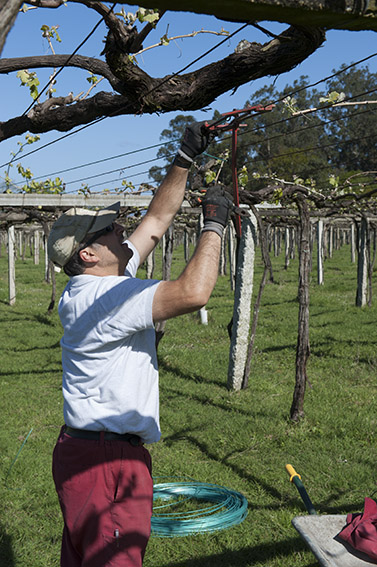
The good news is that out in the vineyard the pruning is finished and we are currently working on attaching the vines to the wires. Fortunately we now have small hand-held machines for doing this, so the whole process is speeded up considerably. Previously every single attachment had to be tied in a knot by hand! As soon as we have a period of dry weather we can start to burn the mountains of cuttings that have accumulated in the corner of each vineyard. Of course by burning the cuttings we reduce the possible spread of any fungus spores.

Significantly there is no new growth on the vines as yet. In some vintages we have had buds, shoots and even leaves on the plants by this time, but as I write this entry everything still lies dormant, which is actually no bad thing.

Nordic skiers only

As I left home this morning the outside temperature was only 4°C (just under 40°F), and on the horizon I could not believe what I saw……. snow covered hillsides – in the middle of March! Unfortunately I was on a motorway at the time, otherwise I would have stopped to take a photo, so therefore you will just have to take my word for it. I could of course have made something up using Photoshop – perhaps a beautiful shot of Angela making a snowman in front of the bodega, but that would be missing the point. The real story is that it’s been a long, cold and wet winter, so far (and maybe it’s not over yet).

The good news is that out in the vineyard the pruning is finished and we are currently working on attaching the vines to the wires. Fortunately we now have small hand-held machines for doing this, so the whole process is speeded up considerably. Previously every single attachment had to be tied in a knot by hand! As soon as we have a period of dry weather we can start to burn the mountains of cuttings that have accumulated in the corner of each vineyard. Of course by burning the cuttings we reduce the possible spread of any fungus spores.

Significantly there is no new growth on the vines as yet. In some vintages we have had buds, shoots and even leaves on the plants by this time, but as I write this entry everything still lies dormant, which is actually no bad thing.

Better late than never!

March 8th, 2013 | Press

Decanter

A day or two ago when I was writing about our Wine Advocate rating I decided to have a quick look back at our tasting result from the UK’s Decanter magazine. To my horror I discovered that, despite a fantastic review, being rated near the very top of the tasting in the ‘outstanding’ category, I had never mentioned the result on our blog site! Whilst I had written individually to our existing customers announcing our success, I had completely overlooked our social media outlets. So here is a new post relating to the article from the August 2012 issue of Decanter – nothing like being up to date……

The tasting panel comprised three Spanish wine experts – Ferran Centelles, former sommelier at the world famous el Bulli, and Spanish sommelier of the year in 2006. The late John Radford (who sadly died a few months after the tasting), award winning writer and broadcaster, having written several books about  Spanish wines, and Caballero de Vino Español. Sarah Jane Evans MW, wine writer and also a member of the Gran Orden de Caballeros. Owing to the highly qualified nature of this panel we were especially proud of the results:

A2O ‘Sobre Lias’ 2010 – Highly recommended (90-94 pts)

Smoky, earthy, leafy with bonfire aromas. Richer, ripe style with an off-dry impression; yellow peaches, golden plums and exotic fruit, with lime acidity underpinning. Finish is long and ripe, with plenty of finesse and expression.

Bodega Castro Martin Family Estate Selection ‘Sobre Lias’ 2010 – (Outstanding 95-100 pts)

Restrained example of Albariño, with green, refreshing acidity and a long, stony finish. Well made and full of green peaches, green apple and white flowers. Very food friendly and a wine that can be aged for up to three years.

Decanter

A day or two ago when I was writing about our Wine Advocate rating I decided to have a quick look back at our tasting result from the UK’s Decanter magazine. To my horror I discovered that, despite a fantastic review, being rated near the very top of the tasting in the ‘outstanding’ category, I had never mentioned the result on our blog site! Whilst I had written individually to our existing customers announcing our success, I had completely overlooked our social media outlets. So here is a new post relating to the article from the August 2012 issue of Decanter – nothing like being up to date……

The tasting panel comprised three Spanish wine experts – Ferran Centelles, former sommelier at the world famous el Bulli, and Spanish sommelier of the year in 2006. The late John Radford (who sadly died a few months after the tasting), award winning writer and broadcaster, having written several books about  Spanish wines, and Caballero de Vino Español. Sarah Jane Evans MW, wine writer and also a member of the Gran Orden de Caballeros. Owing to the highly qualified nature of this panel we were especially proud of the results:

A2O ‘Sobre Lias’ 2010 – Highly recommended (90-94 pts)

Smoky, earthy, leafy with bonfire aromas. Richer, ripe style with an off-dry impression; yellow peaches, golden plums and exotic fruit, with lime acidity underpinning. Finish is long and ripe, with plenty of finesse and expression.

Bodega Castro Martin Family Estate Selection ‘Sobre Lias’ 2010 – (Outstanding 95-100 pts)

Restrained example of Albariño, with green, refreshing acidity and a long, stony finish. Well made and full of green peaches, green apple and white flowers. Very food friendly and a wine that can be aged for up to three years.

Wine Advocate

March 5th, 2013 | Press

Wine scores

Well, what’s in a score? I’ve said it before, and I’ll say it again – the score used for rating a wine is just a number. The main thing is that people buy our wine, but even more importantly, that they actually enjoy drinking it. The Wine Advocate has just published its article written by the Englishman, Neal Martin, following a visit to Pontevedra and his extensive tasting at our D.O. office. Suffice to say that all of his top scores were awarded to special cuvées, that’s to say the premium wines made by a few of the top bodegas (usually sold at a premium price). Out of the remainder of the ‘everyday drinking’ albariños (in other words the wines that represent the main production of each bodega), we actually did rather well. The two wines that we submitted were rated within the top handful of wines, and the tasting notes, I think,  speak for themselves.

A2O ‘Sobre Lias’ 2011

The 2011 A20 Sobre Lias has more complexity on the nose with subtle white peach and fruit salad aromas. The palate is fresh and crisp on the entry with Granny Smith apples, pear and grapefruit. It is focused, poised with decent weight towards the finish. This is very fine. Drink now-2018.

Bodega Castro Martin Family Estate Selection ‘Sobre Lias’ 2011

The 2011 Albarino Sobre Lias undergoes a six-month lees aging and that lends the nose a pleasant lift of apple blossom and greengage scents. The palate is fresh and vibrant with a twist of bitter lemon on the entry. It is well-balanced and fresh, hints of apricot in the background underpinning a focused, vibrant tangerine-tinged finish. Drink now-2017.

Wine scores

Well, what’s in a score? I’ve said it before, and I’ll say it again – the score used for rating a wine is just a number. The main thing is that people buy our wine, but even more importantly, that they actually enjoy drinking it. The Wine Advocate has just published its article written by the Englishman, Neal Martin, following a visit to Pontevedra and his extensive tasting at our D.O. office. Suffice to say that all of his top scores were awarded to special cuvées, that’s to say the premium wines made by a few of the top bodegas (usually sold at a premium price). Out of the remainder of the ‘everyday drinking’ albariños (in other words the wines that represent the main production of each bodega), we actually did rather well. The two wines that we submitted were rated within the top handful of wines, and the tasting notes, I think,  speak for themselves.

A2O ‘Sobre Lias’ 2011

The 2011 A20 Sobre Lias has more complexity on the nose with subtle white peach and fruit salad aromas. The palate is fresh and crisp on the entry with Granny Smith apples, pear and grapefruit. It is focused, poised with decent weight towards the finish. This is very fine. Drink now-2018.

Bodega Castro Martin Family Estate Selection ‘Sobre Lias’ 2011

The 2011 Albarino Sobre Lias undergoes a six-month lees aging and that lends the nose a pleasant lift of apple blossom and greengage scents. The palate is fresh and vibrant with a twist of bitter lemon on the entry. It is well-balanced and fresh, hints of apricot in the background underpinning a focused, vibrant tangerine-tinged finish. Drink now-2017.

The rise and fall of Sidi Brahim

March 4th, 2013 | International News

Algeria

At your next dinner party there is a question about wine that you can ask your guests, which I can almost guarantee everyone will get wrong. Which country was the world’s leading wine exporter in the 1950’s? France? Italy? Spain or perhaps even Germany? All wrong…… it was Algeria! Now, where it all went, and how it was consumed is another story.

The story of the Algerian wine industry is quite interesting, and also more significantly, precipitated the creation of the French laws of appellation. After the disaster of phylloxera in the 1860’s the French were initially left scrambling about in Spain and Italy in an attempt to satisfy the demand for wine in their domestic market. In the late 19th century the French turned to their relatively new Colony of Algeria to try to fill the gap. With the aid of French wine growers who had settled there, they produced enormous volumes of cheap, high alcohol wine which arrived in France tax-free (as the country was treated as a part of France). At this time the total volume of wine exports accounted for around one third of Algeria’s gross domestic product and half of its total export revenues!

Originally this was advertised as French wine, which, as the French vineyards themselves started to recover from disease, was not well received by the growers still residing in France. In response to protests (made most vigorously by the producers of Champagne, Bordeaux and Burgundy), the French government created some rather flimsy laws in an attempt to protect their home-grown wines. These were eventually formalised into the French rules of Appellation d’Origine Contrôlée, thus authenticating the origin of wines. Although these new rules protected the French quality wines, the table wine producers of the Languedoc still faced still competition from Algeria, and so instead of taxing the wines themselves, which would have been somewhat unpalatable (pardon the pun), the French government decided to tax the over productive vineyards. This in itself however, did not cause the demise of the industry, as recently as 1961 Algeria was still the world’s 4th largest wine producer – it was really when the French withdrew altogether from the country, and the industry was Nationalised and consequently badly mismanaged, that the wheels well and truly fell off and production volumes tumbled back to the original 19th century levels.

Historically therefore, Algeria has inadvertently played an important part in the history of world wine production, not only for its sheer size, but also for being instrumental in the creation of the original AOC laws. 

And who or what  is Sidi Brahim? Well, it’s actually a famous Algerian wine brand named after the Battle of Sidi-Brahim, which to this day is still sold quite widely in France. Indeed, as recently as the 1960’s people in France used to joke about one or two of the more feeble Burgundy or Bordeaux wines being ‘boosted’ by adding a bit of the heavier, more alcoholic Sidi Brahim!!

Algeria

At your next dinner party there is a question about wine that you can ask your guests, which I can almost guarantee everyone will get wrong. Which country was the world’s leading wine exporter in the 1950’s? France? Italy? Spain or perhaps even Germany? All wrong…… it was Algeria! Now, where it all went, and how it was consumed is another story.

The story of the Algerian wine industry is quite interesting, and also more significantly, precipitated the creation of the French laws of appellation. After the disaster of phylloxera in the 1860’s the French were initially left scrambling about in Spain and Italy in an attempt to satisfy the demand for wine in their domestic market. In the late 19th century the French turned to their relatively new Colony of Algeria to try to fill the gap. With the aid of French wine growers who had settled there, they produced enormous volumes of cheap, high alcohol wine which arrived in France tax-free (as the country was treated as a part of France). At this time the total volume of wine exports accounted for around one third of Algeria’s gross domestic product and half of its total export revenues!

Originally this was advertised as French wine, which, as the French vineyards themselves started to recover from disease, was not well received by the growers still residing in France. In response to protests (made most vigorously by the producers of Champagne, Bordeaux and Burgundy), the French government created some rather flimsy laws in an attempt to protect their home-grown wines. These were eventually formalised into the French rules of Appellation d’Origine Contrôlée, thus authenticating the origin of wines. Although these new rules protected the French quality wines, the table wine producers of the Languedoc still faced still competition from Algeria, and so instead of taxing the wines themselves, which would have been somewhat unpalatable (pardon the pun), the French government decided to tax the over productive vineyards. This in itself however, did not cause the demise of the industry, as recently as 1961 Algeria was still the world’s 4th largest wine producer – it was really when the French withdrew altogether from the country, and the industry was Nationalised and consequently badly mismanaged, that the wheels well and truly fell off and production volumes tumbled back to the original 19th century levels.

Historically therefore, Algeria has inadvertently played an important part in the history of world wine production, not only for its sheer size, but also for being instrumental in the creation of the original AOC laws. 

And who or what  is Sidi Brahim? Well, it’s actually a famous Algerian wine brand named after the Battle of Sidi-Brahim, which to this day is still sold quite widely in France. Indeed, as recently as the 1960’s people in France used to joke about one or two of the more feeble Burgundy or Bordeaux wines being ‘boosted’ by adding a bit of the heavier, more alcoholic Sidi Brahim!!

What is Fairtrade wine?

February 26th, 2013 | Business

Fairtrade

So why have I chosen this moment to write about Fairtrade wine? Well, it’s simply because as of yesterday we slid quietly (perhaps too quietly) into ‘Fairtrade fortnight’ – two weeks when the wine industry is required to focus its attention on ethically produced wines.

I think I should start by saying that to the best of my knowledge there is no such thing as Fairtrade wine here in Spain, and the reason for this  is quite simply that we do not need it. Fairtrade products exist to ensure that the people who are making them (and possibly even more importantly, their employees), receive ‘fair’ remuneration for their products and their labour. As we live in a modern western democracy we would of course hope that Spanish companies and their workers are not subjected to the same economic pressures as some of our poorer third world cousins – hence the fact that Fairtrade does not really apply to us.

The worst affected countries are reported to be South Africa, Chile and Argentina where agricultural workers are notoriously badly paid. Even a recent 52% increase paid to workers in the South African vineyards means that they still only earn a meagre R105 per day (approx £7.50 or $11.50), which is probably still well below what we should consider to be ‘fair’. Obviously this is one of the reasons that wines from these countries are often so cheap, as labour alone accounts for a considerable chunk of the production cost of each bottle. The cheaper the grape production, the cheaper the liquid. Simple.

Of course in more modern production areas the vineyard costs have been reduced by the introduction of mechanisation, but this requires a considerable financial investment at the offset, and also means that perhaps the resulting fruit is not quite as good. There will be some who would argue that mechanisation in the vineyard makes little or no difference, but I believe that there are only a very few of the world’s very top producers who would support this idea. Usually the more care we take with our fruit, the better the end product, and I for one am certainly a believer that probably 95% of our quality comes from the vineyard (or perhaps even more!).

To close I am reminded of the story of a restaurant that advertised “food at popular prices”. One customer complained “but this food is expensive and your sign says food at popular prices”. The owner looked at him and replied dismissively “Yes, but we like them”….. perhaps the antipathy of Fairtrade?

Fairtrade

So why have I chosen this moment to write about Fairtrade wine? Well, it’s simply because as of yesterday we slid quietly (perhaps too quietly) into ‘Fairtrade fortnight’ – two weeks when the wine industry is required to focus its attention on ethically produced wines.

I think I should start by saying that to the best of my knowledge there is no such thing as Fairtrade wine here in Spain, and the reason for this  is quite simply that we do not need it. Fairtrade products exist to ensure that the people who are making them (and possibly even more importantly, their employees), receive ‘fair’ remuneration for their products and their labour. As we live in a modern western democracy we would of course hope that Spanish companies and their workers are not subjected to the same economic pressures as some of our poorer third world cousins – hence the fact that Fairtrade does not really apply to us.

The worst affected countries are reported to be South Africa, Chile and Argentina where agricultural workers are notoriously badly paid. Even a recent 52% increase paid to workers in the South African vineyards means that they still only earn a meagre R105 per day (approx £7.50 or $11.50), which is probably still well below what we should consider to be ‘fair’. Obviously this is one of the reasons that wines from these countries are often so cheap, as labour alone accounts for a considerable chunk of the production cost of each bottle. The cheaper the grape production, the cheaper the liquid. Simple.

Of course in more modern production areas the vineyard costs have been reduced by the introduction of mechanisation, but this requires a considerable financial investment at the offset, and also means that perhaps the resulting fruit is not quite as good. There will be some who would argue that mechanisation in the vineyard makes little or no difference, but I believe that there are only a very few of the world’s very top producers who would support this idea. Usually the more care we take with our fruit, the better the end product, and I for one am certainly a believer that probably 95% of our quality comes from the vineyard (or perhaps even more!).

To close I am reminded of the story of a restaurant that advertised “food at popular prices”. One customer complained “but this food is expensive and your sign says food at popular prices”. The owner looked at him and replied dismissively “Yes, but we like them”….. perhaps the antipathy of Fairtrade?

Wine Geek test

February 25th, 2013 | Oddballs

wine geek

How do you know if you’re becoming a Wine Geek? Here are a few of the tell tale signs: 

1). You worry that you’ve left a bottle of wine in the car with the windows closed

2). You’re really upset that you weren’t born in the year of a great vintage

3). You’re convinced that you’re suffering from compulsive glass swirling syndrome

4). You’ve installed humidity control in your basement

5). You keep separate wine stocks for ‘normal’ and ‘knowledgeable’  dinner guests

6). You don’t consider a red wine great unless you can ‘taste’ the vineyard in the sediment

7). You can recite the names of all the 1st growth Bordeaux wines but can’t remember your own home phone number

8). You can happily consume Champagne at any time of day and for absolutely any reason

How many of these symptoms do you recognise?

wine geek

How do you know if you’re becoming a wine geek? Here are a few of the tell tale signs: 

1). You worry that you’ve left a bottle of wine in the car with the windows closed

2). You’re really upset that you weren’t born in the year of a great vintage

3). You’re convinced that you’re suffering from compulsive glass swirling syndrome

4). You’ve installed humidity control in your basement

5). You keep separate wine stocks for ‘normal’ and ‘knowledgeable’  dinner guests

6). You don’t consider a red wine great unless you can ‘taste’ the vineyard in the sediment

7). You can recite the names of all the 1st growth Bordeaux wines but can’t remember your own home phone number

8). You can happily consume Champagne at any time of day and for absolutely any reason

How many of these symptoms do you recognise?

Accidentally stolen?

February 19th, 2013 | Oddballs

With almost the entire world economy in recession it is hardly surprising that even wine sales are reflecting the general trend and have taken a bit of a dive. The cru classé wines of Bordeaux that have traditionally been a ‘safe haven’ for investors have also not been immune to the downturn. As a result of all the turmoil probably one of the most difficult areas of the market is that of the mid-priced wines, including our very own albariño.  At the top end, the expensive, luxury wines will always sell as consumers push the boat out and treat themselves for special occasions. On the other side of the coin, as they try to reduce their outgoings and save a few pounds, dollars or euros, then lower end wines can also feel the benefit of this ‘trading down’. This then leaves the selection of mid-priced wines slightly in limbo, perhaps left on the shelf as unsold.

Now, it could be that I’m really quite an evil person, or maybe it’s just because I am naturally suspicious (living in Spain certainly does not help, especially amidst all the recent tales of political  and financial corruption), but when I read stories of strange wine ‘thefts’ I simply can’t help but wonder. 62,000 bottles of wine, valued at AUD 500,000 recently went missing whilst in transit across New South Wales. The point that makes this story a bit curious is that the transport company who were moving these wines went into administration whilst they were in possession of the stock. Now forgive me for thinking, that strikes me as being a bit bizarre to say the very least.

Then there was a local tale, much nearer to home, here in Galicia. A wine cellar (perhaps overstocked with too much old vintage wine), was apparently broken into, and several tanks of wine were inexplicably emptied down the drain. As far as I know nothing was actually stolen, and there was no clear motive for the break-in. Vandalism? I’m not so sure I have to admit. In the meantime I have no doubt that the respective insurance companies will be studying these uncanny losses quite closely.

With almost the entire world economy in recession it is hardly surprising that even wine sales are reflecting the general trend and have taken a bit of a dive. The cru classé wines of Bordeaux that have traditionally been a ‘safe haven’ for investors have also not been immune to the downturn. As a result of all the turmoil probably one of the most difficult areas of the market is that of the mid-priced wines, including our very own albariño.  At the top end, the expensive, luxury wines will always sell as consumers push the boat out and treat themselves for special occasions. On the other side of the coin, as they try to reduce their outgoings and save a few pounds, dollars or euros, then lower end wines can also feel the benefit of this ‘trading down’. This then leaves the selection of mid-priced wines slightly in limbo, perhaps left on the shelf as unsold.

Now, it could be that I’m really quite an evil person, or maybe it’s just because I am naturally suspicious (living in Spain certainly does not help, especially amidst all the recent tales of political  and financial corruption), but when I read stories of strange wine ‘thefts’ I simply can’t help but wonder. 62,000 bottles of wine, valued at AUD 500,000 recently went missing whilst in transit across New South Wales. The point that makes this story a bit curious is that the transport company who were moving these wines went into administration whilst they were in possession of the stock. Now forgive me for thinking, that strikes me as being a bit bizarre to say the very least.

Then there was a local tale, much nearer to home, here in Galicia. A wine cellar (perhaps overstocked with too much old vintage wine), was apparently broken into, and several tanks of wine were inexplicably emptied down the drain. As far as I know nothing was actually stolen, and there was no clear motive for the break-in. Vandalism? I’m not so sure I have to admit. In the meantime I have no doubt that the respective insurance companies will be studying these uncanny losses quite closely.

Women in wine

February 15th, 2013 | International News

 I recently read an article listing the top 50 most influential women in the wine trade. As you might imagine there was an interesting mix of characters, including property owners, journalists, MW’s, winemakers, writers etc.,etc. – a real cross-section of our industry. Perhaps not unsurprisingly at No.1 sits Gina Gallo, chief winemaker of the Gallo empire. Whilst I have never met her, I do know her husband Jean-Charles Boisset rather well. I have visited the Boisset family home on a number of occasions, and indeed it was his father Jean-Claude who sponsored me to become a Chevalier du Tastevin at the world famous Clos de Vougeot in Burgundy. The night of my induction was something that I will never forget, and I should also mention that it was the first official event that Angela and I attended together, even before we were married. Jean-Charles attended the dinner with us.

Meanwhile, back at the list of famous women, I am pleased to say that, despite not knowing Gina Gallo, I have met at least two of the other top five candidates on the list, namely Jancis Robinson and Lalou Bize-Leroy. The latter (formerly the joint head of Domaine de la Romanée-Conti), and now the owner of the world famous Domaine Leroy, is certainly near the very top of my own list of favourite winemakers. In the last few months Angela and I have enjoyed at least two bottles of Domaine Leroy at our favourite restaurant Pepe Vieira. Naturally, these wines are highly sought after, and usually quite difficult to find (especially here in Spain). It was Angela’s first experience of this Domaine’s stunning wines, and I think it’s fair to say that she was quite impressed….

A bit nearer to home we have our own list of famous women. Within the denomination of Rias Baixas several of the best wines are made by women (including our very own I hasten to add). It’s probably at this point in my post that I should admit that there is a vaild argument that women make better wines than men. Without trying to sound sexist for one moment, they do have a very good touch around the cellar, and produce some very fine and elegant wines.

I should close by saying that today’s photo shows my very own famous women – the two Angelas, my wife and our beautiful daughter. The photo was taken at a recent tasting and was the very first time that we have revealed Angela 2.o to the world of wine! The next generation? We shall see…..

I recently read an article listing the top 50 most influential women in the wine trade. As you might imagine there was an interesting mix of characters, including property owners, journalists, MW’s, winemakers, writers etc.,etc. – a real cross-section of our industry. Perhaps not unsurprisingly at No.1 sits Gina Gallo, chief winemaker of the Gallo empire. Whilst I have never met her, I do know her husband Jean-Charles Boisset rather well. I have visited the Boisset family home on a number of occasions, and indeed it was his father Jean-Claude who sponsored me to become a Chevalier du Tastevin at the world famous Clos de Vougeot in Burgundy. The night of my induction was something that I will never forget, and I should also mention that it was the first official event that Angela and I attended together, even before we were married. Jean-Charles attended the dinner with us.

Meanwhile, back at the list of famous women, I am pleased to say that, despite not knowing Gina Gallo, I have met at least two of the other top five candidates on the list, namely Jancis Robinson and Lalou Bize-Leroy. The latter (formerly the joint head of Domaine de la Romanée-Conti), and now the owner of the world famous Domaine Leroy, is certainly near the very top of my own list of favourite winemakers. In the last few months Angela and I have enjoyed at least two bottles of Domaine Leroy at our favourite restaurant Pepe Vieira. Naturally, these wines are highly sought after, and usually quite difficult to find (especially here in Spain). It was Angela’s first experience of this Domaine’s stunning wines, and I think it’s fair to say that she was quite impressed….

A bit nearer to home we have our own list of famous women. Within the denomination of Rias Baixas several of the best wines are made by women (including our very own I hasten to add). It’s probably at this point in my post that I should admit that there is a vaild argument that women make better wines than men. Without trying to sound sexist for one moment, they do have a very good touch around the cellar, and produce some very fine and elegant wines.

I should close by saying that today’s photo shows my very own famous women – the two Angelas, my wife and our beautiful daughter. The photo was taken at a recent tasting and was the very first time that we have revealed Angela 2.o to the world of wine! The next generation? We shall see…..

Monthly Archives

Categories

ARE YOU OF LEGAL AGE? This site is intended for those of legal drinking age. By entering, you confirm that you are of legal drinking age in the country where this site is being accessed. ¿ERES MAYOR DE EDAD? Este sitio está destinado a personas en edad legal para beber alcohol. Al ingresar, confirma que tiene la edad legal para beber en el país donde se accede a este sitio.