Vine vigour

July 18th, 2013 | Vineyards

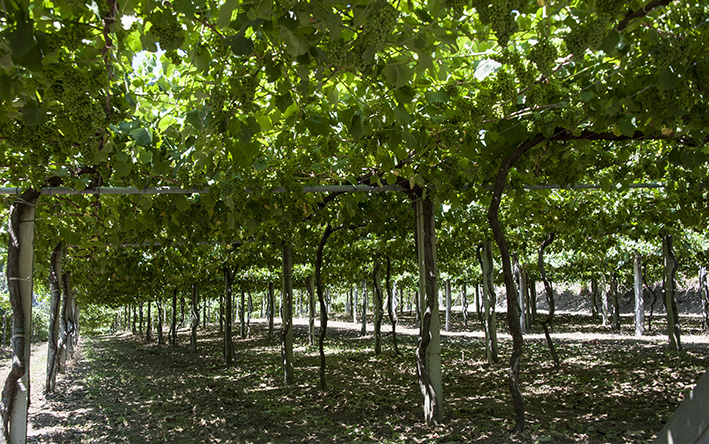
ClimberAfter a long, cool, wet spring building up the water table in the soil, we now have very hot, sunny weather. Of course our vines really revel in these conditions, and they start to grow very, very quickly – almost out of control. This very rapid development of the shoots is known as vine vigour, and will hopefully slow down as the grape clusters start to develop during ‘veraison’ – the moment when the recognisable fruit starts to develop. The problem is that if the canopy grows unchecked then this will simply detract from the quality of the grapes, as the excess foliage competes for the resources of the vine plant. This is why we spend long periods during the summer removing leaves and thinning the canopy.

Of course vines are natural climbers, which is why we use wires to train them. Unfortunately they do not distinguish between different types of wire, which is why today’s photo shows a vine plotting its escape from the vineyard by means of a telephone cable. (Yes, we still have some overhead telephone cables out here in the wilds of Galicia – fibre optics are merely a dream of the future!)

ClimberAfter a long, cool, wet spring building up the water table in the soil, we now have very hot, sunny weather. Of course our vines really revel in these conditions, and they start to grow very, very quickly – almost out of control. This very rapid development of the shoots is known as vine vigour, and will hopefully slow down as the grape clusters start to develop during ‘veraison’ – the moment when the recognisable fruit starts to develop. The problem is that if the canopy grows unchecked then this will simply detract from the quality of the grapes, as the excess foliage competes for the resources of the vine plant. This is why we spend long periods during the summer removing leaves and thinning the canopy.

Of course vines are natural climbers, which is why we use wires to train them. Unfortunately they do not distinguish between different types of wire, which is why today’s photo shows a vine plotting its escape from the vineyard by means of a telephone cable. (Yes, we still have some overhead telephone cables out here in the wilds of Galicia – fibre optics are merely a dream of the future!)

Blowing hot and cold

July 15th, 2013 | Bodega

Ye Olde AirconI have now been living in Spain for 11 years, and although there have been quite a few changes and modifications in the bodega, the office where we work remains largely unchanged. Having spent several years working on a large table, I now at least, have a desk.

One of the other things I noticed is that, following a decidedly chilly winter, we are now sitting in the office perspiring (and quite profusely in recent days). The problem is that our offices have no fixed heating or cooling system. In winter we have a couple of plug-in radiators, and in summer we leave the windows open as long as we dare, until our south-facing office becomes too unbearable. On the wall of the office we have a very old air conditioning unit which has never worked in all the time that I have lived here. I have therefore come to one simple conclusion – we take much greater care of the temperature of our cellar, tanks and wine, than we do of ourselves. And quite right too…. our wine will always take priority.

Having said that, we have now decided that enough is enough (Angela has finally objected to me sitting here in my Speedos). We have just placed an order for a new aircon unit that will replace the original Sanyo unit which may have been here since the bodega was first built (see picture).

Of course, Sod’s Law dictates that the moment that we have the new air conditioning installed, then so the current period of stifling weather will come to an end!

Ye Olde AirconI have now been living in Spain for 11 years, and although there have been quite a few changes and modifications in the bodega, the office where we work remains largely unchanged. Having spent several years working on a large table, I now at least, have a desk.

One of the other things I noticed is that, following a decidedly chilly winter, we are now sitting in the office perspiring (and quite profusely in recent days). The problem is that our offices have no fixed heating or cooling system. In winter we have a couple of plug-in radiators, and in summer we leave the windows open as long as we dare, until our south-facing office becomes too unbearable. On the wall of the office we have a very old air conditioning unit which has never worked in all the time that I have lived here. I have therefore come to one simple conclusion – we take much greater care of the temperature of our cellar, tanks and wine, than we do of ourselves. And quite right too…. our wine will always take priority.

Having said that, we have now decided that enough is enough (Angela has finally objected to me sitting here in my Speedos). We have just placed an order for a new aircon unit that will replace the original Sanyo unit which may have been here since the bodega was first built (see picture).

Of course, Sod’s Law dictates that the moment that we have the new air conditioning installed, then so the current period of stifling weather will come to an end!

A basket case

July 12th, 2013 | Bodega

BasketsIt suddenly occurred to me the other day that of all the things I have written about our bodega over the last several years, there is one thing that I have never mentioned….. our baskets!

When it comes albariño at Bodegas Castro Martin we chose to store our wines in tank and bottle only as and when required – simply because the wine keeps better and stays fresher in tank. In an ideal world we would bottle each tank, label it at the time of bottling, and then simply sell it, but unfortunately life in the world of wine is never that simple.

As I have mentioned on previous occasions, as we increase the number of overseas markets that we sell to, so the range of different labelling requirements becomes more complicated. It’s not because we are inventing different brands for each market, but it’s simply that the legal label requirements vary so much from country to country. So, for example, if we are bottling a tank of our Castro Martin Family Estate wine, then the question is, how many cases do we label with the EU back label, how many with the U.S. back label, how many with the Australian back label, and so on. The simple answer is that we never know, and so there is only one solution….. to bottle at least a part of each tank without any labels at all. Of course this may sound slightly illegal, but as long as we keep copious bottling records and mark each batch very clearly, then this means that we can store the unlabelled bottles in large metal baskets until required. This wine without label is known as ‘clean skin’ stock. 

Each time we receive an order for a market that requires its own specific back label, then we simply select the appropriate baskets, take out the wine, and label it accordingly. Job done.

BasketsIt suddenly occurred to me the other day that of all the things I have written about our bodega over the last several years, there is one thing that I have never mentioned….. our baskets!

When it comes albariño at Bodegas Castro Martin we chose to store our wines in tank and bottle only as and when required – simply because the wine keeps better and stays fresher in tank. In an ideal world we would bottle each tank, label it at the time of bottling, and then simply sell it, but unfortunately life in the world of wine is never that simple.

As I have mentioned on previous occasions, as we increase the number of overseas markets that we sell to, so the range of different labelling requirements becomes more complicated. It’s not because we are inventing different brands for each market, but it’s simply that the legal label requirements vary so much from country to country. So, for example, if we are bottling a tank of our Castro Martin Family Estate wine, then the question is, how many cases do we label with the EU back label, how many with the U.S. back label, how many with the Australian back label, and so on. The simple answer is that we never know, and so there is only one solution….. to bottle at least a part of each tank without any labels at all. Of course this may sound slightly illegal, but as long as we keep copious bottling records and mark each batch very clearly, then this means that we can store the unlabelled bottles in large metal baskets until required. This wine without label is known as ‘clean skin’ stock. 

Each time we receive an order for a market that requires its own specific back label, then we simply select the appropriate baskets, take out the wine, and label it accordingly. Job done.

Cold, cold, cold, hot!

July 9th, 2013 | Weather

HeatwaveIt must be something in my blood, or perhaps something in the genes of every Englishman, but I’m going to mention the weather again! Only a few days ago I posted that there had been a sudden change and that someone, somewhere, had pressed the ‘summer’ button, at the same time raising the question of how long would it last? Well, I can tell you that not only has it continued, but it has actually become even hotter – on the coast (where we live) reaching 38°C (100°F), with not a breath of wind. A little further inland, in the city of Ourense, that lies in a natural basin surrounded by hills (notorious for trapping heat), it is even worse, with temperatures of over 43°C (110°F)

The problem is that being Galicia, we are not really geared up for long periods of extreme heat, and there are not that many locations fitted with air conditioning – it is certainly not a common fixture in people’s homes. In circumstance like this, when there is nowhere to escape the heat, the only thing we can do is keep the shutters closed and stay in the shade!

HeatwaveIt must be something in my blood, or perhaps something in the genes of every Englishman, but I’m going to mention the weather again! Only a few days ago I posted that there had been a sudden change and that someone, somewhere, had pressed the ‘summer’ button, at the same time raising the question of how long would it last? Well, I can tell you that not only has it continued, but it has actually become even hotter – on the coast (where we live) reaching 38°C (100°F), with not a breath of wind. A little further inland, in the city of Ourense, that lies in a natural basin surrounded by hills (notorious for trapping heat), it is even worse, with temperatures of over 43°C (110°F)

The problem is that being Galicia, we are not really geared up for long periods of extreme heat, and there are not that many locations fitted with air conditioning – it is certainly not a common fixture in people’s homes. In circumstance like this, when there is nowhere to escape the heat, the only thing we can do is keep the shutters closed and stay in the shade!

Inside the press

July 8th, 2013 | Equipment

New membrane (3)Having just written about changing the membrane in one of our presses I thought that this might be the ideal moment to explain how the wine press really works…..

Using today’s photo you can clearly see that the press is a cylinder more or less divided into two halves. On one side there is the new (beautifully white) inflatable membrane, whilst on the other side you can see a series of silicone rubber ‘fingers’. Once the press has been filled with grapes the pressing cycle begins and the whole cylinder rotates rather like a large tumble dryer. As it rotates the pneumatic membrane slowly inflates to a predetermined pressure, and the grapes are gently crushed, releasing their juice. The juice escapes through holes and is collected in a large tray underneath before it is chilled rapidly and moved to the tank room ready for fermentation. The membrane then deflates and the rubber ‘fingers’ begin to do their job.

Once the bag has deflated the cylinder rotates and the fingers serve to break up the compacted grape pomace. (Pomace is the mixture of grape skins and stalks – known as marc in French, and bagazo in Spanish). Once the pomace is broken up a little the membrane re-inflates to a slightly higher pressure and crushes the grapes again extracting yet more juice.

The length of the cycle, amount of pressure used and the number of pressings for each load of grapes is determined according to the requirement of the individual winemaker and the style and quality of wine they are attempting to make. Less pressing, less pressure and shorter cycles usually equate to a higher quality wine – indeed, some high quality wines are made entirely from ‘free run’ juice, or possibly just the first press. However, there is a danger that if the juice is too clean and pure, lacking in phenolic compounds, that the finished wine could potentially lack a bit of structure and balance.

Of course another decision which has to be made even before the grapes are pressed is whether they should be de-stemmed or not. Certainly the act of de-stemming will allow a much greater weight of grapes to enter the press (without the stems they occupy much less space), but on  the downside, for a white wine maker, fruit oxidation starts from the very second that the skin of the fruit is broken. Again this is the winemaker’s choice, and again this will have an influence on the style of the finished wine.

New membrane (3)Having just written about changing the membrane in one of our presses I thought that this might be the ideal moment to explain how the wine press really works…..

Using today’s photo you can clearly see that the press is a cylinder more or less divided into two halves. On one side there is the new (beautifully white) inflatable membrane, whilst on the other side you can see a series of silicone rubber ‘fingers’. Once the press has been filled with grapes the pressing cycle begins and the whole cylinder rotates rather like a large tumble dryer. As it rotates the pneumatic membrane slowly inflates to a predetermined pressure, and the grapes are gently crushed, releasing their juice. The juice escapes through holes and is collected in a large tray underneath before it is chilled rapidly and moved to the tank room ready for fermentation. The membrane then deflates and the rubber ‘fingers’ begin to do their job.

Once the bag has deflated the cylinder rotates and the fingers serve to break up the compacted grape pomace. (Pomace is the mixture of grape skins and stalks – known as marc in French, and bagazo in Spanish). Once the pomace is broken up a little the membrane re-inflates to a slightly higher pressure and crushes the grapes again extracting yet more juice.

The length of the cycle, amount of pressure used and the number of pressings for each load of grapes is determined according to the requirement of the individual winemaker and the style and quality of wine they are attempting to make. Less pressing, less pressure and shorter cycles usually equate to a higher quality wine – indeed, some high quality wines are made entirely from ‘free run’ juice, or possibly just the first press. However, there is a danger that if the juice is too clean and pure, lacking in phenolic compounds, that the finished wine could potentially lack a bit of structure and balance.

Of course another decision which has to be made even before the grapes are pressed is whether they should be de-stemmed or not. Certainly the act of de-stemming will allow a much greater weight of grapes to enter the press (without the stems they occupy much less space), but on  the downside, for a white wine maker, fruit oxidation starts from the very second that the skin of the fruit is broken. Again this is the winemaker’s choice, and again this will have an influence on the style of the finished wine.

Changing our neumáticos

July 6th, 2013 | Bodega

Changing the membraneWith all the controversy surrounding Formula One at the moment, and the problems with Pirelli, I thought that now might be a good time to change the neumáticos in our bodega too! Well, strictly speaking, these are not tyres, but rather the large pneumatic ‘airbags’ that we have inside our presses. A membrane ‘blowout’ in our presses during harvest can be just as devastating for us as it was for Luis Hamilton or Felipe Massa in the British Grand Prix last week.

Thankfully this is not a job that we have to do every year, but just once every several years. Sometimes it takes the form of an emergency replacement during harvest when a membrane is damaged beyond repair, but on this occasion it is a pro-active change, as we decide that one of the current airbags has reached the end of its working life. The repairs that are made during harvest can sometimes be the result of debris or a foreign object that accidentally finds its way into the press in one of the collection cases. Perhaps the most common example would be a pair of secateurs carelessly discarded in the vineyard. Obviously this punctures the membrane and caused rapid deflation in exactly the same way as a piece of debris on the racetrack during a Grand Prix might cause a tyre to explode.

However, that is where the Grand Prix analogy ends. We don’t have four helmeted guys standing at the side of the press waiting to rip out the old membrane and change it in under 5 seconds. For this job someone spends the best part of half a day sweating, actually inside the press, removing and replacing the hundreds of nuts and bolts that secure the bag (see today’s photo). Nothing glamorous about this job, and I suspect that the pay is not quite as high as a Formula One team either……

The annual job of servicing our presses is one of the first signs that this year’s harvest is not that far away!

Changing the membraneWith all the controversy surrounding Formula One at the moment, and the problems with Pirelli, I thought that now might be a good time to change the neumáticos in our bodega too! Well, strictly speaking, these are not tyres, but rather the large pneumatic ‘airbags’ that we have inside our presses. A membrane ‘blowout’ in our presses during harvest can be just as devastating for us as it was for Luis Hamilton or Felipe Massa in the British Grand Prix last week.

Thankfully this is not a job that we have to do every year, but just once every several years. Sometimes it takes the form of an emergency replacement during harvest when a membrane is damaged beyond repair, but on this occasion it is a pro-active change, as we decide that one of the current airbags has reached the end of its working life. The repairs that are made during harvest can sometimes be the result of debris or a foreign object that accidentally finds its way into the press in one of the collection cases. Perhaps the most common example would be a pair of secateurs carelessly discarded in the vineyard. Obviously this punctures the membrane and caused rapid deflation in exactly the same way as a piece of debris on the racetrack during a Grand Prix might cause a tyre to explode.

However, that is where the Grand Prix analogy ends. We don’t have four helmeted guys standing at the side of the press waiting to rip out the old membrane and change it in under 5 seconds. For this job someone spends the best part of half a day sweating, actually inside the press, removing and replacing the hundreds of nuts and bolts that secure the bag (see today’s photo). Nothing glamorous about this job, and I suspect that the pay is not quite as high as a Formula One team either……

The annual job of servicing our presses is one of the first signs that this year’s harvest is not that far away!

Independence!

July 4th, 2013 | Fiestas

TETRRF-00024113-001In Spain people do not need an excuse for a fiesta. Halloween, for example, is now almost as big here as it is in the States, although I rather suspect that few people know its origin or what it is really supposed to represent. 

Anyway, enough of all that. Today is 4th of July, celebrated by Americans around the world (but not the Spanish…….. just yet).

Happy Independence day!

TETRRF-00024113-001In Spain people do not need an excuse for a fiesta. Halloween, for example, is now almost as big here as it is in the States, although I rather suspect that few people know its origin or what it is really supposed to represent. 

Anyway, enough of all that. Today is 4th of July, celebrated by Americans around the world (but not the Spanish…….. just yet).

Happy Independence day!

A question of timing…

July 3rd, 2013 | Tasting

FHC 2013I had a feeling that I had already written about today’s subject once before, but looking back through my archives I can’t find anything, so I thought that today I would have a little moan about wine fairs. Well, not so much the wine fairs themselves (although we are very selective about those that we chose to attend), but more about the time of year that they are held. The problem is to do with the size of our wine cellar…. I will explain.

Bodegas Castro Martin is a comparatively small, family run bodega – we have only a handful of employees, and the day-today management is shared pretty much between Angela and myself. This means that we have a hand in everything, from managing the vineyards (Angela’s speciality), to making the wine, and then marketing and selling it. This also includes handling any customer or press visits and attending tastings and wine fairs – and thereby lies the problem.

Any wine fair that falls around harvest time, or in the month or two immediately after, is completely impossible for us to attend. It is a direct conflict, and it goes without saying that our harvest and wine making must always come first. From September through November we are tied to Ribadumia, and at some points during that period we are almost living in the bodega (by the way, we don’t have bedrooms).

The significance of our size therefore, is quite simple. If we were a larger business or perhaps decided to be less ‘hands on’, then we would probably employ a fully suited and booted sales manager who could attend these events on our behalf, without any detriment to either the harvest or the finished wine. The truth is that we love the personalised service that we are able to offer our customers – our wines are our children and we don’t allow them to go anywhere without us!

FHC 2013I had a feeling that I had already written about today’s subject once before, but looking back through my archives I can’t find anything, so I thought that today I would have a little moan about wine fairs. Well, not so much the wine fairs themselves (although we are very selective about those that we chose to attend), but more about the time of year that they are held. The problem is to do with the size of our wine cellar…. I will explain.

Bodegas Castro Martin is a comparatively small, family run bodega – we have only a handful of employees, and the day-today management is shared pretty much between Angela and myself. This means that we have a hand in everything, from managing the vineyards (Angela’s speciality), to making the wine, and then marketing and selling it. This also includes handling any customer or press visits and attending tastings and wine fairs – and thereby lies the problem.

Any wine fair that falls around harvest time, or in the month or two immediately after, is completely impossible for us to attend. It is a direct conflict, and it goes without saying that our harvest and wine making must always come first. From September through November we are tied to Ribadumia, and at some points during that period we are almost living in the bodega (by the way, we don’t have bedrooms).

The significance of our size therefore, is quite simple. If we were a larger business or perhaps decided to be less ‘hands on’, then we would probably employ a fully suited and booted sales manager who could attend these events on our behalf, without any detriment to either the harvest or the finished wine. The truth is that we love the personalised service that we are able to offer our customers – our wines are our children and we don’t allow them to go anywhere without us!

Weather update

July 1st, 2013 | Weather

heatI’ve said it before and I’ll say it again – we now have weather in extremes….. Just over a week ago I was complaining that we had experienced a very cool spring, with hardly any days above 20°C (68°F). Indeed, in recent weeks the average temperature had probably been nearer to 15°C (59/60°F), but that was until now!

Last week we had a fairly sudden and dramatic change when the thermometer hit 30°C (86°F) and has pretty much stayed there ever since. I can clearly remember about 10 days ago putting a fleece on in the office and thinking how ridiculous I felt dressed like that in the middle of June – today I’m in a t-shirt and shorts!

The question I guess has to be, how long will it last, and do we really want an extremely hot summer? The forecast is set for more of the same for at least the next week, so we will just have to wait and see how the rest of our summer evolves. Long term forecasts probably won’t help.

We should however, be very grateful that we are not experiencing the same problems as Arizona where temperatures have been in excess of 50°C (over 120°F). Only this morning we hear the tragic news that an entire team of 19 fire fighters have lost their lives whilst tackling raging forest fires over there. Sadly, this takes me back to Melbourne in 2009, when Angela and I arrived there on ‘Black Saturday’, with temperatures of more than 45°C (113°F) and winds of around 60mph – 173 people died, including 120 in one single fire storm. Simply dreadful.

heatI’ve said it before and I’ll say it again – we now have weather in extremes….. Just over a week ago I was complaining that we had experienced a very cool spring, with hardly any days above 20°C (68°F). Indeed, in recent weeks the average temperature had probably been nearer to 15°C (59/60°F), but that was until now!

Last week we had a fairly sudden and dramatic change when the thermometer hit 30°C (86°F) and has pretty much stayed there ever since. I can clearly remember about 10 days ago putting a fleece on in the office and thinking how ridiculous I felt dressed like that in the middle of June – today I’m in a t-shirt and shorts!

The question I guess has to be, how long will it last, and do we really want an extremely hot summer? The forecast is set for more of the same for at least the next week, so we will just have to wait and see how the rest of our summer evolves. Long term forecasts probably won’t help.

We should however, be very grateful that we are not experiencing the same problems as Arizona where temperatures have been in excess of  50°C (over 120°F). Only this morning we hear the tragic news that an entire team of 19 fire fighters have lost their lives whilst tackling raging forest fires over there. Sadly, this takes me back to Melbourne in 2009, when Angela and I arrived there on ‘Black Saturday’, with temperatures of more than 45°C (113°F) and winds of around 60mph – 173 people died, including 120 in one single fire storm. Simply dreadful.

Vintage Sherry?

June 26th, 2013 | Odds & Sods

La GuitaWhen I was a boy (a long, long time ago), I still remember that my mum’s favourite drink was Harvey’s Bristol Cream Sherry. Harvey’s was a Bristol wine merchant dating back to 1796, that was famous for centuries as an importer of sherry. It still exists today, but now as a wine museum and tapas restaurant, still serving it’s most famous beverage – Bristol Cream Sherry. Unfortunately I don’t remember too much about its taste, except to say that it was desperately sweet and sticky – if not for drinking then it could probably have served as some type of glue – an early adhesive for the Post-It pad perhaps?

On the subject of sherry, one of my own favourite drinks, and something that we nearly always have in our refrigerator, is Manzanilla. Of course anyone who drinks Manzanilla will know that one of the single most important factors in enjoying this fortified wine is that it is fresh, from a recent bottling. Of course this is quite ironic coming from someone who encourages consumers to drink their albariño with a bit of bottle age! The brand that I chose to drink is La Guita (not to be confused with La Gitana), not just because I like its taste, but also because I believe it is the only brand of Manzanilla to include the exact bottling date printed on the back label. You will often see me in my local supermarket sorting through the bottles on the shelf to find the newest wine….. 

Of course, by far the best way to enjoy a fresh glass of Manzanilla is to visit the coastal town of Sanlúcar de Barrameda in Cádiz where it is made. The distinctive Manzanilla wine acquires its dry, slightly salty tang from the seaside environment and the moist poniente wind that blows from the west along the Straights of Gibraltar. Its style is also derived from the distinctive chalky soil, the grape variety and from the local climate, which is cooler with high humidity, resulting in a higher level of flor yeast. As with our own wine it is absolutely perfect with seafood.

Yesterday I was out shopping with La Guita on my shopping list – there were only three bottles on the shelf. Upon closer examination one bottle was from 2010, one bottle from 2011 and the most recent bottle from March 2012….. doesn’t say too much for their stock rotation, and suffice to say that I didn’t buy any of them. I will look for some newer stock elsewhere.

La GuitaWhen I was a boy (a long, long time ago), I still remember that my mum’s favourite drink was Harvey’s Bristol Cream Sherry. Harvey’s was a Bristol wine merchant dating back to 1796, that was famous for centuries as an importer of sherry. It still exists today, but now as a wine museum and tapas restaurant, still serving it’s most famous beverage – Bristol Cream Sherry. Unfortunately I don’t remember too much about its taste, except to say that it was desperately sweet and sticky – if not for drinking then it could probably have served as some type of glue – an early adhesive for the Post-It pad perhaps?

On the subject of sherry, one of my own favourite drinks, and something that we nearly always have in our refrigerator, is Manzanilla. Of course anyone who drinks Manzanilla will know that one of the single most important factors in enjoying this fortified wine is that it is fresh, from a recent bottling. Of course this is quite ironic coming from someone who encourages consumers to drink their albariño with a bit of bottle age! The brand that I chose to drink is La Guita (not to be confused with La Gitana), not just because I like its taste, but also because I believe it is the only brand of Manzanilla to include the exact bottling date printed on the back label. You will often see me in my local supermarket sorting through the bottles on the shelf to find the newest wine….. 

Of course, by far the best way to enjoy a fresh glass of Manzanilla is to visit the coastal town of Sanlúcar de Barrameda in Cádiz where it is made. The distinctive Manzanilla wine acquires its dry, slightly salty tang from the seaside environment and the moist poniente wind that blows from the west along the Straights of Gibraltar. Its style is also derived from the distinctive chalky soil, the grape variety and from the local climate, which is cooler with high humidity, resulting in a higher level of flor yeast. As with our own wine it is absolutely perfect with seafood.

Yesterday I was out shopping with La Guita on my shopping list – there were only three bottles on the shelf. Upon closer examination one bottle was from 2010, one bottle from 2011 and the most recent bottle from March 2012….. doesn’t say too much for their stock rotation, and suffice to say that I didn’t buy any of them. I will look for some newer stock elsewhere.

Monthly Archives

Categories

ARE YOU OF LEGAL AGE? This site is intended for those of legal drinking age. By entering, you confirm that you are of legal drinking age in the country where this site is being accessed. ¿ERES MAYOR DE EDAD? Este sitio está destinado a personas en edad legal para beber alcohol. Al ingresar, confirma que tiene la edad legal para beber en el país donde se accede a este sitio.