Harvest 2013 – Day 4

October 8th, 2013 | Harvest

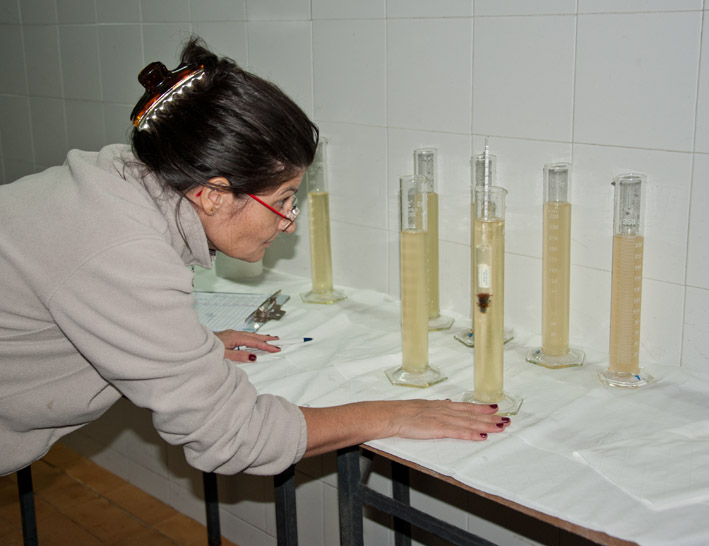
Angela in the labAnother fine and sunny day in Galicia for our fourth day of harvest. I believe that yesterday we hit the dizzy heights of 26°C (79°F), and today should be more of the same. Of course this just means that there is one less thing to worry about, and we can concentrate on our work. 

The good news is that, despite the recent rains, there are still some very positive noises coming from our laboratory where Angela spends most of her time secreted away at this time of year. She is very upbeat her tests and tastings of the grape must, saying that it is extremely fruity, floral and well balanced….. and who am I to question her judgement (she is the boss after all!)

Today we are continuing our work in our ‘El Pazo’ vineyard – our single biggest vineyard site of 5 hectares (just over 12 acres). This is the vineyard that provides most of the fruit for our Castro Martin ‘Family Estate’ wine. Even with more than 50 people working  it will still take more than two days to strip this site of its precious harvest. Fortunately this site is only a couple of kilometres from the bodega, which means that we can transport the fruit to our presses with the minimum of delay. As with every vineyard, in every harvest, we have a permanent shuttle of vehicles running between the picking location and the bodega. It’s all about logistics….

After three extremely busy days, our fourth day seemed to be slightly more ‘relaxed’ as most of the grapes supplied by other growers had already made it into our tanks (weekends are traditionally the busiest days). Perhaps it’s all relative, and only appears to be quieter because we have finally hit our stride, because the truth of the matter is that on day four we had only made two pressings less than Sunday, our busiest day so far.

Angela in the labAnother fine and sunny day in Galicia for our fourth day of harvest. I believe that yesterday we hit the dizzy heights of 26°C (79°F), and today should be more of the same. Of course this just means that there is one less thing to worry about, and we can concentrate on our work. 

The good news is that, despite the recent rains, there are still some very positive noises coming from our laboratory where Angela spends most of her time secreted away at this time of year. She is very upbeat her tests and tastings of the grape must, saying that it is extremely fruity, floral and well balanced….. and who am I to question her judgement (she is the boss after all!)

Today we are continuing our work in our ‘El Pazo’ vineyard – our single biggest vineyard site of 5 hectares (just over 12 acres). This is the vineyard that provides most of the fruit for our Castro Martin ‘Family Estate’ wine. Even with more than 50 people working  it will still take more than two days to strip this site of its precious harvest. Fortunately this site is only a couple of kilometres from the bodega, which means that we can transport the fruit to our presses with the minimum of delay. As with every vineyard, in every harvest, we have a permanent shuttle of vehicles running between the picking location and the bodega. It’s all about logistics….

After three extremely busy days, our fourth day seemed to be slightly more ‘relaxed’ as most of the grapes supplied by other growers had already made it into our tanks (weekends are traditionally the busiest days). Perhaps it’s all relative, and only appears to be quieter because we have finally hit our stride, because the truth of the matter is that on day four we had only made two pressings less than Sunday, our busiest day so far.

Harvest 2013 – Day 3

October 7th, 2013 | Harvest

Loading pressesYesterday I was reminded of the famous Hollywood film ‘The Perfect Storm’, not because it was raining or stormy, but more because we pretty much achieved the prefect day. It was one of those very rare days when everything goes according to plan, like a well-oiled machine. Even the last pressing of the day was within 10kg of the optimum weight of the wine press! It’s just a shame that these days don’t occur to often.

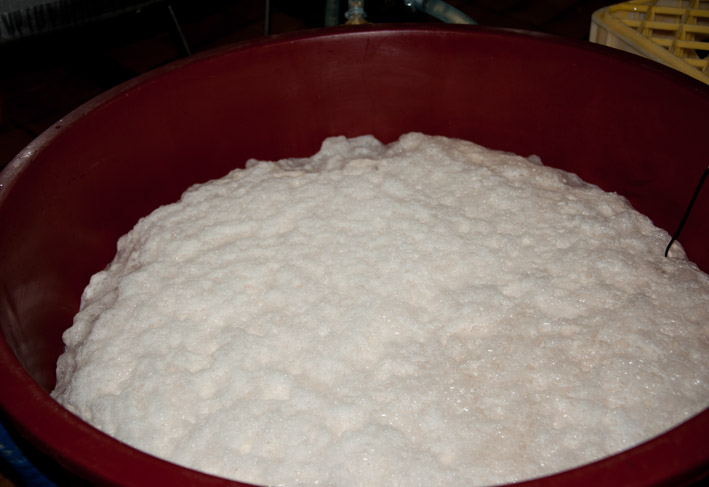
Day three was much more complicated as we were not only harvesting grapes, but also we started to ‘rack’ some of the new grape ‘must’ (juice). After a day or two sitting quietly, well chilled, in tank (known as ‘settling’), the new grape juice is transferred to clean tanks, leaving all the remnants of soil, leaves, stems, berries etc. behind, at the bottom of the original tank. This clean juice will now be left to recover a bit of temperature before being ‘seeded’ with yeast.

The reduced pressing time (to achieve more concentrated must) is also adding pressure to the team working in the bodega. Bearing in mind that all our presses are loaded manually, case by case, no sooner had we finished loading one press, then the next press had finished and had to be loaded…. it was very much a non-stop production line. Exhausting for those involved. The only consolation of this system is that we can chew through the pallets of grapes much quicker, and this in turn means that we can finish pressing in the early hours of the morning rather than at dawn the next day!

Loading pressesYesterday I was reminded of the famous Hollywood film ‘The Perfect Storm’, not because it was raining or stormy, but more because we pretty much achieved the prefect day. It was one of those very rare days when everything goes according to plan, like a well-oiled machine. Even the last pressing of the day was within 10kg of the optimum weight of the wine press! It’s just a shame that these days don’t occur to often.

Day three was much more complicated as we were not only harvesting grapes, but also we started to ‘rack’ some of the new grape ‘must’ (juice). After a day or two sitting quietly, well chilled, in tank (known as ‘settling’), the new grape juice is transferred to clean tanks, leaving all the remnants of soil, leaves, stems, berries etc. behind, at the bottom of the original tank. This clean juice will now be left to recover a bit of temperature before being ‘seeded’ with yeast.

The reduced pressing time (to achieve more concentrated must) is also adding pressure to the team working in the bodega. Bearing in mind that all our presses are loaded manually, case by case, no sooner had we finished loading one press, then the next press had finished and had to be loaded…. it was very much a non-stop production line. Exhausting for those involved. The only consolation of this system is that we can chew through the pallets of grapes much quicker, and this in turn means that we can finish pressing in the early hours of the morning rather than at dawn the next day!

Harvest 2013 – Day 2

October 6th, 2013 | Harvest

Garden VineyardOur second day was quite different from a weather point of view – the clouds more or less disappeared completely to give us a beautiful, fresh, clear sunny morning. Apparently, we are told, that this sunshine is the shape of things to come, or should last at least until the 2013 harvest is well and truly behind us (or at least the picking part). We started day one with a very busy day, there was no gentle or gradual introduction day as we may have done in previous years – this year we launched into the campaign absolutely head on. The 2013 grape rush continued into day two – our target now being to finish all fruit collection in five or six days, trimming at least one or two days off our normal schedule. 

With just over 50 people picking in our own vineyards we managed to more or less finish our Castrelo vineyard on day one, and so today our team turned their attention to Cunchidos (a smaller location of just under one hectare). The fruit here was sucked up with a matter of a few hours, and so the entire team relocated yet again – this time to an even smaller vineyard, not actually owned by us, but managed entirely by Castro Martin. In some ways this is a very typical Galician vineyard location as it comprises only a few hundred square metres surrounding a house. In effect it is the garden of the owner, and takes only about an hour to pick. (Please remember that in a denomination of only 4,000 hectares, there are roughly 6,700 registered grape growers, meaning that there are literally thousands of tiny vineyards dotted around our hillsides).

At the end of day two our harvest crew had just enough time to move once more to our largest location, ‘El Pazo’ – our 5 hectare walled vineyard (or ‘Clos’ as the French would call it). They managed about an hours picking, still in prefect conditions, before daylight started to fail. Time to bring the curtain down on day two.

Garden VineyardOur second day was quite different from a weather point of view – the clouds more or less disappeared completely to give us a beautiful, fresh, clear sunny morning. Apparently, we are told, that this sunshine is the shape of things to come, or should last at least until the 2013 harvest is well and truly behind us (or at least the picking part). We started day one with a very busy day, there was no gentle or gradual introduction day as we may have done in previous years – this year we launched into the campaign absolutely head on. The 2013 grape rush continued into day two – our target now being to finish all fruit collection in five or six days, trimming at least one or two days off our normal schedule. 

With just over 50 people picking in our own vineyards we managed to more or less finish our Castrelo vineyard on day one, and so today our team turned their attention to Cunchidos (a smaller location of just under one hectare). The fruit here was sucked up with a matter of a few hours, and so the entire team relocated yet again – this time to an even smaller vineyard, not actually owned by us, but managed entirely by Castro Martin. In some ways this is a very typical Galician vineyard location as it comprises only a few hundred square metres surrounding a house. In effect it is the garden of the owner, and takes only about an hour to pick. (Please remember that in a denomination of only 4,000 hectares, there are roughly 6,700 registered grape growers, meaning that there are literally thousands of tiny vineyards dotted around our hillsides).

At the end of day two our harvest crew had just enough time to move once more to our largest location, ‘El Pazo’ – our 5 hectare walled vineyard (or ‘Clos’ as the French would call it). They managed about an hours picking, still in prefect conditions, before daylight started to fail. Time to bring the curtain down on day two.

Paint the town red…. or the walls yellow!

October 3rd, 2013 | Harvest

StripesAfter days of delay caused by the poor weather, we are finally poised and ready to start. To be honest we have been ready for some days now, and consequently have been looking around the cellar for odd jobs to do to help pass the time! We have actually had so much time that Fran was able to paint some fancy, florescent coloured stripes on the wall of our truck loading area (see photo). I am told that this will help the drivers line up their vehicles…..

The last two days have in fact, been dry(ish), but we have resisted the temptation to start as we knew that the poor weather was returning today. At the moment it’s actually quite stormy – blustery rain with high winds. The good news is that it’s going to start drying out from tomorrow and according to the forecasts (and believe me I had studied all of them), there is a ‘window’ of fine weather approaching. They tell us that next week is going to be dry and sunny, but my experience tells me, believe it when it happens. We will certainly have everything ready to start tomorrow, but until we open the shutters in the morning we will not make any definitive decision.


StripesAfter days of delay caused by the poor weather, we are finally poised and ready to start. To be honest we have been ready for some days now, and consequently have been looking around the cellar for odd jobs to do to help pass the time! We have actually had so much time that Fran was able to paint some fancy, florescent coloured stripes on the wall of our truck loading area (see photo). I am told that this will help the drivers line up their vehicles…..

The last two days have in fact, been dry(ish), but we have resisted the temptation to start as we knew that the poor weather was returning today. At the moment it’s actually quite stormy – blustery rain with high winds. The good news is that it’s going to start drying out from tomorrow and according to the forecasts (and believe me I had studied all of them), there is a ‘window’ of fine weather approaching. They tell us that next week is going to be dry and sunny, but my experience tells me, believe it when it happens. We will certainly have everything ready to start tomorrow, but until we open the shutters in the morning we will not make any definitive decision.

Forbes on wine women

October 2nd, 2013 | Press

Forbes MagazineThe Forbes business magazine recently published an article about the women winemakers of Rias Baixas. I am married to one of the originals (for a moment there I nearly wrote ‘oldest’, but then I thought better of it!). When Angela started making wine at Castro Martin she really was one of the very few women in our denomination. I think it would be fair to say that in many wine regions, as little as only 15 or 20 years ago, there were hardly any. Today the situation has changed dramatically as many of the best wines of our area are made by women – and who am I to argue with that fact?

The presence of women in the Rias Baixas denomination has recently been acknowledged by Forbes magazine, perhaps better known for recognising business entrepreneurs than wine makers. The interview with Angela was not conducted in person but rather in the form of a questionnaire, seeking her opinion on the various aspects of wine making within our area. As with many interviews the content was highly edited – Angela’s comment relating to food pairing was dramatically simplified, but at least her more significant comment about women wine makers remained largely untouched. To see the full article click HERE.

Forbes MagazineThe Forbes business magazine recently published an article about the women winemakers of Rias Baixas. I am married to one of the originals (for a moment there I nearly wrote ‘oldest’, but then I thought better of it!). When Angela started making wine at Castro Martin she really was one of the very few women in our denomination. I think it would be fair to say that in many wine regions, as little as only 15 or 20 years ago, there were hardly any. Today the situation has changed dramatically as many of the best wines of our area are made by women – and who am I to argue with that fact?

The presence of women in the Rias Baixas denomination has recently been acknowledged by Forbes magazine, perhaps better known for recognising business entrepreneurs than wine makers. The interview with Angela was not conducted in person but rather in the form of a questionnaire, seeking her opinion on the various aspects of wine making within our area. As with many interviews the content was highly edited – Angela’s comment relating to food pairing was dramatically simplified, but at least her more significant comment about women wine makers remained largely untouched. To see the full article click HERE.

Time to get the chopper out

September 30th, 2013 | Harvest

Helicopter vineyardI remember from back in the 1980’s or perhaps even earlier than that, the scandals that they had in Bordeaux when vineyard workers were forced to pick grapes under the down draft of helicopters. At that time, if there was any rainfall during the harvest, some of the very richest Châteaux would pay huge amounts of money to have helicopters hovering over the vines in an attempt to rapidly dry off the rain soaked grapes. It goes without saying that any water on the grapes would have the effect of diluting the grape must, very much in the same way that if they simply left the grapes to dry out on the vine before picking, then water absorbed through the soil could also reduce concentration.

We actually have a similar problem in our vineyards right now, except that I’m afraid to say my helicopter is currently in the workshop and cannot be used. (I doubt that a model controlled by my mobile phone would have much effect anyway!). Of course there is a slightly cheaper alternative that we can use – our treatment spraying equipment works using sprays and a very large fan (to distribute the liquid in the form of a fine mist). By using only the huge fan part of the machine we can simply pass under the pergolas and blow any excess water off the bunches. Maybe not as glamorous as a helicopter, but almost as effective.

Seriously though, our original plan was to pick today, or at least early this week. The bad news is that we’ve had five or six days of significant rainfall and so this will now be delayed. Looking at the various forecasts it might be nearer the end of the week before we have a suitable window. Our weather watch continues….

Helicopter vineyardI remember from back in the 1980’s or perhaps even earlier than that, the scandals that they had in Bordeaux when vineyard workers were forced to pick grapes under the down draft of helicopters. At that time, if there was any rainfall during the harvest, some of the very richest Châteaux would pay huge amounts of money to have helicopters hovering over the vines in an attempt to rapidly dry off the rain soaked grapes. It goes without saying that any water on the grapes would have the effect of diluting the grape must, very much in the same way that if they simply left the grapes to dry out on the vine before picking, then water absorbed through the soil could also reduce concentration.

We actually have a similar problem in our vineyards right now, except that I’m afraid to say my helicopter is currently in the workshop and cannot be used. (I doubt that a model controlled by my mobile phone would have much effect anyway!). Of course there is a slightly cheaper alternative that we can use – our treatment spraying equipment works using sprays and a very large fan (to distribute the liquid in the form of a fine mist). By using only the huge fan part of the machine we can simply pass under the pergolas and blow any excess water off the bunches. Maybe not as glamorous as a helicopter, but almost as effective.

Seriously though, our original plan was to pick today, or at least early this week. The bad news is that we’ve had five or six days of significant rainfall and so this will now be delayed. Looking at the various forecasts it might be nearer the end of the week before we have a suitable window. Our weather watch continues….

Time to harvest?

September 27th, 2013 | Harvest

Harvest timeI did not realise when I mentioned the ‘Ruta do Viño’ bus tour the other day, that the programme of visits is actually much more extensive than I first thought. Apart from the Bodegas that are included on the bus tour itinerary there are also a number of other wineries that are offering visits, specifically tailored around the harvest. These are of course guided tours, sometimes limited to groups of no less than 6 or 8 people, always by appointment, and….. in many cases, there is a small entry fee! From my own point of view I’m afraid to say that even with all these pre-conditions I wouldn’t really welcome tour groups during our harvest. It’s not that we are particularly unsociable (as I would like to think that those who do visit us are always extended a warm welcome), it’s simply that there are so many things going on, many of which can be unpredictable. I simply wouldn’t want to tie myself down with a bus, or even carload of visitors – it would just be too distracting.

Having said all that, I do hope that we actually have a harvest this year – the weather, I have to report, has really turned against us. After months of fine weather we are now experiencing heavy rain and high winds. I was on the phone only the other day to one of our contacts in the States when I used the expression “the lull before the storm” in my conversation. What I really meant by this was that with everything now ready we are simply sitting back waiting for the optimum time to start picking, rather than implying that there was actually some seriously bad weather on the way. Unfortunately, in the end, we got the latter.

The good news is that the state of the fruit before the rain was extremely healthy, which, in the first instance, will certainly help to slow down the potential onset of any disease. The only problem might be is that if this inclement weather persists then the juice could be a little diluted. Our vigil continues……

Harvest timeI did not realise when I mentioned the ‘Ruta do Viño’ bus tour the other day, that the programme of visits is actually much more extensive than I first thought. Apart from the Bodegas that are included on the bus tour itinerary there are also a number of other wineries that are offering visits, specifically tailored around the harvest. These are of course guided tours, sometimes limited to groups of no less than 6 or 8 people, always by appointment, and….. in many cases, there is a small entry fee! From my own point of view I’m afraid to say that even with all these pre-conditions I wouldn’t really welcome tour groups during our harvest. It’s not that we are particularly unsociable (as I would like to think that those who do visit us are always extended a warm welcome), it’s simply that there are so many things going on, many of which can be unpredictable. I simply wouldn’t want to tie myself down with a bus, or even carload of visitors – it would just be too distracting.

Having said all that, I do hope that we actually have a harvest this year – the weather, I have to report, has really turned against us. After months of fine weather we are now experiencing heavy rain and high winds. I was on the phone only the other day to one of our contacts in the States when I used the expression “the lull before the storm” in my conversation. What I really meant by this was that with everything now ready we are simply sitting back waiting for the optimum time to start picking, rather than implying that there was actually some seriously bad weather on the way. Unfortunately, in the end, we got the latter.

The good news is that the state of the fruit before the rain was extremely healthy, which, in the first instance, will certainly help to slow down the potential onset of any disease. The only problem might be is that if this inclement weather persists then the juice could be a little diluted. Our vigil continues……

Oh, no…. rain!

September 25th, 2013 | Harvest

AutumnI may well have tempted fate by mentioning it the other day, but after two months of almost drought conditions the forecast rain has finally arrived, and it has suddenly turned decidedly autumnal. I’m afraid it was almost inevitable that such a late harvest would be affected by rain, and it simply wasn’t realistic to expect this extended dry period to continue into October. Until today we had been anticipating a start to our 2013 harvest at the beginning of next week, but now we will have to wait and see what effect this rain is going to have. It rather depends on how long the rainfall continues that will determine how much is absorbed into the soil, and then in turn, how much finds its way into the fruit. Another important factor will be the temperature – at the moment the thermometer has dropped to around 18°C (65°F). This being the case conditions under the canopy are currently not too humid and sticky, but again this will depend on how quickly things dry up.


AutumnI may well have tempted fate by mentioning it the other day, but after two months of almost drought conditions the forecast rain has finally arrived, and it has suddenly turned decidedly autumnal. I’m afraid it was almost inevitable that such a late harvest would be affected by rain, and it simply wasn’t realistic to expect this extended dry period to continue into October. Until today we had been anticipating a start to our 2013 harvest at the beginning of next week, but now we will have to wait and see what effect this rain is going to have. It rather depends on how long the rainfall continues that will determine how much is absorbed into the soil, and then in turn, how much finds its way into the fruit. Another important factor will be the temperature – at the moment the thermometer has dropped to around 18°C (65°F). This being the case conditions under the canopy are currently not too humid and sticky, but again this will depend on how quickly things dry up.

The gift shop is at the exit

September 24th, 2013 | Rias Baixas

Bus TourA while ago I wrote about the Ruta do Vino and the fact that we have opted out. The Wine Route is a more or less a map of our denomination that advises tourists which Bodegas are actively open to visits. As I mentioned when I wrote about this before the reason we have decided not to participate is that we simply don’t have the manpower to accommodate wine tourism. If we said “yes” then we could easily spend the whole of our summer just giving guided tours of the cellar and not conducting any real business.

In some countries such as Australia and the United States enotourism can actually make a healthy contribution to the sales of a winery, but that rather depends on the size of the business and the resources that they have available. Larger wineries will have tour guides, tasting rooms and the inevitable shop, where they not only sell wine, but other wine related trinkets and souvenirs. All this can generate a significant income when done properly.

In our own region cellar door business is not very common, and it is only the very largest cellars and co-operatives that are set up properly for tourism. However, there is an initiative coming up that will hopefully open a few more doors for some cellars. In the coming weeks our D.O. have organised a ‘Wine Bus’ that will follow the Rias Baixas wine route visiting three cellars a day. The bus ride will cost participants a mere 12 Euros each, which seems like pretty good value to me, assuming that the Bodegas will include a small tasting in the tour.

I suppose the only downside is the timing, as the tours start this month and continue until the end of October – this coincides perfectly with the 2013 harvest. As I mentioned before at Castro Martin we do not have the resources to accommodate tours or tour buses, and the thought that 50 curious visitors might turn up at our door on a busy harvest day would simply fill me with terror!

Bus TourA while ago I wrote about the Ruta do Vino and the fact that we have opted out. The Wine Route is a more or less a map of our denomination that advises tourists which Bodegas are actively open to visits. As I mentioned when I wrote about this before the reason we have decided not to participate is that we simply don’t have the manpower to accommodate wine tourism. If we said “yes” then we could easily spend the whole of our summer just giving guided tours of the cellar and not conducting any real business.

In some countries such as Australia and the United States enotourism can actually make a healthy contribution to the sales of a winery, but that rather depends on the size of the business and the resources that they have available. Larger wineries will have tour guides, tasting rooms and the inevitable shop, where they not only sell wine, but other wine related trinkets and souvenirs. All this can generate a significant income when done properly.

In our own region cellar door business is not very common, and it is only the very largest cellars and co-operatives that are set up properly for tourism. However, there is an initiative coming up that will hopefully open a few more doors for some cellars. In the coming weeks our D.O. have organised a ‘Wine Bus’ that will follow the Rias Baixas wine route visiting three cellars a day. The bus ride will cost participants a mere 12 Euros each, which seems like pretty good value to me, assuming that the Bodegas will include a small tasting in the tour.

I suppose the only downside is the timing, as the tours start this month and continue until the end of October – this coincides perfectly with the 2013 harvest. As I mentioned before at Castro Martin we do not have the resources to accommodate tours or tour buses, and the thought that 50 curious visitors might turn up at our door on a busy harvest day would simply fill me with terror!

Wet & Dry

September 20th, 2013 | Harvest

Wet & DryNo! I’m not referring to the special sandpaper for do-it-yourself enthusiasts invented in 1921 by the 3M Company, but instead to a summary of this year’s fruit growing season. To use an old football (soccer) analogy it has been “a game of two halves” – the first part of the year very wet and cold, the second part of the year very dry and sunny. 

You might be forgiven for thinking that dry sunny weather is perfect for growing grapes, and of course, it is much better than a grey, damp summer. The problem is that this year it has been almost too extreme. Since more or less the end of June, until today’s date, we have had almost no rainfall whatsoever, and as the harvest rapidly approaches the vines are more than a little stressed. Believe it or not we do need a little rain during the growing season, but the most important factor in this is the timing. A little rain in mid-summer is not a bad thing, but rain too close to the harvest can cause problems. For example, if the grapes are small and thick-skinned (owing to dry weather), then a sudden downfall of rain can cause the berries to grow rapidly and burst their skins, leading inevitably to rot (and not of the noble variety). It goes without saying that the element we really don’t want is humidity – this is why too much rain in summer is a very bad thing. The ground gets wet, the sun comes out and the humidity gets trapped under the canopy, and this can be especially bad in an area such as ours that uses pergolas. If our overhead vegetation is too thick, then the humidity can’t easily escape.

Having said all that, we have the very opposite problem at the moment – our grapes are quite small owing to the lack of rainfall – healthy but small. Naturally if the ratio of pulp to skin and pip is low then we will have reduced yields. Quality? We will have to wait and see.

Wet & DryNo! I’m not referring to the special sandpaper for do-it-yourself enthusiasts invented in 1921 by the 3M Company, but instead to a summary of this year’s fruit growing season. To use an old football (soccer) analogy it has been “a game of two halves” – the first part of the year very wet and cold, the second part of the year very dry and sunny. 

You might be forgiven for thinking that dry sunny weather is perfect for growing grapes, and of course, it is much better than a grey, damp summer. The problem is that this year it has been almost too extreme. Since more or less the end of June, until today’s date, we have had almost no rainfall whatsoever, and as the harvest rapidly approaches the vines are more than a little stressed. Believe it or not we do need a little rain during the growing season, but the most important factor in this is the timing. A little rain in mid-summer is not a bad thing, but rain too close to the harvest can cause problems. For example, if the grapes are small and thick-skinned (owing to dry weather), then a sudden downfall of rain can cause the berries to grow rapidly and burst their skins, leading inevitably to rot (and not of the noble variety). It goes without saying that the element we really don’t want is humidity – this is why too much rain in summer is a very bad thing. The ground gets wet, the sun comes out and the humidity gets trapped under the canopy, and this can be especially bad in an area such as ours that uses pergolas. If our overhead vegetation is too thick, then the humidity can’t easily escape.

Having said all that, we have the very opposite problem at the moment – our grapes are quite small owing to the lack of rainfall – healthy but small. Naturally if the ratio of pulp to skin and pip is low then we will have reduced yields. Quality? We will have to wait and see.

Monthly Archives

Categories

ARE YOU OF LEGAL AGE? This site is intended for those of legal drinking age. By entering, you confirm that you are of legal drinking age in the country where this site is being accessed. ¿ERES MAYOR DE EDAD? Este sitio está destinado a personas en edad legal para beber alcohol. Al ingresar, confirma que tiene la edad legal para beber en el país donde se accede a este sitio.