

Destination Middle East!

May 27th, 2019 | Bodega

At the very end of last week we loaded a full container bound for the Middle East! Of course, it was a refrigerated container, as it will almost certainly cross the Mediterranean before navigating the Suez Canal on it’s route. Who knows what exterior temperatures it might encounter, but at least we know the wine will be quite safe inside, preserved at a cool 10°C (50°F).

The other really ‘cool’ part of the journey (pun intended) is that we will be able to track it’s progress online. We have the name of the ship, and by visiting marinetraffic.com we will be able to follow our container mile by mile along it’s route. The technology is amazing as always!

It has taken some time to get this order co-ordinated and ready to go, especially as we have learned that they have strict rules about the documentation – every ‘i’ has to be dotted and every ‘t’ crossed (and also certified officially by the local Chamber of Commerce). Having said that, it was a very good order and so all the effort has been well worth it!

2018 Alcohol

May 21st, 2019 | Harvest

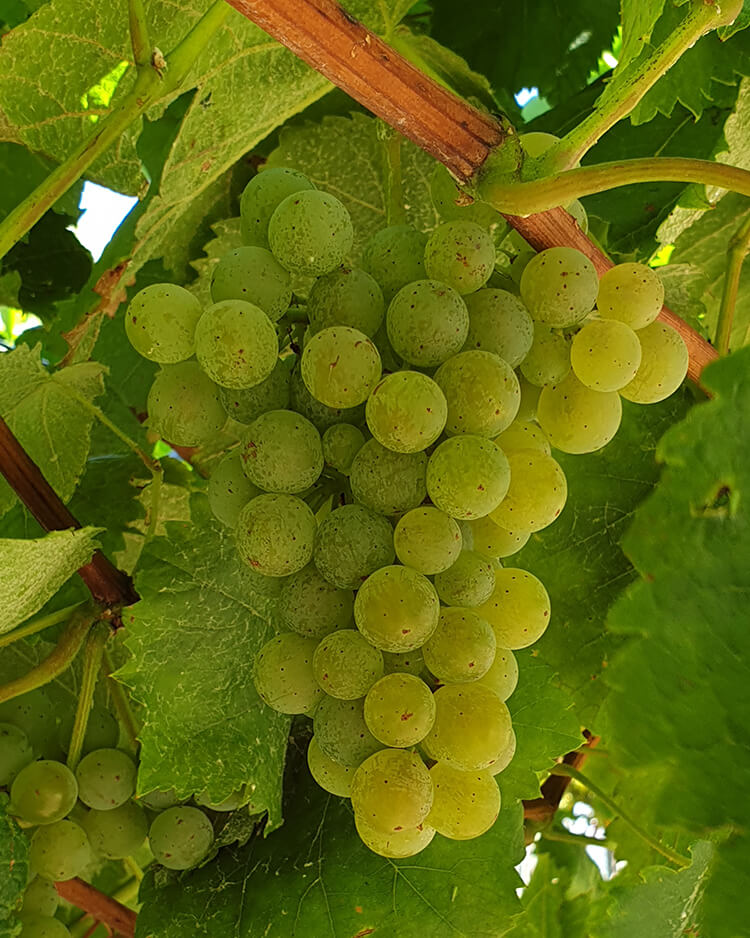
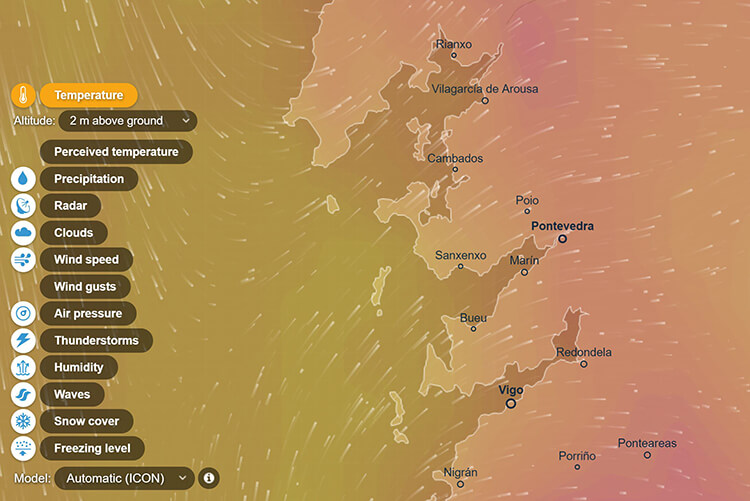
Galician weather is always difficult to predict at the best of times – for example, at this very moment we are experiencing some significant shifts of temperature, sometimes within the very same day. Our vines are certainly quite advanced for the time of year, and in some small pockets we are already seeing the onset of flowering. This could equate to a harvest at the very beginning of September if the weather behaves as it should. Vamos a ver (we will see).

However, the reason I am writing about alcohol is actually because of what happened during the summer of 2018. After poor spring and cool early summer the 2018 vintage was largely saved by a late burst of sun and warmth in August and early September. So much so that the final, very rapid maturation of the fruit actually took many by surprise, and at least some of the resulting albariño grapes were picked with between 13° and 14° potential alcohol!

Of course, here at Castro Martin we always to our very best to retain the typicity of our grape and our denomination, but even we struggled to pick all of our fruit before it ‘overcooked’!

Last week we racked a number of our 2018 tanks, removing them from the lees. The first step following this is to have every wine analysed, running tests for every parameter including stability. The results were all very good, with the key elements exactly at the correct levels in relation to one another, meaning that the wines are well balanced. The only slightly a-typical aspect was the alcohol, with a couple of wines just touching the 13% mark (not perhaps for the very first time, but certainly not within the last 17 years that I have been in Galicia).

We will need to adjust some of our 2018 labels accordingly.

Another planet…

May 14th, 2019 | Press

There are some days when I read something that someone writes about albariño, that well, just leaves me scratching my head in puzzlement. For the purposes of this post there is absolutely no need to name name’s or to point accusing fingers, but simply read this and see if you agree.

“If you like Sauvignon blanc, you will love Albarino. It is like a red in white’s clothing. This is the most widely planted white grape variety in Spain. It is rich and full-bodied like a red wine but tart and crisp on the finish like a white.”

In all my year’s in the wine trade I have never heard of any white wine being described as a red in white’s clothing, let alone an albariño. Rich and full-bodied like a red? I really have no idea what this means, because in my opinion it’s certainly not accurate and possibly even misleading. Perhaps I am just living in the wrong universe, or maybe just speak a different (wine) language!

But thereby lies the problem. Sometimes a little knowledge in the wrong hands can be a dangerous thing, especially in the age of the internet where any individual can potentially have easy access to a large audience. Having said that, I am sure that this type of commentary is not unique to the wine business.

The Road to Madrid – what a night!

May 8th, 2019 | Odds & Sods

Another amazing European night at Anfield!! OK, so I am sure that maybe a few people don’t even know what Anfield is (nothing to do with wine, by the way)… it is the home of my beloved Liverpool FC.

A few weeks ago I drove down to Porto to watch them in their last Champions League game, which they won 4-1. Last night, in the semi-final, it was a completely different story. After playing the first game of a two game tie in Barcelona, they were 3-0 down, and so in the return game at Anfield they had to win at least 4-0 to qualify for the final. Which is exactly what they did!

Few experts gave them much chance, and certainly none of the Barcelona team or supporters expected it, but in a breathtaking, pulsating game, they were blown away by a brilliant Liverpool team, and an atmosphere that was so electric I could feel it in Pontevedra!

It could take me a few days to recover….

Ageing is at an end….

May 7th, 2019 | Bodega

As though we could ever forget, wine making is an annual cycle, and often, when I am writing our posts, I feel as though I am repeating myself (which is clearly the case, and not simply down to my old age!).

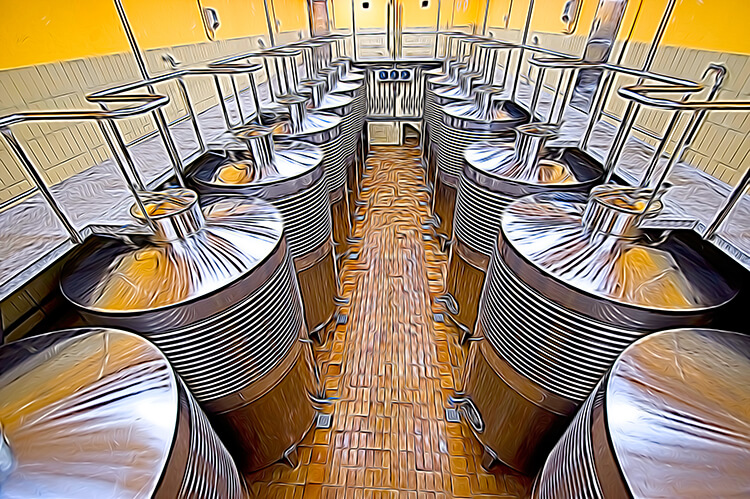
For example, we have today started to rack the first of our 2018 wines. After around 8 months resting quietly on their lees, we have finally started to transfer the first few tanks – leaving the lees at the bottom, and effectively skimming the clean wine off the top and moving it to clean tanks. Once this process has been completed, then these clean tanks will not be touched or moved again until we prepare them for bottling. The objective being, as always, to restrict the movement and  handling to the absolute minimum, which is of course, fundamental in a white wine cellar (reducing the risk of oxidation as much as humanly possible).

Today’s photo (just in case you had not seen this before), shows the lees left at the bottom of the tank – not pretty and not particularly drinkable either! Despite the fact that it takes the form of a brown/grey sludge with quite a thick consistency, it’s usefulness is still not at an end. This sludge will be collected in containers and sent to our local distillery to be used for making aguardiente. As you may gather, almost nothing is wasted, and everything is re-cycled or re-used wherever possible.

By the way, that is not dirt or rust on the inner walls of the tank, these are simply the tartrate crystals (potassium bitartrate) formed by the cold temperatures used during fermentation and ageing.

Worst wine awards?

April 29th, 2019 | Competitions

A day of two ago I received an e-mail for the Yuki Wine Awards, or so I thought. It transpires that the guy sending the mail was called Yuki, representing the Japan Wine Awards – unfortunately his mail had a rather unfortunate header! For a moment I understood it to be a competition for makers of ‘yucky’ wines (actually, I could think of a few possible contenders!)

As you may know I have never been a great fan of wine competitions. So far, in the first few months of 2019, we have been invited to no fewer than 22. Inevitably, the vast majority of these claim to be “Important International Competitions”. Whilst I have no doubt that some of them are probably quite important, it really must be a very lucrative business, with the average entry fee, PER BOTTLE, being around €120, with the most expensive being €200 per bottle. From our side, if you take into account the cost of the samples, together with the cost of the international shipping (by far the most expensive element), the cost of entry soon adds up.

It is clear that ‘International Wine Competitions’ have become big business – the entry fee alone, multiplied by thousands of bottles will soon add up to a pretty substantial amount. And, as a former judge myself, I know that organisers always ‘encourage’ a high percentage of medals and award winners (possibly just to encourage producers to keep entering). As you can probably work out, I am still an old sceptic.

Choose your bat carefully

April 23rd, 2019 | Green Issues

Two of the biggest problems that we have in our vineyards are disease (often weather related) and pests (insects that can cause and spread disease). In the case of vineyard pests there are many different preventative measures that can be employed, some more aggressive than others. The use of phytosanitary treatments is the easy option, albeit far from being the most natural, and we now spend our time looking for more suitable options, in our quests for mindful, sustainable fruit production.

One method is by the use of pheromone traps, which causes confusion and should prevent mating of the insects – a method that we use in our own vineyards. However, a new and more innovative method is being studied in other wine regions of the world…. bats.

Studies have been carried out in France over a three year period using bats as a method of pest control. It appears that certain species of bat will feast on both the grapevine moth and the cochylis moth – it is known as BatViti… The result has been that the amount of pesticides required has been “significantly” reduced, and only really need to be used as a last resort.

Of course, the species of bat used is critical (I guess), as there are, of course, some species that feed on fruit and would enjoy a veritable banquet in our vineyards!

Storing opened bottles

April 15th, 2019 | Odds & Sods

Assuming that you don’t drink a full bottle at every sitting, then what is the best way to preserve your wine and keep it as fresh as possible? Of course, there are hundreds of gadgets on the market, each one claiming better results than the competition, but in reality, you can start by doing two simple things. Push the cork back in, or find something airtight to reseal the bottle, and put your bottle in the fridge – by far the simplest solution that usually works pretty well (and can be applied to both red and white wines).

How long the bottle will actually keep, once it has been opened, really depends on a number of factors, such as the quality of the wine, how it was made, and how old the wine is when first opened. Without getting too technical if a wine is made correctly and has a good ‘structure’ then it will usually survive a bit longer than a cheap and cheerful wine that gives it’s all as soon as it is opened and then can deteriorate quite quickly.

In the case of our own albariño the structure, and therefore it’s ageing potential, is enhanced by the extended lees contact. The lees at the bottom of the tank absorb oxygen, protecting it and adding complexity. It also sets the wine up for maximum protection against oxidation (this is the very simplified version of what actually happens!). Suffice to say that our ‘sobre lias’ process adds to the shelf life of our wine.

Despite wine bottles being sealed with a cork (or some other form of closure), oxidation starts in the closed bottle. This can be influenced by the type of closure used, but it never stops completely. Indeed, a perfectly hermetic seal can potentially cause other types of problems – but that’s a whole other story. The point is that oxidation (the main reason why wines deteriorate over time), is an ongoing process during the life of a bottle, and this is simply accelerated enormously by removing the cork. If the wine in question has spent several years in bottle, it will already be slighty oxidised, and once opened will tend to fall apart rather more quickly. Hence that fact that younger, fresher wines will usually survive longer in your fridge. Heat, or even warmth, will also help to accelerate the ageing process, which is why a fridge is recommended. Simply remember to take out a red wine shortly before you want to drink it, or otherwise just let it warm up a little in the glass.

Natural food – Part 1

April 8th, 2019 | Food & Wine

As a follow up to my ramblings about natural wine, I thought that I should write a little about food trends too. After all, food and wine are very closely related and both subject to innovation and fashion.

Admittedly, I am a little cut off from the main centres of food fashion, being out here on a limb, virtually in the middle of nowhere, but I will have a go regardless.

Whilst ‘painting pictures’ on a plate might seem a bit outdated, presentation of food is still important, and dishes must still have eye appeal, one way or another. One slightly strange trend is that some chefs are not only desperate to discover new ingredients to cook, and different styles to incorporate, but they are also taking the presentation of their dishes to the extreme, using all sorts of odd receptacles on (and in) which to serve their food.

Meanwhile, ingredients themselves are changing, as we are now being encouraged to eat odd cuts of meat and fish, that we perhaps haven’t tried before. Bellies, brains, cheeks, combs, ears, gizzards, hearts, hocks, kidneys, lungs, marrow, necks, shanks, spleens, tongues, trotters, and even testicles are all appearing with much greater frequency on our restaurant menus. Not to mention a whole range of edible plants that can be added to the list.

Sourcing of ingredients is also more important than ever. We are now finding a multitude of naturally grown and sustainable products, together with meat and fish sourced either from the wild or from naturally reared livestock. Organic, grass fed, sustainable and fair trade are just a few of the words now appearing regularly on our food labelling. (Not even taking into account the more specialised categories such as vegan and gluten free etc.,)

Experimentation in food is spreading like wildfire, fuelled by a whole army of celebrity chefs, cookery programmes and TV competitions. Meanwhile, on the internet, the competition for likes and clicks is fierce – and so, in may ways, the more outlandish and unique your dish, the better. We are very rapidly adapting, modifying and re-defining the way we cook and eat, and often in a very positive way.

Return to winter!

April 5th, 2019 | Weather

After several weeks of dry sunny weather, and temperatures sometimes reaching as high as the mid-20’s C (68-75°F), since the beginning of April we have witnessed a big change. Nights are suddenly just a degree or two above freezing and daytime temperatures are barely reaching double figures (°C). Not only that, it is raining – but we can’t really complain – we really need it! Obviously this cold, wet weather makes it feel like winter again, and our big jackets that had maybe been packed away, are now very much the order of the day again.

OK, so today’s picture is only two screengrabs from my phone, one from two weeks ago, and the other from today – but simply by looking at the weather icons you can really see the difference (even if a daytime temperature is not displayed).

Monthly Archives

Categories

ARE YOU OF LEGAL AGE? This site is intended for those of legal drinking age. By entering, you confirm that you are of legal drinking age in the country where this site is being accessed. ¿ERES MAYOR DE EDAD? Este sitio está destinado a personas en edad legal para beber alcohol. Al ingresar, confirma que tiene la edad legal para beber en el país donde se accede a este sitio.