

The dark side of the moon

October 13th, 2009 | Uncategorized
You can just about see the moon’s horizon, but earth is not visible

Yesterday was probably one of our busiest days in the cellar – plenty of wine making action, not to mention a visit from our Australian importer, and an Australian journalist – travelling seperately, but both, totally by co-incidence, arriving with us on the same day….. Oh, and by the way, it was a public holiday in Spain just for good measure!

The only option, in order to accomodate everything, was a very early start, and doing as much as we could before they both arrived around lunch time. We had already made clear, very early on, that going out for lunch was not an option, and that they should either eat before, or bring a sandwich! I have to say that we are usually much more friendly and hospitable than this, but unfortunately at this time of year it is the rapidly emerging wine that dictates our timetable – time and good wine waits for no man.

One of our current jobs in the cellar is adding a fining agent to the fermentation in the shape of Wyoming bentonite. Bentonite is a special type of clay that was first named in Wyoming in the 19th century, and is distinct from other clays in that it is formed from volcanic ash. Without trying to get too technical, it is a negatively charged substance which when hydrated and added to wine, will attract the positively charged particulate in the wine. As bentonite hydrates and swells it becomes like a sponge, and after mixing it thoroughly into the wine, the positively charged matter in the wine attaches to the bentonite. The weight of the molecules then cause the matter to drop to the bottom of the tank and become what is known as ‘finings’.

There you are, clear as mud, if you’ll pardon the pun.

Anyway, my picture today is not from a moon landing as the title would imply, but is merely the surface of the bentonite solution after it had been hydrated. Pretty…..

No.9 – a divine number?

October 10th, 2009 | Uncategorized
‘Perfect’ merlot grapes in Bordeaux


No sooner had I declared that we were pretty happy with our Albariño harvest this year than the Bordeaux producers jumped on the bandwagon and claimed to have produced their best crop in 60 years. It seems like they have already forgotten 2005 which they described as the ‘perfect’ vintage, not to mention that it is probably far too early in the campaign to make such bold statements. Usually such comments are reserved for the annual tasting which is held in Bordeaux every spring following the vintage (when the wines are still very much in their infancy). The cynical side of me tends to ask if this might have something to do with the very poor Primeur sales that they have experienced in the region over the last two years.

Now, I am not saying that it won’t be a good, or possibly even a great vintage (and certainly a bit of early hype never goes amiss), but it should be remembered that this comment was made by the director of the Bordeaux Institute of Vine and Wine Sciences, so you might say that he has a bit of a vested interest. I can also remember one French producer who claimed to have at least 4 or 5 ‘vintages of the century’ during the 1980’s alone – in the end such claims just start to lose any credibility.

An interesting footnote for numerologists or perhaps just for those who like to compile vintage charts – it would seem that 2009 has given us yet another good vintage ending with the year ‘9’. OK, so it’s a sweeping generalisation, but if you look back there are far more good vintages than bad ones, not to mention one or two truly exceptional – 1949, 1959 for example (not that I have any of these in my private cellar).

Did someone order pizza?

October 7th, 2009 | Uncategorized

Apart from everything else that is happening in the bodega at the moment – cleaning, preparing orders, drinking tea, etc. we also have the small but not insignificant matter of making wine.

After the removal of some impurities by chilling the new grape must and allowing it to ‘settle’, we allow the temperature to recover and then begin the process of innoculation (in reality a task that was completed a few days ago). Now, some in our area might claim that they ferment their wine with the natural yeasts that live on the grape skins, but in our own experience this simply does not work. The ‘wild’ yeasts are just not strong enough to survive the rigours of a full alcoholic fermentation, which is why they have to be augmented each time with cultured yeasts.

It is quite amusing when the yeast salesman comes knocking these days – he virtually opens his catalogue, and asks “well, what flavour do you want?” In the case of our bodega the answer is always the same – we want a very neutral yeast that does not mask or alter the natural fruit of the albariño grape. In my former life as a wine buyer I always looked for wines that were the most typical of the area from which they originated, a ‘textbook wine’ if you will. Today nothing has changed – Angela and I still focus our efforts on making the most pure and typical albariño that we can…… a wine that does exactly what is says on the label.

The photo above shows the yeast just after it has been rehydrated, and before we add it to the tanks. At this moment the cellar is filled with a wonderful aroma (assuming that you like the smell of yeast), and Angela just can’t resist getting her hands into the foaming mass to help start it working. In fact, if I didn’t stop her she would probably start eating the stuff!

♫Just in time…♪♫

October 6th, 2009 | Uncategorized

Pretty much within a couple of days of picking the last fruit of 2009, the sun finally disappeared and the skies turned a more familiar autumnal grey. Then, a few days later the heavens opened, and the rain came down…… stair rods, to use an old-fashioned expression.

Of course this did not stop the work of cleaning the cases that we use for picking, for two reasons. Firstly, our guys have to be well water-proofed against the pressure washers anyway, and secondly, the rain actually helps to loosen the dirt a little. Indeed, if the cases sit outside waiting to be cleaned in hot sunshine, then the sticky grape juice simply bakes on and becomes even more difficult to clean. To be honest, the way the rain is coming down at the moment perhaps we don’t even need the machines!

Inside the cellar we have a backlog of orders to prepare, but we really need to finish cleaning before we can even contemplate this. For example, our bottling and labelling hall is currently filled with stock that we usually keep in the area into which the presses are emptied. Emptying presses is probably the messiest part of the whole harvest, hence the fact that we have to keep the area completely clear.

We hope that within a week or so normal service will be resumed.

Counting the cost

October 1st, 2009 | Uncategorized

With the picking over, and our tanks filled with fresh grape must, we switch into deep clean mode. The sticky juice just gets everywhere – floors, walls, stairs, door handles – you name it. Then of course, there is the equipment – tanks, presses, pumps, hoses, not to mention the odd couple of thousand baskets that we use to collect the fruit – all covered with a gluey, syrup-like coating. The pressure washers are working overtime.

Seeding the tanks is about to begin, but in the meantime we also have to spend time in the office analysing the cost of this year’s operation. In addition to the overtime accrued by our own full-time staff we also examine in detail the costs of our casual staff (picking team), and consider how this may or may not affect our future tariffs. The final bottle price not only relates to the price of grapes, but also to every single cost associated with handling them. In Rias Baixas where only manual picking can be used, regrettably this is never cheap.

In recent years we have collected detailed information of all these incidental costs in order that we can compare the efficiency of each campaign, and make adjustments where necessary. In addition to this, Angela keeps records of every single grape, and it’s path through the cellar, giving us complete traceability of every step in the winemaking process.

Thank heavens for Excel!

Day 7¼ – Hold the presses!

September 29th, 2009 | Uncategorized

So, as we limp into what we now believe will be our last day (honest), the final few grapes are gathered in. Of course when we stopped last night we did have to make sure that we left enough fruit on the vine to fill at least one press, otherwise it would be a case of shoes and socks off, and start stomping!

The photo above shows me (quite rare as I am usually on the other side on the lens) measuring sulphur to add to the new grape must. Before anyone panics I should tell you that we use sulphur in solution for this operation, but it is still pretty agressive, hence the mask. If this was 100% pure sulphur, then I would probably kill everyone in the building by adding it like this! (By the way, Angela says I look much more attractive in this picture – I have no idea what she means).
Oh, and one final harvest note about temperature…. At the moment we still have an outside temperature of around 26°-28°C (80°F), whereas in the cellar, where the refridgeration is chilling tanks, it is a mere 14°C (57°F). Dressing for such a wide variation can be quite difficult, and I sometimes find myself sitting in a warm office, with the sun streaming in through the window, wearing a fleece!

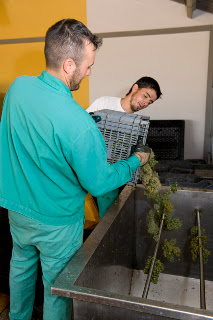
So, this is really it for 2009! This photo shows Juan and David tipping the very last case of this year’s harvest into the press. Down below, in the pressing room, Fran started the final cycle at 2pm, and so with all the grapes safely gathered under cloudless blue skies, we hand over to Angela to work her magic in the cellar.

With our thanks to everyone in the vineyards and the bodega who have worked so hard for the 7½ days. Now, let the cleaning begin!!!!

Day 7 – The final bunches

September 28th, 2009 | Uncategorized
Herminda’s office – who needs an Apple laptop when you have a Grape notebook?
(photo by mobile phone)
Whilst it was very nice to have a break from picking, today seems like a bit of an anti-climax. Having been in full harvest mode for nearly a week, it just seems really hard to re-motivate everyone, including myself, for just one last push.

The good news is that in a quiet moment Angela and I did a systematic tasking of all the musts, and all I can say is “looking good” – yes, we are very happy with what we have harvested so far. If fermentations etc. go according to plan then 2009 should be a very useful vintage. Expensive, but useful. (If you read one of my pre-harvest posts about grape prices, then you might understand where I’m coming from). Now I am not saying for one second that we make bad wines, and perhaps I shouldn’t say this, but for me at least, the 2009 will be better than last year.

Finally, as the day wears on, and the grapes keep coming, we realise to our horror that we might have miscalculated. By the afternoon we have every available person out in the Pazo vineyard helping to pick the ‘final’ grapes, until in the end, at around 8.30pm, the daylight defeats us and we retreat back to the Bodega. The end was obviously not as nigh as we thought!

Sunday – a day of rest

September 27th, 2009 | Uncategorized

In English we call it a praying mantis, in Spanish it is a mantis religiosa – rescued from a case of grapes on Saturday. I just thought that with such a name it might be appropriate to post this picture on a Sunday.

As I explained yesterday, we have perhaps only one day of picking left (in one or two sections of our vineyards), but in the warm sunshine, fruit left on the vine for one more day can only benefit.

Despite no picking, there is still racking to be done in the cellar, and so not a day of rest for everyone.

More news on the final day tomorrow.

Day 6 – Watching the temperature

September 26th, 2009 | Uncategorized

Slowly the emphasis of our work starts to shift from outdoors to indoors, as we have fewer grapes left on the vine, and more juice in our tanks. As with all wine making, temperature is the key, when we start to impose our own individual character on the fruit that we collect. In a way, it is like being a chef – yes, you need to start with the very best raw ingredients, but then the individuality of the final dish, or in our case wine, will very much depend on how we handle our fruit.

Obviously, there are many steps in the wine making process, but in each there is very little margin for error. If Gordon Ramsay does not like the piece of fish that his Chef de Partie offers up to him, he will simply chuck it in the bin and start again (and probably swear a lot in the process!). If we make a mistake in our cellar, we cannot start again, we only have one chance to get it right. At this moment, there are really two important factors that will influence the final outcome – heat and oxidation – these are our enemies, and have to be avoided at all costs. This is one of the reasons that I make such a big fuss about our cooling system – it’s an important piece of kit for us!

In mentioning temperature, perhaps I should make a small comment about the weather. So far it has been really kind to us, as we still enjoy brilliant blue skies and warm sunshine. In fact, thinking back over the last few years, I don’t think I can recall a vintage with absolutely 0% precipitation – perhaps I am wrong.

In view of this continued good weather we will stop picking a little early today, to give the final plots a chance to drop a bit of acidity. (We may not resume again until Monday, as the forecast for the next couple of days still looks very good). But even if we did produce an odd tank with a slightly higher acidity, we can always use small amounts for blending with other tanks in the future – like adjusting the pepper and salt in your final dish (to use my cooking analogy once again).

Oh, and by the way, the photo shows my little post-it notes stuck on the control panel – with so much movement of must around the cellar this simply gives me an at-a-glance reminder of where everything is – not very high-tech!

Day 5 – Over the hump

September 25th, 2009 | Uncategorized
Some valves controlling our cooling system (obviously designed by Mr Heath Robinson himself!)

As we roll into day 5 I think it is safe to say that we are well past the mid-point of this years harvest. With around 40 pickers in our vineyards our presses are well supplied, and have no break at all between unloading and re-filling (well, they do only work once a year).

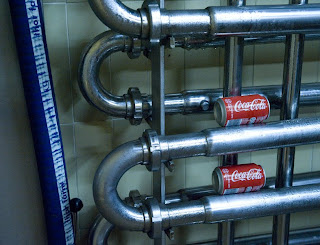
The racking of the clean ‘must’ is well under way, and so far the cooling system is behaving itself. Indeed, it is proving so effective that it can apparently chill the odd can of Coke! The zig-zag arrangement of pipes in the photo are known as a heat exchanger – this is a length of pipe surrounded by an outer cooling jacket through which the grape juice passes immediately after pressing. Obviously, because the exchanger is icy cold this has the effect of cooling the must very rapidly even before it reaches the temperature controlled tanks – it is just a slightly more effective way to drop the temperature quickly.

I think that’s what they call product placement (using our heat exchanger)

As I mentioned a little earlier, I am the one who treads the 39 steps more than most, often rushing samples from the grape reception down to the laboratory two floors below (I lost 2kg in the first 3 days!). From what Angela has seen so far, she is pretty happy with her analysis, and it looks like it will not be necessary to make any adjustments to the acidity this year – we shall see…..

Monthly Archives

Categories

ARE YOU OF LEGAL AGE? This site is intended for those of legal drinking age. By entering, you confirm that you are of legal drinking age in the country where this site is being accessed. ¿ERES MAYOR DE EDAD? Este sitio está destinado a personas en edad legal para beber alcohol. Al ingresar, confirma que tiene la edad legal para beber en el país donde se accede a este sitio.