

Archive for ‘Winemaking’

Natural wine (and food) – Part 3

February 18th, 2019 | Bodega

In my last post I raised the question – what steps can we take to make our wine more natural? Of course, the answer to this question is, as always, divided into two parts – grape production and wine making.

We start by examining every process in detail by considering the best and most effective, natural products and operations that we can use, thereby manipulating the must and wine as little as possible. This might seem quite straightforward, but then, unfortunately, some of these processes can have drawbacks and can create potential problems, both to the finished wine and also its evolution in bottle.

Over the years I have written extensively about our vineyard practices, using as many traditional and organic products as possible. Not only are these better for the plants and soils, but the vines will also react naturally, not building any product resistance, as they might do in the case of some more modern systemic treatments. It’s very similar to humans. For example, the difference between using homeopathic medicines as opposed to antibiotics. The former is very natural, and whilst the latter might be more convenient, it can cause long-term problems, forming immunity and rendering treatment useless.

Inside the cellar we already know that white wines are especially prone to oxidation during every stage of their lifetime – from the moment fruit is picked to the moment that it sits in a glass waiting to be consumed. Preservation and longevity are therefore our biggest considerations in everything that we do. What can we do to capture, and ultimately preserve the freshness of the albariño grape variety, whilst at the same time keeping it as ‘natural’ as possible. It ain’t easy, that’s for sure!

Natural wine (and food) – Part 2

February 12th, 2019 | Food & Wine

In a number of countries the latest trends in what we drink can be determined by fashion – what style or varietal is hot, and what are the journalists and influencers writing about? For example, in recent years we have witnessed the success of Prosecco, and the resurgence of rosé wines, and also the steady, unerring growth of natural, organic or biodynamic wines.

As wine producers we obviously have to be aware of these developments, and do what we can to react to the market. Of course, there is always a limit to how much we are able to react as there are always controls, rules and laws that we have to respect. In our case, for example, we can’t make rosé wine from a white grape, but it we look closely perhaps there are some small adjustments that we can make to produce wines that are as ‘natural’ as possible.

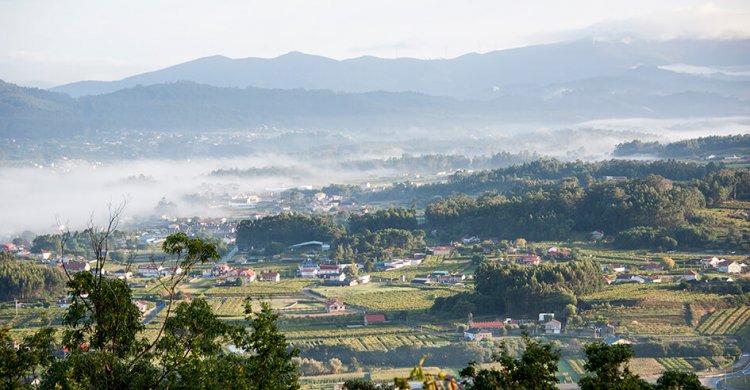
In the vineyards we already do almost as much as we can, or as much as nature and our climate will allow, but to be brutally honest it’s highly unlikely that we would ever be able to do enough to achieve fully certified organic or biodynamic status. Indeed, there are exactly ZERO wine cellars in our denomination that are certified as such. It’s really dictated by the vagaries of our wet, cool, humid climate – great for making a fresh, zesty, cool climate albariño, but not much help at all for making biological or biodynamic wine.

So what can we do?…. It’s really all about intervention – the less intervention that we make, the more natural the process. In order to achieve this we can simply examine every step that we take both inside and outside the bodega, and then decide what techniques we can adjust, or possibly eliminate completely. It’s a delicate balance between art and science!

In my next installment I will explain in more detail what we already do, and some of the options and innovations that are open to us.

Natural wine (and food) – Part 1

February 5th, 2019 | Food & Wine

There is no doubt that we need to take care of our planet, in every possible way. These days it’s all about carbon footprint, minimal intervention, and natural products, and this is not unique to the wine industry.

If you think for a moment about the evolution of wine making, then it must be true to say that once-upon-a-time all wines were ‘natural’ (when wine was first produced). Then, over the decades and centuries, as technology has evolved, we have started to make cleaner, more technical wines – the inherent problem being that at least some of the body and character has almost certainly been processed and filtered out.

Of course tradition is important, and this is often protected through the rules and regulations of the controlling bodies – the D.O.’s and A.O.C.’s of this world. On the other hand, I believe that technology still has it’s part to play, but the question is, how much technology? The quality and style of the end product will ultimately be directly determined by the amount of intervention and manipulation that takes place (both in the vineyard and in the wine cellar).

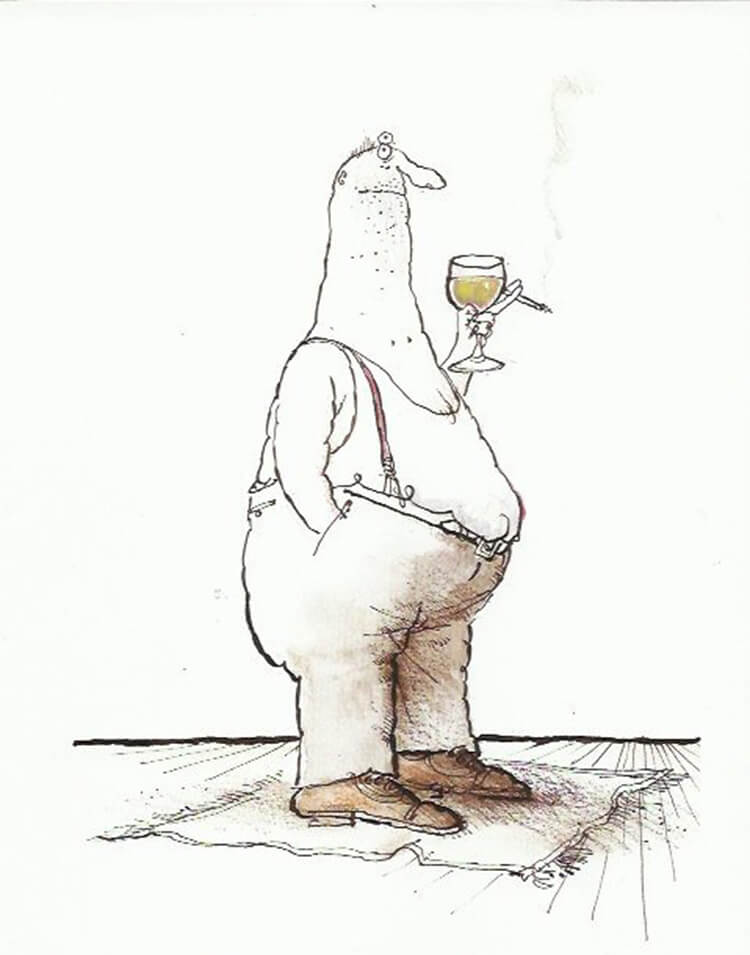
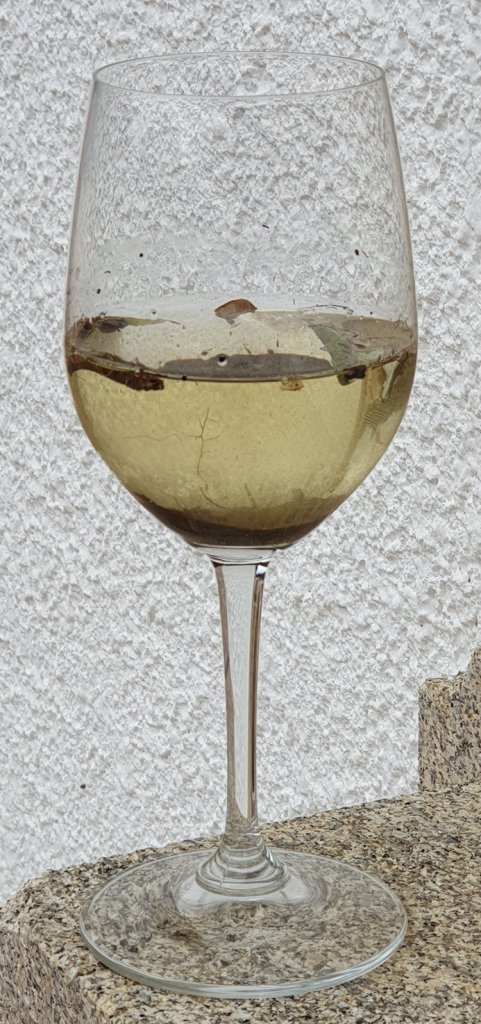
Don’t get me wrong, I really enjoy wines that are allowed to fully express themselves and that are a true and honest representation of their roots and origins, but at the same time I don’t want to be offered a completely opaque wine that leaves a residue of soil at the bottom of my glass! Believe it or not I have atually been presented with such a glass (OK, maybe without the soil), but to be brutally honest, I didn’t really like it one bit. As a former wine buyer I was trained to be open-minded about new and exciting wines, but then there always has to be a limit.

Our current official classifications (that can be certified), are biological, biodynamic and natural. However, wines can also be sustainable, with the least possible amount of intervention – using what I prefer to call ‘mindful winemaking’. And that is just what we do.

2018 – winemaking update

November 2nd, 2018 | Harvest

Well, it seems like winter is finally here. Our extended, late summer is now well and truly over, as the more usual weather of rain and much cooler temperatures is finally upon us. Time to light the fire and put the slippers on!

Meanwhile, inside the wine cellar, after weeks of almost constant vigilance, the making of our 2018 wine is finally behind us. The fermentation period requires that we measure the density of the wine at least twice a day, every day (the density being an indicator of how quickly the fermentation is taking place), and this is where the temperature control really comes into its own. If the process is moving too quickly then lowering the temperature can help to reduce the speed of fermentation – conversely, if it is moving too slowly, then allowing a small increase of temperature will help to get things back on track. Controlling the length of fermentation will ultimately determine the style of wine produced, and suffice to say that a white wine made with a shorter, slightly higher temperature fermentation will be quite different from a wine made with a long, slow, cool fermentation. It’s really a matter of taste and down to the personal preference of the winemaker.

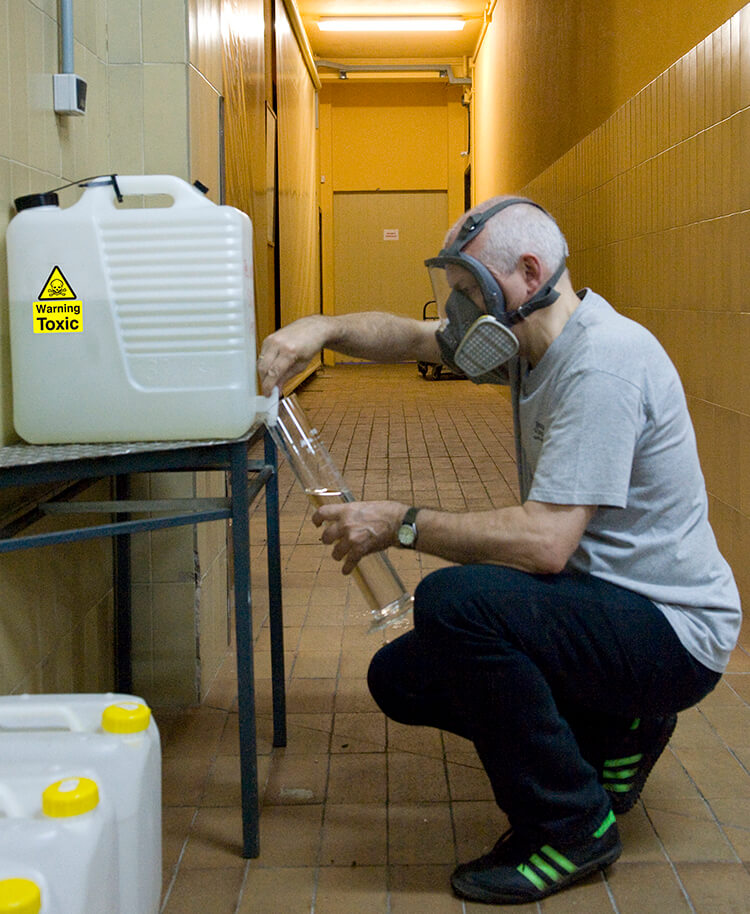
The final act that really brings the fermentation to a close is the addition of sulphur. This will effectively kill any yeast cells that are still active once all of the sugar has been consumed. For this we use tanks of pure, liquid sulphur dioxide, which is extremely hazardous and very dangerous to handle. Suffice to say that full face masks and protective equipment are very much the order of the day.

Post Harvest – Fermentation

October 1st, 2018 | Bodega

Just when you think that all the hard work, collecting grapes is done, then it all starts again inside the bodega. We have two huge programmes running simultaneously with one another…. The first is a deep clean, and when I say deep clean, it really has to be deep! Grape juice must be one of the stickiest substances on the planet (perhaps it could give Gorilla Glue a run for it’s money!) To be honest it’s not really ‘super’ sticky but it’s special property is that it simply transfers everywhere – there are few places that escape, so much so that a full change of clothes and shoes is really essential at the end of each working day. So now the task in hand is that we have to unstick everything, by far the most difficult chore being the presses – the epicentre of juice production.

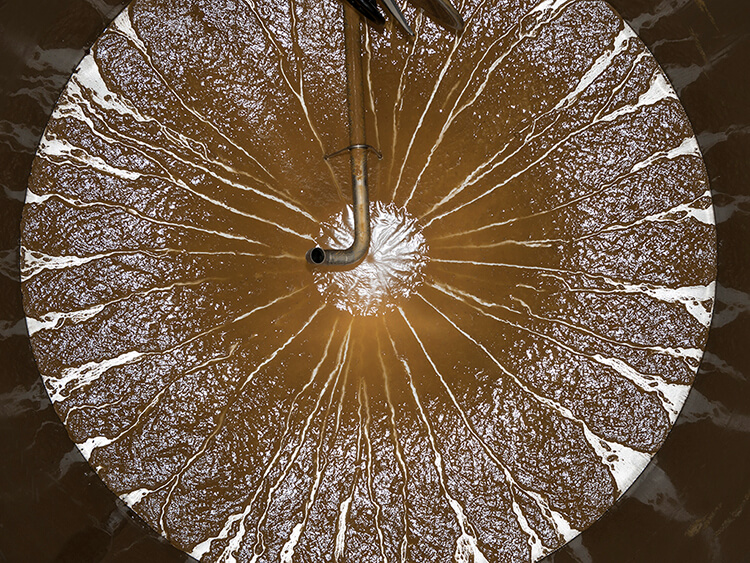
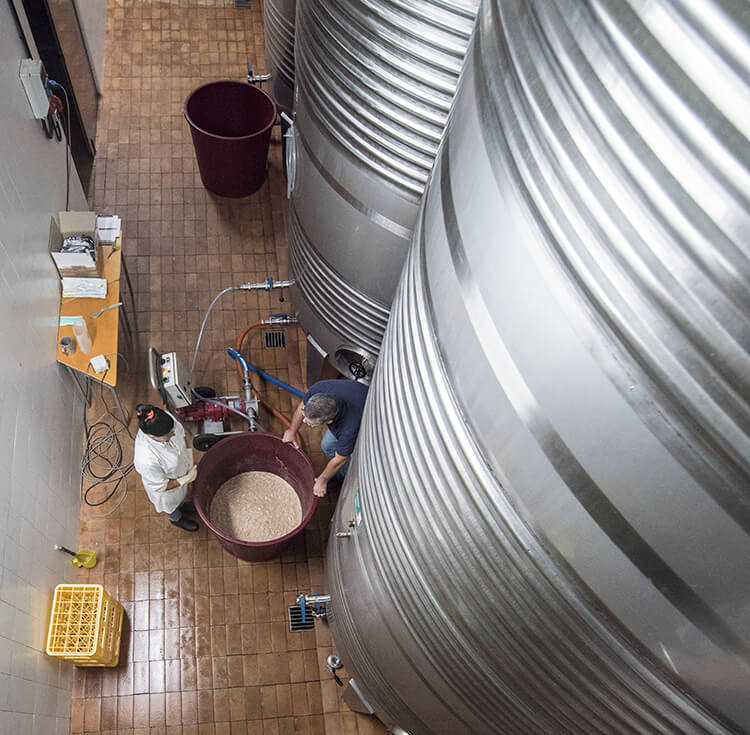
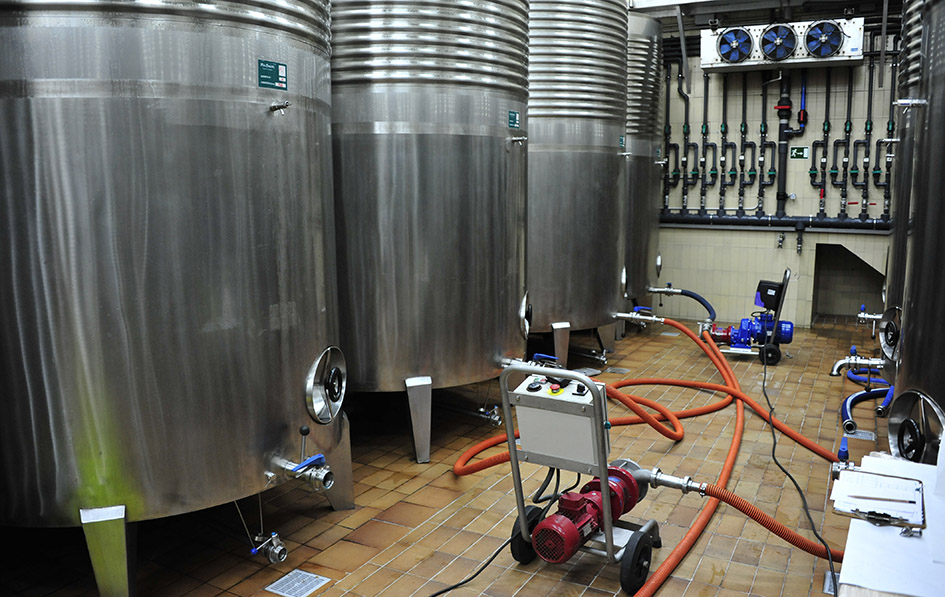
The second, and most important project is getting the fermentation under way. I did post a quick photo a day or two ago, taken as we started to re-hydrate the yeast, but once this is done then it has to be carefully and slowly added to each tank, one-by-one. The process of seeding a single large tank (see photo) can take up to 4 or 5 hours – the smaller tanks are a bit quicker, taking about 3 hours. Of course this time includes the pumping-over after the yeast is added. Pumping over is simply a mixing process, when we connect the top of the tank to the bottom using hoses, and then circulate the juice and yeast mixture in a cyclical motion for a couple of hours.

The timing of fermentation is determined by the juice, when, after cold settling, the temperature recovers to a level warm enough to support the yeast. If the juice is too cold, then the yeast will simply die of shock – the result? No fermentation!

This year the temperature dictated that we were here for the entire weekend, meaning that for the last two or three weeks, none of us have had a break! Who was it said that running a wine cellar is a romantic profession?!

Post Harvest – let’s make wine

September 27th, 2018 | Bodega

So now that the last grape is safely in, and the cold settling period is concluded, we embark on the small matter of wine making. Year-on-year there is never too much variation in what we do – we might make some small adjustments according to the vintage, and perhaps trial a new product or two in one odd tank, but the majority of what we do remains largely unchanged.

There is one characteristic of the 2018 vintage that I haven’t really mentioned as yet…. alcohol. I did say that we had been surprised by the quality of the fruit, and that it was quite viscose (rescued by a dry and warm August and September), but the other side effect of heat is alcohol. My guess is that we will see the FIRST EVER Castro Martin wines of 13% Alcohol!

We had already seen a number of 13% wines appearing last year, whereas our own mean average alcohol for 2017 was somewhere between 12.5% and 13% (the label has to be within 0.5% of the actual). This year we will almost certainly break this barrier, whilst bearing in mind that many people are still picking in 32°C heat (heaven only knows what level of alcohol this fruit will yield). Could we see albariños approaching 14% in 2018?

Oh, and by the way, don’t simply dismiss today’s picture as just another ‘moon shot’ – this is actually the yeast being mixed, just before it is added to one of our tanks!

Almost upon us!

September 5th, 2018 | Pre-harvest

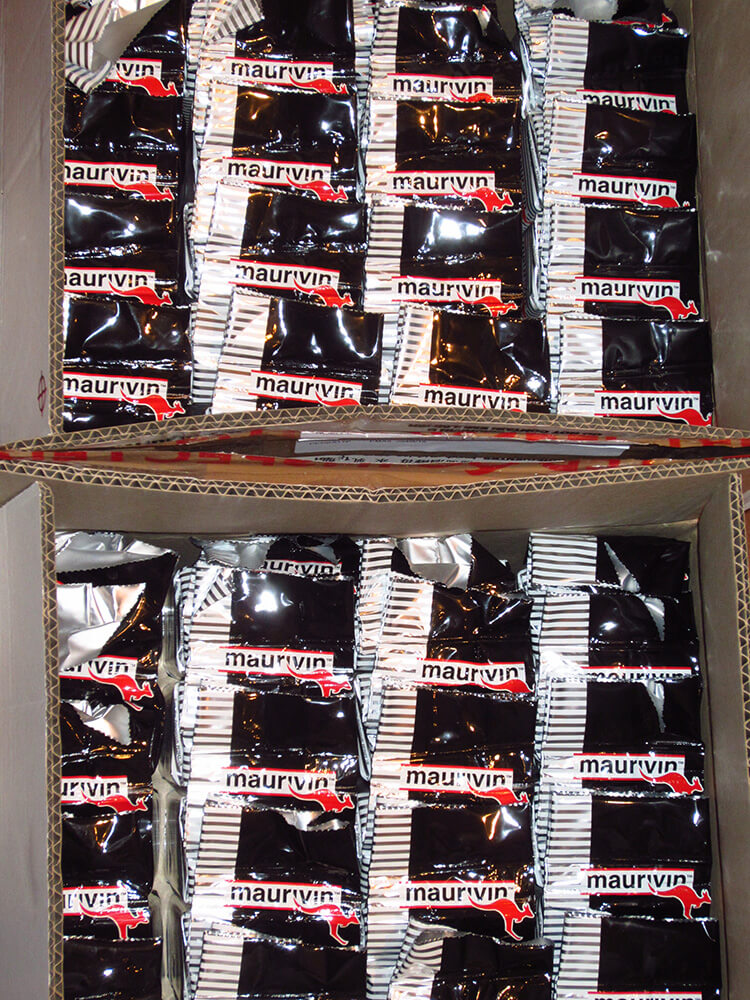
There are certain telltale signs that start to emerge as harvest time gets closer. For example, the products that we use to elaborate our wines start to arrive at our door.

For example, today we have received several cases of yeast. It goes without saying that we would prefer to use naturally occurring yeast (that forms a layer on the skin of the berries), but unfortunately this isn’t always the best option. One of the big problems is sustaining the fermentation until it’s complete. In some wine growing areas, and with some grape varieties this would perhaps not present a problem, but in Rias Baixas our own natural yeasts are really not strong enough to do this work on their own (and more especially with our temperature control working at low temperatures). The result would be half-fermented tanks that need re-seeding; hence our choice to preempt this problem. It’s sad but true that not everything happens as nature intended, and therefore it sometimes requires a helping hand along the way.

The yeast that we select is very neutral, and doesn’t impart any unnatural flavours or aromas to our finished wine. We grow albariño, we sell albariño, and guess what?…. we want it to taste of albariño!

How do you like your albariño?

July 16th, 2018 | Rias Baixas

The other day my UK journalist friend Tim Atkin wrote an article about typicity. In the context of wine, this simply means the typical characteristics that you would expect to find in a particular type of wine – a combination of factors typical of the denomination, of the grape variety, all ultimately influenced by the local climate and/or vintage.

In Rias Baixas the definition of a typical albariño will certainly vary according to the sub-zone. Although there is only 60km seperating the north from the south of the denomination, climatic and soil variations can already produce some widely differing styles. These days, unfortunately, flavour profiles can also be manipulated by the use of cultured yeasts whereby a wine’s typicity can be can be rendered almost unrecognisable. At Castro Martin however, we always opt for a very ‘neutral’ yeast, doing our very best to preserve and protect the delicate aromas of the albariño grape. Our extended lees ageing period helps not only to enhance this, but also adds further to the complexity of the finished wine.

In our view an albariño should always have a delicate fruit, perhaps slightly floral nose, sometimes offering a hint of salinity. On the palate flavours are often piercing and intense – a lively sweet and sour mixture. Notes of freshly cut fruit dominate – citrus, green apple, pear  and can include more exotic fruits such as melon, apricot and white peach. On the finish is can have a ‘nervous’, granitic edge and a streak of a salt-lick zestiness. It sounds like a real mouthful – but this is exactly what the typical albariño should be.

Let the racking begin

June 4th, 2018 | Bodega

The fermentation of our 2017 wines finished at the beginning of October last year, and since that moment our wines have been resting quietly on their lees. Today, some 8 months later, we have just started the annual racking. Over the winter the lees settle to form a sort of thick paste at the bottom of the tank, and today we are simply drawing off the clean wine from above (making sure that the don’t disturb the lees in the process).

It’s actually quite a slow process, with long periods of inactivity as we wait for the precious liquids to be transferred. Once the clean wine is relocated we then transfer the lees into large airtight containers to be sold to the distillery for making aguardiente. Nothing is wasted!

The final job is to clean the interior of the empty tanks, which is a chore in itself. The walls of the tanks are nearly always thick with brown crystals that resemble rust (from the tartaric acidity in the wine), and they can be quite tough to remove. We have to use a caustic solution, but then making absolutely certain that the tank is rinsed thoroughly before it is ready to receive the next wine.

So what does it cost? Part 2

May 23rd, 2018 | Bottles and bottling

[:en]The shocking fact is that for less expensive wines, the cheapest element of the price that you pay is for the wine itself – the actual 75cl of white, pink or red liquid in your bottle! When you consider the amount of effort that goes into producing a single bottle (from growing the fruit, harvesting, converting it into wine, bottling it and packaging it), the fact that this can actually represent just a tiny fraction of what you pay is really a bit of a scandal (speaking from a wine producers point of view, of course)!

I guess that the same could be said for any number of products that you might find in your weekly shopping basket – we are after all, simple fruit farmers. The only difference being that we take the production one step further by fermenting the fruit into alcohol. And thereby lies the key word….. Alcohol!

The moment that the bottles and pallets leave our door is when the costs start to mount up. Transport and shipping I have already mentioned, but once our wine crosses the Spanish border, it immediately become liable for the duties and taxes of the importing country. It’s only when you start to examine these additional levies a bit more closely, that you see the cost of a bottle really beginning to accelerate.

When goods eventually arrive at their destination then they can also attract further warehousing and handling costs. Depending on the type of customer, they could then attract further, onward distribution costs even before they arrive anywhere near a consumer.

Now we can finally talk profit! Of course the wine producer himself has already extracted a very modest cut, and then the importer will add a further margin before passing the bottles on to a retailer or restaurant. Of course the profits made by shops and restaurants are already well documented, and it is probably better that I don’t comment at all – suffice to say that these can be quite “healthy”.

The net result is that with all the handling, distribution, taxes and duties etc., a very modestly priced wine can end up being quite a bit more expensive. A very frightening calculation (working backwards), is that a bottle sold in the UK for around £5.00 leaves almost nothing at all for the cost of the wine itself![:es]The shocking fact is that for less expensive wines, the cheapest element of the price that you pay is for the wine itself – the actual 75cl of white, pink or red liquid in your bottle! When you consider the amount of effort that goes into producing a single bottle (from growing the fruit, harvesting, converting it into wine, bottling it and packaging it), the fact that this can actually represent just a tiny fraction of what you pay is really a bit of a scandal (speaking from a wine producers point of view, of course)!

I guess that the same could be said for any number of products that you might find in your weekly shopping basket – we are after all, simple fruit farmers. The only difference being that we take the production one step further by fermenting the fruit into alcohol. And thereby lies the key word….. Alcohol!

The moment that the bottles and pallets leave our door is when the costs start to mount up. Transport and shipping I have already mentioned, but once our wine crosses the Spanish border, it immediately become liable for the duties and taxes of the importing country. It’s only when you start to examine these additional levies a bit more closely, that you see the cost of a bottle really beginning to accelerate.

When goods eventually arrive at their destination then they can also attract further warehousing and handling costs. Depending on the type of customer, they could then attract further, onward distribution costs even before they arrive anywhere near a consumer.

Now we can finally talk profit! Of course the wine producer himself has already extracted a very modest cut, and then the importer will add a further margin before passing the bottles on to a retailer or restaurant. Of course the profits made by shops and restaurants are already well documented, and it is probably better that I don’t comment at all – suffice to say that these can be quite “healthy”.

The net result is that with all the handling, distribution, taxes and duties etc., a very modestly priced wine can end up being quite a bit more expensive. A very frightening calculation (working backwards), is that a bottle sold in the UK for around £5.00 leaves almost nothing at all for the cost of the wine itself![:]

Monthly Archives

Categories

ARE YOU OF LEGAL AGE? This site is intended for those of legal drinking age. By entering, you confirm that you are of legal drinking age in the country where this site is being accessed. ¿ERES MAYOR DE EDAD? Este sitio está destinado a personas en edad legal para beber alcohol. Al ingresar, confirma que tiene la edad legal para beber en el país donde se accede a este sitio.