

Archive for ‘Odds & Sods’

Halloween

October 31st, 2016 | Fiestas

[:en]Tim Hanni MWWhether you call it Halloween, All Hallows Eve or Samhain, I think it would be fair to say that the origin of Halloween has always been slightly unclear, and is probably celebrated by different people for different reasons. Celebrated by Pagans, Christians the Celts and/or the Gaels, one of the few common connections appears to be the date – on the eve of All Saints Day (or All Hallows Day).

Perhaps some of the modern traditions (or some might say the ‘Americanisation’ of Halloween), are an amalgamation of various elements derived from the different ancient traditions – dressing in costumes, trick-or-treating or even carving pumpkins can all be explained in some way (the latter probably evolving from the Gaelic tradition of carving turnips to ward off evil spirits).

In America the name Jack O’Lantern came from the folkloric story of Stingy Jack, and was probably developed by the influx of Irish immigrants in the mid-19th century who, not being able to find turnips to carve, used the more readily available pumpkin into which to carved their scary faces.

This brings me on quite conveniently to an old friend of mine, Tim Hanni MW (now a Professor at the Nappa Valley Wine Academy). I know Tim from my previous life as a buyer when he worked for Beringer, pretty much as their food and wine ambassador. I have to say that it was Tim who single-handedly opened my eyes to the concept of food and wine pairing with a series of tastings that he called quite simply, ‘Cause and Effect’. Truly amazing stuff for which I will always be indebted to Tim as my single greatest influence on this very tricky and highly subjective matter.

Tim is also a writer and has written a no-nonsense book called ‘Why you like the wines you like – changing the way the world thinks about wine’. I have had a copy of this book for some years, and it is a very entertaining read, that could maybe help clarify your own ideas about wine, and why you like it. (Available on Amazon) Tim shares many of my own views about wine and is often referred to as “The Wine Anti-Snob”!

However, Tim has recently laid down his pen and picked up his carving tool to create his very own Jack O’Lantern, which, for some inexplicable reason, he has referred to as his ‘Trumpkin’!!![:es]Tim Hanni MWWhether you call it Halloween, All Hallows Eve or Samhain, I think it would be fair to say that the origin of Halloween has always been slightly unclear, and is probably celebrated by different people for different reasons. Celebrated by Pagans, Christians the Celts and/or the Gaels, one of the only common connections appears to be the date – on the eve of All Saints Day (or All Hallows Day).

Perhaps some of the modern traditions (or some might say the ‘Americanisation’ of Halloween), are an amalgamation of various elements derived from the different ancient traditions – dressing in costumes, trick-or-treating or even carving pumpkins can all be explained in some way (the latter probably evolving from the Gaelic tradition of carving turnips to ward off evil spirits).

In America the name Jack O’Lantern came from the folkloric story of Stingy Jack, and was probably developed by the influx of Irish immigrants in the mid-19th century who, not being able to find turnips to carve, used the more readily available pumpkin into which to carved their scary faces.

This brings me on quite conveniently to an old friend of mine, Tim Hanni MW (now a Professor at the Nappa Valley Wine Academy). I know Tim from my previous life as a buyer when he worked for Beringer, pretty much as their food and wine ambassador. I have to say that it was Tim who single-handedly opened my eyes to the concept of food and wine pairing with a series of tastings that he called quite simply, ‘Cause and Effect’. Truly amazing stuff for which I will always be indebted to Tim as my single greatest influence on this very tricky and highly subjective matter.

Tim is also a writer and has written a no-nonsense book called ‘Why you like the wines you like – changing the way the world thinks about wine’. I have had a copy of this book for some years, and it is a very entertaining read, that could maybe help clarify your own ideas about wine, and why you like it. (Available on Amazon) Tim shares many of my own views about wine and is often referred to as “The Wine Anti-Snob”!

However, Tim has recently laid down his pen and picked up his carving tool to create his very own Jack O’Lantern, which, for some inexplicable reason, he has referred to as his ‘Trumpkin’!!![:]
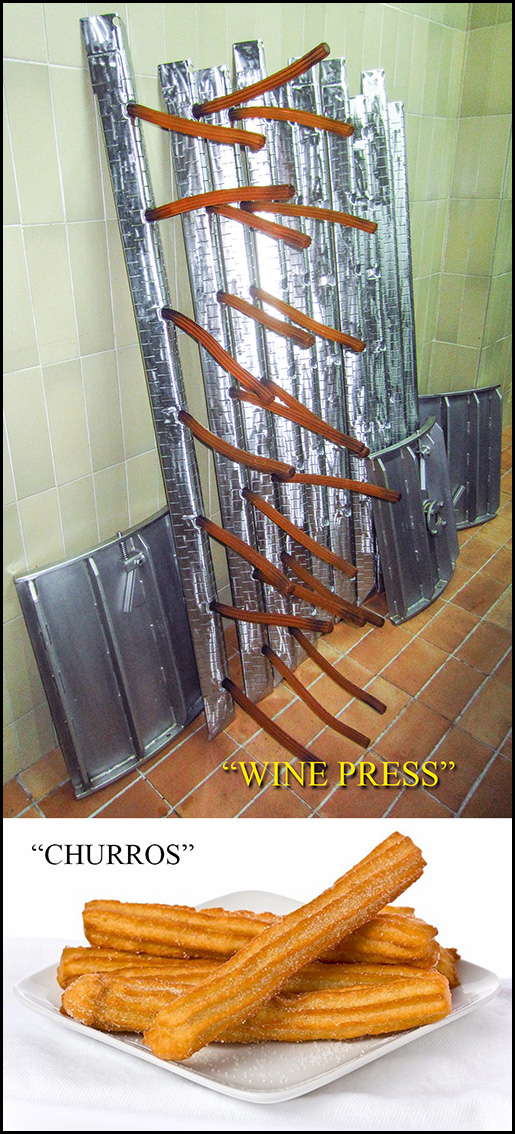
Wine made with ‘churros’!

October 24th, 2016 | Bodega

Wine & Churros 2Now that the vendimia is behind us and the fermentations are at an end, we continue with the ongoing task of deep cleaning the wine cellar. There are some areas, including the tank room, that we are pretty much unable to touch until the wines are finished and the tanks firmly closed. (During our fermentations the tanks have to be left open to allow the huge amounts to CO2 generated to escape – supported by a strong air extraction system so that we don’t all expire whilst working from a lack of oxygen!)

In the pressing room for example, the presses themselves have been thoroughly cleaned, albeit that they still need to be re-assembled and some of the internal parts fixed back inside.

Today’s photo shows some of these pieces – the long rubber ‘fingers’ extending from the steel parts that you can see, are the pieces that help to break up the grapes and bunches as the machine rotates during pressing (in a similar action to the modern washing machine, as it rotates gently back and forth during the cycle). The long brown fingers of the press are ribbed, and really, really remind me of the very famous Spanish delicacy ‘churros’, which are traditionally eaten with a thick hot chocolate drink – the churros themselves being used for ‘dunking’ in the cup!.

I’m afraid that these rubber fingers, even if they were sprinkled with sugar and dipped in chocolate, wouldn’t taste quite the same!

Hot spice!

June 16th, 2016 | Food & Wine

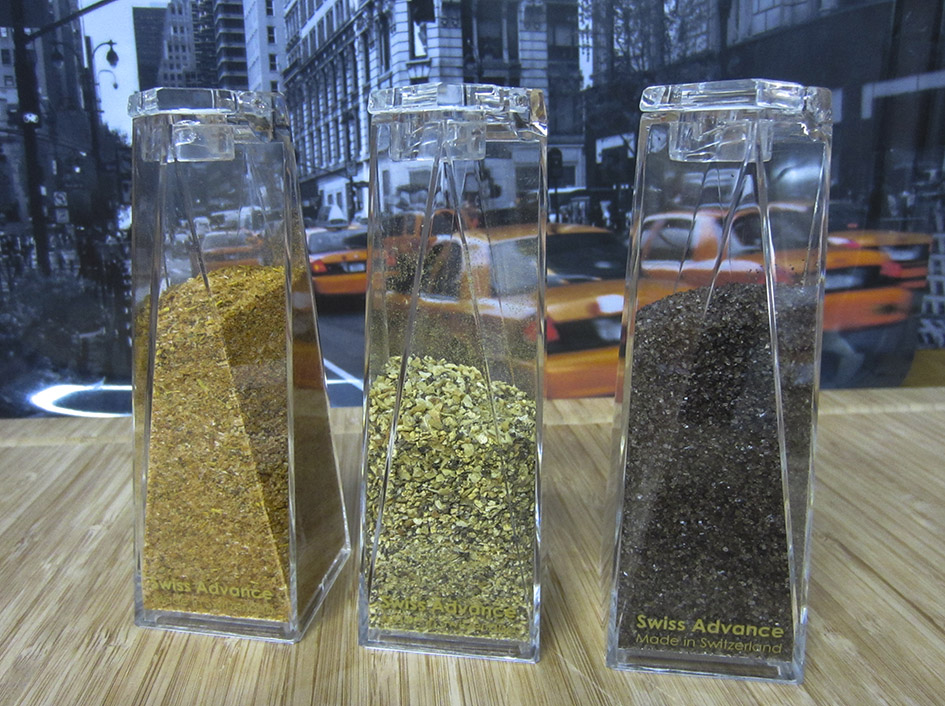
[:en]CondimentsOn our recent trip to Seattle we visited a diner (actually quite a good restaurant) called the Steelhead Diner, very near to the famous Pike’s market. Quite unusually these days, they had condiments on the table – salt and pepper – but not your run-of-the-mill salt and pepper. For a start the salt was darker in colour than the pepper, but fortunately both were clearly labelled. Smoked salt and garlic pepper (although that is not the full description which I’m afraid I don’t remember). They were both unusual and delicious, and fortunately both were available from a spice shop in the adjacent market. We bought a bag of each, wrapped them in several layers (as they were quite pungent), and packed them in our hand luggage. This was our first mistake….. Both in Seattle and New York the airport security picked them up on x-ray, bags were searched and we had to explain these mysterious powders to U.S. customs officers.

When we eventually arrived back in Spain I at least had the presence of mind to temporarily store them in air-tight glass containers, until I could find some suitable shakers for the table. Now, in Galicia we already have a humidity problem, whereby it’s virtually impossible to keep a pot of free running salt, and so I decided to buy something special, from Switzerland, in order to keep them dry and in good condition. Air tight condiment pots designed for mountain trekking and climbing – these should do the job!

When these fancy spice pots arrived I used a small funnel to fill them, but when one large grain of the pepper spilled onto the work surface I almost instinctively put it on my tongue to try it – mistake number two. This was the hottest thing that I had ever put in my mouth – and this is coming from someone who much prefers their Indian food ‘tear-inducingly’ hot. My mouth was on fire (I can only imagine like eating a super hot chilli), and so I rushed to the fridge and took several large swigs of cold milk direct from the bottle. Just as well that we had no tastings programmed because I  really couldn’t feel my tongue!

The final chapter of my spice story is that not only did we have to put the glass container (that I had used to store these condiments) through the dishwasher, but we also had to wash out the entire cupboard just to get rid of the smoked spice smell. Powerful stuff…..[:es]CondimentsOn our recent trip to Seattle we visited a diner (actually quite a good restaurant) called the Steelhead Diner, very near to the famous Pike’s market. Quite unusually these days, they had condiments on the table – salt and pepper – but not your run-of-the-mill salt and pepper. For a start the salt was darker in colour than the pepper, but fortunately both were clearly labelled. Smoked salt and garlic pepper (although that is not the full description which I’m afraid I don’t remember). They were both unusual and delicious, and fortunately both were available from a spice shop in the adjacent market. We bought a bag of each, wrapped them in several layers (as they were quite pungent), and packed them in our hand luggage. This was our first mistake….. Both in Seattle and New York the airport security picked them up on x-ray, bags were searched and we had to explain these mysterious powders to U.S. customs officers.

When we eventually arrived back in Spain I at least had the presence of mind to temporarily store them in air-tight glass containers, until I could find some suitable shakers for the table. Now, in Galicia we already have a humidity problem, whereby it’s virtually impossible to keep a pot of free running salt, and so I decided to buy something special, from Switzerland, in order to keep them dry and in good condition. Air tight condiment pots designed for mountain trekking and climbing – these should do the job!

When these fancy spice pots arrived I used a small funnel to fill them, but when one large grain of the pepper spilled onto the work surface I almost instinctively put it on my tongue to try it – mistake number two. This was the hottest thing that I had ever put in my mouth – and this is coming from someone who much prefers their Indian food ‘tear-inducingly’ hot. My mouth was on fire (I can only imagine like eating a super hot chilli), and so I rushed to the fridge and took several large swigs of cold milk direct from the bottle. Just as well that we had no tastings programmed because I  really couldn’t feel my tongue!

The final chapter of my spice story is that not only did we have to put the glass container (that I had used to store these condiments) through the dishwasher, but we also had to wash out the entire cupboard just to get rid of the smoked spice smell. Powerful stuff…..[:]

Burgundy = Ribera Sacra? I think not!

May 25th, 2016 | Odds & Sods

[:en]Ribera Sacra

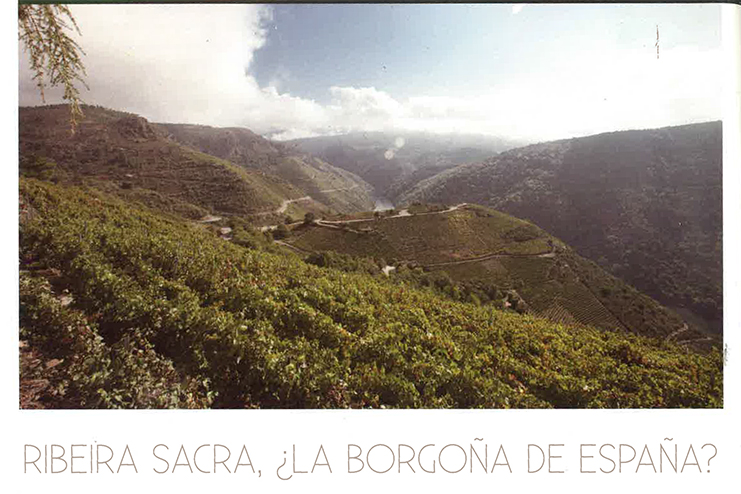
I read a Spanish wine publication recently (which shall remain nameless), where one of the articles named our neighbouring wine region of Ribera Sacra as ‘the Burgundy of Spain’. As someone who knows Burgundy really quite well (having travelled there extensively for about 14 years during my wine career), this startling headline certainly caught my eye. What on earth could they possibly mean, I thought to myself? Is the geography similar? Do they grow Pinot Noir (or Chardonnay for that matter)? Are the climates similar? What could the connection possibly be?

Certainly it’s true that the history of Ribera Sacra dates back to the spread of the Roman Empire across Europe (the resulting vine cultivating practices subsequently perpetuated by the church), but then the same can be said of many a wine region throughout Europe. As far as I can see however, in reading this article, this is where any similarity begins and ends.

The Ribera Sacra vineyards cling to the steep sided valley of the River Sil, where the most common grape varieties cultivated are Mencia and the Alicante Bouschet – a typography much more akin to the Douro Valley than the rolling hills of Burgundy. The resulting wines are also very different – I really adore some of the great wines of Burgundy, both red and white, whereas wines of the Ribera Sacra don’t really excite me at all. Indeed, during my time here I have only really found one or two that I would consider worth drinking a second time.

The final thought of the author was to say that he was convinced that the wines produced in Ribera Sacra could easily share “the delicacy and finesse of the Grand Crus of Burgundy”! The only conclusion I could draw upon reading this was either that the writer had never tasted a Burgundy Grand Cru, or that he must be on drugs!

 [:es]Ribera SacraI read a Spanish wine publication recently (which shall remain nameless), where one of the articles named our neighbouring wine region of Ribera Sacra as ‘the Burgundy of Spain’. As someone who knows Burgundy really quite well (having travelled there extensively for about 14 years during my wine career), this startling headline certainly caught my eye. What on earth could they possibly mean, I thought to myself? Is the geography similar? Do they grow Pinot Noir (or Chardonnay for that matter)? Are the climates similar? What could the connection possibly be?

Certainly it’s true that the history of Ribera Sacra dates back to the spread of the Roman Empire across Europe (the resulting vine cultivating practices subsequently perpetuated by the church), but then the same can be said of many a wine region throughout Europe. As far as I can see however, in reading this article, this is where any similarity begins and ends.

The Ribera Sacra vineyards cling to the steep sided valley of the River Sil, where the most common grape varieties cultivated are Mencia and the Alicante Bouschet – a typography much more akin to the Douro Valley than the rolling hills of Burgundy. The resulting wines are also very different – I really adore some of the great wines of Burgundy, both red and white, whereas wines of the Ribera Sacra don’t really excite me at all. Indeed, during my time here I have only really found one or two that I would consider worth drinking a second time.

The final thought of the author was to say that he was convinced that the wines produced in Ribera Sacra could easily share “the delicacy and finesse of the Grand Crus of Burgundy”! The only conclusion I could draw upon reading this was either that the writer had never tasted a Burgundy Grand Cru, or that he must be on drugs![:]

Spring is here!

March 20th, 2016 | Food & Wine

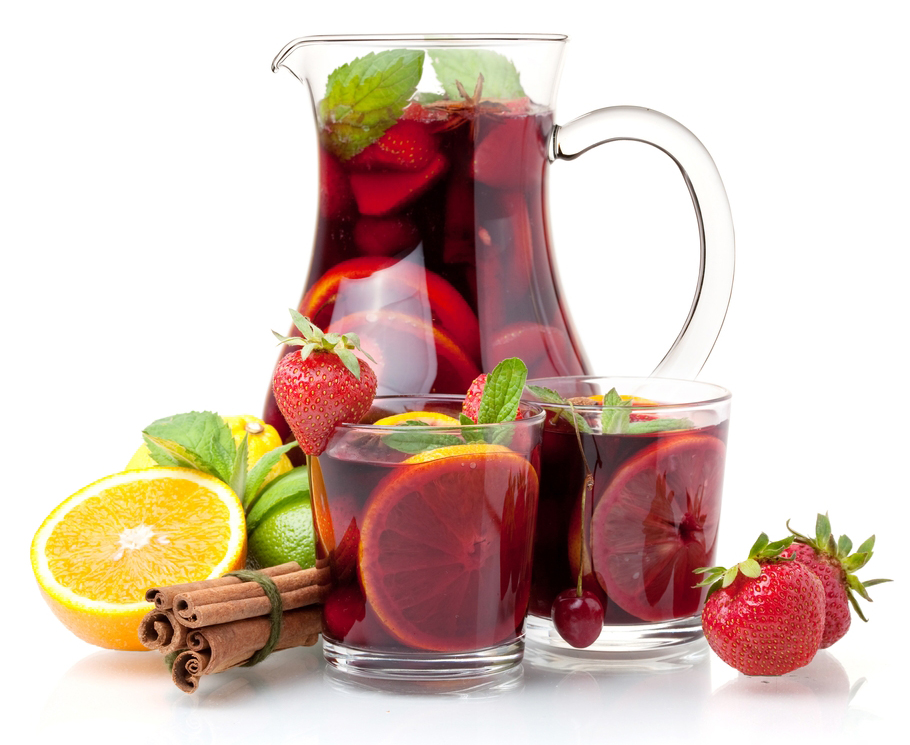
sangria (1)On the first official day of Spring, it’s maybe time to think about changing our drinking habits. Lock away the heavier, warming winter red wines and break out the lighter, fruity reds, or maybe even an odd summer white (including the Castro Martin of course!)

One of the other spring/summer options is Sangria, widely served in Spain and Portugal, but most probably first created by the Romans. As they expanded their Empire across Europe it seems that they may have used wine to sanitise their drinking water, and hence the first Sangria was created. Adding fruit and spices simply evolved out of boredom – centuries ago wine consumers didn’t have a wide selection of different varietals to chose from, and so adding fruits was merely a way of creating new flavours to enjoy.

The point is that there isn’t really any fixed ‘recipe’ for making Sangria, the only common ingredient being the wine. Of course our beloved EU paper pushers have now come up with an official definition – the simplified version is that it is an aromatised wine of less than 12% volume, that may be enhanced by natural fruit juices or extracts, and that it may be carbonised. The possibilities and permutations are therefore endless. The alcohol content can vary by anything from 4% to 12%, and in some countries it is actually made using white wine (although this might be considered odd as the word Sangria literally translates to ‘bloodletting’, which (rather grimly) implies that it is made from red wine).

In any event, Sangria provides a great way to test your ‘mixology’ this summer….

Natural Wines

March 14th, 2016 | Odds & Sods

future-libraryA few days ago I posted some comments about the different categories of ‘Eco friendly’ wine. Shortly after making this post I read a great tongue-in-cheek article written by Ron Washam, ex-award winning sommelier and contributor to the website of my friend Tim Atkin MW.

The premise of the article is that it is written in the year 2095 whilst visiting the World’s Greatest Wine Library.

“Many of you may be old enough to remember Natural Wines. Natural Wines were wines said to be better because they were made using minimally invasive techniques. In the United States, the same techniques were used for what were later called “Natural Wars,” like in Syria and Afghanistan. But the concept of Natural Wine began in the late 20th Century, and seems to have been a reaction to the degradation of the planet. Climate change was just being acknowledged, and fossil fuels were king. It was a primitive time, when elephants actually walked the Earth. So we can excuse the Natural Wine writers their ignorance.

I thumbed through the collected papers of Alice Feiring. Was it me, or did the papers smell vaguely of reduction? Feiring’s work speaks often of biodynamics, the system of agriculture expounded by the 20th Century Austrian lunatic Rudolf Steiner (Austria was the birth place of many famous lunatics of the 20th century, a fact which also explains why so much Grüner Veltliner was planted there). Steiner, and his Natural Wine disciples, believed that different energies and lunar cycles were important factors in grape growing. We know now that it wasn’t biodynamics that improved the biomass of the vineyards, but that it was actually the proponents’ poor personal hygiene.

Right next to the Feiring library are the translated works of Nicolas Joly. Joly was the most vocal winemaker on the subject of biodynamics, and the World’s Greatest Wine Library has dozens of copies of Joly’s books translated into English from his native language, Space Alien.”

If you read Ron’s website (The Hosemaster of Wine) on a regular basis, you will understand that it is not necessarily his intention to insult, but he simply puts a very irreverent spin on wine matters that we all often take far too seriously. After all, wine is fun and here to be enjoyed, not endlessly over-analysed.

Home brew

March 9th, 2016 | Odds & Sods

Home brewIt’s quite a romantic idea to serve a wine made by your own fair hand, and even more so if your name appears on the label. I guess that this could be why a handful of celebrities have invested their millions into producing their very own wine…… ‘Pretentious’ I think it’s called. The reality though, is somewhat different to the dream – it’s quite hard work to grow grapes and make wine, even more difficult to sell it, and quite impossible to make a profit (OK, that last part is not strictly true, except to say that there are a lot of bodegas in Galicia struggling to make ends meet at the moment).

On a much smaller scale you could of course, buy a wine kit and make your own wine in the comfort of your own kitchen. Admittedly not quite as romantic an idea, but potentially a lot more fun (assuming that it works!). I believe that there are many different ways of doing it, although I confess that I have never tried, and I am sure that some kits will achieve better results than others. I did however, see a rather elaborate kit that caught my eye, the only downside being the price – $239 to make 1 gallon of wine. By my calculations that translates to about $63 a litre, or $47 a bottle (75cl)! You could buy a pretty decent bottle for that amount of money, and so you would hope that the result is at least drinkable, otherwise you might end up with a wine making kit that simply resembles a fairly expensive chemistry set.

This particular wine kit is available in different flavours (I am reluctant to say grape varieties), Chilean Merlot, Cabernet Sauvignon, Pinot Noir, Moscato, Australian Chardonnay and Italian Pinot Grigio. The world of wine is at your feet, but only if you are prepared to forego a wonderful Spanish albariño…. Castro Martin – not available in any wine kit!

Working hours

February 18th, 2016 | Business

CerradoThis morning I had three separate chores to do in the centre of Pontevedra – visiting three separate businesses. The problem was that I had no idea what time they opened, and so I made a quick search on Google. The result was not really what I wanted. One opened at 8am, the second at 9am, and the last one at 9.30am. Clearly I didn’t want to hang around in town waiting for the third business to open, so the only option was to wait at home until just before 9.30. This was really frustrating and I just felt like I was wasting my morning….

It occurred to me that the situation is actually much worse than this, if you examine Spanish business hours in general. Businesses can open at more or less any hour between 8am and 10/10.30am in the morning, and then close again for lunch at any time between 1.30pm and 2.30pm. And guess what? This very same scenario is repeated again in the evening! Shops and offices re-open between 3.30pm and 5.30pm, and then close again at any time up until about 10pm. I have to say that this system doesn’t strike me as being particularly efficient (or convenient). For example, unless you know the opening and closing times of every business that you want to contact or visit, then it can be quite complicated. (Without mentioning the fact that the very same businesses can, and do, vary their hours between winter and summer!)

Weekends are another story…. Many shops still close for the weekend at lunch time on Saturday, which would appear to be a bit of an archaic practice – especially in times of recession when you really need to maximise your income. Shops are closed on Sundays here in the provinces (but much less so in the big cities these days). Here in the ‘sticks’ shops are allowed to open for a limited (and controlled) number of Sundays throughout the year, normally around Christmas or ‘Sale’ periods.

At Castro Martin we only make one small adjustment to our timetable during the year, between winter and summer. In winter we start an hour later at 9am, but this is simply because of daylight hours. On winter mornings our guys cannot prune vines in the dark, hence the fact that we start a little later.

So near, but yet so far…

January 27th, 2016 | Galicia

Google EarthI installed a city map App on my phone the other day. As soon as it was up and running it started to search for any major cities close to our location – it didn’t find any! The results however, were slightly surprising. Apparently the nearest major city to Barrantes (where our bodega is located) is Lisbon! Somehow I had assumed that it would be Madrid, but actually Lisbon is some 55km nearer (Lisbon 415km, Madrid 470km). One of the facts that didn’t surprise me is that Barcelona is 950km from our door, and I assume that this is the straight line distance. Apart from flying, the journey to Barca is almost an expedition (over 1,150km by road – about 11 hours driving)!

It’s also quite interesting to know that London is only 300km further than Barcelona, which actually corroborates the fact that from Galicia to Cataluña is the widest point of Spain (east to west). Sometimes, when people come to visit us, their geography of the country can be a little confused. When I mention that we are located in northern Spain, many visitors respond by saying “so you must be near Bilbao then?”. This is not the case! Bilbao is actually just under 500km from our door (as the crow flies) and certainly used to be a full days drive – new roads have made it a bit quicker now, albeit still probably six hours.

I guess my point is that Galicia is still a very rural and remote corner of Spain. Getting in and out of our Province is still not easy – roads are improving, air routes are limited, and trains are still quite poor (taking several hours to reach Madrid). Hence the fact that I’m really looking forward to visiting London next week!

Big is beautiful? Maybe not…

January 18th, 2016 | Food & Wine

ChocolateI have lived in Galicia for more than a dozen years now, and one of my big frustrations (as a would-be chef) is the continued lack of variety in the range of fruit and veg on offer. It is very basic to say the least, and is certainly not expanding to include any ‘exotics’. When I originally left the UK, one of the big food shopping trends at that time was for ‘baby’ vegetables – everything was shrinking, albeit not in price! We were told that fruit and veg picked younger and fresher was simply more flavourful, and I think that in most instances, this was very probably true.

I’m afraid to say that here in Galicia, the exact opposite would seem to be the case – the bigger the better appears to be the general rule of thumb. Huge potatoes and carrots that are either ‘woody’or have little flavour (also potatoes are almost never sold by variety, and so exactly which ones to chose can be a bit of a lottery).

This obsession with size also seems to spill over into restaurants – Galician portion sizes can be huge. Indeed, I recently read a review on Trip Advisor whereby one consumer, sampling the ‘tasting menu’ at a local Michelin starred restaurant, complained about portion sizes, and demanded that he should be able to repeat certain courses. Obviously this was refused, and consequently the guy was completely scathing in his review.

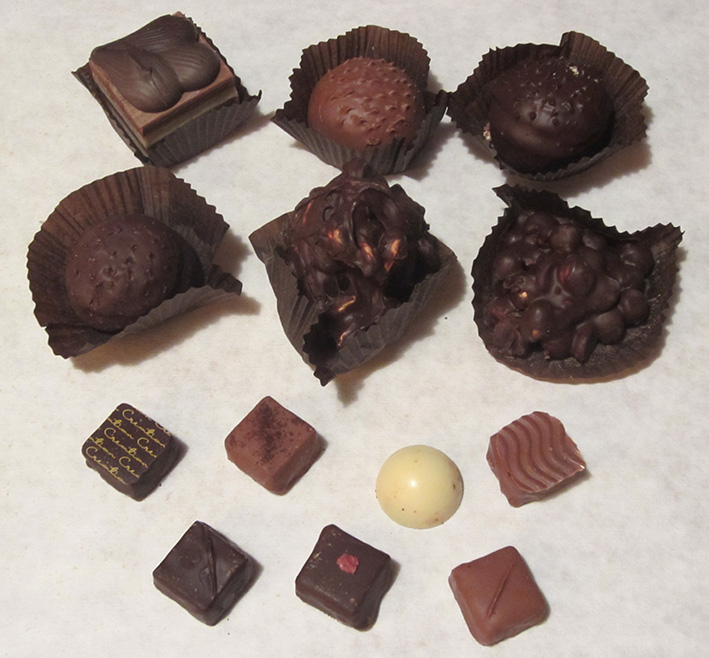
Finally hand-made chocolate. At Christmas we were lucky enough to receive a few gifts, including some had-made chocolates. One box was from a well-known producer in Catalunia, Spain, whilst a second box was from a chocolatier in Belgium. Both are shown in today’s photo – can you tell which chocolates are Spanish and which are Belgian?

Monthly Archives

Categories

ARE YOU OF LEGAL AGE? This site is intended for those of legal drinking age. By entering, you confirm that you are of legal drinking age in the country where this site is being accessed. ¿ERES MAYOR DE EDAD? Este sitio está destinado a personas en edad legal para beber alcohol. Al ingresar, confirma que tiene la edad legal para beber en el país donde se accede a este sitio.