

Archive for ‘Fiestas’

Soggy Holidays!

December 22nd, 2012 | Fiestas
There is good news and bad news here in Galicia as Christmas approaches. The good news is, firstly, that the world didn’t end on Friday as predicted in the Mayan Calendar, and then secondly the local seafood prices have remained more stable this year. The latter is actually quite important news in Galicia as seafood forms an important part of the traditional Christmas menu for us. Under normal circumstances supply and demand would push prices through the roof at this time of year, but possibly, owing to the the deep recession that we have, the demand this Christmas has been somewhat subdued. In previous years some of the most sought after seafood has achieved quite astronomical levels – percebes (sea barnacles) for example, were changing hands at around 200 Euros per kilo! This year however, whilst the market has softened a little, it is still possible to pay between 100-150 Euros for percebes in some local towns. Fresh camarónes (shrimp) are still commanding prices of around the 100 Euro/kg mark, cigalas (crayfish) can be found at around 80 Euros, and nécoras (crab) are between 50-60 Euros/kg. 

The bad news is that our Christmas holidays have been, and will probably continue to be, extremely wet – perhaps not quite as wet as other parts of Europe, but we have still experienced some significant rainfall. For the first two weeks of this month it rained almost non-stop, producing more than double the volume for the entire month of December last year. Only last week we suffered torrential, horizontal rain, driven by winds of over 90kph (56mph), but having said that the poor people of New York and the U.S. east coast will probably dismiss that as insignificant.

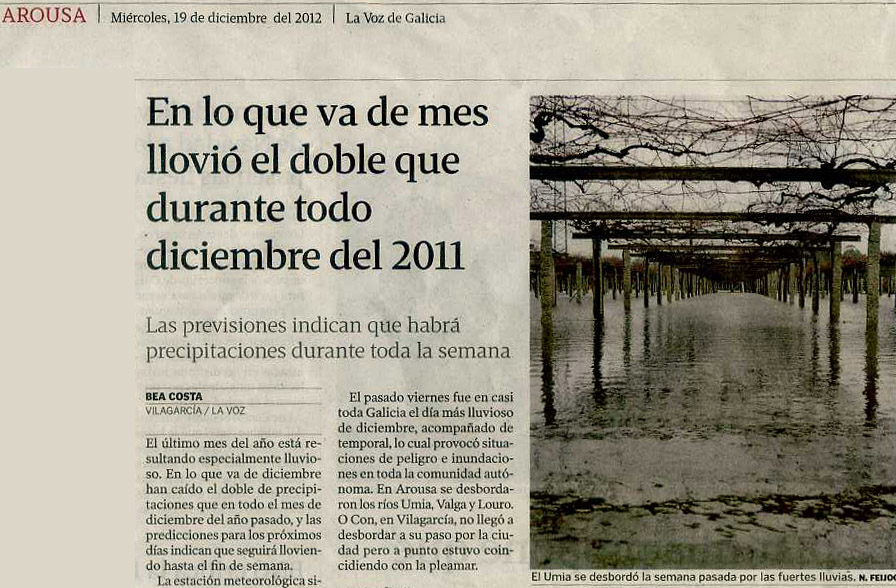
I should finish by saying that the vineyard in the newspaper picture is not ours – our soil is pretty wet, but I’m happy to say that we are not flooded.

There is good news and bad news here in Galicia as Christmas approaches. The good news is, firstly, that the world didn’t end on Friday as predicted in the Mayan Calendar, and then secondly the local seafood prices have remained more stable this year. The latter is actually quite important news in Galicia as seafood forms an important part of the traditional Christmas menu for us. Under normal circumstances supply and demand would push prices through the roof at this time of year, but possibly, owing to the the deep recession that we have, the demand this Christmas has been somewhat subdued. In previous years some of the most sought after seafood has achieved quite astronomical levels – percebes (sea barnacles) for example, were changing hands at around 200 Euros per kilo! This year however, whilst the market has softened a little, it is still possible to pay between 100-150 Euros for percebes in some local towns. Fresh camarónes (shrimp) are still commanding prices of around the 100 Euro/kg mark, cigalas (crayfish) can be found at around 80 Euros, and nécoras (crab) are between 50-60 Euros/kg. 

The bad news is that our Christmas holidays have been, and will probably continue to be, extremely wet – perhaps not quite as wet as other parts of Europe, but we have still experienced some significant rainfall. For the first two weeks of this month it rained almost non-stop, producing more than double the volume for the entire month of December last year. Only last week we suffered torrential, horizontal rain, driven by winds of over 90kph (56mph), but having said that the poor people of New York and the U.S. east coast will probably dismiss that as insignificant.

I should finish by saying that the vineyard in the newspaper picture is not ours – our soil is pretty wet, but I’m happy to say that we are not flooded.

Christmas spirit

December 20th, 2012 | Fiestas

It’s only a couple of years ago that the shelves and window ledges in our office were covered in beautiful, colourful Christmas cards. These days, I am almost afraid to admit, that our shelves are bare, but should quickly add that this is nothing to do with our popularity. The simple truth is that they have been replaced by e-cards, or Christmas messages sent over the internetweb-thingy. I must confess that for the last couple of years we are guilty of doing the very same ourselves. My best guess is that as companies tighten their purse strings and cut costs in these difficult times, that there is a considerable saving to be made in postal charges. Even sending a single card across Europe will cost nearly one GB Pound, or one Euro, and that’s excluding the cost of the card itself.

With the aid of a bit of Photoshop it is now quite simple to put together a nice picture with a friendly seasonal greeting – press the button on our computer keyboard, and presto, it is sent!

The reason I mention Photoshop is because it is now apparent that not everybody has access to this wonderful software. Take for example the main picture in today’s posting – an e-card received from our local Xunta (government office). Now, at this festive time of year you might think that they could select a slightly more joyful picture to send out, rather than the slightly bleak picture of their offices that they used. It look’s like a prison building with a bit of holly stuck in front of it. Not even a flake of snow to be seen!

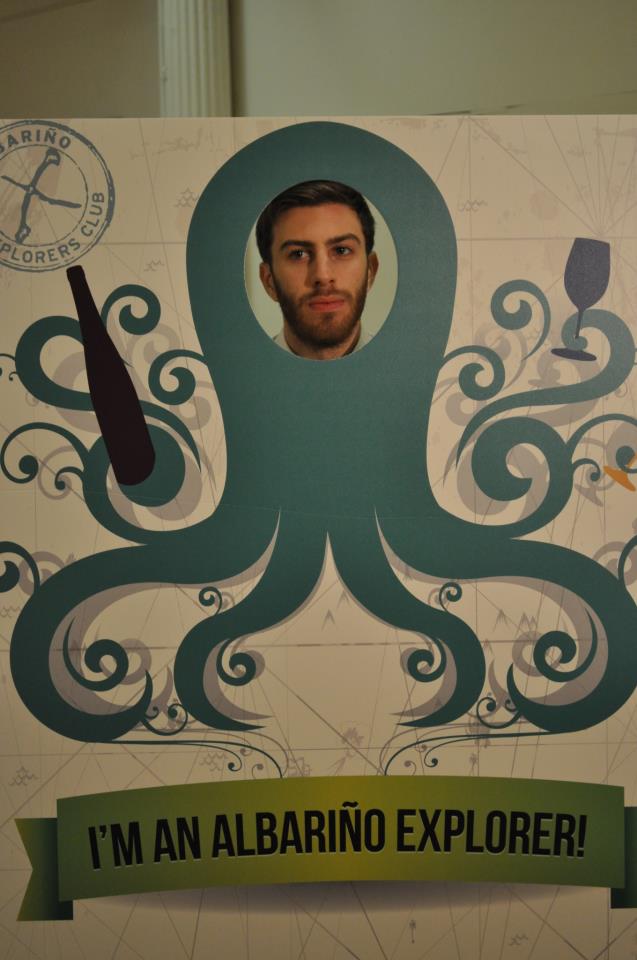
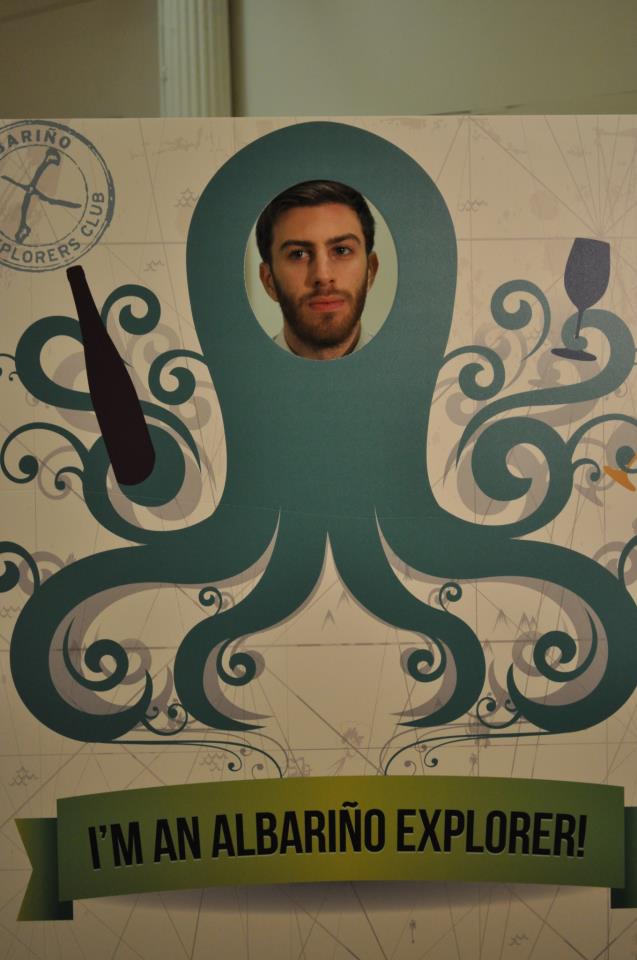
Finally, there is the poor Pulpo guy, who was made to stick his head through a poster and have his picture taken disguised as an Octopus. He certainly doesn’t look too thrilled about it, and again the Christmas spirit is not exactly shining through…..

It’s only a couple of years ago that the shelves and window ledges in our office were covered in beautiful, colourful Christmas cards. These days, I am almost afraid to admit, that our shelves are bare, but should quickly add that this is nothing to do with our popularity. The simple truth is that they have been replaced by e-cards, or Christmas messages sent over the internetweb-thingy. I must confess that for the last couple of years we are guilty of doing the very same ourselves. My best guess is that as companies tighten their purse strings and cut costs in these difficult times, that there is a considerable saving to be made in postal charges. Even sending a single card across Europe will cost nearly one GBPound, or one Euro, and that’s excluding the cost of the card itself.

With the aid of a bit of Photoshop it is now quite simple to put together a nice picture with a friendly seasonal greeting – press the button on our computer keyboard, and presto, it is sent!

The reason I mention Photoshop is because it is now apparent that not everybody has access to this wonderful software. Take for example the main picture in today’s posting – an e-card received from our local Xunta (government office). Now, at this festive time of year you might think that they could select a slightly more joyful picture to send out, rather than the slightly bleak picture of their offices that they used. It look’s like a prison building with a bit of holly stuck in front of it. Not even a flake of snow to be seen!

Finally, there is the poor Pulpo guy, who was made to stick his head through a poster and have his picture taken disguised as an Octopus. He certainly doesn’t look too thrilled about it, and again the Christmas spirit is not exactly shining through…..

Whole lotta wine

August 17th, 2012 | Denomination

A week or so ago we had our annual Albariño Festival a few km from our cellar in the local town of Cambados. As some of you may already know from previous posts I have a sort of love/hate relationship with the festival, as there are parts of it I like, and parts where I think we have lost our way a bit. I will explain…..

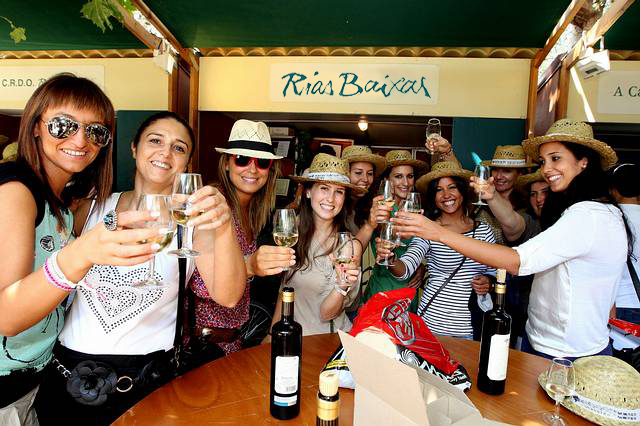
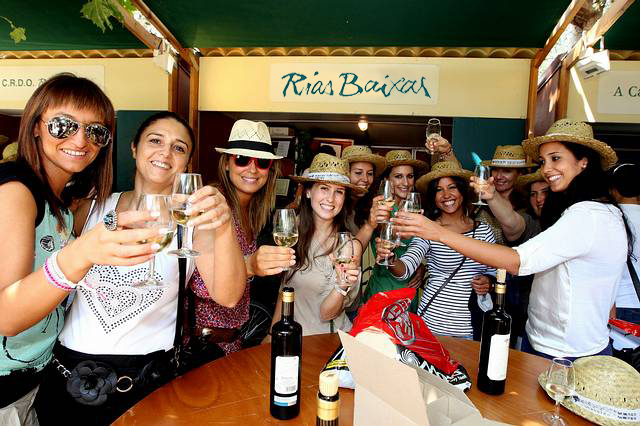
Of course the idea of any festival is to celebrate something – in this case our fantastic wines. We invite visitors, not only from our own region, but from around the world to come and taste our wines. Indeed, we have even added a ‘Taste Tunnel’ where people can buy a ticket to pass through and sample many of the best wines of the region, in an organised and civilised fashion. For me, I believe that this is the way that it should be done – an opportunity to taste, and to get to know the wines of Rias Baixas. During the day and early evening the festival retains this calm, orderly atmosphere, where visitors stroll around and enjoy an odd glass of wine or two – a great advertisement for our region.

However, after dark and during the night, the atmosphere changes, where to be honest our celebration becomes more of a drunken ‘free-for-all’, or perhaps an organised botellon (as I have described it in the past). Selling huge amounts of wine to young people might be considered a good way of moving a bit of stock, but does it really send out the right signals? In other countries they try to promote the consumption of alcohol ‘in moderation’, often with health warnings printed on the bottles – here it would appear, that as a region, we are quite simply endorsing the abuse of alcohol. It is after all, an ‘official’ festival. It is for this reason alone that we have chosen not to take a booth at the fair for the last four or five years.

Certainly, I do not wish to be seen as a ‘killjoy’, to stop young people having fun, but it is just that in my opinion any serious wine tasting festival should at least be seen to distance itself from encouraging drunken behavior…..

If the official statistics for the festival to be believed, this might give you a clearer picture. It is claimed that over a 4 day period (bearing in mind that there is very little activity during the day, and that some booths do not even open), some 85,000 bottles of albariño were consumed. More than 7,000 twelve bottle cases, or the equivalent of more than 4½ 40ft containers of wine. In the small seaside town of Cambados, that is an awful lot of wine to sell in just 4 days, and perhaps not a statistic to be proud of?

A week or so ago we had our annual Albariño Festival a few km from our cellar in the local town of Cambados. As some of you may already know from previous posts I have a sort of love/hate relationship with the festival, as there are parts of it I like, and parts where I think we have lost our way a bit. I will explain…..

Of course the idea of any festival is to celebrate something – in this case our fantastic wines. We invite visitors, not only from our own region, but from around the world to come and taste our wines. Indeed, we have even added a ‘Taste Tunnel’ where people can buy a ticket to pass through and sample many of the best wines of the region, in an organised and civilised fashion. For me, I believe that this is the way that it should be done – an opportunity to taste, and to get to know the wines of Rias Baixas. During the day and early evening the festival retains this calm, orderly atmosphere, where visitors stroll around and enjoy an odd glass of wine or two – a great advertisement for our region.

However, after dark and during the night, the atmosphere changes, where to be honest our celebration becomes more of a drunken ‘free-for-all’, or perhaps an organised botellon (as I have described it in the past). Selling huge amounts of wine to young people might be considered a good way of moving a bit of stock, but does it really send out the right signals? In other countries they try to promote the consumption of alcohol ‘in moderation’, often with health warnings printed on the bottles – here it would appear, that as a region, we are quite simply endorsing the abuse of alcohol. It is after all, an ‘official’ festival. It is for this reason alone that we have chosen not to take a booth at the fair for the last four or five years.

Certainly, I do not wish to be seen as a ‘killjoy’, to stop young people having fun, but it is just that in my opinion any serious wine tasting festival should at least be seen to distance itself from encouraging drunken behavior…..

If the official statistics for the festival to be believed, this might give you a clearer picture. It is claimed that over a 4 day period (bearing in mind that there is very little activity during the day, and that some booths do not even open), some 85,000 bottles of albariño were consumed. More than 7,000 twelve bottle cases, or the equivalent of more than 4½ 40ft containers of wine. In the small seaside town of Cambados, that is an awful lot of wine to sell in just 4 days, and perhaps not a statistic to be proud of?

4th July

July 4th, 2012 | Fiestas

My briefest post to date – Happy Independence Day to our American cousins (although I’m not so sure that us Brits are necessarily sharing in this day of celebration)!

By the way, did you know that the Declaration of Independence was actually signed two days earlier, on 2nd July, and that John Adams and Thomas Jefferson were the only two men who signed the Declaration and later went on to become President of the United States?

My briefest post to date – Happy Independence Day to our American cousins (although I’m not so sure that us Brits are necessarily sharing in this day of celebration)!

By the way, did you know that the Declaration of Independence was actually signed two days earlier, on 2nd July, and that John Adams and Thomas Jefferson were the only two men who signed the Declaration and later went on to become President of the United States?

The sweet smell of sardine

June 24th, 2012 | Fiestas

 The festival of San Juan is the celebration of midsummer’s day here in Spain. It’s slightly complicated in that midsummer’s day does not actually fall on the day of the summer solstice, which was four days ago on 20th June. You would be forgiven for thinking that the longest day in the northern hemisphere might also be the same as midsummer’s day, but not so…. To complicate matters slightly further the celebrations are not actually held on the actual Festivo of San Juan (24th), but on the evening of the 23rd. Bonfires, fire and water are the main features of the night, and according to tradition, if people jump three times over a bonfire on San Juan’s night, they will be cleansed and purified, and their problems burned away. 

Midsummer tradition is especially strong in northern areas of the country, such as here in Galicia, where pagan beliefs are widespread. Towards midnight bonfires are lit and when relatively safe, people jump over the fire shouting “meigas fora” (witches off!). The traditional drink is Queimada, made from a mix of Galician aguardiente, sugar, coffee beans and pieces of fruit. This is then set alight to ward off evil spirits.

Here on the coast the traditional food at this celebration is grilled sardines. Not only is it impossible to get the smell of burnt fish out of your clothes and hair, but the odour of fish and smoke still hangs in the air the following day!

The festival of San Juan is the celebration of midsummer’s day here in Spain. It’s slightly complicated in that midsummer’s day does not actually fall on the day of the summer solstice, which was four days ago on 20th June. You would be forgiven for thinking that the longest day in the northern hemisphere might also be the same as midsummer’s day, but not so…. To complicate matters slightly further the celebrations are not actually held on the actual Festivo of San Juan (24th), but on the evening of the 23rd. Bonfires, fire and water are the main features of the night, and according to tradition, if people jump three times over a bonfire on San Juan’s night, they will be cleansed and purified, and their problems burned away. 

Midsummer tradition is especially strong in northern areas of the country, such as here in Galicia, where pagan beliefs are widespread. Towards midnight bonfires are lit and when relatively safe, people jump over the fire shouting “meigas fora” (witches off!). The traditional drink is Queimada, made from a mix of Galician aguardiente, sugar, coffee beans and pieces of fruit. This is then set alight to ward off evil spirits.

Here on the coast the traditional food at this celebration is grilled sardines. Not only is it impossible to get the smell of burnt fish out of your clothes and hair, but the odour of fish and smoke still hangs in the air the following day!

Albariño Day

May 7th, 2012 | Fiestas

Did you know that this Wednesday, 9th May, is Albariño Day? Well no, neither did I…. Apparently it has been organised by a marketing company in the United States, which is great – hats off to them. It just seems a shame that this initiative only applies to the U.S. market, and then to only a handful of Bodegas (represented by this particular company). Personally I would have thought it more appropriate for such a celebration to be organised here in the region of origin, especially when the Spanish are so great at holding Fiestas for more or less any reason. Of course we do have our local Albariño Festival held on the first Sunday of August, so why didn’t we attempt to export this idea around the world, and invite the planet to drink albariño at the beginning of August?

Anyway, I’ll climb down of my soap box for a moment to ask if anyone knows the significance of this date? In other words, why was the 9th May chosen specifically for this celebration? This is the first time that albariño day has been held, so I just wondered why they would pick a Wednesday? (I have asked this question on their Facebook page, let’s just see if I get a response).

Don’t get me wrong, I do think it’s a fab idea, and I will join them in my own private party at home, following their advice:

How to Participate in Albariño Day?

It’s easy! Open a bottle of cool, crisp Albariño and share your thoughts on Twitter and Facebook. What do you love most about Albariño? What are your favorite pairings? Where do you enjoy Albariño in your area? Albarino Day is all about spreading the love and also learning (or trying) something new.

Did you know that this Wednesday, 9th May, is Albariño Day? Well no, neither did I…. Apparently it has been organised by a marketing company in the United States, which is great – hats off to them. It just seems a shame that this initiative only applies to the U.S. market, and then to only a handful of Bodegas (represented by this particular company). Personally I would have thought it more appropriate for such a celebration to be organised here in the region of origin, especially when the Spanish are so great at holding Fiestas for more or less any reason. Of course we do have our local Albariño Festival held on the first Sunday of August, so why didn’t we attempt to export this idea around the world, and invite the planet to drink albariño at the beginning of August?

Anyway, I’ll climb down of my soap box for a moment to ask if anyone knows the significance of this date? In other words, why was the 9th May chosen specifically for this celebration? This is the first time that albariño day has been held, so I just wondered why they would pick a Wednesday? (I have asked this question on their Facebook page, let’s just see if I get a response).

Don’t get me wrong, I do think it’s a fab idea, and I will join them in my own private party at home, following their advice:

How to Participate in Albariño Day?

It’s easy! Open a bottle of cool, crisp Albariño and share your thoughts on Twitter and Facebook. What do you love most about Albariño? What are your favorite pairings? Where do you enjoy Albariño in your area? Albarino Day is all about spreading the love and also learning (or trying) something new.

Happy Earth, Book, George’s Day!

April 23rd, 2012 | Fiestas

I’m not quite sure how all these International Days are supposed to work, or how you’re supposed to know about them, but suffice to say that somehow I keep missing them. It’s not that I don’t use the internet or follow the news, but it’s becoming quite clear to me that many of these special days are simply not as well publicised as perhaps they should be.

Apparently, yesterday was Earth Day, which was organised by the ‘Green’ movement. It is claimed that more than one billion* people around the world voiced their appreciation for the planet and demanded its protection (*give or take an odd million). They are standing for a sustainable future and calling upon individuals, organizations, and governments to do their part. 

Today is International Book Day, organised by UNESCO, and is a day when we should promote reading, publishing and copyright. The 23rd April is selected for book day as it is often quoted as the anniversary of the deaths of both William Shakespeare and Miguel de Cervantes. At least one official celebration of this day is the reading of Cervantes’ Don Quixote (actually a two-day “readathon”).

In England it is also St George’s Day, as we honour the life of England’s very own Patron Saint (albeit that there is no public holiday). I think it’s probably fair to say that St George’s Day, St Andrew’s Day (Scotland) and St David’s Day (Wales) are not celebrated as much as St Patrick’s Day in Ireland, but apparently many people are now working to get these days re-established on the calendar for all British people.

So today, by way of recognition, I will be reading a book, made from re-cycled paper, about the life and times of St George (I think that covers all the bases).

I’m not quite sure how all these International Days are supposed to work, or how you’re supposed to know about them, but suffice to say that somehow I keep missing them. It’s not that I don’t use the internet or follow the news, but it’s becoming quite clear to me that many of these special days are simply not as well publicised as perhaps they should be.

Apparently, yesterday was Earth Day, which was organised by the ‘Green’ movement. It is claimed that more than one billion* people around the world voiced their appreciation for the planet and demanded its protection (*give or take an odd million). They are standing for a sustainable future and calling upon individuals, organizations, and governments to do their part. 

Today is International Book Day, organised by UNESCO, and is a day when we should promote reading, publishing and copyright. The 23rd April is selected for book day as it is often quoted as the anniversary of the deaths of both William Shakespeare and Miguel de Cervantes. At least one official celebration of this day is the reading of Cervantes’ Don Quixote (actually a two-day “readathon”).

In England it is also St George’s Day, as we honour the life of England’s very own Patron Saint (albeit that there is no public holiday). I think it’s probably fair to say that St George’s Day, St Andrew’s Day (Scotland) and St David’s Day (Wales) are not celebrated as much as St Patrick’s Day in Ireland, but apparently many people are now working to get these days re-established on the calendar for all British people.

So today, by way of recognition, I will be reading a book, made from re-cycled paper, about the life and times of St George (I think that covers all the bases).

A Spanish Easter

April 5th, 2012 | Fiestas

We have received very special Easter offer from a hotel in the Basque Country for this Easter – 3 nights bed and breakfast, one dinner (with water), one free circuit of the spa, garage space, late check out…. Oh, and not forgetting a rather sinister looking man in a black hood and cape too! I’m sorry but I do find this mailshot rather off-putting, or am I just being ridiculous?

Spain celebrates ‘Semana Santa’, (Holy Week) much more than most other European countries. The whole week is filled with street processions, organised in the majority of Spanish towns each evening, from Palm Sunday to Easter Sunday. Participants carry statues of saints on floats or wooden platforms in an atmosphere of mourning – which can seem quite oppressive to outsiders.

In some of the processions, marchers wear clothes reminiscent of the Klu Klux Klan. In fact their clothes are meant to represent ‘Nazareños’, people from Nazareth. It is the religious fraternities and brotherhoods of each town that are responsible for organising the processions, and the people who actually carry the sculptures and biblical scenes are known as ‘costaleros’. These floats are extremely heavy, and the costaleros have to be strong, as the processions will last for many hours. The pain that they suffer is likened to that experienced by Christ and the men consider it a great honor to carry the float, despite (and indeed, because of) the pain involved.

We have received very special Easter offer from a hotel in the Basque Country for this Easter – 3 nights bed and breakfast, one dinner (with water), one free circuit of the spa, garage space, late check out…. Oh, and not forgetting a rather sinister looking man in a black hood and cape too! I’m sorry but I do find this mailshot rather off-putting, or am I just being ridiculous?

Spain celebrates ‘Semana Santa’, (Holy Week) much more than most other European countries. The whole week is filled with street processions, organised in the majority of Spanish towns each evening, from Palm Sunday to Easter Sunday. Participants carry statues of saints on floats or wooden platforms in an atmosphere of mourning – which can seem quite oppressive to outsiders.

In some of the processions, marchers wear clothes reminiscent of the Klu Klux Klan. In fact their clothes are meant to represent ‘Nazareños’, people from Nazareth. It is the religious fraternities and brotherhoods of each town that are responsible for organising the processions, and the people who actually carry the sculptures and biblical scenes are known as ‘costaleros’. These floats are extremely heavy, and the costaleros have to be strong, as the processions will last for many hours. The pain that they suffer is likened to that experienced by Christ and the men consider it a great honor to carry the float, despite (and indeed, because of) the pain involved.

Happy St Patrick’s Day

March 17th, 2012 | Fiestas

It goes without saying that with a surname like McCarthy my family origins are from the deep south of Ireland – but that goes back many, many generations. Perhaps I should be dying my hair green today by way of celebration, but I am spared by the fact that I now have very little hair worth speaking of (not that I ever dyed it when I did have hair!). Alternatively, I could drink gallons of Guiness, which I admit I nearly always have in my fridge, albeit not in gallons. However, perhaps an even better idea, and more in keeping with my current situation, would be to recommend a few fat, creamy Dublin Bay oysters washed down with a cool, refreshing glass of Castro Martin albarino.

During my research I was surprised to discover that Spain’s biggest St Patrick’s Day celebration is held on the Costa Blanca, in a place called Cabo Roig. To be very honest I have absolutely no idea what specific connection this small town has with Ireland, but I have a feeling that I must be missing something very obvious. Apart from the name of the place sounding vaguely Gaelic and there being a Flanagan’s bar and a Bog Road, Google did not offer any other apparent connection. Unless you know otherwise…….

It goes without saying that with a surname like McCarthy my family origins are from the deep south of Ireland – but that goes back many, many generations. Perhaps I should be dying my hair green today by way of celebration, but I am spared by the fact that I now have very little hair worth speaking of (not that I ever dyed it when I did have hair!). Alternatively, I could drink gallons of Guiness, which I admit I nearly always have in my fridge, albeit not in gallons. However, perhaps an even better idea, and more in keeping with my current situation, would be to recommend a few fat, creamy Dublin Bay oysters washed down with a cool, refreshing glass of Castro Martin albarino.

During my research I was surprised to discover that Spain’s biggest St Patrick’s Day celebration is held on the Costa Blanca, in a place called Cabo Roig. To be very honest I have absolutely no idea what specific connection this small town has with Ireland, but I have a feeling that I must be missing something very obvious. Apart from the name of the place sounding vaguely Gaelic and there being a Flanagan’s bar and a Bog Road, Google did not offer any other apparent connection. Unless you know otherwise……..

Pontevedra’s pharmacy parrot

February 21st, 2012 | Fiestas

This picture (captured by Angela on her mobile), was taken in the centre of Pontevedra, and shows Galicia’s most famous parrot looking out of the window of a pharmacy….. don’t ask, it’s a long story.

Saturday night was Carnival in Pontevedra, albeit that our local High Street does not enjoy quite the same atmosphere as Rio’s Sambadrome – especially when the temperature is barely above freezing. Having said that the locals clearly put a lot of effort into their costumes and floats, and they certainly had a good time, despite the cold.

The parrot? Well, he’s the adopted mascot of the Pontevedra Carnival (every local town has their own mascot, including Meaño with their very own sardine!) Ravachol as he is called, apparently lived his life in a chemist’s shop in Pontevedra, and for some reason was named after a French anarchist. Legend has it that he died during the 1913 Carnival, and consequently his death has been commemorated at the end of every Carnival week ever since. A huge stuffed parrot is paraded through the streets and then burned. Delicious with Albariño!!!! (Is that too cruel?)

The statue of Ravachol in Pontevedra

This picture (captured by Angela on her mobile), was taken in the centre of Pontevedra, and shows Galicia’s most famous parrot looking out of the window of a pharmacy….. don’t ask, it’s a long story.

Saturday night was Carnival in Pontevedra, albeit that our local High Street does not enjoy quite the same atmosphere as Rio’s Sambadrome – especially when the temperature is barely above freezing. Having said that the locals clearly put a lot of effort into their costumes and floats, and they certainly had a good time, despite the cold.

The parrot? Well, he’s the adopted mascot of the Pontevedra Carnival (every local town has their own mascot, including Meaño with their very own sardine!) Ravachol as he is called, apparently lived his life in a chemist’s shop in Pontevedra, and for some reason was named after a French anarchist. Legend has it that he died during the 1913 Carnival, and consequently his death has been commemorated at the end of every Carnival week ever since. A huge stuffed parrot is paraded through the streets and then burned. Delicious with Albariño!!!! (Is that too cruel?)

The statue of Ravachol in Pontevedra

Monthly Archives

Categories

ARE YOU OF LEGAL AGE? This site is intended for those of legal drinking age. By entering, you confirm that you are of legal drinking age in the country where this site is being accessed. ¿ERES MAYOR DE EDAD? Este sitio está destinado a personas en edad legal para beber alcohol. Al ingresar, confirma que tiene la edad legal para beber en el país donde se accede a este sitio.