

June rains will shrink 2012 harvest

July 9th, 2012 | Harvest

 Some parts of Northern Europe have experienced the wettest month of June ever recorded. This summer it has become quite common to hear that an entire months rain has fallen in a matter of hours, causing traffic chaos and flash flooding in some areas.

Of course, for our vineyards, this has not been great news. Any temperature above about 15°C with humidity of between 75% and 98% provides ideal conditions for the germination of oidium (also known as powdery mildew) and mildew (downy mildew). Whilst this atrocious weather is a disaster for grape growers, our suppliers of vineyard treatments must be rubbing their hands with glee. Consequently our tractors have been busy, as the inclement weather has obliged us to spray more than we would really like.

Clearly some grapes have already been lost as the office of our local denomination have already declared that this years harvest will be greatly reduced. I guess that after the enormous, record-breaking harvest of 2011, a reduction of kilos was only to be expected, although no-one could have foreseen the reason why.

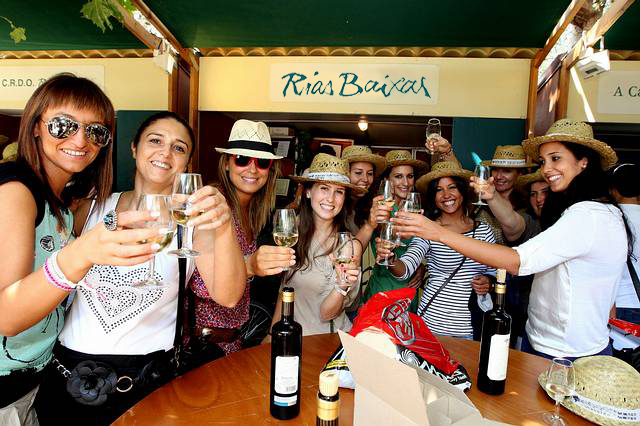
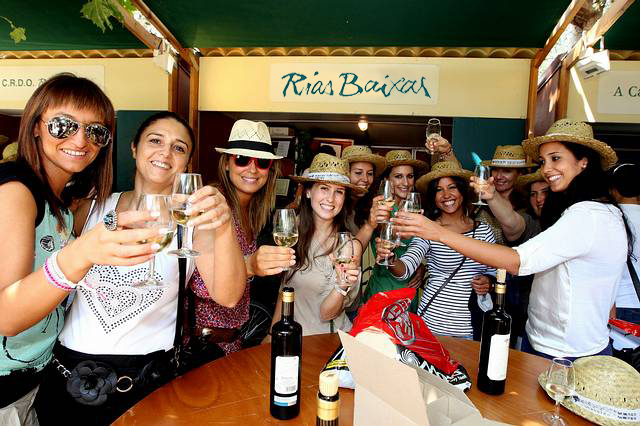
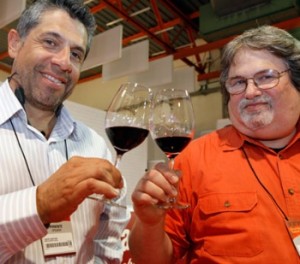
By the way, don’t worry, the photo is not of me, and there are two reasons why it couldn’t be. Firstly, the photographer has hair, and secondly, I only use Nikon cameras! 

Some parts of Northern Europe have experienced the wettest month of June ever recorded. This summer it has become quite common to hear that an entire months rain has fallen in a matter of hours, causing traffic chaos and flash flooding in some areas.

Of course, for our vineyards, this has not been great news. Any temperature above about 15°C with humidity of between 75% and 98% provides ideal conditions for the germination of oidium (also known as powdery mildew) and mildew (downy mildew). Whilst this atrocious weather is a disaster for grape growers, our suppliers of vineyard treatments must be rubbing their hands with glee. Consequently our tractors have been busy, as the inclement weather has obliged us to spray more than we would really like.

Clearly some grapes have already been lost as the office of our local denomination have already declared that this years harvest will be greatly reduced. I guess that after the enormous, record-breaking harvest of 2011, a reduction of kilos was only to be expected, although no-one could have foreseen the reason why.

By the way, don’t worry, the photo is not of me, and there are two reasons why it couldn’t be. Firstly, the photographer has hair, and secondly, I only use Nikon cameras! 

Are you all in?

July 5th, 2012 | Odds & Sods

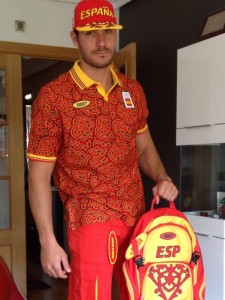
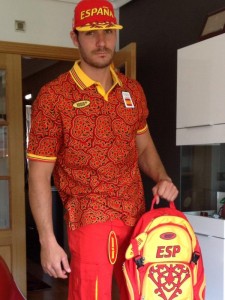
Nothing to do with wine, but more to do with the SpanEnglish theme again. As a frustrated English football fan (we have lots of practice at being frustrated), my wife and daughter forced me to endure three hours of agony on Spanish TV the other night. The triumphant return of the Spanish National football team, brandishing yet another trophy to add to their growing collection. Spain is certainly on top of the world in footballing terms if nothing else – hopefully this success might give a small, much needed boost to the economy.

The all-conquering team and their entourage used open top buses to negotiate the crowded streets of Madrid, the buses themselves obviously being sponsored by Adidas, their kit supplier. On the front of each bus appeared a slogan: la roja is all in, adidas is all in…… All in what exactly? Answers on a postcard please.


Nothing to do with wine, but more to do with the SpanEnglish theme again. As a frustrated English football fan (we have lots of practice at being frustrated), my wife and daughter forced me to endure three hours of agony on Spanish TV the other night. The triumphant return of the Spanish National football team, brandishing yet another trophy to add to their growing collection. Spain is certainly on top of the world in footballing terms if nothing else – hopefully this success might give a small, much needed boost to the economy.

The all-conquering team and their entourage used open top buses to negotiate the crowded streets of Madrid, the buses themselves obviously being sponsored by Adidas, their kit supplier. On the front of each bus appeared a slogan: la roja is all in, adidas is all in…… All in what exactly? Answers on a postcard please.

4th July

July 4th, 2012 | Fiestas

My briefest post to date – Happy Independence Day to our American cousins (although I’m not so sure that us Brits are necessarily sharing in this day of celebration)!

By the way, did you know that the Declaration of Independence was actually signed two days earlier, on 2nd July, and that John Adams and Thomas Jefferson were the only two men who signed the Declaration and later went on to become President of the United States?

My briefest post to date – Happy Independence Day to our American cousins (although I’m not so sure that us Brits are necessarily sharing in this day of celebration)!

By the way, did you know that the Declaration of Independence was actually signed two days earlier, on 2nd July, and that John Adams and Thomas Jefferson were the only two men who signed the Declaration and later went on to become President of the United States?

You can taste the sea

July 3rd, 2012 | Odds & Sods

The other day Angela and I opened up a bottle of a recently bottled 2011 over dinner (for quality control purposes of course)! One of the immediately apparent characteristics of this new wine was the zesty, salt-lick character, often associated with young albariño from the Salnés Valley (the northern part of our DO where we are located). Where this sensation actually originates from is open to conjecture, and could be the combination of several factors. The gentle Atlantic sea breeze, the natural salts in some of our sandy soils, or perhaps even the particular clone of albariño itself…. whichever is responsible, it’s delicious, and gives our wine one of its unique, cool climate characteristics.

It reminded me of something that I read in the press only a few weeks ago. The story of how one particular French wine had been deliberately stored on the seabed in order to see the effect this would have on its evolution. Of course this is nothing new, and has been tried before, in barrel, bottle and sometimes other specially constructed containers. On many occasions it is done knowingly, by way of experimentation, but on some occasions it has been done by accident as in the case of shipwrecks. Very recently eleven bottles of 200 year-old Champagne were sold at auction for about US$140,000 – they had spent the last couple of centuries at the bottom of the Baltic Sea until they were uncovered in 2010. The well chilled, lightless seabed had apparently preserved the contents perfectly, indeed some tasters actually claimed that the bottles had been improved.

Experiments with red Bordeaux wines stored in barrel under the sea have also noted some interesting changes – not only a loss of alcohol, but also an increased level of sodium, apparently adding a very subtle salty note, that helped to integrate the tannins.

In our albariño we enjoy this zesty, salty note for free, and it’s still perfect with seafood!

The other day Angela and I opened up a bottle of a recently bottled 2011 over dinner (for quality control purposes of course)! One of the immediately apparent characteristics of this new wine was the zesty, salt-lick character, often associated with young albariño from the Salnés Valley (the northern part of our DO where we are located). Where this sensation actually originates from is open to conjecture, and could be the combination of several factors. The gentle Atlantic sea breeze, the natural salts in some of our sandy soils, or perhaps even the particular clone of albariño itself…. whichever is responsible, it’s delicious, and gives our wine one of its unique, cool climate characteristics.

It reminded me of something that I read in the press only a few weeks ago. The story of how one particular French wine had been deliberately stored on the seabed in order to see the effect this would have on its evolution. Of course this is nothing new, and has been tried before, in barrel, bottle and sometimes other specially constructed containers. On many occasions it is done knowingly, by way of experimentation, but on some occasions it has been done by accident as in the case of shipwrecks. Very recently eleven bottles of 200 year-old Champagne were sold at auction for about US$140,000 – they had spent the last couple of centuries at the bottom of the Baltic Sea until they were uncovered in 2010. The well chilled, lightless seabed had apparently preserved the contents perfectly, indeed some tasters actually claimed that the bottles had been improved.

Experiments with red Bordeaux wines stored in barrel under the sea have also noted some interesting changes – not only a loss of alcohol, but also an increased level of sodium, apparently adding a very subtle salty note, that helped to integrate the tannins.

In our albariño we enjoy this zesty, salty note for free, and it’s still perfect with seafood!

BCM Albariño – Liquid engineering

July 1st, 2012 | Technical

In Chinese restaurants we are quite used to ordering our dishes by number, whilst in other restaurants even the wines on the list are allocated a bin number. I must confess that I don’t really enjoy ordering my bottle by number – perhaps I’m just a bit of a wine snob at heart.

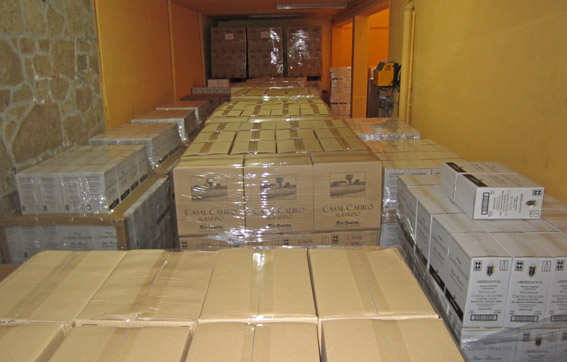
In the case of selling to airlines our wines are also allocated numbers, but not for their wine list. They are actually allocated part numbers, perhaps in the same way that they might allocate a number to their replacement nuts and bolts! If you think about it, the use of numbers on our bottles is not that unusual. A huge percentage of the bottles that we buy will have a unique bar code, and if they don’t have this, then they will certainly have a Lot Number that gives us the ability to trace our wine back to a particular bottling, or if needed, back to the exact source of the grapes used in the bottle.

I have no doubt that the part number we print on our airline cartons simply makes it easier for them to track their stock as it moves around the world, although I have never really considered our wine as being a spare part!

In Chinese restaurants we are quite used to ordering our dishes by number, whilst in other restaurants even the wines on the list are allocated a bin number. I must confess that I don’t really enjoy ordering my bottle by number – perhaps I’m just a bit of a wine snob at heart.

In the case of selling to airlines our wines are also allocated numbers, but not for their wine list. They are actually allocated part numbers, perhaps in the same way that they might allocate a number to their replacement nuts and bolts! If you think about it, the use of numbers on our bottles is not that unusual. A huge percentage of the bottles that we buy will have a unique bar code, and if they don’t have this, then they will certainly have a Lot Number that gives us the ability to trace our wine back to a particular bottling, or if needed, back to the exact source of the grapes used in the bottle.

I have no doubt that the part number we print on our airline cartons simply makes it easier for them to track their stock as it moves around the world, although I have never really considered our wine as being a spare part!

Wine monopoly

June 28th, 2012 | Local News

Over the last couple of months there has been a lot of work going on in one particular local Café-Bar. Located in the village of Barrantes the bar is actually owned by Angela’s family, albeit that they chose not to manage it on a daily basis. Between tenants it was decided to give the place a quick lick of paint, but this rapidly developed into a full blown refurbishment. The interior of the place was completely ripped apart and then rebuilt.

As part of the redecoration the family decided that at least one of the long walls (5½ metres) might make a suitable location for another photo montage, similar to the one that we created in the entrance hall of the Bodega. However, this time, instead of a vineyard and wine making theme, the photos would be chosen to represent the local countryside and people. However, on this occasion I didn’t even need to get my camera out, simply because my computer was already packed with the thousands of photos that I have taken in Galicia over the last 10 years – the difficult part would be to sift through them all and chose some of the best.

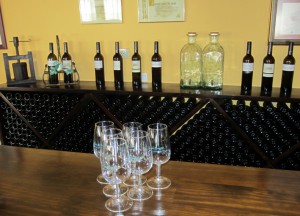
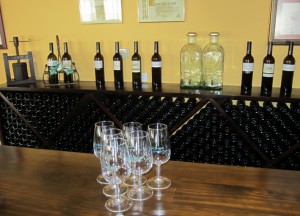
The advantage of owning the place is that as part of the contract one of the fundamental conditions imposed by the family on any potential tenant is that the only albariño served must be supplied by our bodega (in the same way that a brewery would impose its beer in one of their properties). As part of the decoration this gave us yet another opportunity to showcase our range. In the picture you can see a display of some of the wines that we sell, but you should take note that the bottles we use are in fact empty, otherwise the temptation for some might be too great!

Over the last couple of months there has been a lot of work going on in one particular local Café-Bar. Located in the village of Barrantes the bar is actually owned by Angela’s family, albeit that they chose not to manage it on a daily basis. Between tenants it was decided to give the place a quick lick of paint, but this rapidly developed into a full blown refurbishment. The interior of the place was completely ripped apart and then rebuilt.

As part of the redecoration the family decided that at least one of the long walls (5½ metres) might make a suitable location for another photo montage, similar to the one that we created in the entrance hall of the Bodega. However, this time, instead of a vineyard and wine making theme, the photos would be chosen to represent the local countryside and people. However, on this occasion I didn’t even need to get my camera out, simply because my computer was already packed with the thousands of photos that I have taken in Galicia over the last 10 years – the difficult part would be to sift through them all and chose some of the best.

The advantage of owning the place is that as part of the contract one of the fundamental conditions imposed by the family on any potential tenant is that the only albariño served must be supplied by our bodega (in the same way that a brewery would impose its beer in one of their properties). As part of the decoration this gave us yet another opportunity to showcase our range. In the picture you can see a display of some of the wines that we sell, but you should take note that the bottles we use are in fact empty, otherwise the temptation for some might be too great!

The sweet smell of sardine

June 24th, 2012 | Fiestas

 The festival of San Juan is the celebration of midsummer’s day here in Spain. It’s slightly complicated in that midsummer’s day does not actually fall on the day of the summer solstice, which was four days ago on 20th June. You would be forgiven for thinking that the longest day in the northern hemisphere might also be the same as midsummer’s day, but not so…. To complicate matters slightly further the celebrations are not actually held on the actual Festivo of San Juan (24th), but on the evening of the 23rd. Bonfires, fire and water are the main features of the night, and according to tradition, if people jump three times over a bonfire on San Juan’s night, they will be cleansed and purified, and their problems burned away. 

Midsummer tradition is especially strong in northern areas of the country, such as here in Galicia, where pagan beliefs are widespread. Towards midnight bonfires are lit and when relatively safe, people jump over the fire shouting “meigas fora” (witches off!). The traditional drink is Queimada, made from a mix of Galician aguardiente, sugar, coffee beans and pieces of fruit. This is then set alight to ward off evil spirits.

Here on the coast the traditional food at this celebration is grilled sardines. Not only is it impossible to get the smell of burnt fish out of your clothes and hair, but the odour of fish and smoke still hangs in the air the following day!

The festival of San Juan is the celebration of midsummer’s day here in Spain. It’s slightly complicated in that midsummer’s day does not actually fall on the day of the summer solstice, which was four days ago on 20th June. You would be forgiven for thinking that the longest day in the northern hemisphere might also be the same as midsummer’s day, but not so…. To complicate matters slightly further the celebrations are not actually held on the actual Festivo of San Juan (24th), but on the evening of the 23rd. Bonfires, fire and water are the main features of the night, and according to tradition, if people jump three times over a bonfire on San Juan’s night, they will be cleansed and purified, and their problems burned away. 

Midsummer tradition is especially strong in northern areas of the country, such as here in Galicia, where pagan beliefs are widespread. Towards midnight bonfires are lit and when relatively safe, people jump over the fire shouting “meigas fora” (witches off!). The traditional drink is Queimada, made from a mix of Galician aguardiente, sugar, coffee beans and pieces of fruit. This is then set alight to ward off evil spirits.

Here on the coast the traditional food at this celebration is grilled sardines. Not only is it impossible to get the smell of burnt fish out of your clothes and hair, but the odour of fish and smoke still hangs in the air the following day!

Cooking in the bathroom!

June 18th, 2012 | Bodega

Anyone who has visited our Bodega will know that on the first floor we have a large function room and tasting bar. There is a capacity to seat about 50 people around half a dozen refractory style tables – all very nice, except there is one small but significant technical problem….. we have no kitchen! Quite honestly this has always puzzled me a bit, especially as so much of our bodega was so thoughtfully designed.

Behind our tasting bar we have a small fridge and a simple microwave, and as such our lunches in the office have always been limited to sandwiches, salads or anything that can be re-heated in the microwave. Not a very inspiring menu choice….. until now.

Over the last couple of weeks, our super-handyman Fran has built us a kitchen. Using a small loo (bathroom, restroom, cloakroom or toilet – depending on where you come from) and an area of adjacent corridor we now have a small, but beautifully hand-built kitchen, complete with oven, hotplates and most importantly a kettle for making tea! This doesn’t mean that we are now going to start catering for weddings in our function room, but it does at least that we will have a much better choice of snacks and meals at lunch time. No doubt I will still be responsible for all the cooking, as I am at home. (It’s just as well that Angela doesn’t read this blog).

Anyone who has visited our Bodega will know that on the first floor we have a large function room and tasting bar. There is a capacity to seat about 50 people around half a dozen refractory style tables – all very nice, except there is one small but significant technical problem….. we have no kitchen! Quite honestly this has always puzzled me a bit, especially as so much of our bodega was so thoughtfully designed.

Behind our tasting bar we have a small fridge and a simple microwave, and as such our lunches in the office have always been limited to sandwiches, salads or anything that can be re-heated in the microwave. Not a very inspiring menu choice….. until now.

Over the last couple of weeks, our super-handyman Fran has built us a kitchen. Using a small loo (bathroom, restroom, cloakroom or toilet – depending on where you come from) and an area of adjacent corridor we now have a small, but beautifully hand-built kitchen, complete with oven, hotplates and most importantly a kettle for making tea! This doesn’t mean that we are now going to start catering for weddings in our function room, but it does at least that we will have a much better choice of snacks and meals at lunch time. No doubt I will still be responsible for all the cooking, as I am at home. (It’s just as well that Angela doesn’t read this blog).

Half a bottle – per week!

June 13th, 2012 | National News

Don’t get me wrong, we should never appear to be flippant about the consumption of alcohol (or perhaps I should say over-consumption), but it is becoming increasingly difficult  to comprehend exactly how we should calculate a “moderate” amount. We are constantly told “consume in moderation”, but the truth is that the so called ‘experts’ appear to disagree on exactly how we should interpret this phrase.

Yet another study (oh dear!), this time by a team of researchers at Oxford University, says that we should drink no more than half a unit of alcohol per day. This would equate to three small glasses of wine per week, and if we assume that a small glass is 125ml, then this would be exactly half a bottle of wine per week (375ml).

The confusion is caused as this new advice appears to contradict the guideline given by the UK Government itself. Officially the government says that men can safely drink 3-4 units of alcohol per day (approx 250ml), and women 2-3 units (approx 175ml) – these figures are calculated using our own albariño of 12% alcohol by volume, as an example. Certainly we need some sort of sensible, realistic guideline, but the question then becomes, who is actually giving us the correct information?

This new research then goes on to claim that up to 4,500 lives a year could be saved in the UK alone. Please forgive me for being a little cynical here, but isn’t that rather like saying that researchers tell us that if we don’t drive our cars, then several thousand lives a year could also be saved? This has to be a case of using our own common sense, doesn’t it?

Don’t get me wrong, we should never appear to be flippant about the consumption of alcohol (or perhaps I should say over-consumption), but it is becoming increasingly difficult  to comprehend exactly how we should calculate a “moderate” amount. We are constantly told “consume in moderation”, but the truth is that the so called ‘experts’ appear to disagree on exactly how we should interpret this phrase.

Yet another study (oh dear!), this time by a team of researchers at Oxford University, says that we should drink no more than half a unit of alcohol per day. This would equate to three small glasses of wine per week, and if we assume that a small glass is 125ml, then this would be exactly half a bottle of wine per week (375ml).

The confusion is caused as this new advice appears to contradict the guideline given by the UK Government itself. Officially the government says that men can safely drink 3-4 units of alcohol per day (approx 250ml), and women 2-3 units (approx 175ml) – these figures are calculated using our own albariño of 12% alcohol by volume, as an example. Certainly we need some sort of sensible, realistic guideline, but the question then becomes, who is actually giving us the correct information?

This new research then goes on to claim that up to 4,500 lives a year could be saved in the UK alone. Please forgive me for being a little cynical here, but isn’t that rather like saying that researchers tell us that if we don’t drive our cars, then several thousand lives a year could also be saved? This has to be a case of using our own common sense, doesn’t it?

Slogans

June 7th, 2012 | Marketing

I mentioned yesterday that I was trying to come up with a good slogan that we could use for our Bodega, so I had a quick look on the internet for a bit of inspiration – here are some of my favourites:

You can’t buy happiness but you can buy wine, and that’s kinda the same thing.

I do not get drunk – I get awesome.

A meal without wine is called breakfast.

Wine – how classy people get wasted.

Error! Windows cannot find the file. Would you like some wine instead?

And finally, the secret to enjoying a good bottle of wine. 1. Open the bottle and allow it to breathe. 2. If it doesn’t look like it’s breathing give it some mouth-to-mouth.

I mentioned yesterday that I was trying to come up with a good slogan that we could use for our Bodega, so I had a quick look on the internet for a bit of inspiration – here are some of my favourites:

You can’t buy happiness but you can buy wine, and that’s kinda the same thing.

I do not get drunk – I get awesome.

A meal without wine is called breakfast.

Wine – how classy people get wasted.

Error! Windows cannot find the file. Would you like some wine instead?

And finally, the secret to enjoying a good bottle of wine. 1. Open the bottle and allow it to breathe. 2. If it doesn’t look like it’s breathing give it some mouth-to-mouth.

Monthly Archives

Categories

ARE YOU OF LEGAL AGE? This site is intended for those of legal drinking age. By entering, you confirm that you are of legal drinking age in the country where this site is being accessed. ¿ERES MAYOR DE EDAD? Este sitio está destinado a personas en edad legal para beber alcohol. Al ingresar, confirma que tiene la edad legal para beber en el país donde se accede a este sitio.