Three Glorietas & One Hail Mary……

May 3rd, 2007 | Uncategorized
Seems like an orderly arrangement…. taken from the UK highway code
Firstly allow me to apologise for the title of this post, it is not intended to offend – it is simply that roundabouts are known as ‘Glorietas’ here in Spain, and it might be worth saying a quick prayer before trying to negociate one!

My post today clearly has nothing to do with wine, but is intended as more of a public service to those who might be planning a road trip to Spain (and not only those who wish to visit our Bodega).

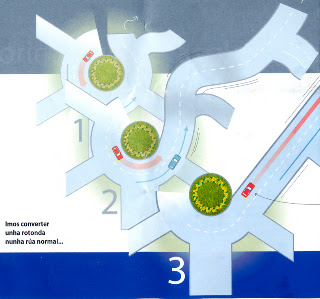
The first thing you must know is that roundabouts are only a fairly recent addition to the Spanish road system, and appear to be springing up at nearly every junction where two roads meet. (I have to assume that the traffic ministers deem them to be safer than crossroads or traffic lights, but I regret to say, this is simply not the case!) The problem appears to be that the older generation of drivers were simply not educated as to how to deal with them, and the younger generation are being educated in what seems to be a fairly bizzare fashion. Take for example the illustrations below, taken from a brochure designed specifically to help negociate roundabouts.

What exactly does this mean – are you confused?

The next picture shows how to turn right when approaching from the wrong lane…… make a full circuit and only exit when you start to feel dizzy!

Not the simplest way to turn right!

OK, so what’s the point of this message? Simply that you should forget what you have learned in your own country and approach roundabouts with extreme caution – do not expect other drivers to stop even when you think they should, and beware of drivers crossing in front of you from the wrong lane.

Do take care when driving in Spain, and remember my motto – Expect the unexpected.

Rias Baixas – Wine styles

April 20th, 2007 | Uncategorized


It’s true that there is a lot of snobbery in wine drinking, and we are probably all guilty of a bit of name dropping, or using the odd oenological phrase to demonstrate our knowledge. One such phrase that is sometimes used, and often abused within the wine world is the French expression
‘Terrior’ – and this does not simply mean soil or region as our dictionary might suggest.

In the world of wine ‘terroir’ can refer to any number of elements – not simply region and soil, but it can also include aspect, climate, grape variety and even the wine making technique itself. In addition to ‘terroir’ we then have the term ‘microclimate’, which can be used to narrow a vine growing region down to tiny areas or even individual vinyeards.

There is no doubt that these varying physical conditions will have an influence on the fruit (even if the same varietal), and will therefore modify the resulting wine. And after all, most wine makers worth their salt will explain that at least 90% of quality is created in the vineyard.

Within the Rias Baixas denomination, there are literally hundreds of different microclimates (which is really as a result of the way in which our tiny vineyards are distributed). However, at the risk of making sweeping generalisations, there are actually two main criteria that tend to produce distinctly different styles of Albariño. These are climate and soil…..

Although our denomination stretches barely 100km (60 miles) from North to South there can be quite significant differences in the weather, with the South being up to 1° or 2°C warmer. The South is also considerably drier – especially the inland areas of Rosal that do not enjoy quite the same refreshing maritime influences. Away from the sea summer temperatures can actually be several degrees warmer.

Rias Baixas North (sub regions – Valle de Salnés & Ribeira del Ulla)
As one would imagine the wines from the cooler Northern zones are usually not as heavy, and have marginally lower alcohol than those from the South. They have the steely, zesty, almost salt like qualities, tight structure and ‘nervosity’ often found in cool climate wines – in other words many of the attributes normally associated with the Albariño grape variety. This style is also influenced by the high concentration of granite in the sub-soil of the area that can provide an extra touch of minerality to the quality of the wine.

Rias Baixas South (sub regions – Soutomaior, Condado de Tea & El Rosal)
The additional heat of the South also provides extra sugar, and therefore alcohol – the resulting wines tend to be a little more full bodied and slightly heavier. It could be said that this fuller style is in some ways a little atypical of Albariño, and might not be the choice of the purist (I sometimes compare this to the differing styles of Chablis available from France). The sandy soils and alluvial deposits from the Miño river on the Portuguese border do not give the same mineral structure as the Northern wines, and they can sometimes be softer with lower acidity.

Of course, the wine making technique of each individual cellar will have a huge influence on the quality and style of the finished wine. And in addition, there are also cellars that buy a ‘mix’ of Albariño grapes from different sub zones in order to balance their wine, and perhaps add acidity where it may be lacking.

As I have said many times before, tasting is purely subjective and in the end it is your own tastebuds that will help you decide the style of Albariño that you prefer.

How much filtration is best for your wine?

April 13th, 2007 | Uncategorized
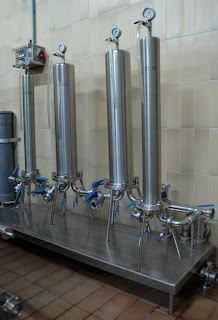
Our traditional ‘Kieselguhr’ filter

One of the great conundrums of wine making is deciding precisely how much filtration your wine requires before bottling. Too little can leave the wine cloudy and possibly unstable, too much and you have a highly polished wine with little or no flavour. Purists may even argue that wines should be bottled without any filtration at all – commercially however, this would be a dangerous decision to make, or at the very least, something of a calculated risk.

In our Bodega we have two types of filter – a Kieselguhr (diatomaceous earth) filter, which uses a fine powder of siliceous earth to absorb particles in the wine. In more traditional cellars this is probably the most widely used system – it is not overly agressive and still leaves the wine clean enough to bottle with a reasonable degree of safety.

Our more modern, ‘membrane’ filter

The second type that we have is a ‘membrane’ filter, which as the name implies, uses a physical barrier through which the wine passes, rather like a very fine strainer. The level of filtration is determined by the density of the filter (or filters) used, and this is measured in microns. The finer the filter, the cleaner the wine – but also, possibly, the more bland the wine….

So, deciding the level of filtration is a fine balance – producing a wine that retains character and some body; but a wine that will remain bright and stable in the bottle.

Making a fine wine is not as easy as you might think!

Time to come clean……

April 11th, 2007 | Uncategorized
Well, did you wash your hands on April 1st?

I recently recommended a virtual visit to the Bodega using Google Earth, and as I think I mentioned at the time, this is really quite impressive.

Slightly less impressive was the Prolafiol ‘virtual tasting’ that I recommended a couple of days later….. on April 1st! So, for those of you who did not understand the concept, then please allow me to explain:

Prolafiol is actually an anagram of April Fool, which I’m afraid means that this was just another example of my strange English sense of humour. I therefore apologise to any of my readers who may have spent hours scrubbing their hands and frantically rubbing the screen trying to extract wine odours. (Well, maybe there were just one or two people, you never know).

Actually, here is Spain, they do not ‘celebrate’ April fool’s day on April 1st, but they do have a similar day of practical jokes on December 28th that is known as the Día de los inocentes.

To be truthful, I can’t see my wife Angela planning any dastardly jokes, but don’t say that you haven’t been warned!

Time = Money!

April 4th, 2007 | Uncategorized
Juan (Señor Gadget) demonstrates the new equipment

Much of the investment that we make in the Bodega is to do with improving the quality of our wine, but not always….. As I have said in previous blogs, the pruning and tying of vines is a back-breaking job, made even more so by our ‘Pergola’ system of training. Anything that we can do to make the job a little easier is therefore welcomed by our staff.
This year we have made a modest investment in a new gadget for the vineyard which carefully ties the shoot of the vine plant to the training wires (it leaves a precise space around each shoot so that it does not become constricted during growth). The chore of tying vines to the wires is now infinitely quicker than before, and so we are able to save time, and perhaps a few pesetas, for other important jobs in and around the Bodega.

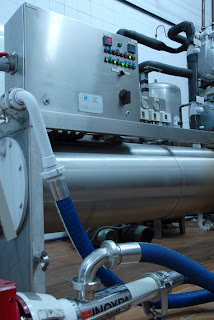
Cold stabilisation (note the ‘frosted’ metal tube)

In earlier blogs I have discussed the process of cold stabilisation (chilling the wine rapidly to approximately -5°C to precipitate the tartrates), and over the last months we have invested here too.

The machine that we use is a little old but very high quality, and far too expensive to discard completely, so we have given it a thorough overhaul – a completely new and much more efficient compressor that allows us to pass the wine more quickly than before – saving time and energy, but more importantly, reducing the time that the wine is exposed to possible oxidation. Our local contractors have been working on this overhaul for nearly six months now, and so hopefully, after so much time (and a substantial financial investment), we will finally start to benefit from the results.

Visit with Google, now taste with Prolafiol!

April 1st, 2007 | Uncategorized


If you tried the virtual visit with Google Earth recommended in my last post, and were astonished by the technology, then you really have to try this one to believe it…..

Prolafiol® tasting technology has been around for one or two of years now and we are delighted that (after much pressure from our local D.O.), they have finally added Albariño to their list of noble grape varieties. We invite you to try this unique virtual “tasting” experience – Please start by double clicking on the image to enlarge and then follow the instructions carefully:

Hands must be perfectly clean before starting (do not use perfumed hand wash)

1. Click box in lower right corner to activate Prolafiol tasting.
2. Using finger tip very gently rub selected coloured box
(Warning! Excessive pressure may damage your screen)
3. Finger tip should now reveal trace odours of chosen grape variety
4. Repeat process for next selection (using different finger)

As with any new technology there have been problems depending on your operating system (for example, I have been trying to establish if it works with new Windows Vista). If you need any advice just drop me an e-mail.

Happy (virtual) tasting!

Make a virtual visit with Google Earth!

March 30th, 2007 | Uncategorized

If you have a reasonably good computer, with a reasonably fast connection (ADSL) then you must pay us a virtual visit using Google Earth

If you have not used this site before let me tell you that it is a great deal of fun, and apart from seeing spectacular aerial views of our bodega and vineyards, you can ‘fly’ to virtually any location on the planet (including your own home). The technology is quite breathtaking, and completely safe.

OK, so first you have to download the programme from the Google Earth site, and then once you have it installed you will have the whole world at your finger tips. On the left of the screen is the ‘search’ facility, and if you click on the ‘fly to’ tab, you can then simply enter our co-ordinates and visit our different locations. The co-ordinates you need are as follows:

The Bodega: 42°30’18.91”N,8°45’23.73”W

El Pazo Vineyard: 42°29’48.67”N,8°46’27.20”W

Castrelo Vineyard: 42°28’45.38”N,8°48’29.62”W

I would of course recommend that you simply copy and paste these numbers into the search facility, and then you can zoom in as close as you like.
So, have a great flight, and we will have a (virtual) glass of Albariño ready for you on your arrival!

We’re doing the des-fandango!

March 22nd, 2007 | Uncategorized
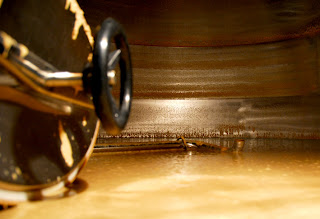
Racking in progress
Believe it or not there is no quiet time of year in the Bodega. Since the beginning of the year we have been busy in the vineyards with pruning and tying the vines, whilst indoors we have just started another big job…..

During the winter we have been tasting our tanks of the 2006 wines on a regular basis, and this is not just because we like Albariño. Since fermentation, the wines have been sitting on their lees (the exhausted yeasts), developing character and accumulating more complex flavours and aromas. One of the critical points in the wine-making year is to pick the optimum moment for racking (drawing the clean wine off the lees). This is decided by both taste and experience – once the wines are completely nourished by the lees, and before the wine shows signs of ‘reduction’ that can lead to bitterness and off flavours.

The length of time that an Albariño rests on it’s lees is not fixed in stone, but is actually determined by the healthiness of the lees themselves. If the lees are not clean they will pass on unpleasant flavours to your wine in a very short space of time.

The racking is a big step forward towards the release of the new wine, but there is still more work to do before it can be deemed ready for bottling.

Although the lees may look like a rather disgusting, dirty-brown porridge, there is a wonderful aroma of yeast that permeates the air during the racking process, making our cellar smell more like a bakery.

Footnote: If you are puzzled by the title of this post, it originates from the Spanish word ‘desfangar’, which means ‘to rack’. For me at least, a desfangador sounds more like a Spanish guy in tight black trousers brandishing his castanets than a piece of equipment we use for racking – Sorry, just my strange sense of humour!

New search tool added to our blog

March 21st, 2007 | Uncategorized

To make it easier to find the articles that really interest you I have added a new “LABEL” to each entry. This means for example, that if you are only interested in reading about our Harvest at Bodegas Castro Martin, then simply click on “HARVEST” in the labels list on the right hand side of the page. By doing this you will pull up all the entries that I have made since the start of our blog in January 2006.

Please do not forget that you can find much more (press and general information) on our full website at www.castromartin.com
As with all technology, there is a small downside – in upgrading the site it seems to have effected my HyperText Markup Language. OK, so I’m showing off now – but what this means to you is that it has randomly altered the word spacing on some of my entries. No big deal, but not quite as pretty….

Happy St Patrick’s Day from Castr O’Martin!

March 16th, 2007 | Uncategorized
The pipes, the pipes are calling

I thought it only appropriate that with all the Celtic connections we have here in Galicia (not to mention me being a McCarthy), that we should wish all our Irish cousins a Happy St. Patrick’s Day. No doubt there will be plenty of drinking in the Emerald Isle tomorrow, albeit probably more of the ‘black stuff’ than of our own Albariño. Having said that, we do have a very good importer for our wine, both North and South of the border, so it will be available….

The above photograph reminds me of my very first visit to Galicia several years ago, on a balmy summers evening, enjoying a chilled glass of Albariño, and at the same time being entertained by a band of pipes and drums. I have to say that it seemed very surreal at the time as I had no idea that the bagpipe had been adopted in this part of Spain.

Lá Fhéile Pádraig sona daoibh

Monthly Archives

Categories

ARE YOU OF LEGAL AGE? This site is intended for those of legal drinking age. By entering, you confirm that you are of legal drinking age in the country where this site is being accessed. ¿ERES MAYOR DE EDAD? Este sitio está destinado a personas en edad legal para beber alcohol. Al ingresar, confirma que tiene la edad legal para beber en el país donde se accede a este sitio.