

Ukraine
March 4th, 2022 | International News


Of course it is not my ambition to become an influencer on this new-fangled interweb thing, I am very much of a different generation. Indeed, when it comes to computers I am barely out of the two-fingered typing stage! When I was young we simply didn’t have access to computers either at school or at University, and my first piece of tech was probably an LCD wrist watch some time back in the 1970’s.
Having said all that, it is always gratifying to know that people do occasionally read our blog, and visit our website. Indeed, Google analytics gives me all the information that I could possibly need, albeit that it doesn’t tell me what our site visitors had for dinner….. yet!
Just a few days ago I noticed that we had reached one small milestone on the internet – we have now passed 250,000 views of our picture gallery. Perhaps that is a tiny number compared to some of the larger protagonists in the wine world, but for a small, family-owned Bodega in the middle of nowhere, we are quite happy about it. Here’s to the first million!

At this time of year the hillsides around our region are shrouded in a blue/grey mist as growers burn their vine cuttings on small bonfires. This is not unique to Rias Baixas, but is actually quite a common site in vineyards around the world. (I often think that this is a bit of a waste as vine cuttings make an excellent fuel to throw on the top of the barbecue coals as you grill your local fish. Having said that, barbecue season is, unfortunately, still a couple of months away for most of us).
There is however, another way to dispose of our cuttings, but this actually depends on how ‘healthy’ they are. Of course, cuttings are actually dead wood, but the question is, is this wood infected or diseased in any way. If there is any evidence of disease, then the only option is to burn. If, on the other hand, they are healthy, then they can simply be turned into mulch and spread back onto the soil as natural organic material. The last month or so of very dry, sunny weather has certainly helped to keep our cuttings dry and disease free, and so this year we are employing the ‘mulching option’.
Today’s picture shows the same vineyard from one day to the next. The first picture shows the ground spread with vine cuttings, and in the second they have virtually disappeared, as they have be ground down and spread thinly on the soil. Almost like magic, but in this case, organic magic!
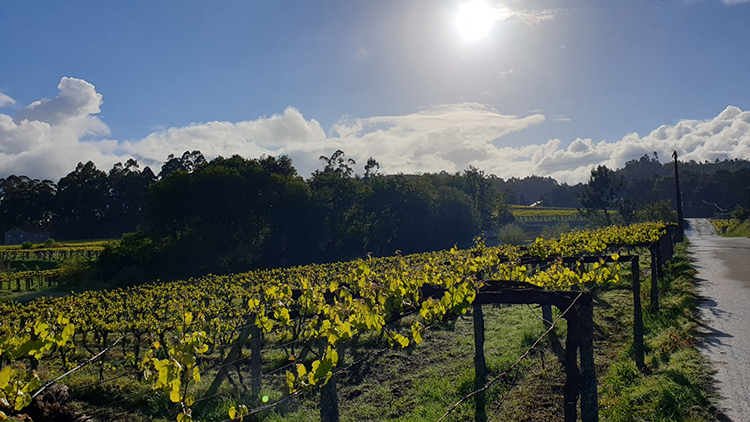
The month of January was quite exceptional, especially for Galicia. Not only was there almost zero rainfall (I think perhaps one or possibly two days at the beginning of the month), but skies have been largely cloudless for the last three or four weeks. Wall-to-wall blue sky every morning and clear, cloudless nights. Daytime temperature regularly reached the mid to high teens (15-19°C, 60-66°F), albeit that the clear January skies inevitably led to some very cold nights, with temperatures, quite frequently, dropping as low as freezing point.
Of course, as I have said many times before this provides us with really ideal conditions for pruning, and to be honest, progress to date has been much quicker than during the poor winter weather conditions that we would normally experience. Hardly a surprising observation.
The forecast tells us that we might have a little light rainfall tomorrow, but that after this we will return to largely clear, cloudless skies. There is however, a downside to this. The same as in many wine producing areas we rely on our winter rainfall to replenish the water table, and we would much rather have rain now, than during the summer months. We shall see….

I recently made a post about our Castro Martin Family Estate albariño winning a Gold+ Medal in the Distinciones Gallaecia (Guía Luis Paadín de Vinos 2022). Quite naturally, I wrote to my customers around the world to advise them, as obviously this can sometimes help to give a little boost to our sales.
In some countries there used to be, and still is, a fashion to have medals printed onto the labels of award-winning wines. In Australia for example, the culture of wine shows and competitions is very strong, they are held annually in many towns and cities across many States. As a result, a huge number of wines end up with gold medals, and (dependant upon the stature of the show), these can be held in very high esteem. As such, it is quite common to see some wine labels emblazoned with rows of gold medals. (A bit OTT for my personal taste). The problem is that it sometimes can feel like there are simply too many medals on offer, and in the end there is a danger that such accolades become over-used, thereby diluting their credibility.
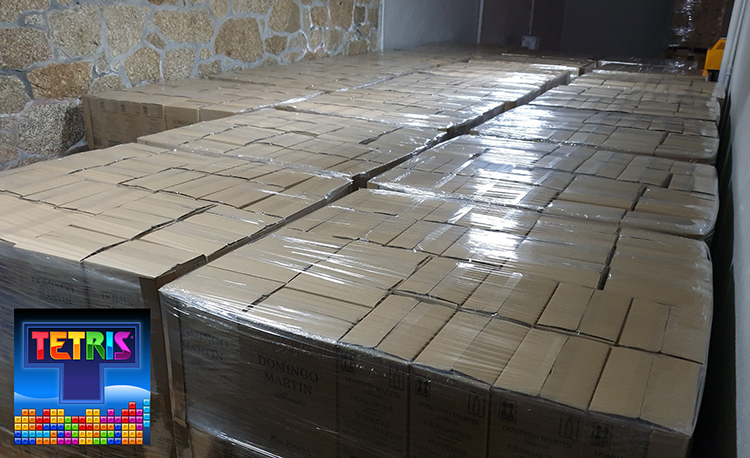
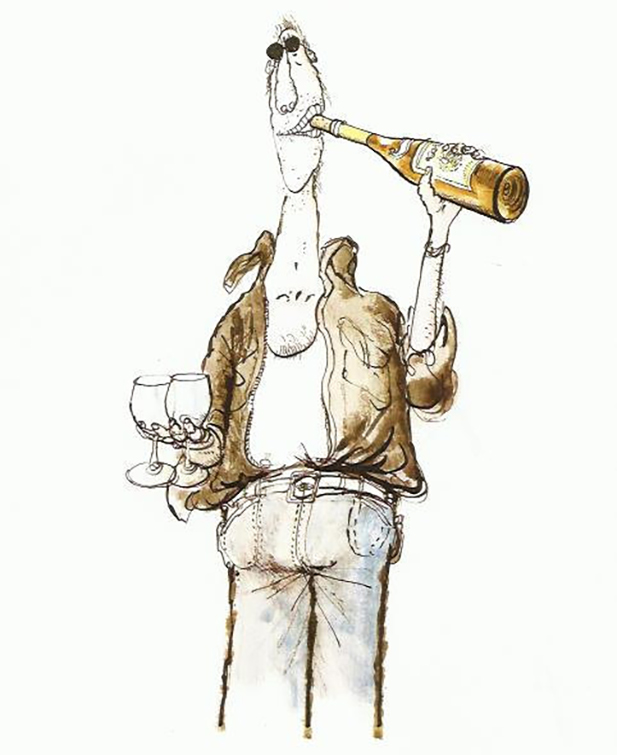
So, when I wrote to my importer in Australia telling him about this award, he immediately replied by saying “please, don’t print your medal on the label!” To be honest, I actually had no intention, but I did reply by sending him a draft of what I was proposing (see today’s picture) just to test his reaction. I can’t publish his reply…. but it was very funny!

As you will know I have very mixed views when it comes to wine competitions – certainly some are more credible than others. Some years ago, when I was a wine buyer, I remember receiving a mailshot, boldly entitled “Winner – the best wine in the World”. Well, that’s quite a claim, despite the fact that every winemaker on earth probably believes (or certainly should believe) that their wine is always the best in the world! However, it transpires (but only after reading the small print), that this wine was voted the best wine in a small, obscure tasting in Turkey. That’s almost like saying “the best wine in the world” – voted by my mum and her next door neighbour! Well, that’s probably a bit cruel and disrespectful….
Anyway! I had completely forgotten that we had entered one or two wines into a tasting in the autumn of last year. The Distinciones Gallaecia, which is based around a Galician wine guide – Guía Luis Paadín de Vinos, Destilados y Bodegas de Galicia 2022. It is judged locally, only involves Galician wines, and is held in very high esteem in our region. Based on the reputation of this competition we were naturally delighted to learn that our Castro Martin Family Estate wine had not only emerged with a Gold medal, but actually with a Gold+ medal, offered to only the very best wines – perhaps the best in the world!!!

Over the centuries many different types of container have been used to ferment and store wines, employing a variety of different materials. In the beginning it was simply a question of the range of materials available, such as the clay amphoras used by Romans and Phoenicians. In recent times, as wine making has become more ‘technical’, the type of container used is now more a matter of personal choice – the choice of the winemaker.
Obviously, the type of vessel used will often have a big impact on the style, and possibly flavour, of the finished wine, albeit that some winemakers still opt to use the most inert type of receptacle possible, in order that the wine is not marked in any way, thereby showcasing the flavours and character of their chosen grape variety.
Wine tanks and containers can be made from stainless steel, concrete, clay, stone, glass fibre, wood (and possibly a few others that have slipped my mind). Each different material can not only change the flavour and texture of a wine, but will also control the evolution (temperature and oxygenation) in very different ways. Concrete, for example, will retain temperature much longer than stainless steel, whilst on the other hand, stainless steel is much more hermetic than, say for example, wood. In addition to this, the way in which the chosen vessel is sealed can also change everything.
A trend which has re-emerged (seemingly since the advent of natural and organic wine), is the amphora. Here in Galicia some cellars are now experimenting with amphorae hewn from granite. It seems that wine making techniques have almost gone full circle.

As most businesses are closed at this time of year, or at least very quiet, I thought that I would do a quick catch up on a post that I made about a year ago.
About a kilometer from the bodega, a very strange structure appeared. The metal frame of a building, but somewhat strangely, built around a 40ft shipping container at it’s core. Of course, it was this part of the construction that really attracted my attention, and my mind was working overtime trying to figure out what the building could be. With an integrated shipping container I assumed that it might be some sort of storage facility (especially being located adjacent to a local motorway). I was wrong.
Progress of construction was slow, probably owing to the pandemic, but by the end of summer 2021 a bar/restaurant emerged, with a wooden exterior giving it the appearance of a large cabin.
To be very honest I haven’t tried it yet, but I will, if only to find out how the container has been integrated into its design.


No, this does not mean that we came third in a wine competition, but it does mean that we now have an official number on our door!
Yesterday afternoon our doorbell rang. I was confronted by a man in his high-vis yellow jacket carrying a small plaque and glue gun (and yes, it was fully loaded). “Where do you want it, mate?”, or words to that effect. “Where do I want what?”, I replied. He showed me the small plaque – it was the official street number of our bodega, which apparently had to be fixed at precisely 1.50 metres above the ground.
I was just a little taken aback, as we had had no say in the design or lettering of this plaque, nor had we been advised that it was even coming. It was the definition of a ‘fait accompli’!!
Anyway, I argued a bit with this Council ‘jobsworth’ (an official who upholds petty rules even at the expense of common sense), and eventually persuaded him to attach it at slightly below the sanctioned height. With a slight grimace he left, glue gun in hand, to continue his mission with our unsuspecting neighbours.
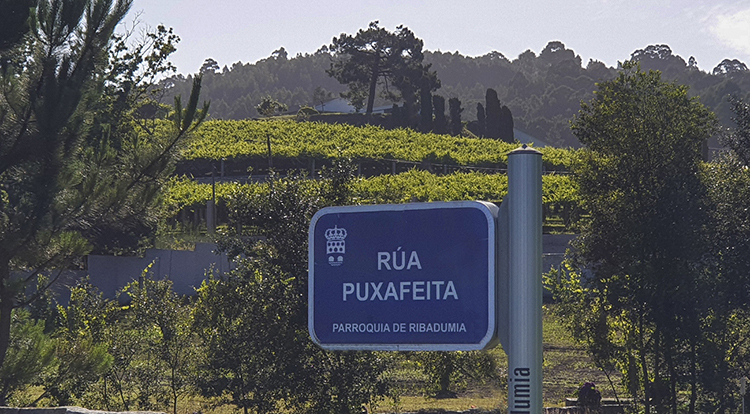
So now, we are officially Rúa Puxafeita 3