

Author Archive

Tank Story II

July 2nd, 2018 | Bodega

Last week I mentioned briefly that putting the tanks back together, welding the steel, is a much more difficult job than cutting them in two (not to mention very highly skilled).

The process of maneuvering the two halves into position and the spot welding is slow, precise and painstaking. As you can perhaps make out from today’s video every small weld is made centimeter by centimeter, re-aligning the metal between each fusion – it really is very exacting work. Once the circle is complete the result is a line of hundreds of individual spot welds that form the new joint. The welds are then hammered flat, with two men working simultaneously, perfectly co-ordinated, one inside the tank and the other outside – it’s really fascinating to watch.

After the hammering comes the final clean up. This is a two part process. Firstly comes the grinding, when the small humps and bumps of the join are removed, leaving a comparatively smooth, flat surface. Finally comes the polishing, when the tank is left with nothing more than a ‘brushed metal’ effect is visible (masking tape is used the give this brushed effect perfectly straight edges). Et voila! Job done!

Of course, now that the new jacket is in place it simply needs to be connected and tested. The odd fact is that this work is not carried out by the same people that made the tank modifications. Connecting to the cold water system will be carried out by either a plumber or refrigeration engineer in the coming days.

New shirts!

June 27th, 2018 | Bodega

After a week away from the bodega our tanks (or should I say half-tanks?) have arrived home, complete with their new shirts. These bottom sections have had new cooling jackets added, to make them more efficient and improve temperature control, especially during fermentation. In English we call them ‘jackets’ whereas the Spanish call them ‘camisas’, which literally translated means shirts.

Obviously it is now down to the simple matter of welding them back together again, which is a highly specialised job, and a good deal more difficult than the process of cutting them. Having said that, the guys who do this work are so good, that once complete you can barely see the join. I will probably add a short video later in the week.

(By the way, the cardboard wrapped around the tanks in the photo are merely there to protect the jackets whilst in transit, this does not form a part of the tank insulation itself – we are just a bit more hi-tech than that! Also, the tanks are turned upside-down, so the strange fins that you see on top are actually the feet).

So who needs teeth anyway?

June 25th, 2018 | Odds & Sods

We often hear stories of celebrities who insure parts of their bodies against loss or injury – dancers may insure their legs, singers can insure their voices and I have even heard of tasters who insure their palates. So what about tasters insuring their teeth?

As a former wine buyer I used to take every possible precaution to protect myself against colds and flu, as in the short term, it would simply be impossible to taste, but what about teeth? By coincidence Angela and I are both undergoing some significant dental work at the moment (no, we haven’t been knocking each other’s teeth out), and I have to tell you that it has had a notable effect on our ability to taste easily. Fortunately is has not prevented us from tasting completely, but has meant that we have both had to modify our techniques.

Angela has had a mouthful of plastic for more than a year now, and then recently, just for good measure, they have added a bit of wire too. My treatment, an implant, has meant that I have been given a denture to wear for the last ten weeks, as the dentist waits for the bone in my jaw to recover.

Whilst I cannot “shpeak” for Angela, I can tell you that I find it quite “imposhible” to taste with a denture, which means that the only option is to remove it. However, this in itself causes another problem. When I try to draw air over my tongue to intensify the taste, the wine simply tries to escape through the gap in my teeth! Stupid I know, but significant…. Of course, I still have the ability to taste, but in the short term (until the work is complete) I have had to modify my physical technique. Not so easy after decades of doing it in my sleep!

Half a tank?

June 19th, 2018 | Bodega

When you start cutting your tanks in half it’s never just for a bit of routine maintenance – it’s usually much more significant than that. Indeed, the last time we did this was following a catastrophe in 2008 when half of our tanks were accidentally crushed by a powerful vacuum (whilst testing the tank cooling jackets).

Today’s ‘vandalism’ has actually been triggered by choice, albeit once again related to the cooling jackets. This time we are adding more cooling to the tanks to give us greater control and more flexibility during harvest. Logistically it’s quite an undertaking, and to be honest there’s no really good time of year to carry out this work. Having just completed the racking, then obviously we were able to relocate the new wines away from the work area, but even so, tank space is always at a premium (because of our extended lees ageing).

The only option is to do this work, step by step, and when time allows. For example, today we will be cutting and removing just four tanks.

Obviously my short video shows the cutting process, but the one thing that a video cannot highlight is the smell! Cutting metal generates, well, a burning metal smell, and so we have to make sure that everything is completely locked down to isolate this as much as possible. We are actually using our powerful extraction system (used during harvest to remove the CO2), to keep the air as fresh as possible.

Who’s the star?

June 18th, 2018 | Food & Wine

Just after I wrote this post, and purely by co-incidence, this article appeared in our local press. Obviously my views differ slightly from that of the author (click on article to enlarge).

A question that I often ask myself, and that is apparently a frequently asked question is – when a restaurant is awarded a Michelin star, does the star belong to the chef or the restaurant? The answer is not quite as clear cut as you might think. Certainly is is the chef who takes the accolades for his menu, but in reality Michelin stars are awarded for the total experience including service, wine list, amenities, general ambiance etc.

Once awarded a star or two does this then mean that the chef has to spend all his waking hours cooking and supervising his kitchen? Well, no, not at all (much to my own chagrin). A chef can apparently train a head chef to prepare his menu and then, if he wishes, move on to set up another enterprise, which explains how a chef can run several different establishments at the same time, clocking up Michelin stars around the country. Indeed there are some celebrity chefs that have been awarded a multitude of stars in a number of different locations (sometimes on different continents!).

Of course, if said chef sells up, moves or forms a different company, then the star rating does not automatically follow him or her, it stays with the restaurant. In these circumstances the restaurant would normally be re-reviewed pretty quickly.

I suppose these ‘roaming’ chefs are a little like flying winemakers, they make their mark and then ‘hover’ around different locations, juggling to keep all the pieces in place.

Call me old-fashioned, but I like to see a talented chef where he should be, in his kitchen, showing off his cooking skills to the paying public.

El Mundial

June 15th, 2018 | International News

As if you didn’t know the World Cup kicked off yesterday, with the Russian hosts giving the Saudis quite a comprehensive beating (no surprise perhaps, that they ended up in probably the weakest group of the tournament).

So football and politics aside, it’s time to put your feet up, kick back on the sofa and enjoy a glass of something refreshing whilst watching the next game – and by that, I mean of course, a well-chilled glass of Castro Martin albariño.

Even if football is not your thing, then you can just as easily recline on your favourite garden chair and savour a glass or two, simply because albariño is the type of wine can you can drink just as easily on its own, even without food. On the other hand, if you are planning to stoke up the barbecue this weekend, then Castro Martin will still be the prefect choice.

Just how versatile can a wine be?

Flaming June? I think not…

June 11th, 2018 | Vineyards

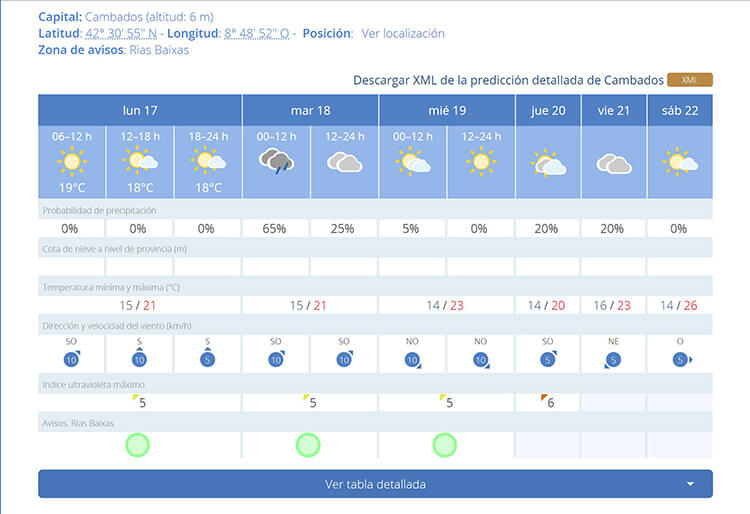
Now, I don’t profess to be any kind of meteorologist, but I do recognise when something’s not quite right. Here we are well into the month of June, and the weather here in northwest Spain is pretty poor to say the least. Daytime temperatures have hovered around the mid-teens °C (60-65°F), it’s grey and there has been a fair amount of rain. Our flowering period started reasonably well, in relatively dry conditions, but then it all went a bit down hill. Some flowering was complete before the rain, but for the rest we will have to wait to see what long-term effect that this cool, wet weather will have. I rather suspect that the flowering will prove to be uneven.

The odd part of this is that in some areas of northern Europe (across the UK, Belgium and Holland for example), they have been enjoying hot, balmy, summer conditions with temperatures into the mid 20’s, perhaps as much as 10°C more than our corner of Spain. This topsy-turvy weather has persisted for some time now (the whole of May) and to be honest I don’t really remember ever seeing this type of persistent weather reversal before.

Back in the UK, my friends still believe that I spend my time basking in a warm, sunny climate – clearly they have not visited Galicia!

Let the racking begin

June 4th, 2018 | Bodega

The fermentation of our 2017 wines finished at the beginning of October last year, and since that moment our wines have been resting quietly on their lees. Today, some 8 months later, we have just started the annual racking. Over the winter the lees settle to form a sort of thick paste at the bottom of the tank, and today we are simply drawing off the clean wine from above (making sure that the don’t disturb the lees in the process).

It’s actually quite a slow process, with long periods of inactivity as we wait for the precious liquids to be transferred. Once the clean wine is relocated we then transfer the lees into large airtight containers to be sold to the distillery for making aguardiente. Nothing is wasted!

The final job is to clean the interior of the empty tanks, which is a chore in itself. The walls of the tanks are nearly always thick with brown crystals that resemble rust (from the tartaric acidity in the wine), and they can be quite tough to remove. We have to use a caustic solution, but then making absolutely certain that the tank is rinsed thoroughly before it is ready to receive the next wine.

Where to plant?

May 30th, 2018 | Galicia

A few weeks ago I took a photo of a guy in the middle of a forest, close to our bodega, cutting trees and making a clearing. Little did I know at that moment that his plan was to plant a small vineyard – but it did start me thinking. Was there any logic whatsoever behind the site that he selected, or was it just a small plot of land where he fancied growing a few grapes? I rather suspect it was the latter.

I have asked myself this question many times, about the seemingly random situation of many of our Rias Baixas vineyards, and how they actually come to be selected. My guess is that, for the vast majority, it is more about convenience than making any type of detailed study to find the best site. This could explain why, in a denomination of only 4,000 hectares, there are nearly 22,000 different vineyard sites!

In the wine business we talk about ‘Terroir’, which many think is simply related to the soil on which a vine is planted, but I can tell you that it is actually much, much more complex than that. Terroir is a combination of factors, including nearly every physical aspect of a vineyard location that you can think of – soil, soil type, drainage, aspect, sun exposure, local rainfall, protection/shade, wind, sea mists etc., etc. All of the individual components that will ultimately determine why the quality of one grape varies from another (assuming that they have been properly cared for).

My photo shows this new planting, bathed in a bit of early morning sun. But what the photo doesn’t tell you is that this location is one of the coldest corners of Ribadumia. The vineyard is on a north facing slope, and apart from this brief touch of sun, it will spend the rest of the day shrouded by trees, with almost no direct sunlight and very little warmth. In a few years I will be interested to explore what it produces.

Blitzed wine?

May 26th, 2018 | Tasting

Yesterday I missed yet another ‘National Day’ – apparently it was National Wine Day (or at least it was in the USA). About 10 days ago I also missed National Tea Day, which, as the world’s greatest tea drinker, came as quite a shock – albeit that every day is National Tea Day for me!

Moving on quickly I read something very interesting yesterday, well, actually quite shocking to me! Putting red wine in a blender to help it breath! Apparently it’s called ‘Hyperdecanting’…..

OK, we live in an age where everything is instant, and few people have the patience to wait for anything. Many prefer to ignore the slow, careful, perhaps more traditional method of decanting, but putting wine into a food blender? Really? Certainly this is something that I would never ever consider myself, even for a half-decent wine, but then we are told that this blitzing is ‘ideal’ for cheaper red wines – it can accentuate the fruit and make them less harsh. Well, I doubt if I will be trying this theory any time soon.

For example, could you ever imagine the sommelier of your favourite restaurant plugging in a blender at the side of your table to aerate your wine – I think not. Simply open the bottle, pour, swirl, wait and savour (or just stick to Coca Cola).

One commentator summed this idea up beautifully – it’s quicker to open a wine with a chainsaw, rather than a corkscrew – but you wouldn’t!!

Monthly Archives

Categories

ARE YOU OF LEGAL AGE? This site is intended for those of legal drinking age. By entering, you confirm that you are of legal drinking age in the country where this site is being accessed. ¿ERES MAYOR DE EDAD? Este sitio está destinado a personas en edad legal para beber alcohol. Al ingresar, confirma que tiene la edad legal para beber en el país donde se accede a este sitio.