When I first arrived in Spain a few years ago one of the things that first struck me when eating out was the number of unlabelled bottles served to the tables – not carafe wine, but wine bottled, with a cork, simply missing any form of identification. This was not an ‘under the counter’ operation, but very open and blatant, and an offer taken up by the large majority of customers. I have no doubt that this wine even tasted a little ‘sweeter’ to these consumers as they enjoyed a cheaper price as a result of not paying any tax!
Whilst this type of ‘deal’ is probably offered all around the vineyards of Europe, I cannot imagine it happening too much in the New World. The real shock for me however, was the sheer volume and audacity of the practice (especially when I consider the stringent controls that we face as wine producers, not only to guarantee the quality of our product, but also to dot every ‘i’ and cross every ‘t’ on the label). In the past, for example, we have actually been pulled up for having a typeface that is 1mm too small, let alone not having any label at all! So it would hardly seem fair, to say the least…..
Possibly out of guilt, but more likely owing to the loss of taxes, our local Government has now started an initiative to stop the practice of unlabelled wine by printing a brochure. How this will help I am not quite sure, as it always the enforcement that seems to be a bit lacking here in Spain. I can only hope that we enjoy more success than the no-smoking law which appears to have made almost no difference whatsoever!
We are probably just over a month away from the start of the 2007 harvest, and whilst we are still ‘open for business’ during this period, we strongly encourage all our customers to order well in advance to avoid possible delay.
Whilst the grapes are still ripening on the vines it is impossible to know the exact date that we will start picking, but my best guestimate would be around the second or third week of September – not quite as early as last year, and perhaps a bit closer to ‘norm’.
The summer so far has not been very kind to our region, as we have experienced a lot of rain and humidity – not the best weather for growing fruit. To be very honest we have been obliged to use some anti-mildew and oidium treatments, but our careful management of the vine canopy has at least helped to minimise the amount of intervention. Other growers have perhaps been a little less fortunate, as the ‘vine vigour’ (created by the additional rainfall) has only served to trap moisture and exaggerate the problem.
We are currently experiencing a hot, dry period, so we have our fingers crossed that this will now continue for the rest of the summer!
The press in Venezuela appear to quite like our wine, which of course could be for several different reasons. The first and most obvious reason is that Angela was born there. Secondly it could be that we have a very good distributor, who makes sure that our wine is regularly presented to the press. And finally, it goes without saying that the most likely reason is that we make a really good Albariño!
Our Casal Caeiro 2006 (which has only recently been released in South America) is described as having “a rich, powerful, aromatic nose, displaying an array of citrus fruits and salty, mineral notes. Clean and intense in the mouth with a lively, fresh acidity and a long, persistent finish.”
In recent weeks two or three of our wines have been mentioned in wine guides and magazines, both in Spain and around the world. These most recent articles have included tasting notes, but no particular rating as such, albeit that all the comments have been very good.

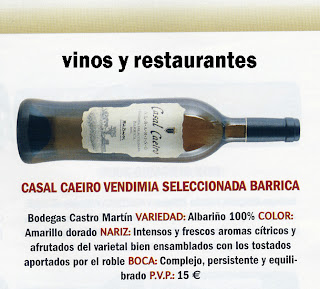
The July issue of Vinos y Restaurantes commented that our Casal Caeiro Barrica displayed “intensely fresh citrus aromas and varietal fruit, nicely combined with the toasted oak”
Always nice to get a mention!
Let me start by saying that I actually like supermarkets – I belong to the minority of males who quite enjoy wheeling a trolley up and down the aisles!
The choice of goods in UK supermarkets is mind-boggling (especially when compared to the somewhat limited selection that we have here in Galicia). I also have to admit that supermarkets have been instrumental in promoting competitive pricing, albeit sometimes at the expense of local traders. Unfortunately our small local shop does not enjoy the same purchasing power, and, regrettably, it is this very power that can sometimes be abused……
We regularly hear of desperate UK dairy farmers being forced out of business as they are obliged to sell their milk to supermarkets at below their cost price – although it would now seem that this problem is slowly being addressed with the promotion of locally produced milk. Likewise with local fruit and vegetables – as the high street giants now scramble to reduce their carbon footprint they are increasingly supporting their local producers. All very positive news.
I am however puzzled by the ‘fair trade’ range of products carried by many chains, simply as this phrase appears to imply that the rest of their trade might not be as fair as it should be! Maybe I am just reading too much into this?
The bad news is that the “supermarket squeeze” on pricing has now filtered through to the wine trade too. The following text is an extract from an article in the UK’s Daily Telegraph, and relates the story of Southern French producers:
Mr Bourchet is just one of many small-scale “vignerons” (wine growers) in the Languedoc and Roussillon region who are prepared to grub up to avoid bankruptcy after three years of losses.
He said times were so bad that several winegrowers had committed suicide since the beginning of the year.
Local wine producers are furious that their sale prices have been slashed by around 50 per cent while wine prices in shops and supermarkets have not dipped. A litre of vin de pays is sold for as little as 0.35 euros (24p) and costs 10 times that amount in supermarkets. “Someone is pocketing the difference and we want to know who,” he said.
My message to the supermarkets….. don’t forget to support your (not so local) wine producers too!
OK, so it’s not Robert Parker Jnr., but 95 points must be good in anyone’s book!
The Gourmet (translated) tasting note reads as follows:
Deliciously fresh and vibrant. A pale yellow colour, as it should be, the nose bursts with mature white fruits, most noticably melon, with a floral background. Mineral acidity with a lovely carbonic touch that adds to the fresheness – delicate and persistent in the mouth.
Recommended with Pulpo a la Gallega, Fresh Langoustines, and Poached Fish
You may find this difficult to believe but we have an ongoing struggle to buy the exact bottle that we really want for our wines, there always seems to be a problem….
Obviously the first consideration that we make is what is best for our wine – we opt for a dark colour to give the wine some protection against ultraviolet light, which over time will cause damage. We have been asked on occasions if we can produce our wine in a clear (white) bottle, but there are a couple of good reasons why we don’t. Firstly, there is the light problem mentioned above, then there is the aesthetic appearance – Albariño can either look bland and anaemic, or in some vintages, because of it’s golden hue, a little maderised and ‘over the hill’. And then finally, clear glass is simply more expensive as it is very difficult to make out of re-cycled glass (most re-cycled glass is coloured because of impurities).
The second criteria when chosing a bottle is that of appearance – it is of paramount importance to have a good presentation befitting the quality of your product. Today there is an overwhelming selection of shapes and colours to chose from, but for numerous reasons we have opted to follow the classic route, chosing a ‘prestige’ Bordeaux shape. In Rias Baixas the bottle traditionally used was the old Rhine shape, but unfortunately this was not always the most practical for storing in a wine cooling cabinet. Some people also consider this to be a little old fashioned.
So, having selected the shape, we then have to select the shade that we want. Our preference would be a very dark green (4th from the left in the photo above). However, actually obtaining a quality bottle of this colour in our part of Spain has proven to be a real nightmare.
We have surfed the catalogues of Spanish, Portuguese and even French producers, but finding the right quality at a reasonable price has proved to be almost impossible. In Portugal we did actually locate a supplier who produced what appeared to be the perfect bottle, so naturally we rushed to place our order. On first sight they looked perfect, but then we tried to bottle with them….. I should tell you at this point that in bottle production temperature is a critical factor, and if they are not cooled correctly, or to quickly, then this makes the glass very brittle, no matter what the weight of the bottle. And yes, you’ve guessed it…. a great looking bottle, but one which had a tendency to explode on our bottling line. (Broken glass on your bottling line is one of your biggest nightmares for obvious reasons).
So, I apologise unreservedly to all our customers who live with the subtle changes in the colour of our bottle as we search (so far in vain) for the perfect supplier. If anyone reading this blog can recommend a good bottle producer – preferably in Spain – then we would be delighted to hear from you.