

Archive for ‘Harvest’

Oh, no…. rain!

September 25th, 2013 | Harvest
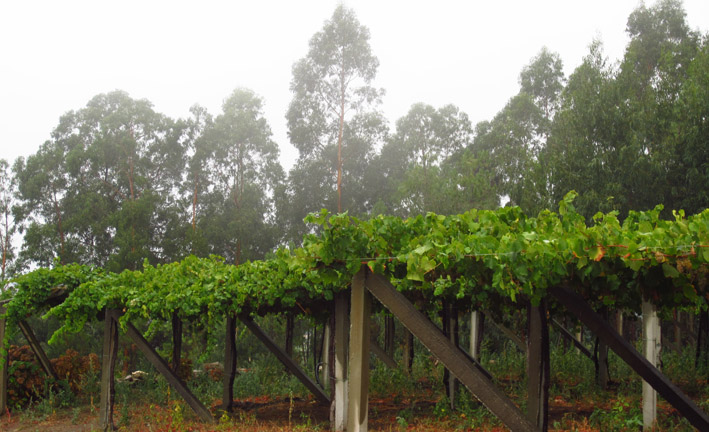
AutumnI may well have tempted fate by mentioning it the other day, but after two months of almost drought conditions the forecast rain has finally arrived, and it has suddenly turned decidedly autumnal. I’m afraid it was almost inevitable that such a late harvest would be affected by rain, and it simply wasn’t realistic to expect this extended dry period to continue into October. Until today we had been anticipating a start to our 2013 harvest at the beginning of next week, but now we will have to wait and see what effect this rain is going to have. It rather depends on how long the rainfall continues that will determine how much is absorbed into the soil, and then in turn, how much finds its way into the fruit. Another important factor will be the temperature – at the moment the thermometer has dropped to around 18°C (65°F). This being the case conditions under the canopy are currently not too humid and sticky, but again this will depend on how quickly things dry up.
 

AutumnI may well have tempted fate by mentioning it the other day, but after two months of almost drought conditions the forecast rain has finally arrived, and it has suddenly turned decidedly autumnal. I’m afraid it was almost inevitable that such a late harvest would be affected by rain, and it simply wasn’t realistic to expect this extended dry period to continue into October. Until today we had been anticipating a start to our 2013 harvest at the beginning of next week, but now we will have to wait and see what effect this rain is going to have. It rather depends on how long the rainfall continues that will determine how much is absorbed into the soil, and then in turn, how much finds its way into the fruit. Another important factor will be the temperature – at the moment the thermometer has dropped to around 18°C (65°F). This being the case conditions under the canopy are currently not too humid and sticky, but again this will depend on how quickly things dry up.
Wet & Dry

September 20th, 2013 | Harvest

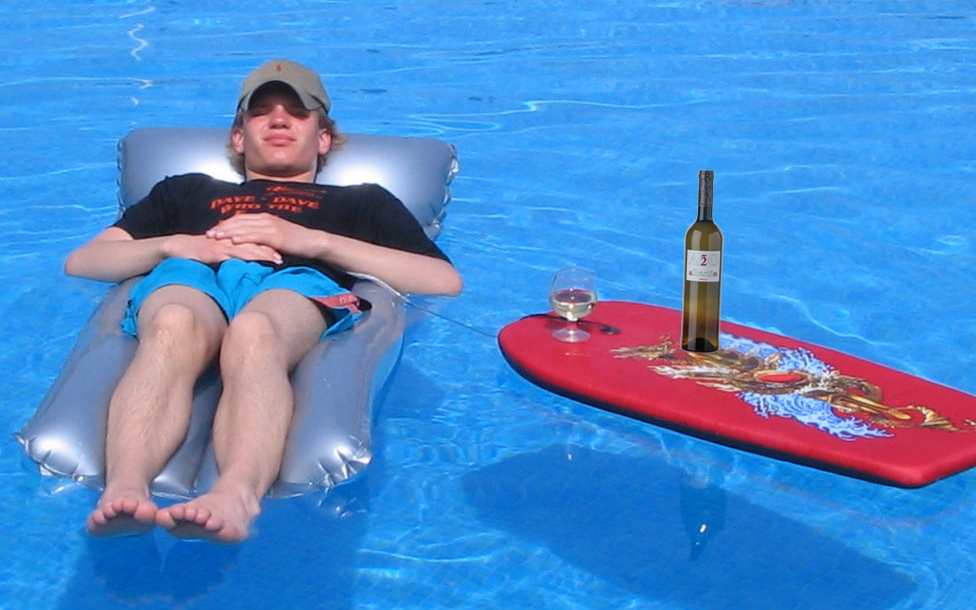
Wet & DryNo! I’m not referring to the special sandpaper for do-it-yourself enthusiasts invented in 1921 by the 3M Company, but instead to a summary of this year’s fruit growing season. To use an old football (soccer) analogy it has been “a game of two halves” – the first part of the year very wet and cold, the second part of the year very dry and sunny. 

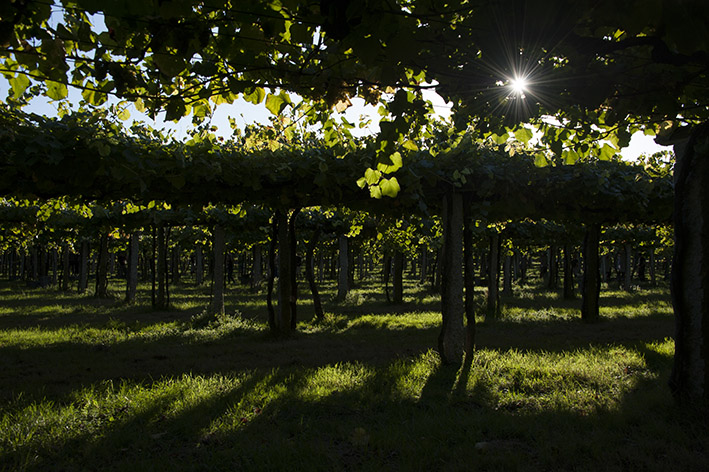
You might be forgiven for thinking that dry sunny weather is perfect for growing grapes, and of course, it is much better than a grey, damp summer. The problem is that this year it has been almost too extreme. Since more or less the end of June, until today’s date, we have had almost no rainfall whatsoever, and as the harvest rapidly approaches the vines are more than a little stressed. Believe it or not we do need a little rain during the growing season, but the most important factor in this is the timing. A little rain in mid-summer is not a bad thing, but rain too close to the harvest can cause problems. For example, if the grapes are small and thick-skinned (owing to dry weather), then a sudden downfall of rain can cause the berries to grow rapidly and burst their skins, leading inevitably to rot (and not of the noble variety). It goes without saying that the element we really don’t want is humidity – this is why too much rain in summer is a very bad thing. The ground gets wet, the sun comes out and the humidity gets trapped under the canopy, and this can be especially bad in an area such as ours that uses pergolas. If our overhead vegetation is too thick, then the humidity can’t easily escape.

Having said all that, we have the very opposite problem at the moment – our grapes are quite small owing to the lack of rainfall – healthy but small. Naturally if the ratio of pulp to skin and pip is low then we will have reduced yields. Quality? We will have to wait and see.

Wet & DryNo! I’m not referring to the special sandpaper for do-it-yourself enthusiasts invented in 1921 by the 3M Company, but instead to a summary of this year’s fruit growing season. To use an old football (soccer) analogy it has been “a game of two halves” – the first part of the year very wet and cold, the second part of the year very dry and sunny. 

You might be forgiven for thinking that dry sunny weather is perfect for growing grapes, and of course, it is much better than a grey, damp summer. The problem is that this year it has been almost too extreme. Since more or less the end of June, until today’s date, we have had almost no rainfall whatsoever, and as the harvest rapidly approaches the vines are more than a little stressed. Believe it or not we do need a little rain during the growing season, but the most important factor in this is the timing. A little rain in mid-summer is not a bad thing, but rain too close to the harvest can cause problems. For example, if the grapes are small and thick-skinned (owing to dry weather), then a sudden downfall of rain can cause the berries to grow rapidly and burst their skins, leading inevitably to rot (and not of the noble variety). It goes without saying that the element we really don’t want is humidity – this is why too much rain in summer is a very bad thing. The ground gets wet, the sun comes out and the humidity gets trapped under the canopy, and this can be especially bad in an area such as ours that uses pergolas. If our overhead vegetation is too thick, then the humidity can’t easily escape.

Having said all that, we have the very opposite problem at the moment – our grapes are quite small owing to the lack of rainfall – healthy but small. Naturally if the ratio of pulp to skin and pip is low then we will have reduced yields. Quality? We will have to wait and see.

More extremes…

September 1st, 2013 | Harvest

DryAfter a very cool wet spring and the prospect of a late harvest as a result, we are now experiencing the opposite – a prolonged warm, dry period. The month of August now behind us, was extremely dry, but also quite sunny and warm – temperatures mostly in the 25-30°C (77-86°F) range. Altogether very pleasant. I was actually trying desperately to recall whether there had been any precipitation  at all during the last month, and was even searching various weather websites to see if I could confirm my idea, but believe it or not I couldn’t find one. Having said that, if there was any rain at all, then it was certainly next to nothing.

So what are the implications for our harvest? Well, it really depends on what happens next. If the dry weather continues for the next few weeks, then it is possible that the berries will start to shrivel and yields could be somewhat reduced. In an ideal world we need just a little rain, enough to refresh the soil and to breathe a bit more life into the vines, but clearly we done want too much rain either as this can lead to potential problems with rot and disease. So we don’t ask for too much – just perfect weather for our vineyards!

Now only another few weeks to run before the games begin.

DryAfter a very cool wet spring and the prospect of a late harvest as a result, we are now experiencing the opposite – a prolonged warm, dry period. The month of August now behind us, was extremely dry, but also quite sunny and warm – temperatures mostly in the 25-30°C (77-86°F) range. Altogether very pleasant. I was actually trying desperately to recall whether there had been any precipitation  at all during the last month, and was even searching various weather websites to see if I could confirm my idea, but believe it or not I couldn’t find one. Having said that, if there was any rain at all, then it was certainly next to nothing.

So what are the implications for our harvest? Well, it really depends on what happens next. If the dry weather continues for the next few weeks, then it is possible that the berries will start to shrivel and yields could be somewhat reduced. In an ideal world we need just a little rain, enough to refresh the soil and to breathe a bit more life into the vines, but clearly we done want too much rain either as this can lead to potential problems with rot and disease. So we don’t ask for too much – just perfect weather for our vineyards!

Now only another few weeks to run before the games begin.

Vendage Verte

August 9th, 2013 | Harvest

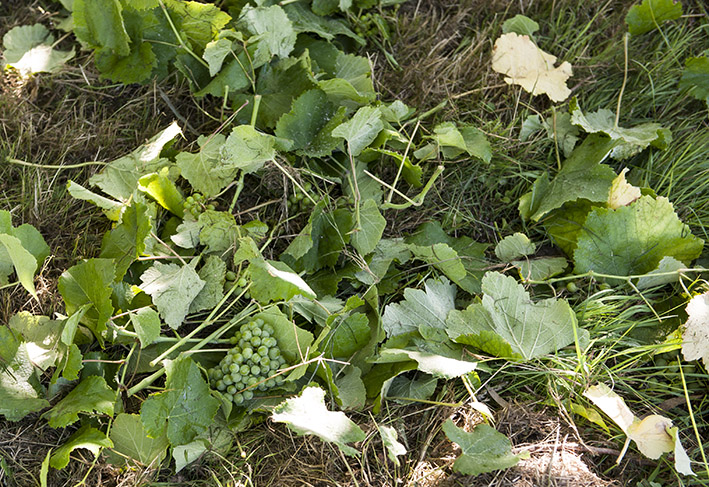
Green harvestOK, I know, we’re a Spanish bodega and I’m using a French wine expression to describe our ‘green harvest’ – it’s just an old habit that dies hard (and I have to admit that it’s not the only French term that I use quite regularly). For example, ‘fiche technique’ is another one…. I think in the U.S. this is sometimes known as a ‘cheat sheet’, which I’m afraid doesn’t have quite the same ring to it.

Anyway, the subject of today’s post, as you might have guessed, is the green harvest that we are making in our vineyards. Despite a difficult, late and extended flowering period, we have actually arrived with (potentially) quite a good crop of fruit. Yes, there are a few uneven bunches (that we would remove anyway), but in addition to this we are also removing some of the excess fruit before it starts to consume too much sugar. In other years this practice might take place a little earlier, but as this year’s vineyard cycle is running a little late we now anticipate the end of September as our expected harvest date.

Clearly there is still a lot of time between now and start of picking and so removing bunches at this stage is always a risky business, but the long-term benefits are quite clear. As with any fruit or vegetable, bigger does not always mean better, and perhaps explains the British obsession with baby vegetables (although I have to admit that in many cases the baby veggies do actually taste better). The point is that if we remove some of the small, green bunches now then the energy of the vine is concentrated into the remaining fruit and we will end up with better grapes….. simple!

The difficulty is, as always, persuading a few of our grape suppliers that this is the best course of action. It’s quite understandable that they can view it as simply throwing potential profit on the floor.

Green harvestOK, I know, we’re a Spanish bodega and I’m using a French wine expression to describe our ‘green harvest’ – it’s just an old habit that dies hard (and I have to admit that it’s not the only French term that I use quite regularly). For example, ‘fiche technique’ is another one…. I think in the U.S. this is sometimes known as a ‘cheat sheet’, which I’m afraid doesn’t have quite the same ring to it.

Anyway, the subject of today’s post, as you might have guessed, is the green harvest that we are making in our vineyards. Despite a difficult, late and extended flowering period, we have actually arrived with (potentially) quite a good crop of fruit. Yes, there are a few uneven bunches (that we would remove anyway), but in addition to this we are also removing some of the excess fruit before it starts to consume too much sugar. In other years this practice might take place a little earlier, but as this year’s vineyard cycle is running a little late we now anticipate the end of September as our expected harvest date.

Clearly there is still a lot of time between now and start of picking and so removing bunches at this stage is always a risky business, but the long-term benefits are quite clear. As with any fruit or vegetable, bigger does not always mean better, and perhaps explains the British obsession with baby vegetables (although I have to admit that in many cases the baby veggies do actually taste better). The point is that if we remove some of the small, green bunches now then the energy of the vine is concentrated into the remaining fruit and we will end up with better grapes….. simple!

The difficulty is, as always, persuading a few of our grape suppliers that this is the best course of action. It’s quite understandable that they can view it as simply throwing potential profit on the floor.

A new working platform

July 24th, 2013 | Bodega

PlatformIf you look back at our blogs or vintage reports over the last few years you will probably find a photo or two of Fran (our cellar guy) balancing precariously on top of the presses during harvest. His task at this point is simply to distribute the grapes evenly inside the press as they tumble from the reception area on the level above, which is much more difficult than it sounds. To be completely honest, clambering up on a ladder and then straddling the machine is very far from ideal, some might say, even a little dangerous.

Finding a solution to alleviate the danger was never going to be easy, and whatever we decided would certainly have to be a customised design and build to fit into a very tight space. Indeed, we quickly realised that short of removing the roof, it was probably a design that would have to be built in situ. Our planners (Fran and myself) got our heads together, and based on our experience of working together on the presses over the last decade, came up with a plan of what was needed.

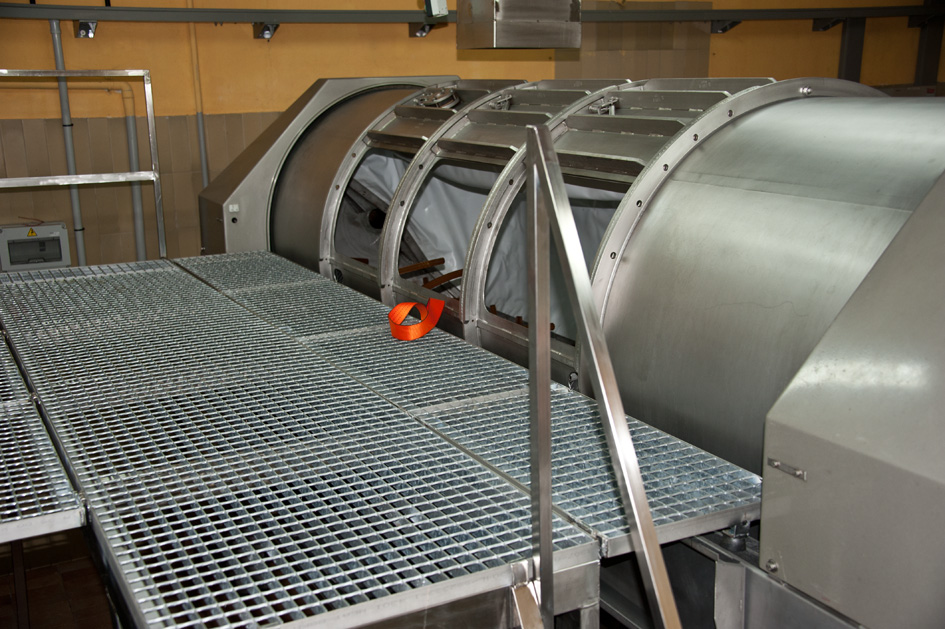
Having missed the window to do this last year (we left it to late!), we got an early start this year, and presto! Our design has now come to fruition. It is an in-house build (as Fran is also very handy with a welding torch), but I’m sure you will agree from today’s photograph, that the finished platform looks both very solid and very professional. Of course the one thing that you don’t really appreciate is that this new working areas is actually 1.80m (nearly 6ft) above the floor, and that the top of the press is nearly 3.0m (over 9ft), which would be a long way to fall onto the tiled concrete floor below!

The genius of the design (that you can just about make out from the photo) are the two side platforms that pull up from each side of the main platform, rather like a draw bridge, allowing the press to be closed up and to turn freely once it has been charged with grapes. 

It’s so impressive that maybe we should give up making wine and move into light engineering!

PlatformIf you look back at our blogs or vintage reports over the last few years you will probably find a photo or two of Fran (our cellar guy) balancing precariously on top of the presses during harvest. His task at this point is simply to distribute the grapes evenly inside the press as they tumble from the reception area on the level above, which is much more difficult than it sounds. To be completely honest, clambering up on a ladder and then straddling the machine is very far from ideal, some might say, even a little dangerous.

Finding a solution to alleviate the danger was never going to be easy, and whatever we decided would certainly have to be a customised design and build to fit into a very tight space. Indeed, we quickly realised that short of removing the roof, it was probably a design that would have to be built in situ. Our planners (Fran and myself) got our heads together, and based on our experience of working together on the presses over the last decade, came up with a plan of what was needed.

Having missed the window to do this last year (we left it to late!), we got an early start this year, and presto! Our design has now come to fruition. It is an in-house build (as Fran is also very handy with a welding torch), but I’m sure you will agree from today’s photograph, that the finished platform looks both very solid and very professional. Of course the one thing that you don’t really appreciate is that this new working areas is actually 1.80m (nearly 6ft) above the floor, and that the top of the press is nearly 3.0m (over 9ft), which would be a long way to fall onto the tiled concrete floor below!

The genius of the design (that you can just about make out from the photo) are the two side platforms that pull up from each side of the main platform, rather like a draw bridge, allowing the press to be closed up and to turn freely once it has been charged with grapes. 

It’s so impressive that maybe we should give up making wine and move into light engineering!

2013 – Late Harvest Albariño?

July 21st, 2013 | Harvest

Summer BusThe long, cool spring of 2013 has certainly had a profound effect in the vineyard. One of the most significant consequences was the delayed and unusually protracted flowering period. Indeed, in some vineyards (not ours) many potential bunches were lost completely as pollination simply didn’t happen.

The knock-on effect of this is of course, that as a direct result, we will probably have a very late harvest too. Clearly it is very early days and a lot can change over the next month or two, but it would seem that we are now looking at collecting our fruit closer to the end of September, rather than the beginning of the month.

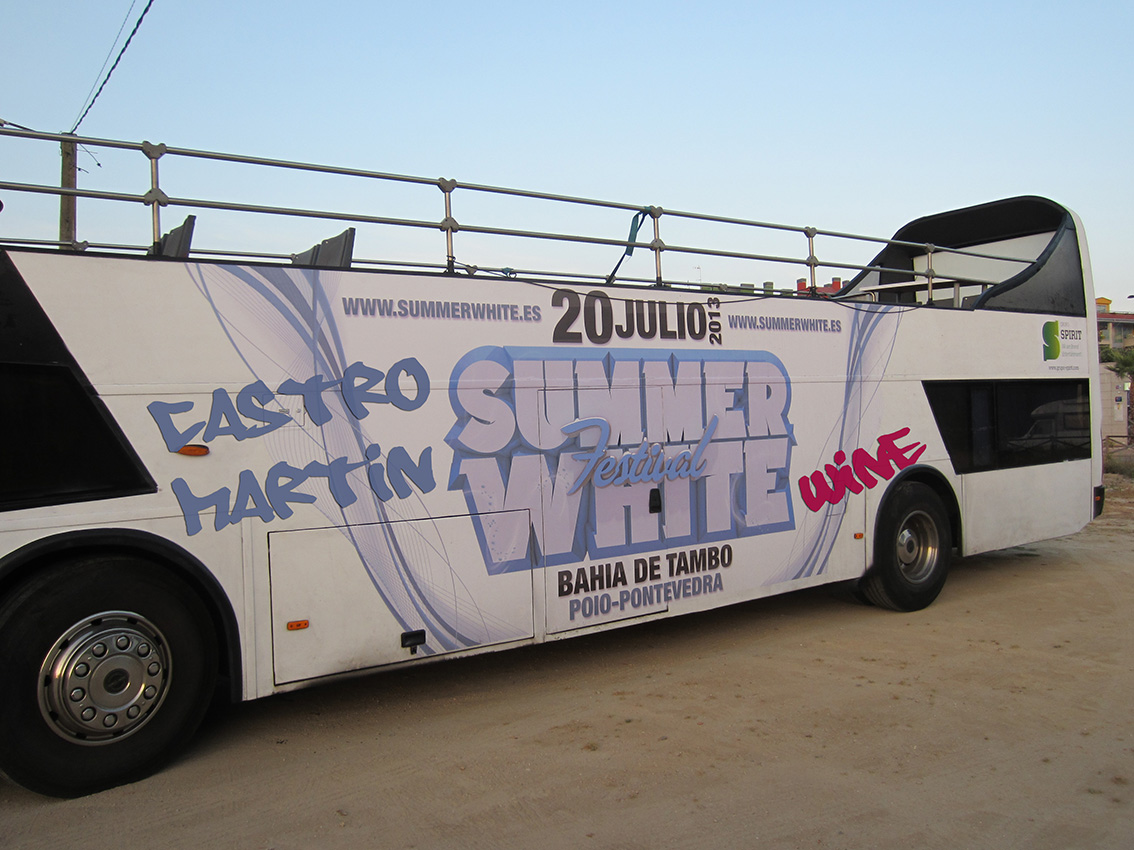
As for the bus in the photo advertising the Summer White festival here in Galicia…… Well, I just happened to have a couple of spray cans in my backpack and couldn’t resist a bit of artistic modification. (Only joking – just Photoshop, click on image to enlarge)

Summer BusThe long, cool spring of 2013 has certainly had a profound effect in the vineyard. One of the most significant consequences was the delayed and unusually protracted flowering period. Indeed, in some vineyards (not ours) many potential bunches were lost completely as pollination simply didn’t happen.

The knock-on effect of this is of course, that as a direct result, we will probably have a very late harvest too. Clearly it is very early days and a lot can change over the next month or two, but it would seem that we are now looking at collecting our fruit closer to the end of September, rather than the beginning of the month.

As for the bus in the photo advertising the Summer White festival here in Galicia…… Well, I just happened to have a couple of spray cans in my backpack and couldn’t resist a bit of artistic modification. (Only joking – just Photoshop, click on image to enlarge)

Changing our neumáticos

July 6th, 2013 | Bodega

Changing the membraneWith all the controversy surrounding Formula One at the moment, and the problems with Pirelli, I thought that now might be a good time to change the neumáticos in our bodega too! Well, strictly speaking, these are not tyres, but rather the large pneumatic ‘airbags’ that we have inside our presses. A membrane ‘blowout’ in our presses during harvest can be just as devastating for us as it was for Luis Hamilton or Felipe Massa in the British Grand Prix last week.

Thankfully this is not a job that we have to do every year, but just once every several years. Sometimes it takes the form of an emergency replacement during harvest when a membrane is damaged beyond repair, but on this occasion it is a pro-active change, as we decide that one of the current airbags has reached the end of its working life. The repairs that are made during harvest can sometimes be the result of debris or a foreign object that accidentally finds its way into the press in one of the collection cases. Perhaps the most common example would be a pair of secateurs carelessly discarded in the vineyard. Obviously this punctures the membrane and caused rapid deflation in exactly the same way as a piece of debris on the racetrack during a Grand Prix might cause a tyre to explode.

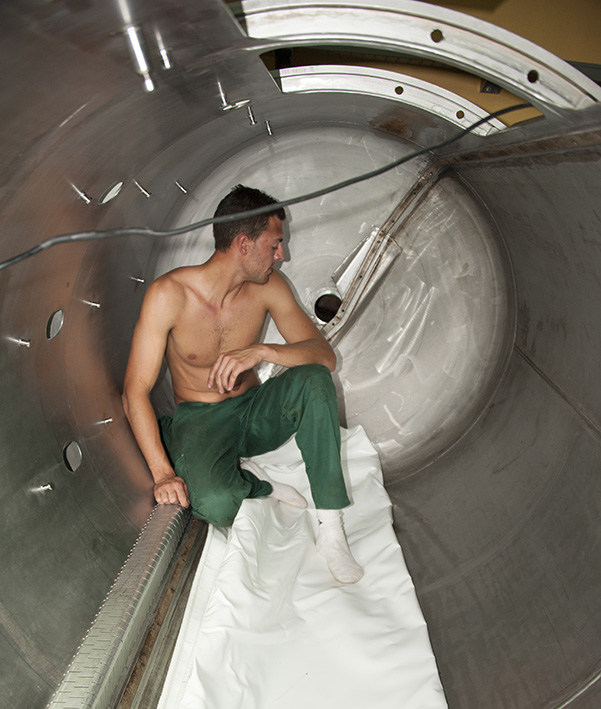
However, that is where the Grand Prix analogy ends. We don’t have four helmeted guys standing at the side of the press waiting to rip out the old membrane and change it in under 5 seconds. For this job someone spends the best part of half a day sweating, actually inside the press, removing and replacing the hundreds of nuts and bolts that secure the bag (see today’s photo). Nothing glamorous about this job, and I suspect that the pay is not quite as high as a Formula One team either……

The annual job of servicing our presses is one of the first signs that this year’s harvest is not that far away!

Changing the membraneWith all the controversy surrounding Formula One at the moment, and the problems with Pirelli, I thought that now might be a good time to change the neumáticos in our bodega too! Well, strictly speaking, these are not tyres, but rather the large pneumatic ‘airbags’ that we have inside our presses. A membrane ‘blowout’ in our presses during harvest can be just as devastating for us as it was for Luis Hamilton or Felipe Massa in the British Grand Prix last week.

Thankfully this is not a job that we have to do every year, but just once every several years. Sometimes it takes the form of an emergency replacement during harvest when a membrane is damaged beyond repair, but on this occasion it is a pro-active change, as we decide that one of the current airbags has reached the end of its working life. The repairs that are made during harvest can sometimes be the result of debris or a foreign object that accidentally finds its way into the press in one of the collection cases. Perhaps the most common example would be a pair of secateurs carelessly discarded in the vineyard. Obviously this punctures the membrane and caused rapid deflation in exactly the same way as a piece of debris on the racetrack during a Grand Prix might cause a tyre to explode.

However, that is where the Grand Prix analogy ends. We don’t have four helmeted guys standing at the side of the press waiting to rip out the old membrane and change it in under 5 seconds. For this job someone spends the best part of half a day sweating, actually inside the press, removing and replacing the hundreds of nuts and bolts that secure the bag (see today’s photo). Nothing glamorous about this job, and I suspect that the pay is not quite as high as a Formula One team either……

The annual job of servicing our presses is one of the first signs that this year’s harvest is not that far away!

2012 – Official numbers

November 5th, 2012 | Harvest

Our local denomination office has finally released the official figures for the 2012 campaign. Taking into account the five sub-zones of Rias Baixas, and including all the permitted grape varieties of the region, a total of 17,567,877 kg was collected. They confirm that area under vine now exceeds 4,000 Ha, standing at 4,048 Ha. Apparently only 167 Bodegas participated in this years harvest, which, if I am not mistaken, means that some Bodegas did not make a 2012 vintage. Over the last year or so the number of Bodegas in our denomination has diminished slightly as some have sadly fallen by the wayside, closing their doors, but even so this number of 167 would appear to indicate that a few simply did not pick.

The total of Albariño grapes picked was 16,873,304 kg (96% of the region’s total), confirming that this number was well below that of 2011. The Consello also add that the grapes picked were in a very good toilet, sorry, sanitary state (I will have to stop using Google translate!)

Our local denomination office has finally released the official figures for the 2012 campaign. Taking into account the five sub-zones of Rias Baixas, and including all the permitted grape varieties of the region, a total of 17,567,877 kg was collected. They confirm that area under vine now exceeds 4,000 Ha, standing at 4,048 Ha. Apparently only 167 Bodegas participated in this years harvest, which, if I am not mistaken, means that some Bodegas did not make a 2012 vintage. Over the last year or so the number of Bodegas in our denomination has diminished slightly as some have sadly fallen by the wayside, closing their doors, but even so this number of 167 would appear to indicate that a few simply did not pick.

The total of Albariño grapes picked was 16,873,304 kg (96% of the region’s total), confirming that this number was well below that of 2011. The Consello also add that the grapes picked were in a very good toilet, sorry, sanitary state (I will have to stop using Google translate!)

Small but beautiful – Day 7

October 5th, 2012 | Harvest

One of the features of the 2012 harvest (which I think I mentioned on day one), is that it is clear that the volume of wine that we produce will be significantly less than last year. The original forecasts of local Consello office claimed that we would be down by 50%, which at the time seemed a little over dramatic. The odd thing is that, despite our presses working flat out, as they always do, we simply do not appear to be filling that many tanks! It would appear therefore, that this forecast might not be too wide of the mark.

On this, the seventh day, with the traumas of our cooling system finally behind us and only a few thousand kilos left to pick, the end was clearly in sight. After the huge crop last year, the campaign of 2012 provided quite a contrast, and in the end the Consello prediction actually proved to be quite accurate, almost half the number of pressings and roughly half the number of kilos. However, before starting any panic regarding a ‘short’ vintage I should quickly remind customers that we are saying 50% down when compared to 2011 – a vintage that broke all records by some distance. So yes, this is a smallish vintage, but it is by no means a disaster, and from our tastings of the must, we should be compensated with a very good wine. As any good wine maker will tell you, a low yield nearly always produces higher quality.

By lunch time the final press was loaded and running, and by early evening the 2012 vintage was finally declared complete (or at least the picking element). As always we are now excited to see what we can create in the cellar!

One of the features of the 2012 harvest (which I think I mentioned on day one), is that it is clear that the volume of wine that we produce will be significantly less than last year. The original forecasts of local Consello office claimed that we would be down by 50%, which at the time seemed a little over dramatic. The odd thing is that, despite our presses working flat out, as they always do, we simply do not appear to be filling that many tanks! It would appear therefore, that this forecast might not be too wide of the mark.

On this, the seventh day, with the traumas of our cooling system finally behind us and only a few thousand kilos left to pick, the end was clearly in sight. After the huge crop last year, the campaign of 2012 provided quite a contrast, and in the end the Consello prediction actually proved to be quite accurate, almost half the number of pressings and roughly half the number of kilos. However, before starting any panic regarding a ‘short’ vintage I should quickly remind customers that we are saying 50% down when compared to 2011 – a vintage that broke all records by some distance. So yes, this is a smallish vintage, but it is by no means a disaster, and from our tastings of the must, we should be compensated with a very good wine. As any good wine maker will tell you, a low yield nearly always produces higher quality.

By lunch time the final press was loaded and running, and by early evening the 2012 vintage was finally declared complete (or at least the picking element). As always we are now excited to see what we can create in the cellar!

Almost there! – Day 6

October 4th, 2012 | Harvest

As always, we attack or vineyards in the order of ripeness, albeit that this year we do not have too many problems in this respect. As you can see from yesterday’s photo the fruit is wonderfully mature, and acid levels are exactly where we would want them to be. Our problems during the 2012 campaign have certainly not originated from the vineyard, and thankfully have been restricted to within the bodega itself. Speaking of which, the temporary repair to our cooling system is still working, and we hope that by tomorrow the new circuits will be ready to install. We have our fingers (and everything else) firmly crossed….

When we first looked out of our window this morning the skies were heavy and overcast – there had been a little overnight rain, but certainly not enough to cause us any problems. Within an hour or so, and more or less at the moment we started to pick, the sun broke through and the clouds disappeared over the horizon. The forecast reassures us that this will be the last of the bad weather for the next few days at least, by which time our harvest will be long finished. It’s all plain sailing from now on!

Our last grapes will be collected from our own ‘El Pazo’ vineyard. This vineyard is more or less split down the middle, into an upper part and a lower part. Every year the fruit in the upper part is always slightly more mature than the fruit in the lower part, and consequently the Pazo is usually picked at two different times. We picked the first part a couple of days ago, and will finish our harvest with the lower part.

Despite my prediction of yesterday, we did not quite make it to the end of the harvest on day six, but if it had not been for lost time, we might well have finished in five full days. The reason for finishing so quickly is the small harvest, and low yields, but more of that tomorrow.

As always, we attack or vineyards in the order of ripeness, albeit that this year we do not have too many problems in this respect. As you can see from yesterday’s photo the fruit is wonderfully mature, and acid levels are exactly where we would want them to be. Our problems during the 2012 campaign have certainly not originated from the vineyard, and thankfully have been restricted to within the bodega itself. Speaking of which, the temporary repair to our cooling system is still working, and we hope that by tomorrow the new circuits will be ready to install. We have our fingers (and everything else) firmly crossed….

When we first looked out of our window this morning the skies were heavy and overcast – there had been a little overnight rain, but certainly not enough to cause us any problems. Within an hour or so, and more or less at the moment we started to pick, the sun broke through and the clouds disappeared over the horizon. The forecast reassures us that this will be the last of the bad weather for the next few days at least, by which time our harvest will be long finished. It’s all plain sailing from now on!

Our last grapes will be collected from our own ‘El Pazo’ vineyard. This vineyard is more or less split down the middle, into an upper part and a lower part. Every year the fruit in the upper part is always slightly more mature than the fruit in the lower part, and consequently the Pazo is usually picked at two different times. We picked the first part a couple of days ago, and will finish our harvest with the lower part.

Despite my prediction of yesterday, we did not quite make it to the end of the harvest on day six, but if it had not been for lost time, we might well have finished in five full days. The reason for finishing so quickly is the small harvest, and low yields, but more of that tomorrow.

Monthly Archives

Categories

ARE YOU OF LEGAL AGE? This site is intended for those of legal drinking age. By entering, you confirm that you are of legal drinking age in the country where this site is being accessed. ¿ERES MAYOR DE EDAD? Este sitio está destinado a personas en edad legal para beber alcohol. Al ingresar, confirma que tiene la edad legal para beber en el país donde se accede a este sitio.