Hot Stuff!

November 9th, 2007 | Uncategorized
The question of the month?

The Spanish are not very big on hot, spicy food, hence it is virtually impossible to find a curry restaurant in my local area. It is therefore quite interesting that a Spanish food and wine magazine should ask the question “which wines go with curry?”

I wrote a month or two ago about matching food with wine, but this is a particularly difficult question to answer, and, as they point out in the article, it rather depends on the way in which the curry is prepared. There is no doubt in my mind that if we are talking about something extremely hot such as Madras or Vindaloo, then my advice is – stick with a cold beer!

The article suggests that with hotter curries you can drink white wines with a softer acidity and perhaps even a little residual sugar, such as a Viognier, or a ripe Chenin Blanc from South Africa. (Before I receive complaints from my wine making friends around the world, I am not suggesting for a moment that all these wines contain residual sugar!)

They go on to recommend that with milder curries you should turn to wines with a little more acidity, such as a dry Riesling, Chablis or even Champagne. Of course, amongst this selection they include our very own Albariño.

A few years ago when I worked in London I once participated in an extensive tasting in a well-known Indian restaurant. Armed with a wide selection of both red and white wines we tasted them with various spicy dishes. As with any type of cuisine there were some good matches, and some violent clashes, depending on the combination of fruit, tannin, acidity and spice. I have to say that in my opinion, there was no simple magic formula for finding a match.

In conclusion, I still have some reservations about wine with curry, although I would not wish to discourage you from drinking Albariño at any time of day. Perhaps I will just test the theory of this publication the next time I cook a curry at home…..

The value of having an Advocate….

November 5th, 2007 | Uncategorized

Love him or hate him Robert Parker Jr has been influencing the latest fashion in wine for nearly 30 years now. Those of you who follow my blog will know that I am not a great fan. Not because of what he originally set out to do, but more because of what he has since become.

His original idea way back in 1978, when he produced the first issue of his Wine Advocate, was simply to unlock some of the mystery of wine for the average man in the street. Using a concise rating system out of 100 points, his readers would know if (according to Parker’s taste), the wine worth buying or not. No harm in that – indeed a very good idea.

Unfortunately, over time, his publication became absurdly over-influential, not only in determining the success or failure of a particular property, but also, more importantly, influencing the style and taste of wine itself.

In Bordeaux for example, he latched on to the distinctive style of winemaker Michel Rolland as being a benchmark for the modern taste of that region. Dark, ripe, over-extracted wines were to become the order of the day, albeit that they simply did not age in the same way, or perhaps even as well as wines that were made using the more traditional ‘old fashioned’ methods. His palate was perhaps influenced by the North American style of up-front, forward, fruit driven wines. Fine if you like that sort of thing, but not so fine when, as a result, every wine maker on the planet becomes desperate to clone this modern, ‘Parker style’. Their goal of course, to glean a few more precious Parker points.

From my own experience as a buyer back in the 80’s, I also heard one or two stories about his work in Burgundy (before he farmed out tasting for that region to Michel Bettane). I was told first hand, by growers themselves, that he had rated their wine when it was actually not possible that he had even tasted it! Heaven only knows why he would chose to do that.

So, my advice in buying wine is the same now as it has always been: Sure, use a wine guide (or even better, cross-reference several) to give you some ideas, but in the end, drink what you enjoy drinking, and not what someone tells you that you should drink!

HAPPY BIRTHDAY TO US!

October 26th, 2007 | Uncategorized
Yipeeee!

On 27th October 2007 we celebrate the 25th anniversary of the inauguration of the current Bodegas Castro Martin wine cellar. Constructed during 1981, but officially inaugurated in 1982 with the ’82 vintage – exactly 25 years ago.

This may not seen like very long, but you should bear in mind that the denomination of Rias Baixas was not actually created until 1987, and so it was Domingo Martin Morales (Angela’s father) who had the foresight to build, what was then, one of the largest cellars in the area.

Built on three levels (thereby using mostly gravity to move the grapes, grape must and wine around) Domingo was also the first in Galicia to install stainless steel tanks for wine making – and with a total capacity of just over 200,000 litres (since increased to over 300,000) the locals considered him to be complete madman! Little did they know….

To clear up any possible confusion I should mention that Angela’s family had actually been making and selling Albariño in the local area for generations before this time, but this was really the beginning of the ‘industrial age’ of wine making for the family.

So please raise a glass (of Albariño of course). Here’s to Domingo Martin Morales, and the next 25 years!

Following the density

October 19th, 2007 | Uncategorized
Measuring the density

In my previous reports I have mentioned that the natural yeasts of the Albariño in our denomination are not vigorous enough on their own to sustain the alcoholic fermentation. For this reason we are obliged to seed the tanks with selected yeasts to help convert the natural grape sugars into wine.

One of the key factors during this process is temperature control – the higher the temperature, the faster, and therefore shorter, the fermentation. Extremes of temperature, either too hot, or too cold can make the fermentation stick, and will ultimately have a detrimental effect on the finished wine. In white wine making temperature is especially critical, and we therefore analyse the grape must at least twice a day to monitor the speed of the reaction.

The method we use is quite simple, measuring the density of the must – in effect looking at the rate at which the sugar is being consumed. Examining the results gives us the information that we need for temperature control – if the sugar is being consumed too quickly we lower the temperature a little.

Depending on the temperature used, fermentation can take anything from one, to three or four weeks.

Responsible drinking?

October 1st, 2007 | Uncategorized
Spain can be a country of contradictions – sometimes between Local and National Governments. I do not comment on many of these simply because they have no connection to the wine trade, but on this occasion, as it relates to alcohol, I feel compelled to comment…..

Last year, whilst explaining why we chose to opt out of the annual Albariño Festival (see August 2006), I mentioned a worrying phenomena that continues to grow here in Spain – The Botellón. Basically these are organised street-drinking parties that take place every weekend in nearly every city, town and village throughout Spain.

Young people take to the off-licences and supermarkets to stock up on spirits and mixers, on the pretext that they cannot afford to drink in bars and discos. The result being that public areas in cities, towns and villages throng with drunken young people well into the early hours of the morning as they openly swig from their bottles. (And when I say young, they start as young as 11, 12 and 13, simply asking their elders to buy the alcohol for them). The areas that they frequent are left littered with debris and empty bottles, and I will not detail some of the other sights and smells! I guess that the only saving grace might be that they do not appear to resort to any violence (as yet).

The Spanish Government has acted by printing the brochure above, stating that one in every three children between the ages of 14 and 18 gets drunk at least once a month, and then it goes on to warn parents that excessive alcohol can cause irreversable brain damage. Bravo! I may hear you say, there is at least one initiative….. but wait, how does Local government chose to back this National scheme?

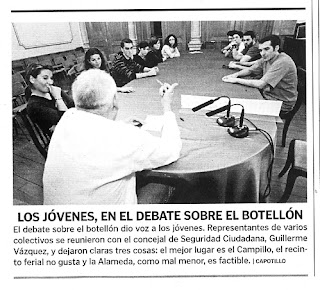
Reported, quite incredibly, in the local Galician press, is a meeting between a member of the local Xunta and representatives of the young people. Their agenda? To discuss ways to prevent this under age street-drinking? Well, no, but actually to find alternative locations around the city of Pontevedra where they might re-locate their Botellón to create a little less disturbance!!!

Apparently the local Government believes that it is easier to accomodate the young people and find them a nice location, rather than to confront them and address the underlying problem…..

Is this a tale of ‘political correctness’ gone mad?

N.B. At the meeting, the young people turned down the alternative locations as unsuitable, so they will continue to party in the historic old town centre of Pontevedra. Heaven help the local residents….

Harvest 2007 – the full story

October 1st, 2007 | Uncategorized
David shows off the ‘fruit of his labour’

You may recall that immediately after our 2006 harvest (in the middle of September), it started to rain. Well, I can tell you now that it almost didn’t stop raining until the end of July 2007! Hardly a complete week passed without some form of precipitation, and this included many days of torrential rain, at times reminiscent of the tropics. Indeed the month of October 2006 recorded the equivalent of six months of the annual rainfall in just three weeks! Suffice to say that I guess we had what you could honestly describe as a wet winter, spring and early summer….

Of course, such humidity levels are not ideal for grape cultivation, and it is only fair to admit that we were obliged to spray against mildew and oidium a little more than usual. Having said that, the many hours that we spent in our vineyards during the early part of the summer certainly paid dividends. By using radical ‘canopy management’ techniques imported from the ‘new world’ (yet rarely seen here in Galicia), we were able to give our fruit the best possible exposure, effectively minimising the levels of treatment needed.

This year, we should certainly make special mention of David (our vineyard manager) who worked tirelessly under Angela’s supervision, to keep our vineyards in tip-top condition – even sacrificing weekends and days of his annual leave to ensure that essential work was carried out at the optimum moment.

The month of August, as we would anticipate, provided a much-needed break from the wet conditions, although temperatures remained fairly modest. However, the character of the 2007 vintage was probably defined during the final two weeks before the grapes were actually collected. The beginning of September witnessed a welcome increase in daytime temperatures, pushing towards 30°C (86°F). Under these conditions the grape sugars received a final boost, but perhaps more significantly, the acidity was reduced to a more manageable level.

Inevitably the actual harvest date was decided by a combination of the physiology of the fruit, and the Galician weather. And so, by Saturday 15th September, with all the boxes ticked, the 2007 harvest kicked off in perfect conditions.

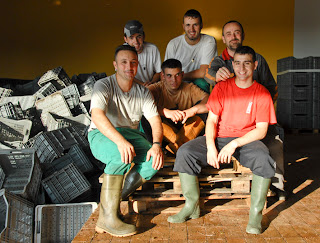
I always believe that the secret of any successful ‘event’ is in the forward planning, and with each passing vintage, we implement the lessons learned from previous years. In this way we hope that each campaign might be a little easier than the last! In 2007 it would appear that this philosophy paid some dividends as our well drilled team went about their business. David and Juan in charge of grape collection, Luisa in charge of grape reception, Fran in charge of the presses, and Angela and I, swanning around trying to look important…..

Actually, I lied about the last part – During the harvest my task is to stay on top of the logistics and planning, making sure that that we have people in the right places when they are needed, and also ensuring that the grapes flow through the cellar in a timely fashion. Angela, meanwhile, can be found in her lab coat, recording the quality of every single grape that enters the Bodega.

The first weekend passed off without major incident, although it soon became clear that the yields of 2007 would be well down on those of 2006. It should be remembered however, that 2006 was a record year, and so this shortfall was only to be expected, and could perhaps equate to a better concentration, and therefore superior quality. We shall see…..

In the early hours of Monday morning as we left the Bodega to grab a few hours sleep, it started to rain (exactly as had been forecast). When we woke up it had stopped, the pavements had dried, but the sky was pretty dull and overcast, with not a breath of wind. In these conditions, having looked at the water retention in the canopy, we decided to suspend picking for the day.

By Tuesday morning the sun had returned, together with a fresh breeze, so naturally we returned to the fray. Fortunately, such a small amount of water had made no difference whatsoever to the quality of the fruit, and this proved to be the only small weather hiccup of the whole vintage.

And so, after one week of picking, all the grapes had been safely gathered in, and we moved into the cellar for the more complex process of the winemaking. The next few weeks will see virtually non-stop activity as we first allow the must to settle, before racking it into clean tanks to begin fermentation. Unfortunately the natural yeasts on the Albariño grape cannot sustain fermentation by themselves, so we stimulate the process by seeding with carefully selected yeasts. After trials with several different yeast strains conducted over the last few years, we have deliberately selected a very neutral variety that allows the delicate flavour of the grape itself to dominate on the palate.

Before fermentation our first view of this year’s ‘must’ reveals a greater concentration than last year – unctuous and with a thicker consistency. The nose and palate both share aromas of peach, pear and apricot (and not as floral as we sometimes see). This rich, generous mouthfeel that originates from the high level of grape sugar, will probably produce an Albariño of around 12.5% alcohol – the same as our 2006 wine. So, despite the reduced quantity that we have produced, we have high hopes for the quality of our 2007 wine.

On the home stretch

September 21st, 2007 | Uncategorized
‘Behind the scenes’ – Luisa records the incoming crop

2007 Harvest – Day 6 – Friday 21st September

At the same moment that many Bodegas in our area are springing into action, our 2007 campaign is about to draw to a close. In some ways this can be one of the most complicated parts of the whole harvest…..

We have two presses, each with a different maximum and minimum capacity. Incredibly the minimum capacity is probably more important than the maximum – exceeding the maximum is practically impossible anyway, as the grapes will not physically enter into the press. However, leaving the press with too few grapes can cause the pneumatic membrane to rupture, as it is forced to over-expand and presses against the rubber ‘fingers’ on the inner walls of the drum. (Does that make any sense to you?)

Meanwhile, back to the original story. Taking into account these weight restrictions we have to ensure that we are not left with an odd few hundred kilos of grapes at the end, as obviously we would not be able to fill even our small press to the minimum level. This might sound like a relatively simple problem that is easy to work out, but believe me, it can be quite tricky when your brain is seizing up at the end of a long week!

And so, apart from the one night of rain, and missing one day to accomodate the drying process, we have enjoyed pretty much a perfect week. I will post a resume of proceedings in the next day or so.

With thanks to my small, but beautifully formed team for 2007

The ‘Big Boys’ join in

September 20th, 2007 | Uncategorized
Who me? 150kph in the vineyard? Impossible!

2007 Harvest – Day 5 – Thursday 20th September

Speaking to our electrician yesterday I am reliably informed that some of the larger players (the two main Co-operatives) in our denomination are entering the game today. I have always been puzzled as to how such a small denomination (less than 3,000 hectares in total), can support two such large Co-operatives, so you can imagine my complete astonishment when I tell you that a third Co-operative opens it’s doors for this harvest. This is assuming of course that the doors have actually been fitted yet….

I am sorry to tell you that this new co-operative was possibly born out of a lack of trust between the bodegas and the growers. The absence of contracts or the complete abuse of such, mean that the growers form co-operatives in an attempt to achieve some sort of security and continuity – you cannot blame them really. The downside of this is, of course, that there is more pressure put on grape supply, and rumours already abound of increased prices – the last thing that any denomination needs.

However, setting up a new co-operative is one thing, selling the wine that they produce from a standing start, is quite another. Time will tell.

So, meanwhile back to our Bodega, the grapes continue to roll in and all is well here in a warm, sunny Barrantes – I only wish I could get my ADSL connection to work properly – we have recently upgraded the connection to 3Mb, but quite frankly I don’t think the lady on the local switchboard can handle it……

Blowing hot and cold……

September 19th, 2007 | Uncategorized
Fran shows great determination when loading the presses!

Harvest 2007 – Day 4 – Thursday 19th September

Today is yet another sunny day, but without the breeze, and consequently warmer than yesterday. One of the big problems that we face in these conditions is the risk of catching colds and flu – perhaps I should explain……

It’s quite simple really – one minute you find yourself working in a warm sunny reception area checking in grapes as they arrive, and the next you are down in the bowels of the cellar racking ‘musts’, where the ambient temperature is usually between 12°C and 14°C. Alternating between a sweatshirt and a t-shirt there is naturally the risk of catching a chill – a sore throat is pretty much an occupational hazard (although this could be caused by the presence of suphur that is used to protect the fresh juice).

Today’s only real problem is a shortage of electricity! It would seem that the recent upgrade of our cooling system (which obviously works overtime during the harvest), has overloaded the circuit a little. You would think that the electricians might have thought of this before now! But no matter, a few adjustments and a bit of sticky tape appears to have done the trick and everything is working again.

Normal service is restored

September 18th, 2007 | Uncategorized
Any ideas what this is?

2007 Harvest – Day 3 – Tuesday 18th September

I have mentioned before that we follow the forecasts closely at harvest time, and I have to admit that they got it spot on once again. We opened the shutters this morning to reveal a perfect blue sky, exactly as promised. The other successful prediction was a drop in temperature – about 4/5°C cooler than the first day of harvest, but still a very pleasant 22°C (72°F). The only slightly unexpected element was a cool fresh breeze (although this did actually help to ensure completely dry fruit).

After nearly three full days of picking it is quickly becoming evident that the yields this year are much lower than 2006, which I guess is only to be expected. We should not forget that the last few of years have produced some record figures, partly owing to new plantings, but also because of some very abundant yields. From a quality standpoint this is no bad thing, albeit that some of our growers would probably find this mentality a little difficult to understand. Naturally they are more motivated by weight, despite the fact that we actually pay more for quality grapes rather than merely volume.

At the very end of the night, we did experience one minor hiccup (let’s hope it will be the first and the last), when one of the presses seized up and refused to move. Thankfully this occurred when it was empty, and being cleaned, so hopefully it will be repaired before start of play tomorrow……

N.B. The above photo is taken looking directly down into one of the tanks as the first litres of grape ‘must’ arrive from the presses.

Monthly Archives

Categories

ARE YOU OF LEGAL AGE? This site is intended for those of legal drinking age. By entering, you confirm that you are of legal drinking age in the country where this site is being accessed. ¿ERES MAYOR DE EDAD? Este sitio está destinado a personas en edad legal para beber alcohol. Al ingresar, confirma que tiene la edad legal para beber en el país donde se accede a este sitio.