

With the picking over, and our tanks filled with fresh grape must, we switch into deep clean mode. The sticky juice just gets everywhere – floors, walls, stairs, door handles – you name it. Then of course, there is the equipment – tanks, presses, pumps, hoses, not to mention the odd couple of thousand baskets that we use to collect the fruit – all covered with a gluey, syrup-like coating. The pressure washers are working overtime.
So, as we limp into what we now believe will be our last day (honest), the final few grapes are gathered in. Of course when we stopped last night we did have to make sure that we left enough fruit on the vine to fill at least one press, otherwise it would be a case of shoes and socks off, and start stomping!
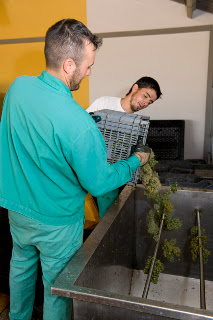
So, this is really it for 2009! This photo shows Juan and David tipping the very last case of this year’s harvest into the press. Down below, in the pressing room, Fran started the final cycle at 2pm, and so with all the grapes safely gathered under cloudless blue skies, we hand over to Angela to work her magic in the cellar.
With our thanks to everyone in the vineyards and the bodega who have worked so hard for the 7½ days. Now, let the cleaning begin!!!!
In English we call it a praying mantis, in Spanish it is a mantis religiosa – rescued from a case of grapes on Saturday. I just thought that with such a name it might be appropriate to post this picture on a Sunday.
As I explained yesterday, we have perhaps only one day of picking left (in one or two sections of our vineyards), but in the warm sunshine, fruit left on the vine for one more day can only benefit.
Despite no picking, there is still racking to be done in the cellar, and so not a day of rest for everyone.
More news on the final day tomorrow.
Slowly the emphasis of our work starts to shift from outdoors to indoors, as we have fewer grapes left on the vine, and more juice in our tanks. As with all wine making, temperature is the key, when we start to impose our own individual character on the fruit that we collect. In a way, it is like being a chef – yes, you need to start with the very best raw ingredients, but then the individuality of the final dish, or in our case wine, will very much depend on how we handle our fruit.
Obviously, there are many steps in the wine making process, but in each there is very little margin for error. If Gordon Ramsay does not like the piece of fish that his Chef de Partie offers up to him, he will simply chuck it in the bin and start again (and probably swear a lot in the process!). If we make a mistake in our cellar, we cannot start again, we only have one chance to get it right. At this moment, there are really two important factors that will influence the final outcome – heat and oxidation – these are our enemies, and have to be avoided at all costs. This is one of the reasons that I make such a big fuss about our cooling system – it’s an important piece of kit for us!
In mentioning temperature, perhaps I should make a small comment about the weather. So far it has been really kind to us, as we still enjoy brilliant blue skies and warm sunshine. In fact, thinking back over the last few years, I don’t think I can recall a vintage with absolutely 0% precipitation – perhaps I am wrong.
In view of this continued good weather we will stop picking a little early today, to give the final plots a chance to drop a bit of acidity. (We may not resume again until Monday, as the forecast for the next couple of days still looks very good). But even if we did produce an odd tank with a slightly higher acidity, we can always use small amounts for blending with other tanks in the future – like adjusting the pepper and salt in your final dish (to use my cooking analogy once again).
Oh, and by the way, the photo shows my little post-it notes stuck on the control panel – with so much movement of must around the cellar this simply gives me an at-a-glance reminder of where everything is – not very high-tech!
Some valves controlling our cooling system (obviously designed by Mr Heath Robinson himself!)
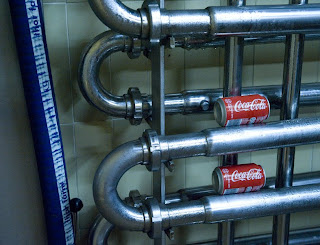
I think that’s what they call product placement (using our heat exchanger)
Erm, not really a harvest story, but more one of my stupid anecdotes – perhaps I’m just getting tired and delirious.
I may have mentioned at some point that our cellar is built on three levels. Grape reception at the top, presses in the middle and tank room (and laboratory) at the bottom.
Somehow my planning must have gone wrong, but I think that during the harvest my own job entails rushing up and down the stairs probably more than anyone else in the building (which I suppose is quite natural when you want to keep an eye on everything).
Yesterday evening, in a moment of mental and physical exhaustion, I actually counted the steps between the top and bottom levels……
Now I don’t know if Angela’s father was an Alfred Hitchcock fan, or if it arrived completely by accident, but we quite literally have
The 39 Steps!
No, I’m not refering to crispy chicken fajitas or enchiladas, but to our largest vineyard which is affectionately known as ‘El Pazo’. It’s real title is the Pazo de Barrantes, but we usually do not refer to it as such because Marques de Caceres (the Rioja producer) actually owns a bodega in the Rias Baixas denomination which sells a wine by that name. Indeed, to cut a very long story short, the 5 hectare ‘El Pazo’ vineyard was orignally owned by them, but was sold to Angela’s father many years ago.

Back up in ‘grape central’ (reception), the fruit is still piling in, but somehow without too much fuss and excitement – all appears very calm and controlled. To put this into context, our sixth pressing on day four finished two hours earlier than our sixth pressing on day one – it would seem that all the first day cobwebs in our performance have been swept away, and we are now operating like a well oiled machine!
There is a fair bit of arithmetic that goes on at harvest time, not only on the winemaking side (where we calculate the sulphur etc. that we have to add to the tanks), but also on the logistics side, making sure that everything and everybody functions in the most efficient way possible.
Indeed, the reason that I picked on this as todays subject was simply because I was sitting at my desk looking at the pressing figures for yesterday. As I think I may have mentioned, months or even years ago, we have two presses, one slightly larger than the other. They both have a fixed ‘operating range’ – in other words, the minimum and maximum amount of grapes that we can load. This is actually a very serious consideration, as attempting to operate outside this range will probably result in extensive (and expensive) damage to our equipment.
So, as each new batch of grapes arrive in reception, not only do we have to examine the origin (seperating certain vineyard plots), but we also have to calculate the optimum loads, and allocate the grapes accordingly.
The real problem occurs when the last grapes arrive – we quite literally have to sit down with calculators and work out how best we can distribute the weights (not an easy task at the end of a long working day when you brain has already been working overtime).
Anyway, returning to my pressing figures for yesterday, I was actually quite surprised to see the volume that we had actually crushed – almost as much as our busiest day last year. The main difference was that yesterday we did not really notice it, which might be testament to the fact that we have now a well-drilled team who know exactly what they have to do.
Oh dear, I must have been tempting fate writing about the presses…. During the evening session the larger of our two presses just stopped working. Fortunately, we pay for 24 hours emergency cover during the harvest and within half an hour we had an engineer working on the problem. Luckily it turned out to be one small piece of circuit wire, a mere 3cm long, that needed replacing, and only one hour of precious pressing time was lost.
Harvest would not be harvest without at least one small hiccup, but having just said that I now have my fingers crossed that it will be the only one!