

Archive for ‘Business’

What wine shortage?

January 16th, 2014 | Business
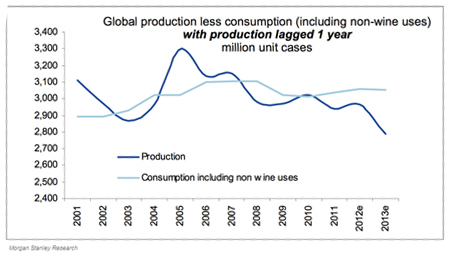
Morgan StanleyWhether we like it or not our daily lives are all heavily influenced by the success or failure of the world banking and financial systems. I’m sure that most people would argue that they have a lot to answer for. More or less every industry is impacted, including the wine industry, whether this be caused directly, by a drop in consumption, or perhaps less obviously, by investment in wine futures or properties.

A few months ago we read dramatic headlines concerning a world shortage of wine – demand for wine had actually outstripped the supply, or so we were lead to believe. It transpires however, that upon closer investigation we may have been misled….. by the Australian research division of an investment bank…… with a vested interest in the wine industry!!!! All the news reports were apparently based on a single study carried out by Morgan Stanley, and closer inspection revealed that the report was actually promoting an Australian wine company as a top stock pick to buy.

It is said that one of the most effective ways of persuasion in investment banking is to come up with a thesis which might, in turn, create big attention-grabbing headlines such as ‘There’s a world shortage of wine’. Inevitably such a dramatic claim will attract lots of press coverage, and in the short term at least, grab the attention of the world. It seems however, that the “research” may have been flawed and based on some slightly distorted, or perhaps even manipulated information, in order to achieve the desired effect. In reality there were probably very few (in the wine industry) who believed it, and perhaps the number of failing wine businesses in France and Spain might go some way to supporting this opinion. 
Morgan StanleyWhether we like it or not our daily lives are all heavily influenced by the success or failure of the world banking and financial systems. I’m sure that most people would argue that they have a lot to answer for. More or less every industry is impacted, including the wine industry, whether this be caused directly, by a drop in consumption, or perhaps less obviously, by investment in wine futures or properties.

A few months ago we read dramatic headlines concerning a world shortage of wine – demand for wine had actually outstripped the supply, or so we were lead to believe. It transpires however, that upon closer investigation we may have been misled….. by the Australian research division of an investment bank…… with a vested interest in the wine industry!!!! All the news reports were apparently based on a single study carried out by Morgan Stanley, and closer inspection revealed that the report was actually promoting an Australian wine company as a top stock pick to buy.

It is said that one of the most effective ways of persuasion in investment banking is to come up with a thesis which might, in turn, create big attention-grabbing headlines such as ‘There’s a world shortage of wine’. Inevitably such a dramatic claim will attract lots of press coverage, and in the short term at least, grab the attention of the world. It seems however, that the “research” may have been flawed and based on some slightly distorted, or perhaps even manipulated information, in order to achieve the desired effect. In reality there were probably very few (in the wine industry) who believed it, and perhaps the number of failing wine businesses in France and Spain might go some way to supporting this opinion. 

What is Fairtrade wine?

February 26th, 2013 | Business

Fairtrade

So why have I chosen this moment to write about Fairtrade wine? Well, it’s simply because as of yesterday we slid quietly (perhaps too quietly) into ‘Fairtrade fortnight’ – two weeks when the wine industry is required to focus its attention on ethically produced wines.

I think I should start by saying that to the best of my knowledge there is no such thing as Fairtrade wine here in Spain, and the reason for this  is quite simply that we do not need it. Fairtrade products exist to ensure that the people who are making them (and possibly even more importantly, their employees), receive ‘fair’ remuneration for their products and their labour. As we live in a modern western democracy we would of course hope that Spanish companies and their workers are not subjected to the same economic pressures as some of our poorer third world cousins – hence the fact that Fairtrade does not really apply to us.

The worst affected countries are reported to be South Africa, Chile and Argentina where agricultural workers are notoriously badly paid. Even a recent 52% increase paid to workers in the South African vineyards means that they still only earn a meagre R105 per day (approx £7.50 or $11.50), which is probably still well below what we should consider to be ‘fair’. Obviously this is one of the reasons that wines from these countries are often so cheap, as labour alone accounts for a considerable chunk of the production cost of each bottle. The cheaper the grape production, the cheaper the liquid. Simple.

Of course in more modern production areas the vineyard costs have been reduced by the introduction of mechanisation, but this requires a considerable financial investment at the offset, and also means that perhaps the resulting fruit is not quite as good. There will be some who would argue that mechanisation in the vineyard makes little or no difference, but I believe that there are only a very few of the world’s very top producers who would support this idea. Usually the more care we take with our fruit, the better the end product, and I for one am certainly a believer that probably 95% of our quality comes from the vineyard (or perhaps even more!).

To close I am reminded of the story of a restaurant that advertised “food at popular prices”. One customer complained “but this food is expensive and your sign says food at popular prices”. The owner looked at him and replied dismissively “Yes, but we like them”….. perhaps the antipathy of Fairtrade?

Fairtrade

So why have I chosen this moment to write about Fairtrade wine? Well, it’s simply because as of yesterday we slid quietly (perhaps too quietly) into ‘Fairtrade fortnight’ – two weeks when the wine industry is required to focus its attention on ethically produced wines.

I think I should start by saying that to the best of my knowledge there is no such thing as Fairtrade wine here in Spain, and the reason for this  is quite simply that we do not need it. Fairtrade products exist to ensure that the people who are making them (and possibly even more importantly, their employees), receive ‘fair’ remuneration for their products and their labour. As we live in a modern western democracy we would of course hope that Spanish companies and their workers are not subjected to the same economic pressures as some of our poorer third world cousins – hence the fact that Fairtrade does not really apply to us.

The worst affected countries are reported to be South Africa, Chile and Argentina where agricultural workers are notoriously badly paid. Even a recent 52% increase paid to workers in the South African vineyards means that they still only earn a meagre R105 per day (approx £7.50 or $11.50), which is probably still well below what we should consider to be ‘fair’. Obviously this is one of the reasons that wines from these countries are often so cheap, as labour alone accounts for a considerable chunk of the production cost of each bottle. The cheaper the grape production, the cheaper the liquid. Simple.

Of course in more modern production areas the vineyard costs have been reduced by the introduction of mechanisation, but this requires a considerable financial investment at the offset, and also means that perhaps the resulting fruit is not quite as good. There will be some who would argue that mechanisation in the vineyard makes little or no difference, but I believe that there are only a very few of the world’s very top producers who would support this idea. Usually the more care we take with our fruit, the better the end product, and I for one am certainly a believer that probably 95% of our quality comes from the vineyard (or perhaps even more!).

To close I am reminded of the story of a restaurant that advertised “food at popular prices”. One customer complained “but this food is expensive and your sign says food at popular prices”. The owner looked at him and replied dismissively “Yes, but we like them”….. perhaps the antipathy of Fairtrade?

The castles and monasteries downsize

January 17th, 2013 | Business

If you’ve ever visited Galicia, or any part of Spain for that matter, the chances are that you might have stayed in a Parador Hotel. What you might already know is that the group consists of more than 90 converted castles, monasteries and palaces dotted around the country – many are quite breathtaking, imposing buildings. The thing that you might not have realised is that the Parador group is owned and run by the Spanish Government, it’s entire workforce therefore being public sector workers.

I remember when I first arrived in Spain 10 or 11 years ago that the Parador hotels were not only very good, but more importantly they were very reasonably priced, and represented fantastic value for money. Since then however, prices have gradually increased, and by Spanish standards they now fall more into the luxury hotel price bracket. This factor, combined with Spain’s current economic woes, have conspired to bring the group to it’s knees, losing €72 million (USD 95.5 million) in 2011, with occupancy falling from 70% in 2011 to 52% in 2012 – losses for 2012 are expected to increase €107m (USD 142 million). The truth is that Paradores have not actually made any profit for years.

Government proposals to close several hotels inevitably resulted in strike action, meaning that many hotels were only able to offer reduced services to their guests (perhaps not the best way to endear themselves to loyal customers). As a result the Government eventually backed down, and will now only close one hotel. They will however, close around 30 hotels during the low season, shedding a few hundred jobs along the way, and also close at least 15 restaurants on a permanent basis. I should add that my own experience of Parador restaurants has been very mixed, ranging from some very good meals with excellent service, to some very poor food with indifferent service. Food was never really one of their fortes. 

Apparently the Paradores, set up in 1926, were “not created purely to make money, but to showcase culturally rich, lesser visited parts of Spain”. It’s a real shame to say that they appear to have succeeded in at least one of their goals.

If you’ve ever visited Galicia, or any part of Spain for that matter, the chances are that you might have stayed in a Parador Hotel. What you might already know is that the group consists of more than 90 converted castles, monasteries and palaces dotted around the country – many are quite breathtaking, imposing buildings. The thing that you might not have realised is that the Parador group is owned and run by the Spanish Government, it’s entire workforce therefore being public sector workers.

I remember when I first arrived in Spain 10 or 11 years ago that the Parador hotels were not only very good, but more importantly they were very reasonably priced, and represented fantastic value for money. Since then however, prices have gradually increased, and by Spanish standards they now fall more into the luxury hotel price bracket. This factor, combined with Spain’s current economic woes, have conspired to bring the group to it’s knees, losing €72 million (USD 95.5 million) in 2011, with occupancy falling from 70% in 2011 to 52% in 2012 – losses for 2012 are expected to increase €107m (USD 142 million). The truth is that Paradores have not actually made any profit for years.

Government proposals to close several hotels inevitably resulted in strike action, meaning that many hotels were only able to offer reduced services to their guests (perhaps not the best way to endear themselves to loyal customers). As a result the Government eventually backed down, and will now only close one hotel. They will however, close around 30 hotels during the low season, shedding a few hundred jobs along the way, and also close at least 15 restaurants on a permanent basis. I should add that my own experience of Parador restaurants has been very mixed, ranging from some very good meals with excellent service, to some very poor food with indifferent service. Food was never really one of their fortes.

Apparently the Paradores, set up in 1926, were “not created purely to make money, but to showcase culturally rich, lesser visited parts of Spain”. It’s a real shame to say that they appear to have succeeded in at least one of their goals.

Summer holiday

August 14th, 2012 | Bodega

Tomorrow we close our doors for a short break. August 15th is a national holiday in Spain anyway, so we decided to make it a super-long ‘bridge’, re-opening again on Monday 27th August. We had planned a similar break last year but had to cancel. As you may recall our harvest actually started at the end of August in 2011 – quite a contrast to 2012. As I look out of my window now the sky is grey, heavy and full of rain, not at all what we would expect (or want) at this time of year. Our summer so far has already been quite cool, not rising much above the mid-20’s (68-75°F), although we have had a bit of sunshine over the last couple of weeks. We know for a fact that the vintage will be much smaller this year, the only thing that no one can predict is the quality.

As you can see from today’s photo our staff are already packed and ready to go. (Any car enthusiasts will recognise this as an old Renault R8 made during the 1960’s). Whatever happens we just hope that the sun shines for everyone!

Tomorrow we close our doors for a short break. August 15th is a national holiday in Spain anyway, so we decided to make it a super-long ‘bridge’, re-opening again on Monday 27th August. We had planned a similar break last year but had to cancel. As you may recall our harvest actually started at the end of August in 2011 – quite a contrast to 2012. As I look out of my window now the sky is grey, heavy and full of rain, not at all what we would expect (or want) at this time of year. Our summer so far has already been quite cool, not rising much above the mid-20’s (68-75°F), although we have had a bit of sunshine over the last couple of weeks. We know for a fact that the vintage will be much smaller this year, the only thing that no one can predict is the quality.

As you can see from today’s photo our staff are already packed and ready to go. (Any car enthusiasts will recognise this as an old Renault R8 made during the 1960’s). Whatever happens we just hope that the sun shines for everyone!

Join the queue

August 8th, 2012 | Business

It’s funny how our customers always appear to order at the same time. We can have nothing for several days, and then two or three orders will suddenly appear together. Certainly there are peaks and troughs during the year – as you might imagine late spring/early summer is usually a very busy time as customers stock up for the warmer weather (we hope).

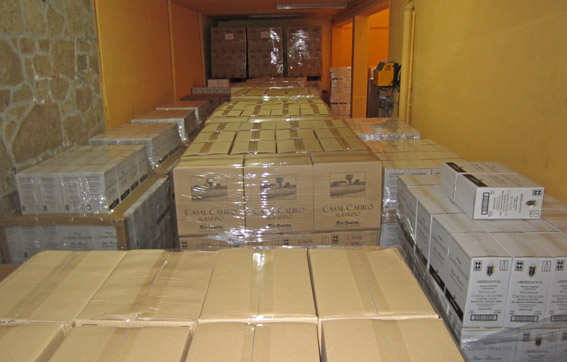
As our thoughts turn towards the harvest we also encourage our importers to order now, rather than in the middle of September when we are up to our ears in grapes.The result of our forward planning can be seen in today’s photo where you can see an orderly queue of pallets waiting to be collected. Indeed, tomorrow we will start to prepare yet another large order for export, and to be quite frank I’m not too sure exactly where we are going to put it.

Hopefully, by the start of next week, we should have an orderly queue of trucks waiting at our door. If the wine does not leave sooner rather than later we may have to cancel the harvest as we simply won’t have enough space to work!

It’s funny how our customers always appear to order at the same time. We can have nothing for several days, and then two or three orders will suddenly appear together. Certainly there are peaks and troughs during the year – as you might imagine late spring/early summer is usually a very busy time as customers stock up for the warmer weather (we hope).

As our thoughts turn towards the harvest we also encourage our importers to order now, rather than in the middle of September when we are up to our ears in grapes.The result of our forward planning can be seen in today’s photo where you can see an orderly queue of pallets waiting to be collected. Indeed, tomorrow we will start to prepare yet another large order for export, and to be quite frank I’m not too sure exactly where we are going to put it.

Hopefully, by the start of next week, we should have an orderly queue of trucks waiting at our door. If the wine does not leave sooner rather than later we may have to cancel the harvest as we simply won’t have enough space to work!

New York wine wars

March 30th, 2012 | Business

If you thought that the most significant wine region for New York wholesalers would be Bordeaux, Burgundy or perhaps Tuscany, you’d be wrong…… it’s actually New Jersey! Now, I’m not saying that New Jersey has suddenly been discovered as the latest new wine producing area, but it is the centre of nearly all warehousing for imported wines sold in New York.

The majority of New York wholesalers store wine in New Jersey for economic reasons, space is cheaper, as well as being logistically more efficient. The warehouses receive imported wines directly from shipping piers and also provide quick deliveries into New York City. There is simply no other location in the immediate area that offers this facility.

So, what’s causing the problem? Well, the problem is actually very significant indeed, as a proposed change in the law threatens to put many New York wholesalers and distributors out of business!

An amendment before the New York Senate would require all wines entering the State to be stored for a period of at least 48 hours before they can be distributed. In other words you would need warehousing located somewhere in New York State itself to store your wine before you can sell it, and the vast majority of wine companies simply don’t have this. It is alleged that there are two very big wine companies behind this proposed change, who, certainly not by coincidence, have their own In-State warehousing. Hence the smaller wholesalers are claiming that it is simply an attempt to drive them out of business. 

The apparent logic behind this move is that many of the States surrounding New York (e.g. New Jersey, Connecticut) have laws which require that alcohol shipped into the State from Out-of-State suppliers be shipped to a licensed wholesaler within the State and maintained at a premises operated by such wholesaler for a minimum period of time – commonly referred to as “at-rest” laws (the 48 hour period mentioned above). This requirement from States bordering New York, clearly puts New York businesses who wish to ship to neighbouring States at a competitive disadvantage (not that wine ever really passes in this direction). This legislation simply establishes a reciprocal “at-rest” provision of law, or so they claim.

If you thought that the most significant wine region for New York wholesalers would be Bordeaux, Burgundy or perhaps Tuscany, you’d be wrong…… it’s actually New Jersey! Now, I’m not saying that New Jersey has suddenly been discovered as the latest new wine producing area, but it is the centre of nearly all warehousing for imported wines sold in New York.

The majority of New York wholesalers store wine in New Jersey for economic reasons, space is cheaper, as well as being logistically more efficient. The warehouses receive imported wines directly from shipping piers and also provide quick deliveries into New York City. There is simply no other location in the immediate area that offers this facility.

So, what’s causing the problem? Well, the problem is actually very significant indeed, as a proposed change in the law threatens to put many New York wholesalers and distributors out of business!

An amendment before the New York Senate would require all wines entering the State to be stored for a period of at least 48 hours before they can be distributed. In other words you would need warehousing located somewhere in New York State itself to store your wine before you can sell it, and the vast majority of wine companies simply don’t have this. It is alleged that there are two very big wine companies behind this proposed change, who, certainly not by coincidence, have their own In-State warehousing. Hence the smaller wholesalers are claiming that it is simply an attempt to drive them out of business. 

The apparent logic behind this move is that many of the States surrounding New York (e.g. New Jersey, Connecticut) have laws which require that alcohol shipped into the State from Out-of-State suppliers be shipped to a licensed wholesaler within the State and maintained at a premises operated by such wholesaler for a minimum period of time – commonly referred to as “at-rest” laws (the 48 hour period mentioned above). This requirement from States bordering New York, clearly puts New York businesses who wish to ship to neighbouring States at a competitive disadvantage (not that wine ever really passes in this direction). This legislation simply establishes a reciprocal “at-rest” provision of law, or so they claim.

An inspector calls

December 13th, 2011 | Bodega

An Inspector Calls, as some of you may know, is the name of a famous thriller written by J.B.Priestley. A play based on the book has been hailed as the theatrical event of our generation, winning more awards than any other play in history, although it is actually nothing to do with my real story today!

Running any business these days means that you will be subject to inspections of every conceivable type, whether it be Financial, Health & Safety, Food Hygiene or Fraud etc. Naturally there are quite a number of rules and regulations that we need to follow in order to comply with the numerous governing bodies.

As Christmas approaches it appears that it must be ‘that time of year’, as we find ourselves with several different inspectors forming an orderly queue at our front door. Obviously we work hard to follow all the rules and regulations laid down, not only for the working environment, but also those set by our Consello, as they strive to control the local wine making process. Despite doing our very best we know that we will never be 100% perfect, and the spectre of heavy fines always looms in the background. In these circumstances, all we can do is keep our fingers tightly crossed and hope that we have done enough……

An Inspector Calls, as some of you may know, is the name of a famous thriller written by J.B.Priestley. A play based on the book has been hailed as the theatrical event of our generation, winning more awards than any other play in history, although it is actually nothing to do with my real story today!

Running any business these days means that you will be subject to inspections of every conceivable type, whether it be Financial, Health & Safety, Food Hygiene or Fraud etc. Naturally there are quite a number of rules and regulations that we need to follow in order to comply with the numerous governing bodies.

As Christmas approaches it appears that it must be ‘that time of year’, as we find ourselves with several different inspectors forming an orderly queue at our front door. Obviously we work hard to follow all the rules and regulations laid down, not only for the working environment, but also those set by our Consello, as they strive to control the local wine making process. Despite doing our very best we know that we will never be 100% perfect, and the spectre of heavy fines always looms in the background. In these circumstances, all we can do is keep our fingers tightly crossed and hope that we have done enough……

At the table of the ‘English Court’

December 5th, 2011 | Business

We are proud in the knowledge that our wines often find themselves on some of the very best restaurant tables around the world, and it makes us even happier when customers decide to make them a central feature of their dining room.

El Corte Ingles is a very well-known chain of department stores situated throughout Spain, and nearly all have dining facilities for their customers in the shape of either cafeterias and/or restaurants. One of the best restaurants to be found here in Galicia is in Vigo, where our Casal Caeiro albariño has been served for more than 25 years (longer than the denomination of Rias Baixas itself has even existed).

Naturally they serve many a great fish dish on their menu, and it goes without saying that our wine offers the perfect compliment. During a recent campaign, our wines, Casal Caeiro, Casal Caeiro Barrica and Aguardiente were all featured, not only on the menu, but also in an extensive display at the door of the restaurant.

We are proud in the knowledge that our wines often find themselves on some of the very best restaurant tables around the world, and it makes us even happier when customers decide to make them a central feature of their dining room.

El Corte Ingles is a very well-known chain of department stores situated throughout Spain, and nearly all have dining facilities for their customers in the shape of either cafeterias and/or restaurants. One of the best restaurants to be found here in Galicia is in Vigo, where our Casal Caeiro albariño has been served for more than 25 years (longer than the denomination of Rias Baixas itself has even existed).

Naturally they serve many a great fish dish on their menu, and it goes without saying that our wine offers the perfect compliment. During a recent campaign, our wines, Casal Caeiro, Casal Caeiro Barrica and Aguardiente were all featured, not only on the menu, but also in an extensive display at the door of the restaurant.

The next new thing – Château Trump!

June 23rd, 2011 | Business

Trump Las Vegas (in a lovely part of town)
You may not be aware, that our favourite business entrepreneur Donald Trump recently seized upon the misfortune of a pair of embattled socialites by buying their winery at a knock-down price. The 776 acre Kluge winery in Virginia has been under new ownership since April, and it should come as no surprise that the folically challenged Mr Trump has no intention of becoming winemaker. Indeed, the former owner Patricia Kluge will stay on – “She has a great instinct for wine, which I don’t,” Mr Trump said. Forgive me for being a bit cynical at this point, but if she had such a great instinct then why was her entire Estate sold to Trump for one tenth of its pre-recession value?
Those in the know say it won’t be too long before the new brand of Château Trump appears on the market, no doubt with a label design smothered in gold (which appears to the trade mark of all his businesses).
P.S. I will confess now that have never tasted a wine made in Virginia.

Trump Las Vegas (in a lovely part of town)
You may not be aware, that our favourite business entrepreneur Donald Trump recently seized upon the misfortune of a pair of embattled socialites to buy their winery at a knock-down price. The 776 acre Kluge winery in Virginia has been under new ownership since April, and it should come as no surprise that the folically challenged Mr Trump has no intention of becoming winemaker. Indeed, the former owner Patricia Kluge will stay on – “She has a great instinct for wine, which I don’t,” Mr Trump said. Forgive me for being a bit cynical at this point, but if she had such a great instinct then why was her entire Estate sold to Trump for one tenth of its pre-recession value? 
Those in the know say it won’t be too long before the new brand of Château Trump appears on the market, no doubt with a label design smothered in gold (which appears to the trade mark of all his businesses).
P.S. I will confess now that have never tasted a wine made in Virginia.

Monthly Archives

Categories

ARE YOU OF LEGAL AGE? This site is intended for those of legal drinking age. By entering, you confirm that you are of legal drinking age in the country where this site is being accessed. ¿ERES MAYOR DE EDAD? Este sitio está destinado a personas en edad legal para beber alcohol. Al ingresar, confirma que tiene la edad legal para beber en el país donde se accede a este sitio.